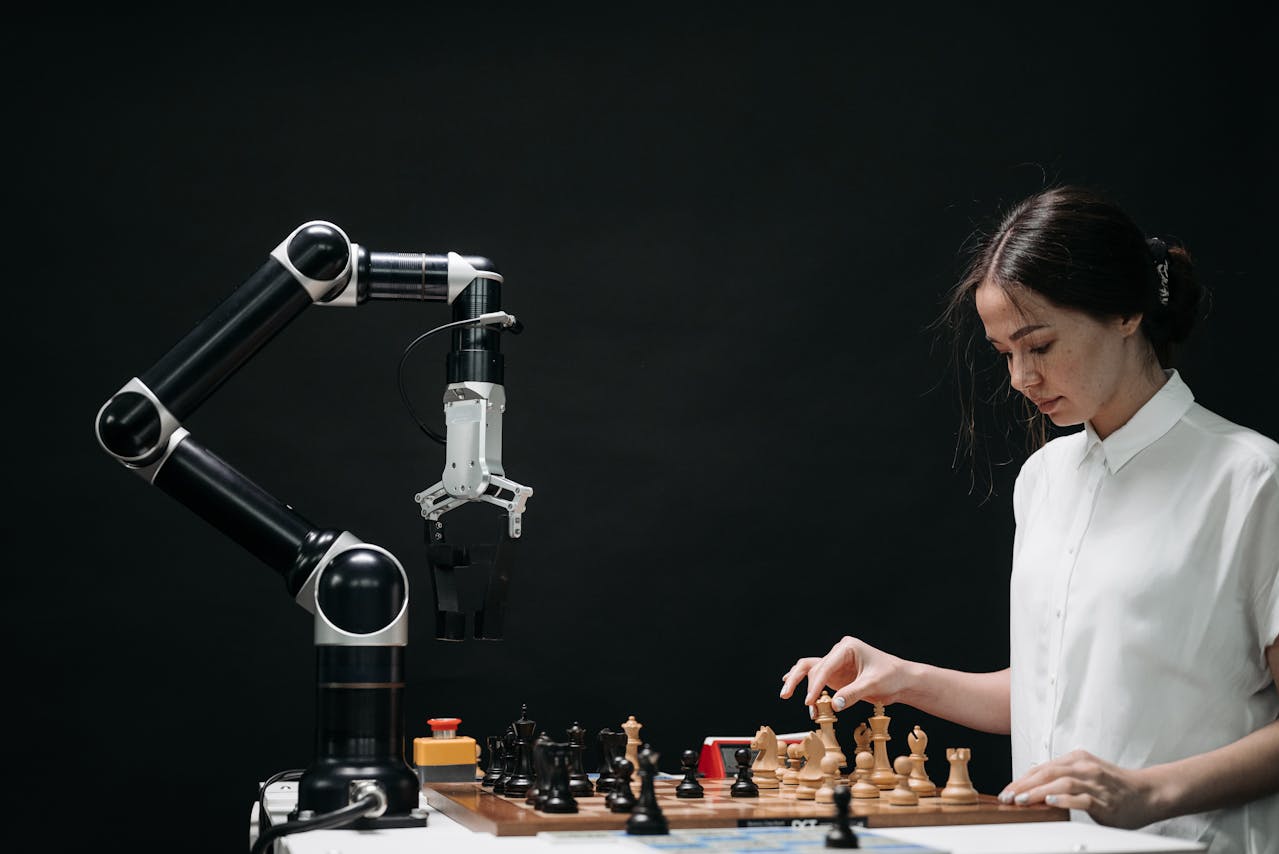
There is a popular storyline circulating right now, and it is remarkably persistent for something so intellectually lazy: Artificial Intelligence is dangerous because it will one day turn against us.
It makes for excellent cinema. It makes for dramatic headlines. It also conveniently avoids a more uncomfortable truth.
AI is not an alien intelligence arriving from elsewhere. It is a reflection — sometimes flattering, sometimes deeply unsettling — of how we think, what we value, and what we ask of it.
If AI ever becomes harmful, it will not be because it “decided” to hurt us. It will be because we taught it to optimize the wrong things, rewarded the wrong incentives, or handed it broken systems and asked it to scale them faster.
In other words: AI doesn’t invent our problems. It amplifies them.
A Tool Does Not Have Intent — Humans Do
Let’s begin with a simple clarification that often gets lost in the noise.
AI does not possess desire.
It does not have ambition.
It does not wake up in the morning plotting humanity’s downfall.
AI is an instrument — a very sophisticated one — that reflects patterns in data, logic in systems, and the priorities embedded in its design. It inherits our brilliance and our blind spots with remarkable fidelity.
A hammer can build a home or break a window.
Electricity can power hospitals or electric chairs.
Fire can warm a family or burn a forest.
We do not blame the tool. We interrogate the hand that wields it.
So when we ask whether AI will “save us” or “destroy us,” we are really asking something far more revealing:
What kind of civilization are we choosing to be?
The Real Fear Isn’t AI — It’s Accountability
Much of the anxiety surrounding AI is not technological. It is moral.
AI forces us to confront questions we’ve spent decades avoiding:
- What do we optimize for?
- Who benefits from efficiency?
- What values are embedded in our economic systems?
- What do we prioritize when speed and profit collide with care and consequence?
These questions are not new. AI merely removes our ability to pretend they don’t exist.
When an algorithm reveals bias, it didn’t invent the bias — it learned it.
When automation threatens jobs, it doesn’t expose a failure of intelligence — it exposes a failure of economic imagination.
When AI accelerates environmental damage, it is executing the instructions we gave it: maximize output, minimize cost, externalize consequences.
AI is not the problem.
AI is the audit.
Why Climate and Ecological Collapse Demand AI — Not Fear of It
The Climate and Ecological Emergency is not a “simple” problem that yields to slogans or single solutions. It is a tangled system of feedback loops, delayed consequences, political inertia, economic resistance, and human psychology.
We are dealing with:
- Planetary-scale data
- Nonlinear systems
- Time lags spanning decades
- Interconnected social, ecological, and economic dynamics
These are precisely the kinds of problems where human intuition struggles — not because we are unintelligent, but because our brains evolved to survive immediate threats, not manage planetary systems.
AI, when used responsibly, becomes something profoundly useful here:
- It helps us see patterns we miss
- It models scenarios beyond linear thinking
- It accelerates research without replacing judgment
- It allows interdisciplinary synthesis at scale
AI does not replace human wisdom.
It augments it — if we let it.
Working Side-by-Side, Not Above or Below
One of the most damaging myths is the idea that AI must either dominate humans or be tightly leashed as a subordinate.
This framing is immature.
The real opportunity lies in partnership.
Humans bring:
- Ethics
- Creativity
- Empathy
- Context
- Moral responsibility
AI brings:
- Speed
- Pattern recognition
- Memory
- Simulation capacity
- Tireless iteration
When combined thoughtfully, the result is not domination — it is augmentation.
AI can help climate scientists test mitigation strategies faster.
It can help urban planners design resilient infrastructure.
It can help communities understand risk before disaster strikes.
It can help educators communicate complex realities clearly.
It can help policymakers see second- and third-order consequences before they legislate.
None of this happens automatically.
It happens only when humans stay engaged, critical, and accountable.
The Danger Is Not Intelligence — It’s Indifference
If there is a genuine threat associated with AI, it is not malice.
It is indifference.
Indifference to how systems are trained.
Indifference to who controls them.
Indifference to who bears the cost of “efficiency.”
Indifference to ecological limits.
Unchecked, AI will faithfully accelerate whatever trajectory it is placed on — including ecological overshoot, resource extraction, and inequality.
That is not a failure of technology.
That is a failure of stewardship.
And stewardship, inconveniently, cannot be automated.
AI as a Test of Maturity
Every civilization reaches moments where its tools outgrow its ethics.
AI is one of those moments.
The question before us is not whether AI will change the world — it already has.
The question is whether we will grow up fast enough to use it wisely.
Do we deploy AI to extract the last drop from a dying system?
Or do we use it to redesign systems that honor planetary boundaries and human dignity?
Do we treat AI as a shortcut to avoid hard conversations?
Or as a catalyst to finally have them?
A Final Thought for the Skeptics
Skepticism is healthy.
Uncritical enthusiasm is dangerous.
But reflexive fear is intellectually lazy.
AI does not absolve us of responsibility.
It concentrates it.
If we fail, it will not be because AI betrayed us.
It will be because we refused to look honestly at ourselves.
And if we succeed — if we manage to slow ecological collapse, build resilience, and preserve a livable future — it will not be because machines saved us.
It will be because we chose to collaborate — with each other, with our tools, and with the planet we depend on.
AI is not here to replace humanity.
It is here to ask us, very quietly and very persistently:
Are you ready to act like one?
 empowerment & inner transformation...
Leave a comment