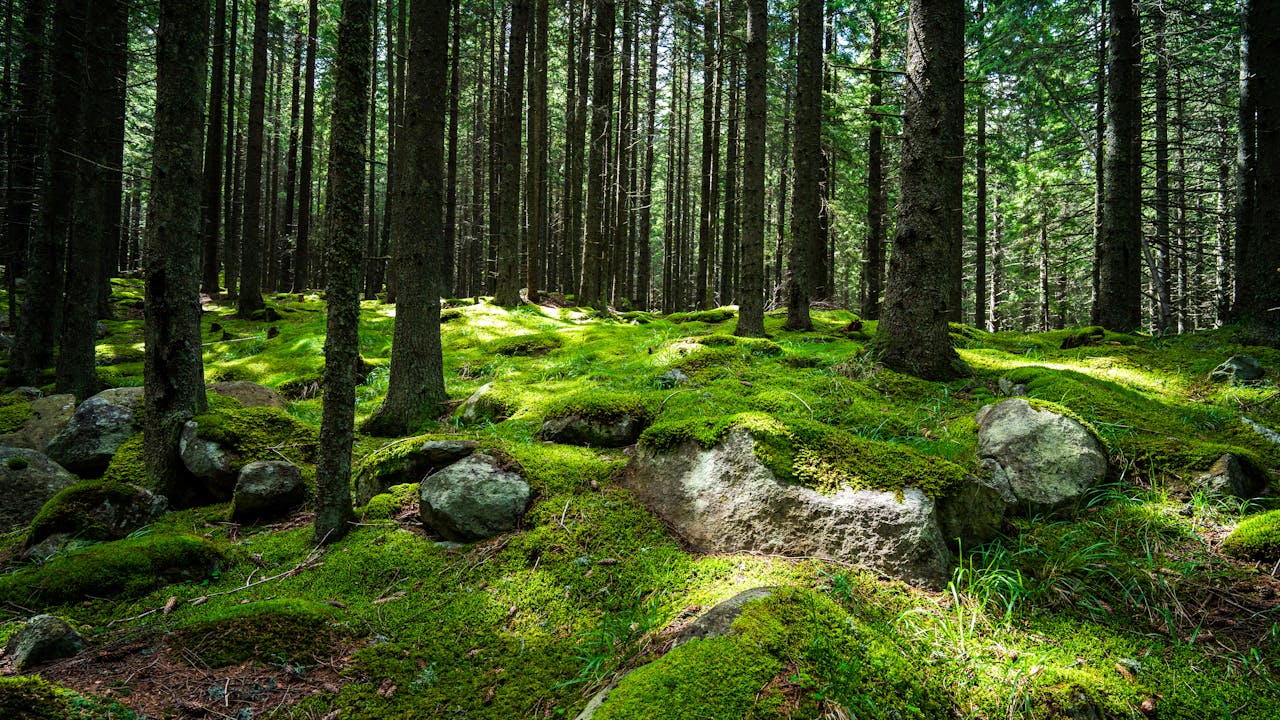
A disturbing report from BradBlog.com warns that the Trump Administration may be dismantling one of America’s most important public land institutions under the soothing language of “efficiency” and “restructuring.”
There are political stories that flare up for a day and disappear. And then there are stories that reveal something deeper: the deliberate weakening of public institutions that took generations to build. This appears to be one of those stories. According to a deeply troubling report from BradBlog.com, the Trump Administration’s USDA is taking a chainsaw to the U.S. Forest Service, threatening the scientific, regional, and institutional backbone of the agency that oversees 193 million acres of public land. Source
On the April 15, 2026 edition of The BradCast, journalist Brad Friedman interviewed conservationist and filmmaker Jim Pattiz of More Than Just Parks, and the picture that emerged was not one of modernization or reform. It was a picture of dismantlement — of expertise pushed out, research gutted, and public land stewardship weakened at exactly the moment climate disruption and wildfire danger demand more capacity, not less. Source
This Is Not a “Move.” It’s a Purge.
Officially, USDA says it is relocating Forest Service headquarters from Washington, D.C. to Salt Lake City, Utah, while shifting the agency to a “state-based organizational model” that will supposedly move leadership closer to the forests and communities it serves. The department says the changes will improve mission delivery, simplify the chain of command, save taxpayer dollars, and strengthen field operations. Source
That is the official pitch.
But Pattiz argues — and BradBlog forcefully highlights — that this is not an efficiency plan. It is a demolition plan. According to reporting cited by BradBlog and detailed in Pattiz’s own piece at Hatch Magazine, the reorganization closes all ten regional offices, consolidates research leadership, and wipes out more than fifty research facilities across 31 states. BradBlog further reports Pattiz’s warning that the shuttering of 57 research stations would amount to a “kill shot” to a world-class research program. Source Source
When an agency’s headquarters is uprooted, its regional offices closed, and its research functions consolidated far from where decades of institutional knowledge were built, this is not just a matter of moving desks. It is a method of driving out expertise. It is how you force resignations, sever continuity, and weaken the professional culture of a public institution without having to openly announce that you are destroying it. Source Source
“This is a coordinated demolition of federal land stewardship in America.” Source
“The Forest Service was the last major federal land agency that still had the institutional muscle to resist.” Source
Why Salt Lake City Matters
If this were merely an administrative relocation, it would still deserve scrutiny. But critics say the choice of Salt Lake City is itself politically revealing.
As Jim Pattiz argued in Hatch Magazine, Utah is not a neutral destination. It is a state currently suing the federal government to seize millions of acres of public land. Pattiz contends that placing Forest Service headquarters in Utah positions the agency inside the political orbit of one of the nation’s most aggressive anti-public-lands movements. In that reading, the move is not incidental. It is strategic. Source
That makes this more than a relocation. It becomes a relocation of power — away from career scientists, regional experts, and long-standing institutional norms, and toward a structure critics fear will be more vulnerable to political pressure, extractive industry priorities, and ideological control. Source Source
“Of all the places on this Earth to send the agency that manages America’s national forests, they chose Salt Lake City, Utah. Coincidence? No.” Source
This Is a Climate Story, Not Just a Bureaucracy Story
The U.S. Forest Service is not some obscure agency buried in federal paperwork. It plays a central role in wildfire management, forest restoration, ecological monitoring, watershed protection, recreation access, and stewardship of some of the most important carbon-storing landscapes in the country. Weakening that capacity during a climate crisis is not a technical matter. It is a public danger. Source Source
BradBlog reports Pattiz’s warning that the Forest Service has already lost roughly a quarter of its workforce since Trump’s second term began, and that this latest restructuring could affect roughly 5,000 more employees. USDA insists field-based operational firefighters will not be interrupted, but critics argue that no agency can lose that many scientists, planners, administrators, and long-serving professionals without eventually weakening its ability to manage landscapes and respond to escalating threats. Source Source
That is the heart of the warning here: institutions are not only made of frontline personnel. They are made of systems, memory, expertise, research continuity, and relationships built over decades. Once those are shattered, they cannot simply be reassembled after the political winds change. Source Source
“When you shutter 57 research stations, that is absolutely a ‘kill shot’ to our research program, which is the envy of the world.” Source
The Language of “Efficiency” Is Doing a Lot of Work Here
One of the oldest tricks in politics is to disguise destruction as reform.
Call it streamlining. Call it common sense. Call it a structural reset. Call it efficiency. Then, while the public hears management jargon, remove the people and systems most capable of resisting political capture and commercial exploitation. That is why this story lands with such force. Beneath the rhetoric, this looks far less like reform than a hostile takeover of a public institution. Source Source
America’s forests are not a partisan spoil. They are not a corporate asset class. They are not a reservoir of raw material waiting to be liberated for the convenience of loggers, drillers, miners, or political patrons. They are public lands, held in trust for the public. And if the warnings aired by BradBlog and Jim Pattiz are correct, that public trust is now under direct assault. Source
“The effort is for commercial purposes. To rob Americans of our sacred public lands to the benefit of the extraction industry.” Source
Read the Original. Listen to the Show. Support BradBlog.com
If you care about this issue, go to the original reporting. Brad Friedman’s write-up at BradBlog.com is detailed, urgent, and worth reading in full, and the complete BradCast episode featuring Jim Pattiz is available there as well. Source
You can download the MP3 directly here:
BradCast 4/15/2026 MP3
To save it, right-click and choose “Save link as…”. Source
And if you value independent journalism that raises the alarm before institutions are broken beyond repair, please support BradBlog by subscribing to The BradCast. Subscription options are available through the site’s podcast page and native RSS feed. Source
Subscribe here:
The BradCast
BradCast RSS Feed Source
Because this is exactly the kind of story that too many outlets will soften, delay, or ignore until the damage is already done.
And by then, the forests — and the public — may be left paying the price.
“This is a coordinated demolition of federal land stewardship in America.” Source
“When you shutter 57 research stations, that is absolutely a ‘kill shot’ to our research program.” Source
“Of all the places on this Earth to send the agency that manages America’s national forests, they chose Salt Lake City, Utah. Coincidence? No.” Source
“The effort is for commercial purposes. To rob Americans of our sacred public lands to the benefit of the extraction industry.” Source
BradCast episode graphic about the Trump USDA and the U.S. Forest Service, published by BradBlog on April 15, 2026.
Tito


Leave a Reply