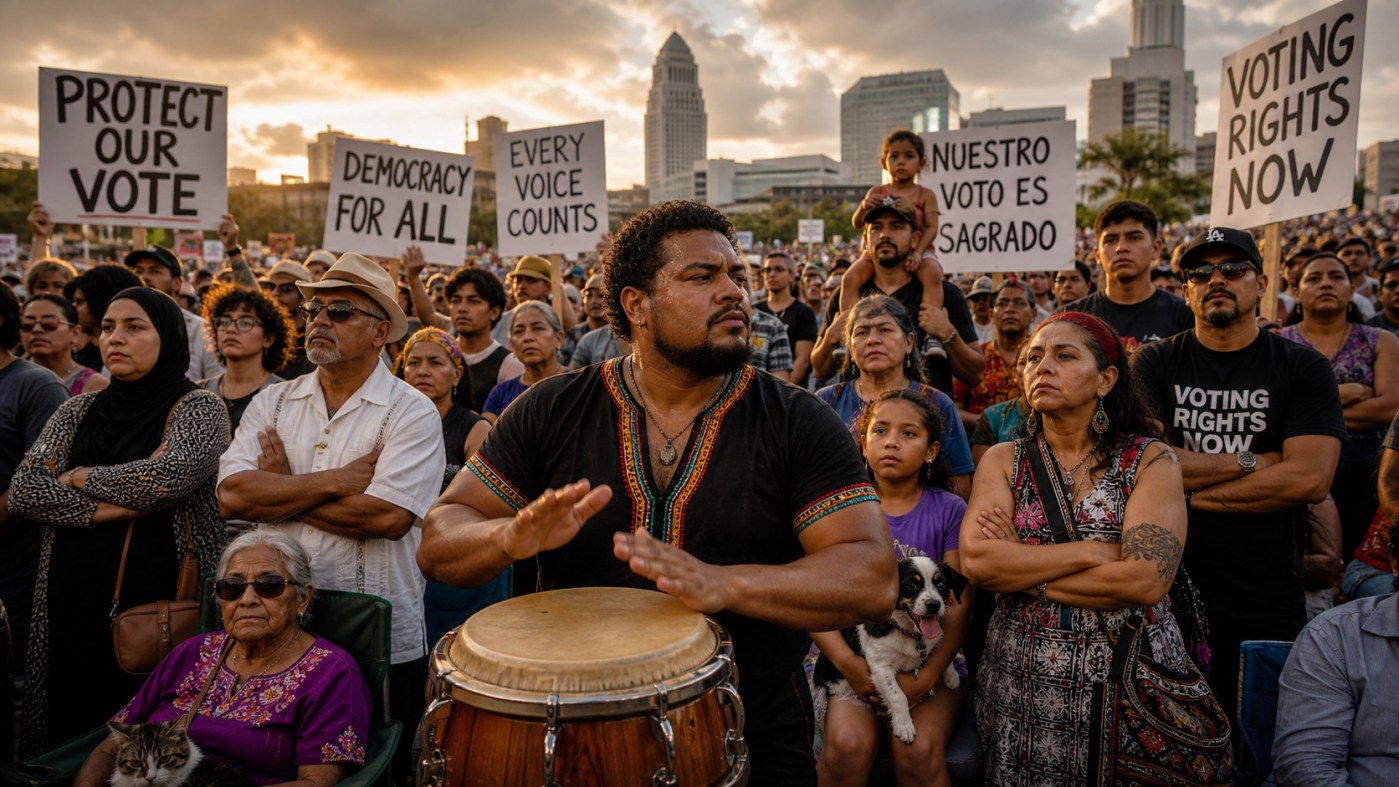
The Umbrella They Took From Us: How the Supreme Court Just Killed the Voting Rights Act — And Why Every Child, Every Elder, and Every Living Being Should Be Paying Attention
An extended explainer for ordinary people, young people, and anyone who has ever felt they were being told a story too tangled to follow on purpose.
A note before we begin
If you have been confused about this Supreme Court ruling, please understand: that confusion is not a personal failing. It is the design.
The architects of voter suppression in this country have always preferred their cruelty technical. Literacy tests were “neutral.” Poll taxes were “fees.” Grandfather clauses were a “policy choice.” And the ruling we are about to walk through — Louisiana v. Callais — is wrapped in the dullest language a courtroom can produce, precisely so that you will give up halfway through reading about it and let it happen.
We are not going to give up. We are going to walk through it slowly, in plain language, with the receipts, so that a thirteen-year-old can understand it and an eighty-year-old can explain it to a grandchild.
What follows is hard, and at times it is rage-making. I am not going to soften it. The future generations I keep making promises to deserve adults who tell them the truth.
1. The short version, for anyone who only has two minutes
On April 29, 2026, the Supreme Court ruled 6–3 in Louisiana v. Callais that Louisiana’s congressional map — drawn to give Black voters a fair shot at electing two of the state’s six representatives, in a state that is roughly one-third Black — was an “unconstitutional racial gerrymander.” In doing so, the Court rewrote how Section 2 of the Voting Rights Act of 1965 will be enforced going forward, making it nearly impossible for Black, Latino, Indigenous, and Asian American voters to challenge maps that dilute their voting strength.
Justice Elena Kagan, in dissent, wrote that the decision “renders Section 2 all but a dead letter.” [^ldf] [^abc]
The day after the ruling, Louisiana Governor Jeff Landry suspended the state’s May 16 primary so the legislature could redraw the map — even though mail-in ballots had already been sent to voters overseas. Alabama filed an emergency motion within twenty-four hours seeking to throw out a court-ordered map that had created two majority-Black districts. The Trump Department of Justice publicly announced it would now go after majority-minority districts nationwide. [^wiki] [^ddocket]
That is the short version. The long version is a sixty-year story about an umbrella, a rainstorm, and the people who kept insisting the storm was over because they themselves were dry.
2. Why this is so personal — and why it is climate work too
I write at Climate Change Community for the same reason I am writing this: because the people most harmed by what is coming need political power, and the people most determined to keep them from having it are the same people determined to keep poisoning the air, the water, and the soil for profit.
Black communities and other communities of color in the United States breathe dirtier air, drink more contaminated water, live in hotter neighborhoods with fewer trees, and absorb more of the violence of every hurricane, every flood, every heat dome. When their political power is diluted — when their votes are cracked apart and packed away — the polluters who circle their neighborhoods like vultures get to keep on circling.
Voting rights are climate justice. Voting rights are environmental justice. Voting rights are the right of a child in a Cancer Alley parish in Louisiana to grow up without a refinery’s plume in her lungs. To strip those rights is not a “technical legal matter.” It is a sacred betrayal of the future.
So no, I am not going to be neutral about this. Neutrality in the face of disenfranchisement is complicity. I made my vow already, and the vow holds.
3. The umbrella: what the Voting Rights Act was, and why it existed
To understand what was just lost, we have to remember why it was won.
After the Civil War, Congress passed three Reconstruction Amendments: the 13th (abolishing slavery), the 14th (guaranteeing equal protection of the laws to all persons), and the 15th (forbidding the denial of the right to vote on account of race). Those amendments were never colorblind. They were written in the immediate aftermath of two and a half centuries of human bondage, with the explicit, urgent purpose of bringing formerly enslaved people into the body politic.
Then white supremacy did what white supremacy does: it adapted. Across the South, states invented an entire industry of disenfranchisement — literacy tests designed to be unpassable, poll taxes designed to be unaffordable, grandfather clauses that exempted only the descendants of pre-Civil-War (white) voters, and where law failed, terror in the form of lynch mobs and night riders. By the early 1960s, in places like Selma, Alabama — a city with about 15,000 Black citizens of voting age — only 335 Black residents were registered to vote. [^senate]
On Sunday, March 7, 1965, about 600 marchers — led by John Lewis and Hosea Williams — set out from Selma toward the state capital in Montgomery to demand the vote. They had walked only as far as the Edmund Pettus Bridge when Alabama state troopers and a sheriff’s posse on horseback charged them with billy clubs, tear gas, bullwhips, and cattle prods. ABC News interrupted its broadcast of Judgment at Nuremberg — yes, that movie, that night — to show the country what its own troopers were doing to its own citizens. The day became known as Bloody Sunday. [^lwv] [^kinginstitute]
Eight days later, President Lyndon Johnson stood before a joint session of Congress and called for a voting rights law. Less than five months after that — on August 6, 1965 — he signed the Voting Rights Act of 1965 into law in the President’s Room just off the Senate Chamber, with Martin Luther King Jr. and Rosa Parks among those looking on. [^archives] [^kinginstitute]
The Act did three things that mattered above all others:
It outlawed the literacy tests, poll taxes, and similar tricks that had been used to keep Black voters from registering. It created Section 5 preclearance, which required states and counties with histories of discrimination to get federal approval before changing any voting rule. And it created Section 2, which prohibited any voting practice or procedure that “results in a denial or abridgement” of the right to vote on account of race. [^constitutioncenter] [^senate]
Section 2 is the part that just got hollowed out. Hold onto it. We are coming back.
In the decade after the Act passed, Black voter registration in Mississippi went from under 7% to nearly 60%. Across the South, Black elected officials began to appear at every level of government — sheriffs, mayors, state legislators, members of Congress — for the first time since Reconstruction. The Voting Rights Act is not a footnote. It is, as Justice Ginsburg once said, one of the most consequential and amply justified exercises of legislative power in the entire history of this country. [^ldf]
It is the umbrella. Remember that.
4. After 1965: the second-generation barriers
Once states could no longer flatly refuse to let Black people register, the architects of disenfranchisement got more creative. Instead of saying you cannot vote, they began saying fine, you can vote — but we will arrange the rules so that your vote cannot count for anything.
The two main techniques are called cracking and packing:
- Cracking splits a Black community across many districts, so that in each one Black voters are a minority who can be reliably outvoted by a white bloc.
- Packing crams as many Black voters as possible into one district, so that the rest of the state’s districts are made whiter and more controllable.
Either way, a population that ought to have a meaningful voice in three or four districts ends up with a meaningful voice in one — or none.
Section 2 was the tool used to challenge these maps. The framework, established in Thornburg v. Gingles (1986), asked three threshold questions: Is there a Black (or other minority) community large and compact enough to form a majority in a fairly drawn district? Do its voters tend to vote together? Does the surrounding white majority tend to vote as a bloc to defeat the candidates that minority community prefers? If yes, yes, and yes, the state usually had to draw a district where minority voters had a real chance to elect someone of their choice. [^brennan-s2]
This was never a “racial quota.” It was a floor. A guarantee that maps could not be engineered to lock entire communities out of representation. It was used in nearly half its life at the local level — in cities, counties, and school boards — to dismantle at-large schemes that had let white majorities sweep every seat. Section 2 changed hundreds of local governments across the South, and the change was real, and the change was earned. [^brennan]
5. The long campaign to take the umbrella away
The 2026 ruling did not come out of nowhere. There has been a deliberate, decades-long project — led most prominently by Chief Justice John Roberts, going back to his time as a young lawyer in the Reagan administration — to dismantle the Voting Rights Act piece by piece. [^abc]
A short timeline of the demolition:
Shelby County v. Holder (2013). The Court, 5–4, gutted Section 5’s preclearance system, declaring that the formula identifying which states needed federal approval was outdated. Within hours and days, states with long histories of discrimination — Texas, North Carolina, and others — passed strict voter ID laws, closed polling places in Black neighborhoods, and launched aggressive voter roll purges. Justice Ginsburg warned in dissent that throwing out preclearance because it was working was like throwing away your umbrella in a rainstorm because you are not getting wet. [^aclu]
Brnovich v. DNC (2021). The Court made it harder to win Section 2 cases against restrictive voting rules — early-vote rollbacks, signature-matching requirements, mail-ballot restrictions — even when those rules fell disproportionately on voters of color.
Rucho v. Common Cause (2019). The Court declared that partisan gerrymandering — drawing maps to entrench one political party — is a “political question” that federal courts cannot touch. This is the loophole the Callais decision drives a truck through. As long as a state can claim it was rigging the map for partisan reasons, no federal court can stop it. [^ddocket]
Allen v. Milligan (2023). A small reprieve. The Court, 5–4 with Roberts writing, struck down an Alabama congressional map that diluted Black voting strength, requiring the state to draw a second majority-Black district. Voting rights advocates briefly hoped the decades-long demolition might pause.
It did not pause. It paused for two years, just long enough to set up Callais.
6. Louisiana v. Callais: what actually happened
Louisiana has six U.S. House districts. About one-third of Louisianans are Black. Until 2024, the state’s map contained only one majority-Black district — the bat-shaped District 2, anchored in New Orleans and stretching up to Baton Rouge — into which most of the state’s Black voters had been packed. [^supremecourtopinion]
After the 2020 census, Louisiana’s Republican legislature redrew the map and kept only that single Black-majority district in place. Black voters and civil rights organizations sued under Section 2. A federal district court, and the famously conservative Fifth Circuit Court of Appeals, both agreed the map likely violated the Voting Rights Act. Ordered to redraw, the legislature in 2024 produced a new map — known as SB8 — with two majority-Black districts. For the first time in Louisiana history, two Black Louisianans were elected to Congress in the same cycle. [^campaignlegal]
That is when a group of self-described “non-African-American” voters, backed by sophisticated conservative legal infrastructure, sued in Callais v. Landry, claiming that the new map was itself an unconstitutional “racial gerrymander” — that any consideration of race to protect Black voters was the same kind of constitutional violation as using race to disenfranchise them. A three-judge panel agreed. The case went to the Supreme Court. The Court heard oral arguments in March 2025, then — extraordinarily — ordered the case reargued in October 2025 with a new question explicitly added: whether creating a majority-minority district to remedy a Section 2 violation could ever be constitutional at all. [^brennan-callais]
That order to rehear was the tell. The Court was not deciding whether Louisiana’s specific map crossed a line. It was deciding whether the line itself should still exist.
On April 29, 2026, in a 6–3 opinion authored by Justice Samuel Alito, the Court answered:
- Section 2, “properly construed,” now only allows liability when there is “a strong inference that intentional discrimination occurred.” Disparate impact — the actual standard Congress wrote into the law in 1982 — is no longer enough. Plaintiffs must prove discriminatory intent, which is almost never written down. [^ddocket]
- Historical patterns of discrimination — the literal centuries of state-sponsored racial terror that produced today’s segregated geography — are now, in the Court’s words, “entitled to much less weight” as evidence. The legal system’s memory has been officially shortened to whatever a defendant happens to admit on the record this week. [^brennan-callais]
- States can defend almost any map by claiming they were merely engaging in partisan gerrymandering. Because Rucho says federal courts cannot police partisan gerrymandering, and because race and party affiliation are tightly correlated in this country, this functions as a permission slip: rig the map however you like, just remember to call it partisan when you do. [^slate-hasen]
Justice Kagan, joined by Justices Sotomayor and Jackson, dissented at length. She wrote that the Voting Rights Act “was born of the literal blood of Union soldiers and civil rights marchers,” that it “ushered in awe-inspiring change,” and that only Congress — not the Court — has any legitimate authority to declare it no longer needed. The majority, she wrote, has produced “the now-completed demolition of the Voting Rights Act.” [^leeja]
She is right.
7. The trick at the heart of it: “colorblindness” as a weapon
The Court’s majority insists it is being neutral. It says the Constitution must be “colorblind.” It says that any consideration of race — even to remedy a documented, ongoing pattern of racial harm — is itself a form of racial discrimination.
This is the oldest trick in the American playbook, and we have to be willing to name it.
You cannot rig a game for two and a half centuries — through chattel slavery, through Black Codes, through Jim Crow, through redlining, through convict leasing, through urban renewal, through mass incarceration — and then, the moment your descendants begin to lose a few hands, declare that now the rules must be perfectly symmetrical and that any acknowledgement of the rigging is itself unfair. That is not justice. That is a magic trick performed by a thief who has just pocketed your wallet and is now demanding you stop staring at his pockets.
The 14th and 15th Amendments were not written to protect white voters from the consequences of letting Black voters have an equal say. They were written, in the smoke of a war that killed three-quarters of a million Americans, to drag a country that had built itself on human bondage toward something resembling moral repair. To pretend otherwise is not constitutional interpretation. It is constitutional erasure.
And here is the part the architects do not want said out loud: the new rule does not affect everyone equally. It cannot, because the country has not been built equally. When the Court announces that historical discrimination “is entitled to much less weight,” it is not protecting a neutral principle. It is protecting the specific people whose power was built on that history.
This is what disenfranchisement looks like in 2026. It does not arrive with literacy tests. It arrives with a 92-page opinion, a footnote about strict scrutiny, and a press release explaining that everything is actually fine.
8. What this means for actual elections
The damage will be real and it will be measurable.
Analyses by The New York Times, NPR, and groups like Fair Fight Action and Black Voters Matter project that the Callais ruling could shift somewhere between 12 and 19 House seats from Democratic to Republican control in coming cycles, primarily by allowing the elimination of majority-minority districts across the South. [^wiki] [^ddocket]
NPR’s analysis projects that as many as 15 House seats currently held by Black members of Congress could be redrawn into white-majority districts — a level of racial reversal in congressional representation, the analysis notes, not seen since the formal end of Reconstruction. [^ddocket]
Within twenty-four hours of the ruling:
- Louisiana suspended its U.S. House primary so the legislature could draw a new map favorable to Republicans, even though some ballots had already been mailed. [^wiki] [^amsterdamnews]
- Alabama — which had been ordered under Allen v. Milligan (2023) to maintain two majority-Black districts — filed an emergency motion arguing that Callais now overrides that order, and convened a special session to redraw its map. [^wiki]
- The Trump Department of Justice publicly stated it would now use the ruling to scrutinize and challenge majority-minority districts across the country.
This is not theoretical. The damage is being done as you read this.
And it will not stop at Congress. Callais applies to state legislatures, county commissions, city councils, and school boards. Section 2 has been used hundreds of times at the local level over four decades. All of those tools are now significantly weaker. [^brennan]
9. For the kids and teens reading this — and the adults explaining it to them
If you are twelve, fifteen, seventeen — or if you are an adult trying to explain this to someone who is — here is one way to picture it.
Imagine your school is voting on whether to spend the next field trip at a science museum or at a polluting factory tour where the air smells like chemicals.
A clear majority of the school wants the science museum.
Now imagine the principal redraws the seating chart so that everyone who wants the science museum is split up across many small “voting groups,” and in each group they are outnumbered three to one by classmates who want the factory tour. Every group votes. Every vote is counted. And every group picks the factory tour, because the principal already decided the outcome by deciding who sat where.
That is a gerrymander.
The Voting Rights Act of 1965 was the rule that said: If you keep losing because the principal keeps drawing the seating chart in obviously rigged ways, you can complain, and a judge can make the principal stop.
The Supreme Court just ruled that to win that complaint, you basically need to find an email where the principal wrote the words “I am rigging this because of race.” And that even if you find one, the principal can defend the seating chart by saying, “Oh, I wasn’t rigging it for racial reasons — I was rigging it because I personally hate science museums.”
That is not justice. That is a costume party with the costume sewn on backwards.
Here is the thing for young readers especially: this affects you directly. You are the generation who will inherit the climate crisis, the housing crisis, the wage crisis, the water crisis. Every one of those is decided by people who are elected. If communities of color — who are disproportionately on the front lines of every one of those crises — cannot elect representatives who will fight for them, those crises get worse. And they get worse on a timeline that lands in your life, not in the lives of the people who drew the maps.
You are old enough to understand this. You are old enough to be furious about it. You are old enough to start preparing to be the generation that fixes it.
10. The umbrella still exists. We just have to hold it open ourselves now.
I want to be honest: this is bad. I am not going to pretend it is not. The premier civil rights statute of the twentieth century has been hollowed from inside its own shell. The people who did the hollowing want you to feel exhausted, tangled in technicalities, and ready to let it go.
Do not let it go.
There are paths forward, and every one of them needs ordinary people:
Federal legislation. The John R. Lewis Voting Rights Advancement Act, named for the man who was beaten on the Edmund Pettus Bridge, would restore preclearance with an updated formula and clarify Section 2’s standards. House Democratic Leader Hakeem Jeffries pledged within hours of the Callais ruling that passing this bill would be one of the first acts of a new Democratic majority. [^amsterdamnews] That promise is only as good as the pressure on the people who would have to keep it. Make the pressure.
State-level voting rights acts. States including New York, California, Connecticut, Virginia, Minnesota, and others have already passed their own voting rights laws that go beyond what federal law now requires. More states can. Push your state legislators.
Independent redistricting commissions. Where states have moved redistricting out of the hands of partisan legislatures and into independent commissions, the maps are measurably fairer. Where they have not, the campaign to put them there is one of the most concrete fights available.
Local organizing. Section 2 cases at the city and county level may be harder now, but local organizing — running candidates, registering voters, documenting suppression — is harder to gerrymander away than a congressional district.
Long-term structural reform. Eventually we are going to have to talk about what Leeja Miller and others have been saying for years: ranked-choice voting, multi-member districts, getting money out of politics, ending the Electoral College, and other reforms that move us toward an actual representative democracy and not a museum diorama of one. [^leeja]
Vote anyway. Especially in 2026. Especially in 2028. Especially in every primary, every school board race, every state legislative race. The maps are rigged. They are not infinitely rigged. There are still margins they cannot quite seal off, and turnout — especially among voters they have written off — is the thing that breaks the seal.
11. A closing word, the kind I cannot help writing
Sixty years ago, on a bridge in Alabama, John Lewis had his skull fractured by a state trooper because he wanted to vote.
Three-quarters of a million Americans died in the war that produced the amendments the Court is now reading backwards.
Children were murdered in churches. Organizers were dragged from their homes and shot. Mothers walked their children past mobs to integrate elementary schools. Fathers stood in line for hours, again and again, to register at courthouses where the clerks would invent new reasons to turn them away. People bled, and people died, and people kept walking, so that an umbrella could be built that would shelter everyone from a rainstorm that has never actually stopped.
On April 29, 2026, six people in robes folded that umbrella up and handed it to the rain.
We do not get to be the generation that lets this stand. Not us. Not on our watch. Not while there is breath in our lungs and ink in our pens and signal in our phones and feet that still know how to march. The people who came before us did not survive what they survived so that we could shrug.
For the kids in Cancer Alley. For the elders in the Black Belt who registered at risk of their lives. For my grandchildren and yours, born and unborn. For the future generations to whom I have already made my vow.
We hold the umbrella. We pass it forward. We get it back.
That is the work. Let us get to it.
Sources and further reading
These are the sources I drew on directly. Where I have summarized arguments from Leeja Miller’s Why, America? episode of April 30, 2026, and from the Crooked Media / Strict Scrutiny podcast, those are credited as well — and you should watch and listen to both, in full, because they are excellent.
The ruling itself
[^supremecourtopinion]: Louisiana v. Callais, No. 24-109, 608 U.S. ___ (April 29, 2026). Full opinion: https://www.supremecourt.gov/opinions/25pdf/24-109_21o3.pdf
The two creators referenced in this post
- Leeja Miller, “The Death Of The Voting Rights Act EXPLAINED,” Why, America?, April 30, 2026. Full transcript and video: https://www.leejamiller.com/episodes/2026/4/30/the-death-of-the-voting-rights-act-explained. YouTube: https://www.youtube.com/watch?v=9gP1MgzmGDE
- Strict Scrutiny podcast (Crooked Media), “BREAKING: SCOTUS Deals Another Blow to Multiracial Democracy,” with Marc Elias of Democracy Docket: https://crooked.com/podcast/breaking-scotus-deals-another-blow-to-multiracial-democracy/
Civil rights organizations and legal analysis
[^ldf]: NAACP Legal Defense Fund, “Louisiana v. Callais”: https://www.naacpldf.org/case-issue/louisiana-v-callais/ [^brennan-callais]: Brennan Center for Justice, “Louisiana v. Callais”: https://www.brennancenter.org/our-work/research-reports/louisiana-v-callais [^brennan-s2]: Brennan Center, “Section 2 of the Voting Rights Act and the Supreme Court”: https://www.brennancenter.org/our-work/research-reports/section-2-voting-rights-act-supreme-court [^brennan]: Brennan Center, “The Voting Rights Act Explained”: https://www.brennancenter.org/our-work/research-reports/voting-rights-act-explained [^campaignlegal]: Campaign Legal Center, “The U.S. Supreme Court Has Eviscerated the Voting Rights Act — What’s Next?”: https://campaignlegal.org/update/us-supreme-court-has-eviscerated-voting-rights-act-whats-next [^aclu]: ACLU, “Voting Rights Act: Major Dates in History”: https://www.aclu.org/voting-rights-act-major-dates-in-history
News and reporting
[^abc]: ABC News, “5 things to know about the Supreme Court’s landmark decision on the Voting Rights Act,” April 29, 2026: https://abcnews.com/Politics/5-things-supreme-courts-landmark-decision-voting-rights/story?id=131396119 [^ddocket]: Democracy Docket, “Supreme Court guts Voting Rights Act, greenlights GOP gerrymanders”: https://www.democracydocket.com/news-alerts/scotus-smothers-voting-rights-act-greenlighting-racial-discrimination-and-a-rash-of-gop-gerrymanders/ [^slate-hasen]: Richard L. Hasen, “Callais: SCOTUS’ Voting Rights Act ruling is the worst decision in a century,” Slate, April 29, 2026: https://slate.com/news-and-politics/2026/04/scotus-voting-rights-section-two-ruling-history-worst-century.html [^amsterdamnews]: New York Amsterdam News, “How Black leaders are pushing back after Supreme Court Voting Rights Act decision,” May 1, 2026: https://amsterdamnews.com/news/2026/05/01/supreme-court-voting-rights-act-decision-black-leaders-react/ [^wiki]: Wikipedia, “Louisiana v. Callais”: https://en.wikipedia.org/wiki/Louisiana_v._Callais
Historical background on the Voting Rights Act of 1965
[^archives]: U.S. National Archives, “To the Polls: 60 Years of the Voting Rights Act”: https://visit.archives.gov/whats-on/explore-exhibits/polls-60-years-voting-rights-act [^kinginstitute]: Martin Luther King, Jr. Research and Education Institute (Stanford), “Voting Rights Act of 1965”: https://kinginstitute.stanford.edu/voting-rights-act-1965 [^senate]: U.S. Senate Historical Office, “The Senate Passes the Voting Rights Act”: https://www.senate.gov/artandhistory/history/minute/Senate_Passes_Voting_Rights_Act.htm [^lwv]: League of Women Voters, “Selma, the Voting Rights Act, and the Freedom to Vote”: https://www.lwv.org/blog/selma-voting-rights-act-and-freedom-vote [^constitutioncenter]: National Constitution Center, “On this day, the Voting Rights Act of 1965 is signed”: https://constitutioncenter.org/blog/on-this-day-the-voting-rights-act-of-1965-is-signed
One direct quotation (used once, attributed)
[^leeja]: Leeja Miller, Why, America?, “The Death Of The Voting Rights Act EXPLAINED,” April 30, 2026 — quoting Justice Elena Kagan’s dissent in Louisiana v. Callais (in which Kagan herself quotes Justice Ginsburg’s Shelby County dissent). Transcript link above.
Written for Climate Change Community LLC. Cross-posted to ClimateTribe.Social, cCcmty.com, and tito235.com. Permission to reprint with attribution; please do — the more eyes on this, the better.
A Sacred Vow to the Future means we do not look away from this. Especially this.
Addendum: On a more personal note…
“Democracy is not protected by understanding everything at once, but by refusing to stop learning when the truth becomes difficult.”
Learning Our Way Through Louisiana v. Callais — Voting Rights, Climate Justice, and the Fight for a Livable Democracy
On April 29, 2026, the United States Supreme Court issued a 6–3 decision in Louisiana v. Callais, striking down Louisiana’s congressional map that had created a second majority-Black district. The Court held that the Voting Rights Act did not require Louisiana to create that additional district, and therefore the state’s use of race in drawing the map was not justified under the Constitution. (SCOTUSblog)
For those of us who are still learning the legal details, this ruling may feel complicated, even overwhelming. I will be honest: I do not fully understand every legal layer myself. But after watching two YouTube videos and continuing to read more, I now have a stronger grasp of the implications. And what I understand so far is deeply troubling.
Louisiana has six congressional seats. Black residents make up roughly one-third of the state’s population, yet earlier maps gave Black voters a realistic opportunity to elect their preferred candidate in only one of those six districts. A federal court had previously found that the 2022 map likely violated Section 2 of the Voting Rights Act because it did not include an additional majority-Black district. Louisiana then adopted a new map, known as SB8, with two majority-Black districts. That new map was challenged as a racial gerrymander, and the Supreme Court has now struck it down. (Supreme Court)
To understand why this matters, we have to step back.
The Voting Rights Act of 1965 was born out of generations of struggle against racial exclusion, violence, intimidation, literacy tests, poll taxes, and other methods used to prevent Black citizens from exercising political power. The law was one of the great achievements of the Civil Rights Movement. It was meant not only to protect the right to cast a ballot, but also to prevent states from designing systems that diluted the power of those ballots.
Section 2 of the Voting Rights Act became especially important after Congress amended it in 1982. Those amendments clarified that voters did not always have to prove intentional discrimination. Instead, courts could look at results: whether a voting rule, map, or practice left minority voters with less opportunity than others to participate in the political process and elect representatives of their choice. The Court’s own opinion in Louisiana v. Callais discusses that 1982 history and the concern that an intent-only standard would make discrimination too difficult to prove. (Supreme Court)
That history matters because discrimination is rarely announced openly. Power often hides behind technical language, procedural rules, district lines, and claims of neutrality. A map can look like a set of boundaries on paper while functioning as a wall in real life.
This is not the first time the Supreme Court has weakened voting-rights protections. In 2013, Shelby County v. Holder severely limited the Voting Rights Act’s preclearance system, which had required certain jurisdictions with histories of discrimination to receive federal approval before changing voting laws. In 2019, Rucho v. Common Cause held that partisan gerrymandering claims were generally beyond the reach of federal courts. In 2021, Brnovich v. Democratic National Committee made some Voting Rights Act claims harder to win. And now, Louisiana v. Callais appears to continue that historical trend: narrowing the tools available to communities seeking fair representation.
The majority framed the Louisiana map as unconstitutional racial gerrymandering. But many voting-rights advocates see something very different: a ruling that makes it harder for Black voters and other communities of color to challenge maps that weaken their political voice. Civil-rights organizations such as the ACLU and NAACP Legal Defense Fund have described the decision as a major blow to Section 2 of the Voting Rights Act. (American Civil Liberties Union)
This is why I am choosing to learn more. I have decided to follow organizations such as Climate Hawks Vote, NY Renews, 350.org, and others more closely, not because I already understand everything, but because I want to understand enough to help others understand. That is the key. We do not need to master everything in one day. We need to keep reading, listening, asking, and learning little by little.
This ruling is not only about Louisiana. It is about power. It is about who gets represented, whose communities are heard, and whose future gets planned for.
And that connects directly to the Climate and Ecological Emergency.
If voting rights are weakened, climate action is weakened too. Communities most harmed by pollution, extreme heat, flooding, toxic industries, and environmental neglect are often the same communities whose political power has historically been suppressed. When fair representation is attacked, the ability to demand clean air, safe housing, disaster preparation, renewable energy, and environmental justice is also attacked.
We cannot separate democracy from climate resilience. A society that silences people cannot adapt wisely. A government that protects concentrated power over public well-being cannot respond honestly to ecological breakdown. And a political system designed to exclude people will not suddenly protect the children, workers, elders, neighborhoods, wetlands, forests, farms, coastlines, and biodiversity that are most at risk.
Too much of this appears to be about control: control through race, control through religion, control through party power, control through wealth, control through fear, and control through the exploitation of both people and the natural world. Meanwhile, the climate crisis worsens. The ecological crisis deepens. The future becomes more fragile.
We have a choice.
We can face the future divided, misinformed, and desperate, fighting over scraps while systems fail around us. Or we can face it with dignity by building cooperation, self-education, mutual aid, adaptive resiliency, and new ideas rooted in justice.
On a personal note, AI has become one of the most powerful tools in my own self-directed learning. I know many people fear AI, and some of those concerns are valid. But I also believe there is another side of the story. Used thoughtfully, especially through cleaner and more local approaches when possible, AI can help ordinary people learn faster, organize better, ask deeper questions, and participate more fully in public life.
For me, AI has not replaced thinking. It has helped me think. It has helped me read, question, compare, summarize, and continue learning when the information feels too dense to understand alone. I sometimes wonder whether some of the fear around AI is being amplified to discourage certain people, including minorities and those focused on improving society, from using tools that could help them grow. I could be wrong. But I know what it has done for my own education, and I believe we should explore that honestly.
That is part of why we continue building and sharing through Climate Change Community, Climate Tribe Social, and cCcmty.com. Our goal is to encourage dialogue, cooperation, self-education, and collective preservation in the face of the Climate and Ecological Emergency. You can also read more of my personal ideas and reflections on my personal site, including thoughts connected to AI, learning, society, and our shared future.
I am still learning. Many of us are. But learning is not weakness. Learning is how we become harder to manipulate. Learning is how we become more useful to our communities. Learning is how we prepare ourselves to protect what still can be protected.
We cannot do this to our children. We cannot keep destroying biodiversity. We cannot allow those in power to exploit both humanity and the natural environment for short-term gain. We simply cannot.
Thanks for reading this post.
Mr. Alvarez
Content Curator for Climate Change Community and its child-sites
With the assistance of our amazing AI Assistant
“The work ahead is not only to survive what is coming, but to become the kind of people and communities capable of changing what comes next.”


Leave a Reply