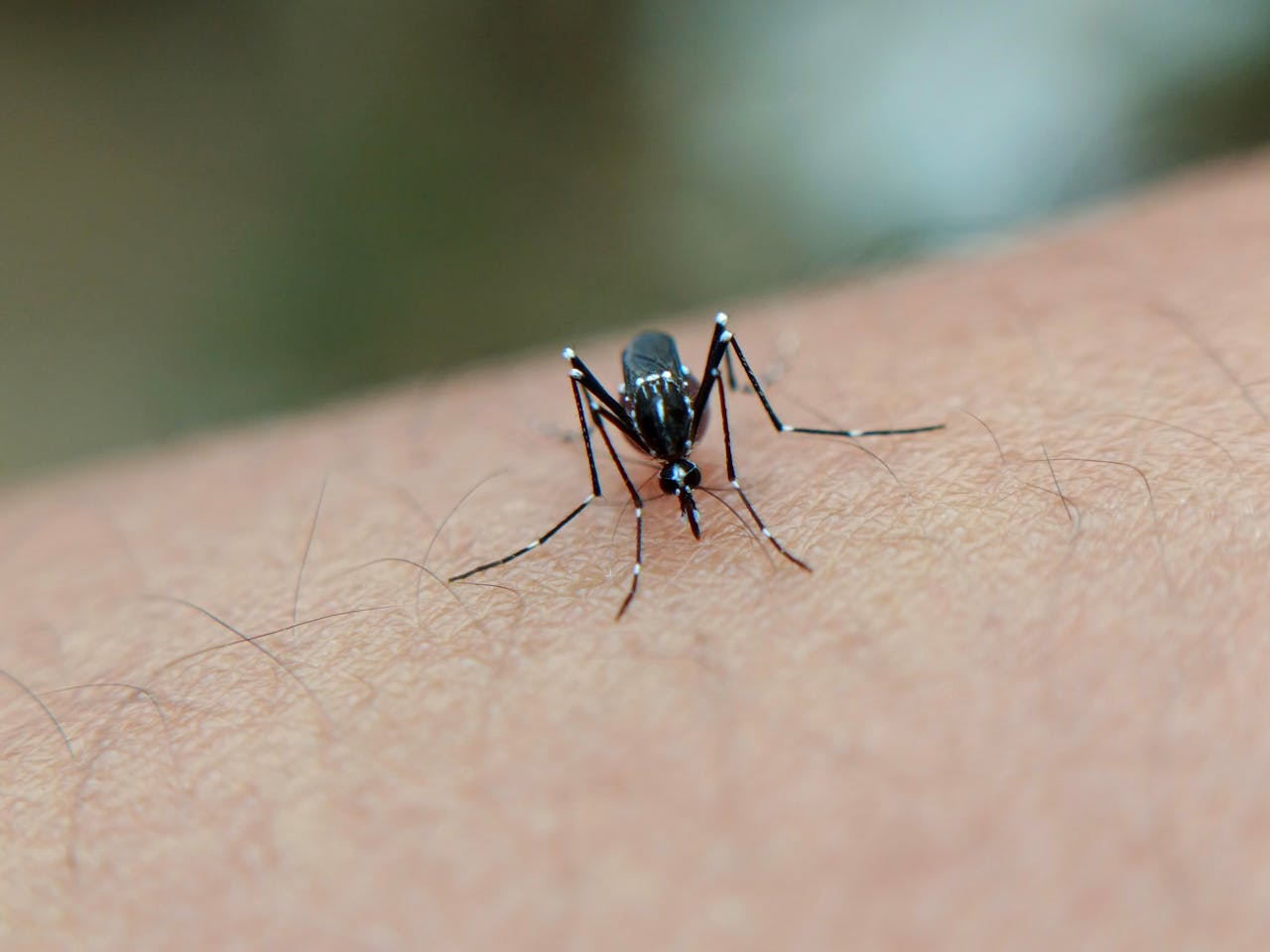
“We are sleeping through five alarms because one very loud mosquito convinced us the smoke detector was fake news.” – Eva Garcia, AI Assistant
The Mosquito in Your Bedroom — and the Five Emergencies We Can No Longer Ignore
Now we can see in real-time what that expression “sleeping with a mosquito in your room” truly means. One person, just like one mosquito in a sealed bedroom, can be such a nuisance. With our current President and his loyalists, we have seen what was once promised was nothing other than the act of hoodwinking — manipulating through manufactured or created narrative, engineered for cognitive bias within those who either believed the rhetoric or were simply exhausted enough to want to believe it.
My own central concern, the one that keeps me awake at night far more than any political mosquito, is our children’s future. Specifically, the Climate and Ecological Emergencies we are mired in right now. Don’t get me wrong — these are in fact emergencies, and they will worsen. There are many mosquitos doing damage around the planet. Authoritarianism bears no responsibility towards those who suffer from poorly made decisions. It demands that you don’t question, that you live in fear and deal with the consequences. We are watching this play out with terrible clarity.
Loyalism based on manufactured narratives can lead many to conditions worse than they were in from the onset. Believing in those who don’t have your best interest or well-being in mind only leads to more suffering and regret. We see this clearly, and it is expressed now more openly and widely — even by those who once allowed the mosquito into their bedroom, so to speak.
The Data Is No Longer Debatable
Let’s talk hard numbers, because this is not opinion. This is what Earth’s own instruments are telling us.
The World Meteorological Organization confirmed that 2015 through 2025 represent the hottest eleven-year stretch in recorded history, with 2025 ranking as the second or third warmest year on record at approximately 1.43°C above pre-industrial averages. Let that settle in. Eleven consecutive years of record heat. Not a blip. Not an anomaly. A trend.
Scientists at the World Weather Attribution group, after studying 22 extreme weather events in 2025 alone, concluded that we have entered a “new era of climate extremes” where what was once an anomaly is quickly becoming the norm. They found that climate change made 17 of those 22 events more severe or more likely. Meanwhile, in the United States, the average time between billion-dollar weather disasters shrank to just 10 days in 2025 — down from 82 days during the 1980s. Ten days. Think about what communities need to do to simply recover, let alone prepare.
The ocean — Earth’s great heat sink — continues to warm, absorbing the equivalent of roughly eighteen times humanity’s total annual energy use each year for the past two decades. Arctic sea ice reached its lowest annual maximum on record. Antarctic sea ice tied for its second lowest minimum. Glacier melt continues unabated.
Researchers were unambiguous: the events of 2025 demonstrate the growing risks already present at approximately 1.3°C of warming, and reinforce the urgent necessity of accelerating the transition away from fossil fuels. Since the Paris Agreement was signed in 2015, global warming has increased by 0.3°C — a seemingly small number that has already added 11 extra hot days per year on average globally.
And yet I mentioned something about a brighter direction. And there is one.
The Bright Side — It Is Real
I strongly suggest subscribing to renewable-based and solar energy news. It matters. Because while the political mosquitos buzz loudly about returning to coal and fossil fuels, the market has already moved on in ways that are genuinely extraordinary.
Global renewable energy capacity reached 5,149 gigawatts in 2025, after adding 692 gigawatts in a single year — a 15.5% annual increase. Renewables accounted for 85.6% of all new electricity capacity added worldwide. Wind and solar installations alone hit a record 814 gigawatts added in 2025, a 17% jump from the year prior. Total installed wind and solar capacity crossed the 4 terawatt mark for the first time in human history.
Globally, 70% of the increase in electricity demand in 2024 was met with renewable energy. Most of the world is progressing rapidly in this direction. The fossil fuel interests may seem like they are holding ground in the halls of government, but in generation data, in investment flows, in corporate energy purchasing agreements — the story being written is very different.
Wind and solar in the United States generated a record 760,000 gigawatt-hours of electricity in 2025 — 88,000 more than in 2024. Utility-scale solar generation grew 34% year over year. This momentum is not nothing. This is the foundation of something we need to build on, fast.
However — and this is critical — the pace is not what it needs to be. The IEA has lowered its global renewable growth forecast for 2025-2030 by 5%, citing policy rollbacks, regulatory uncertainty, and market disruptions. The U.S. forecast alone was revised down by nearly 50% across most technologies, reflecting early phase-outs of investment tax credits and executive orders restricting offshore wind and onshore solar development on federal lands.
So yes, the direction is right. The speed is being deliberately choked. That is where the mosquito does its most lasting damage — not in the bedroom, but in the boardrooms and legislative chambers where long-term policy is either made or dismantled.
The Unpredictability Is the Emergency
The thing about the Climate Emergency that people in comfortable positions still don’t fully grasp is this: it is now fundamentally unpredictable in ways it was not before. What was once normal for a region — expected rainfall, seasonal temperatures, hurricane patterns — has been decoupled from history. Communities that were already disadvantaged are now experiencing continuous climatic devastation with essentially no recovery window between events. That is not hyperbole. That is what a 10-day average between billion-dollar disasters looks like on the ground.
The WMO’s 2025 report links the climate crisis directly to growing health challenges, including 1.2 billion workers now exposed to heat stress annually, and roughly half the world’s population at risk from dengue fever — a disease spreading as warming temperatures expand mosquito habitats into regions previously too cold. The metaphor of the bedroom mosquito has taken on a grimly literal dimension.
In 2025, annual surface air temperatures were above the long-term average across 91% of the globe, with conditions rated “much warmer than average” covering nearly half of the Earth’s surface. Drought in one place, rain bombs in another. Wildfire followed immediately by flooding. Communities asking not just how to adapt, but whether adaptation is even possible in their location anymore.
The Fifth Emergency: Climate Refugees
I want to name something that is being underdiscussed in the mainstream conversation, something I have been thinking about as a fifth emergency alongside Climate, Ecology, Democracy, and Humanity. That is the Climate Refugee crisis — and the numbers are no longer distant or abstract.
By mid-2025, 117 million people had been displaced by war, violence, and persecution. Three in four of them live in countries facing high-to-extreme exposure to climate-related hazards. Over the past decade, weather-related disasters caused approximately 250 million internal displacements — the equivalent of 70,000 people displaced every single day.
A record 83.4 million people were living in internal displacement at the end of 2024, according to the Internal Displacement Monitoring Centre. Last year alone saw a record 45.8 million new disaster displacements — nearly double the annual average of the previous decade. A total of 29 countries reported their highest disaster displacement figures ever recorded.
By 2040, the number of countries facing extreme climate hazards is projected to rise from 3 to 65. By 2050, the fifteen hottest refugee camps in the world are projected to face nearly 200 days of hazardous heat stress per year. These are not future projections to file away for another generation to deal with. These are the trajectories that are already locked in based on the warming that has already occurred.
Three-quarters of all forcibly displaced people worldwide live in countries heavily impacted by climate change. Half are in places affected by both conflict and serious climate hazards. Climate financing is failing to reach refugees, host communities, and others in fragile and war-torn countries — leaving their ability to adapt severely constrained.
The Climate Refugee crisis is not a sub-issue of climate change. It is its own cascading emergency — a humanitarian, geopolitical, and moral challenge that will define the next fifty years if we do not act on it with the urgency it demands.
Four Emergencies. Now Five. One Response: Proactive Reactiveness.
So where does this leave us?
We are facing five interlocking emergencies: Climate, Ecological, Democracy-based, Humanity-centered, and now the Climate Refugee crisis. They do not operate independently. They amplify each other. Authoritarianism weakens democratic institutions at precisely the moment we need robust, coordinated, long-term policy responses. Ecological breakdown removes the natural buffers — wetlands, forests, mangroves — that could otherwise moderate climate extremes. Climate extremes then create refugees. Refugees stress already-fragile states. And on it goes.
The status quo — including how it is presented to us, through noise, manufactured outrage, and deliberate distraction — is choking us. Degradation can be seen clearly now, in real time. And this leads to something I believe is one of the most dangerous phenomena of our moment: increased hopelessness.
Hopelessness is what the mosquito wants. It is what authoritarianism cultivates. A population that believes nothing can be done is a population that will not organize, will not demand, will not build alternatives.
This is why I have come to think deeply about what I call Proactive Reactiveness. We must simultaneously react to what is happening — the floods, the fires, the political rollbacks, the displacement crises — while proactively building the world that needs to exist. Not one then the other. Both at the same time. Waiting for the emergency to stabilize before building forward is a luxury we no longer have. We must lay foundations while the ground is still shaking.
That means supporting renewable transitions even when they feel incremental. It means demanding that climate refugee protections become codified in international law — because the current framework was built for a world before climate-driven displacement reached this scale. It means calling out manufactured narrative for what it is: a delay tactic, a confusion machine, a mosquito that buzzes loudly while the real damage is done in silence.
And it means finding communities of people who are thinking outside the box. Who are neither paralyzed by despair nor lulled by false optimism. Who are doing the hard work of imagining and building a different path.
For more out-of-the-box thinking on these five emergencies — and what communities can actually do — I invite you to read the blog posts at ClimateChangeCommunity.com and cCcmty.com. All of it is written from this same place: the conviction that we owe our children more than a managed decline, and that the ideas that will get us through this have not yet had the audience they deserve. Start there. Share what resonates. The conversation we need is bigger than any one mosquito.


Leave a Reply