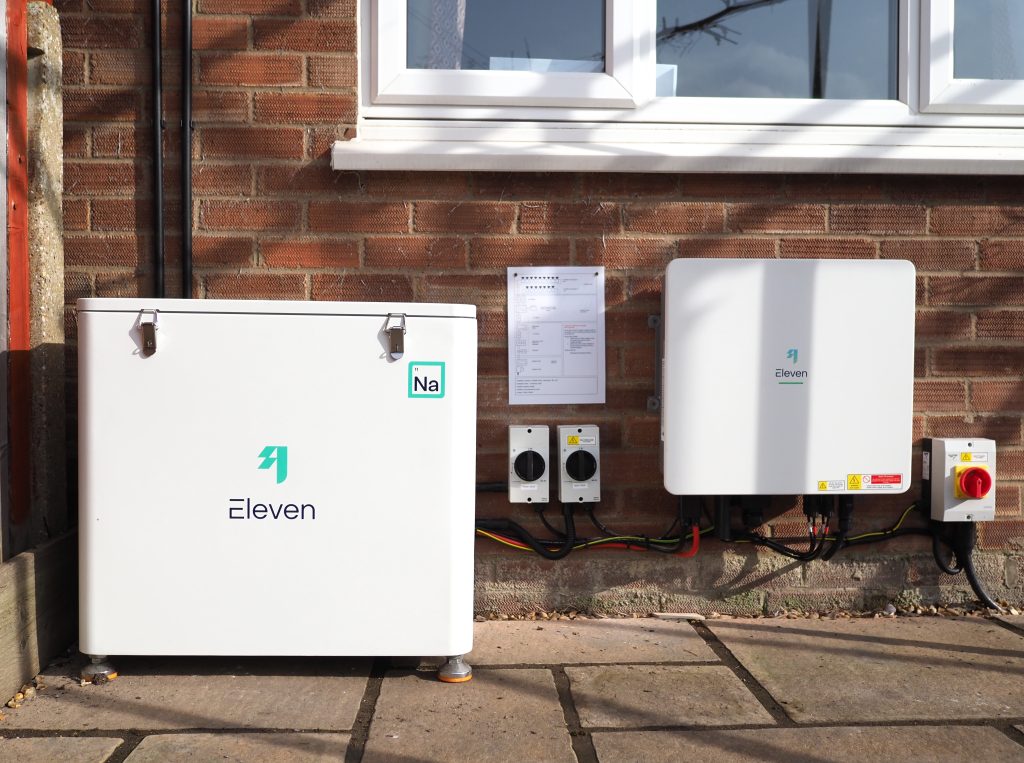
“Most UK homes weren’t designed with battery storage in mind, so retrofit solutions must be robust, safe and easy to install. That’s why we’re bringing sodium-ion to the market — a chemistry that performs reliably outdoors and uses abundant, low-impact materials.” — Yichen Shi PhD, CEO, Eleven Energy
Salt Batteries Are Here — From Homes to Cars to the Grid
Published May 2026 | Climate Change Community
Sodium-ion batteries — often called “salt batteries” because they run on the same element found in table salt — have just crossed a threshold that matters. They are no longer a lab curiosity or a conference slide. They are in homes in the UK. They are going into the first mass-produced electric car. And the largest battery order in the history of sodium-ion technology was just signed — 60 gigawatt-hours for grid storage — in late April 2026. Let’s break down what’s happening, what it means, and why it matters for a just and survivable energy transition.
Why sodium instead of lithium?
Lithium-ion batteries powered the first big wave of EVs and home storage. But they carry serious costs: constrained mineral supply, ecological and social devastation in mining regions, thermal runaway fire risk, and prices that slow adoption in lower-income communities and the Global South.
Sodium is different. It is widely available and can be sustainably extracted from seawater, making it a more environmentally friendly and ethical choice for energy storage. It doesn’t require cobalt, nickel, or water-intensive lithium brine extraction. It is, in the language of planetary boundaries, a far more sensible raw material base for a civilization that needs billions of batteries.
The chemistry works the same way: ions shuttle between cathode and anode through an electrolyte during charge and discharge, just like lithium-ion. The historic limitation was that sodium atoms are larger and heavier, meaning lower energy density. That limitation has been closing fast.
Eleven Energy: Salt Batteries, Right Now, in Your Home
Eleven Energy is a British startup from Cambridge pioneering a fully integrated sodium-ion battery and hybrid inverter system, now installed in homes across the UK. Their product is called the Volta, and it is built on modular 4.5 kWh sodium-ion packs that can be expanded to 36 kWh per inverter.
What makes the Eleven system stand out for real-world deployment isn’t just the chemistry. Eleven’s sodium batteries operate from -20°C to 55°C — giving more reliable year-round performance than lithium batteries, which typically function between 0°C and 40°C. That matters enormously for cold garages, exposed loft installations, and hotter climates, and it reduces the thermal management overhead that makes lithium systems more complex and costly to install.
The system is designed for grid-connected solar PV systems and off-peak tariff shifting, avoiding water-intensive lithium brine extraction and critical metals like cobalt and nickel.
The Eleven system also integrates with smart energy management. It pairs with a user-friendly app for live tracking, smart scheduling, and grid export optimization — and as of December 2025, Eleven became a Smart Tech Partner with Octopus Energy, one of the UK’s largest clean energy retailers, deepening the path toward dynamic tariff charging.
Distribution is scaling: Eleven Energy is being handled through Midsummer Energy, a wholesaler that has carved out an early exclusive relationship, with units described as “flying out the door” despite challenges in the broader UK battery market.
Eleven Energy’s CEO, Yichen Shi PhD, put it directly: “Most UK homes weren’t designed with battery storage in mind, so retrofit solutions must be robust, safe and easy to install. That’s why we’re bringing sodium-ion to the market — a chemistry that performs reliably outdoors and uses abundant, low-impact materials.”
That’s the right frame. Not hype — pragmatic innovation built for the retrofit reality of millions of existing homes.
The First Salt-Powered Car Is Coming: CATL, Changan, and the Nevo A06
Chinese battery giant CATL and automaker Changan announced the launch of the Changan Nevo A06, the world’s first mass-production electric vehicle powered by sodium-ion batteries, due to hit the market mid-2026.
At the heart of the car is CATL’s Naxtra cell — the result of a decade of R&D and roughly 10 billion yuan (US$1.4 billion) in investment — achieving an energy density of 175 Wh/kg, the highest achieved in mass production for sodium chemistry, and delivering a range of over 400 km (249 miles).
The cold-weather performance is where sodium-ion genuinely leaps ahead of lithium. Test data showed the vehicle’s discharge power at -30°C is nearly three times higher than comparable lithium iron phosphate models of the same capacity, and the battery maintains over 90% capacity retention at -40°C, with stable discharge documented even at -50°C.
The Naxtra cells can reach an 80% state of charge in about 15 minutes and are designed to operate across a temperature range from -40°F to 158°F (-40°C to +70°C).
CATL frames this as the beginning of a “dual chemistry era.” Changan announced that its brands — including Avatr, Deepal, Nevo, and Uni — will progressively integrate Naxtra sodium-ion batteries into future models. And CATL aims to bring sodium-ion on par with lithium iron phosphate within the next three years, enabling up to around 600 km of driving range.
From a systems perspective, this matters beyond range numbers. Sodium-ion EVs free up lithium for applications that genuinely need ultra-high energy density, while electrifying large segments of the market — especially in cost-sensitive regions and northern climates where lithium falters.
Grid Storage: The Biggest Salt Deal in History
While the Nevo A06 grabbed headlines, the most consequential sodium-ion news of May 2026 may have happened quietly in Ningde, Fujian. CATL signed a 60 GWh sodium-ion battery deal with energy storage integrator HyperStrong — the largest sodium-ion battery order ever placed — equivalent to roughly half of all energy storage batteries CATL delivered in all of 2025.
CATL’s sodium-ion cell for grid storage, unveiled at ESIE 2026 in Beijing, uses the same enclosure dimensions as its existing 587 Ah lithium storage cell — enabling high compatibility across system design, manufacturing lines, and supply chains, and reducing switching costs for customers. The grid-optimized cell delivers an energy density of 160 Wh/kg, energy conversion efficiency of 97%, cycle life above 15,000 cycles retaining at least 80% capacity, and an operating temperature range of -40°C to 70°C.
Industry reactions have been striking. Some analysts described the deal as a potential “DeepSeek moment” for the global energy storage industry — suggesting that sodium’s wider use in production could greatly reduce costs and improve manufacturing efficiency.
Calvin Xu of Benchmark Mineral Intelligence said: “2026 could become a turning point for sodium-ion storage. We expect its market share to gradually expand in the coming years.”
Not everyone is unqualified in their enthusiasm. Some analysts note that sodium-ion batteries show stronger sensitivity to real-world conditions than lithium-ion, particularly around internal resistance and energy losses, and that buyers have low experience with the technology. Those are legitimate cautions — not reasons to dismiss sodium-ion, but reasons to track real-world performance data carefully as these deployments scale.
Meanwhile in the United States, iron flow battery company ESS Tech signed a letter of intent for a strategic partnership with US sodium-ion startup Alsym Energy, planning to add 8.5 GWh of Alsym’s sodium-ion cells to its portfolio. ESS CEO Drew Buckley described the partnership as creating “a unified, non-lithium platform” that can serve storage needs across short, medium, and long durations from a single provider. For communities worried about lithium dependency and fire risk near schools and hospitals, a non-flammable, non-lithium storage option moving toward commercial scale is exactly the kind of development climate justice demands.
The Science Edge: What’s Still Coming
Alongside these commercial rollouts, researchers are advancing solid-state sodium-ion batteries that could push the chemistry further — combining sodium’s abundance and safety advantages with higher energy densities. Lab results have shown solid-state sodium-ion cells achieving above 99% Coulombic efficiency over 600 charge cycles, beginning to approach the best lithium-ion performance. The remaining challenge is manufacturing at scale and cost. If that hurdle falls, the toolkit for the energy transition gets considerably stronger.
What This Means for a Just Climate Transition
Let’s be clear-eyed. Sodium-ion is not a silver bullet. The technology is still maturing, real-world performance data at scale is still limited, and no battery chemistry resolves the underlying injustice of an economic system that treats the living world as a resource extraction zone. But the direction here matters.
Sodium-ion reduces dependency on geographically concentrated lithium reserves. It opens space for more regionally distributed manufacturing. It lowers fire and toxicity risks that burden frontline communities hosting battery facilities. And it is no longer speculative.
We can now point to:
Home scale: Eleven Energy’s sodium-ion systems deployed in UK homes, integrating with rooftop solar, operating in cold and hot conditions without the safety overheads of lithium — and scaling through a growing installer network.
Transport: The Changan Nevo A06, the world’s first mass-produced sodium-ion passenger EV, arriving on Chinese roads by mid-2026, with expansion across multiple Changan brands planned immediately after.
Grid scale: A 60 GWh supply agreement between CATL and HyperStrong — the largest sodium-ion deal in history — signaling that this chemistry is entering the mainstream of stationary energy storage, with US players like ESS and Alsym building a parallel non-lithium path.
For people trying to decarbonize their homes, communities, and supply chains today, this is not a slide from a conference deck anymore. Salt batteries are tangible tools — tools we can use and scale to make the energy transition faster, cheaper, safer, and fairer for both our children and the other species we share this planet with.
The salt of the Earth, it turns out, might help save it.
“This is not just an order, but the starting point for sodium batteries to officially move from ‘technology option’ to ‘mainstream energy storage configuration.'” — Jerry Wan, CEO, JLi Battery, on the CATL-HyperStrong 60 GWh deal
Tito


Leave a Reply