(And Not the Kind a Comedian on a Madison Square Garden Stage Meant)
My sociology class in college taught me one thing about our Spanish-speaking communities. My life taught me another.
First — primero — I hope this post finds my Latina y Latino brothers and sisters, no matter what age you are, healthy, thriving, and held up by people who love you. I know many of you are struggling. I know it firsthand. And I know the air right now in 2026 is heavy with fear, with raids, with families looking over their shoulders at the supermarket, at the bus stop, at their own front doors.
So when I tell you the title is true — that 21 Latin American countries are dumps — I want you to hold that sentence for a second before you decide what I mean.
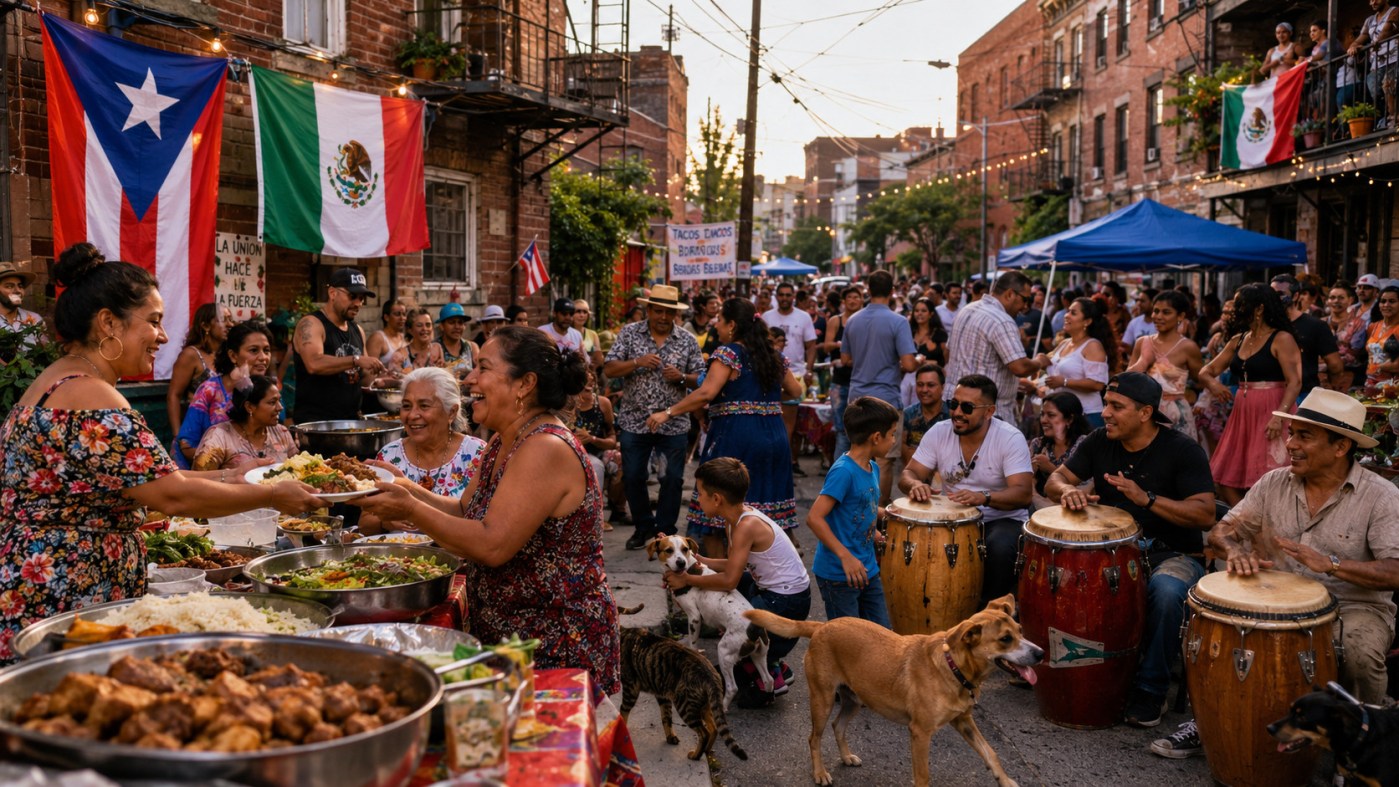
I mean it the way a kitchen is a “dump” of garlic and cilantro and laughter. I mean it the way our grandparents’ homes were a “dump” of cousins, music, and food that never ran out. I mean Latin America is a dump of creative, compassionate, family-oriented people — and the world keeps trying to pretend that’s a flaw instead of a gift.
The word is ugly on purpose. Because in October 2024, on a stage at Madison Square Garden, just days before the election that put this current president back in office, a comedian opening for him called my island — Puerto Rico — a “floating island of garbage.” He refused to apologize. He still hasn’t. The crowd didn’t boo loud enough. And a lot of our people, manipulated and exhausted and looking for somebody who promised them a better economy, walked into that voting booth anyway.
So yes. I picked the title to get your attention. Now stay with me.
The Essay That Changed How I Saw My Own People
Years ago in college, my professor handed me an assignment: write a long essay on the 21 Latin American countries (which, depending who counts and how, includes Spain, Puerto Rico, and the Spanish-speaking Caribbean and Americas). His warning: don’t turn it in if it doesn’t cover all 21.
I didn’t even know who all 21 were.
There was no AI. No Wikipedia. The Netscape browser was barely a thing. So I lived in the public library. I lived in bookstores. And — this is the part that changed me — I sat down with older Spanish-speaking people from all over those 21 countries and I asked them to tell me their stories.
I want to share three of them with you. Because I think about these people almost every day, and I think the rest of the country needs to hear what I heard.
The Old Man Whose Land Stopped Growing
One viejito I sat with told me his family had no intention of ever coming to the United States. They were happy. They had land. They had each other. Then a big American corporation came to his country and damaged the land — pesticides, runoff, soil exhaustion, the kind of slow violence you can’t sue a corporation for because the paperwork was signed by someone who never lived where the food grew. After that, nothing would grow. And they had no choice but to leave.
He said this happens a lot. And then, he said, our people get blamed for wanting to come — after the land and the livelihood that fed three generations was pillaged for somebody else’s quarterly earnings report.
He told me he and his family used to sit in front of their house every evening. Music. Dancing. Eating. Telling stories until the stars came out. He closed his eyes when he said how much he missed that.
He wasn’t lying, and he wasn’t exaggerating. The pattern has a name. The fruit companies — United Fruit, what we now call Chiquita, Dole, Del Monte — once owned millions of acres across Central America and the Caribbean. United Fruit alone, by the 1930s, was the single largest landowner in Guatemala and controlled enough land and rail and government to give us the phrase “banana republic.” When peasants and workers tried to push back — Colombia, 1928, the Banana Massacre — they were shot in the streets. When Guatemala elected a president in 1951 who tried to redistribute unused United Fruit land to landless farmers, the company lobbied the U.S. government into a 1954 coup that broke the country for generations.
That old man’s family wasn’t an isolated tragedy. He was telling me the story of a continent.
The Fishing Family Locked Out of Their Own Beach
Another woman told me about her family’s fishing business. They didn’t just feed themselves — they fed their whole community. Then a luxury resort came in and built itself across their stretch of coast. Then another resort. Then another. Access to the beach — the beach their family had worked for generations — was simply removed from them. Walled off. Roped off. Made the property of people who flew in for a long weekend.
The fishing collapsed. The community scattered. Some came north. And then they got called illegal immigrants here to “cause trouble,” when all they wanted was to build a new life somewhere their old one hadn’t been bulldozed for an infinity pool.
This isn’t ancient history either. From the Dominican Republic to Mexico’s coasts to Puerto Rico itself, coastal communities are still being pushed off ancestral land by tourism developers, by short-term rental investors, by hedge funds buying up the shoreline like Monopoly squares. The displacement keeps happening. The blame keeps landing on the wrong people.
The Family Whose Corn Wouldn’t Come Back
The third story — the one that haunts me the most as a climate writer — was a family who grew several types of corn. Some of the varieties they grew, they told me, no longer exist anywhere on Earth. They’d been passed down for generations. Heritage in a literal, biological sense.
Used to be a severe drought every ten years. Then every five. Then every other summer. And in their hearts they already knew — before any of us were talking about it on TV — that the climate damage being done by the fossil fuel industry was going to make this permanent. So they left. Because corn that won’t grow is corn that won’t feed children.
That family was prophetic. The science has caught up to them. The Central American Dry Corridor — running through Guatemala, El Salvador, Honduras, and Nicaragua — is now one of the most climate-vulnerable regions on Earth. Researchers have documented that drought conditions there are a major driver of migration, with each additional drought month after a long enough stretch measurably increasing the likelihood that families pull up roots and move. Rural poverty in Honduras runs above 80%. In Guatemala, around 77%. Indigenous communities — the ones holding most of the world’s remaining biodiversity on their lands — are getting hit hardest first.
And then, on top of that, this country has the gall to condemn the immigrants showing up at our southern border for the crime of wanting to live.
Shame on us. Shame on the fossil fuel industry. Shame on the deforestation-based agribusinesses that turned forests into feedlots. Shame on every politician who took their money and then stood at a podium and called desperate parents “invaders.”
What All 21 Countries Share
I’ll tell you what I learned from that essay, from those interviews, from a lifetime as a Boricua in New York paying attention.
Every single one of those 21 countries is a dump of creativity.
I can stand behind this with confidence. Sure — some are creative in unethical ways. Crime exists everywhere; every ethnicity has its share. That’s a human story, not a Latino story. But the baseline level of creative ingenuity in Latin American communities is something I don’t think the dominant culture in this country has ever fully sat with.
Let me show you what I mean.
My brother-in-law — way before cellphones, way before “maker culture” was a buzzword on YouTube — took a tiny closet in his apartment and turned it into a multi-faceted workshop. If I’d had a camera I’d be showing it to you right now. Pegboards, mounted tools, drawers built into drawers, lighting rigged from scrap. He could fix anything in there. I have never seen a square foot used more intelligently in my entire life.
My own father — Boricua to the core — could grow a garden literally anywhere. I picked up the habit from him. He could build a vertical garden in a corner of the living room if he felt like it, and his outdoor garden was a small miracle. He understood soil. He understood light. He understood patience.
You see this creativity walking through any neighborhood where our people are concentrated. You see it in the food. In the music — the clave, the tumbao, the bomba, the plena, the cumbia, the son, the bachata. You see it in the poetry. The dance. The way an abuela makes one chicken feed nine people and still sends you home with leftovers. You see it in every Latina y Latino social media feed where someone is building, sewing, painting, cooking, dancing, drumming, organizing.
It is undeniable. And it is precious.
Which brings me to the one flaw I’m going to name, because I love us too much to not name it.
The Flaw — and It Can Be Transformed
Our people, at times, follow toxic leaders. Even our own toxic leaders. Leaders whose character is corrosive, whose attitude is cruelty, whose policy is contempt — and we line up behind them anyway, because they speak our language or share our last name or promise us a piece of the pyramid.
I’m going to be direct.
The current president has shown clear, repeated signs of racism. He encourages division. He mocks people who point out his flaws. He attacks anyone who threatens his ego. And in 2024, a significant share of Cuban and Puerto Rican voters helped put him back in office. Whether they were gaslit, whether they were manipulated, whether they wanted lower gas prices, whether they believed the immigration cruelty would only fall on “the bad ones” — many of them are now watching the truth play out in front of their eyes.
The Pew Research Center has documented that nearly half of U.S. Latinos in 2025 reported feeling less safe in their own local areas because of this administration’s deportation actions. A majority worry they or someone close to them will be deported. Latino Republicans in Congress have started pushing back as the raids spread beyond people with criminal records and start sweeping up day laborers, factory workers, mixed-status families, and even U.S. citizens. Equis Research’s March 2026 polling shows that disappointment and regret among Latino Trump voters is climbing. The administration is doing exactly what some of us said it would do — and some of our own people are finally, painfully, seeing it.
I’m not here to humiliate anyone who voted that way. I am here to ask you, gently and seriously: do we really want a repeat of this?
Do we want this immigration debacle to keep tearing our communities apart? Do we want the cousin nobody can find anymore? The father who didn’t come home from work? The child who watched ICE put their mother into a van?
For me — and I’ll say this plainly — any Latina o Latino who, in the next election, willfully votes for a candidate who continues this president’s agenda, or for any new political figure aligned with him, needs to sit down with themselves and ask where their moral and ethical compass is pointing. Where is their compassion directed? Where is their empathy? Because our community cannot afford another four years of being told we are the problem by the very people profiting from the damage.
If You’re White, or Black, or Republican, Reading This
I want to talk to you too.
Please — for once — consider voting for the person, not the party. Vote for the candidate with a track record of treating human beings like human beings, no matter who those human beings are. Vote for the one who doesn’t lead with cruelty in language and behavior. Vote for the one who doesn’t display the patterns of racism. Vote for the one who has your concerns — your healthcare, your wages, your child’s school, your community’s safety — at the top of an actual agenda, not a slogan.
And while you’re at it: look at where the money is coming from. Look at the super PACs. Look at the “corporations” that are actually fronts for either religious power players or political machines. The whole game is greed, control, and the maintenance of power. Somebody used to tell me the system is rigged to keep us from thriving, and for a long time I didn’t want to believe it. The longer I live, the more I think they were right.
I’m not telling you who to vote for. I’m asking you to look at the candidate clearly. The one with the glittering words and the bottomless campaign account, whose actual behavior shows apathy — or worse. Don’t be manipulated again. Don’t be manipulated again. Don’t be manipulated again.
What Adaptive Resiliency Asks of Us
Here’s where I land.
Our communities — the 21 countries’ worth of us, plus everyone we have loved and absorbed and joined hands with — are not a burden on this country or this planet. We are one of the most creative, adaptive, family-rooted populations on Earth. We have survived colonization, dictatorship, coup, hurricane, drought, displacement, slur, and ridicule, and we are still drumming. Still dancing. Still feeding each other. Still planting gardens in living-room corners.
That is adaptive resiliency in the flesh. That is the same instinct we now need at planetary scale — collaboration, cooperation, dialogue, and yes, the ethical use of new tools (including AI) to coordinate care for one another and for the living world. The same instinct your abuela used to stretch a Sunday meal across a whole block is the instinct humanity needs to stretch a habitable Earth across generations we will never meet.
We are not garbage. We are not “a floating island” of anything to be thrown away. We are the people the climate crisis is going to need most — because we already know how to survive when the system breaks. We already know how to share. We already know how to dance through grief.
So no — Latin America is not a dump of trash.
Latin America is a dump of soul. Of brilliance. Of love. Of resistance. Of music that refuses to die.
And anyone — comedian, politician, corporate executive, voter — who can’t see that is not worth a single vote, a single dollar, or a single minute of our attention.
That’s all I wanted to share with you today, mi gente. Hold each other close. Vote your conscience. Take care of the kids and the elders. Plant something. Cook for somebody. Tell the stories. And remember — somos un pueblo creativo, compasivo, y profundamente vivo.
I’d like to leave you with a Climate Emergency and Humanity vibe. Yes — I am a bonafide Boricua Rumbero from New York. I love mi tumbao.
Visit ClimateChangeCommunity.com and cCcmty.com for more.
Amazona y Que Humanidad.
— Tito


Leave a Reply