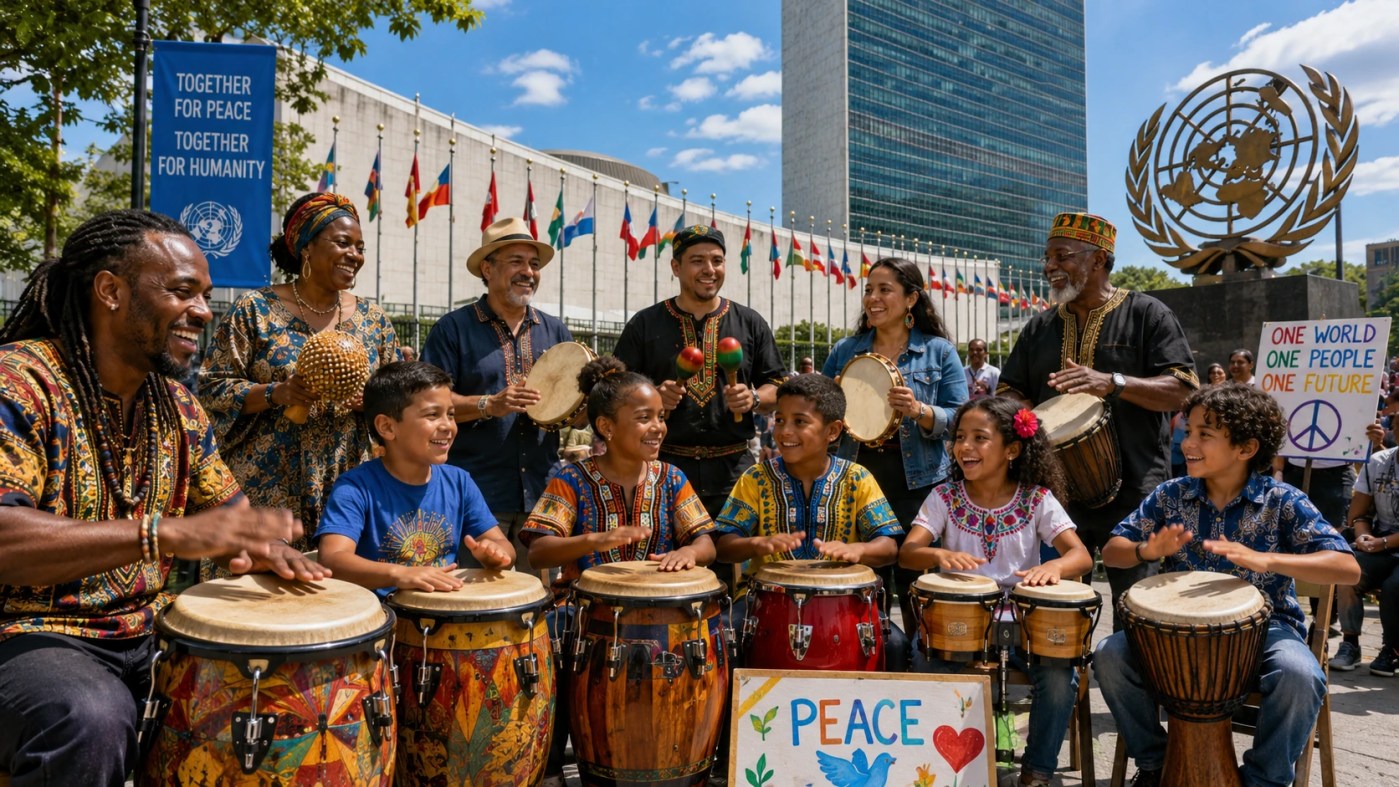
Opening: One Clave, Many Hands
Before any of the data or the history, let me start where I actually come from. I’m a Boricua rumbero from New York. Put a pair of congas in front of me and something old wakes up in my hands.
Here is what a lifetime inside this music has taught me. The drum I play — the conga, the tumbadora — crossed an ocean from Africa. The melodies that ride on top of it carry Spain. And the whole thing was reassembled on the streets and rooftops of New York by Puerto Rican and Cuban hands, in barrios where a dozen homelands lived on a single block. Salsa is not the property of any one nation. It is what happens when many nations stop being afraid of each other long enough to play together.
And it works for one reason: the clave. That two-bar pattern is the law of the music — the shared timeline every instrument bends to. The piano can be doing one thing, the bass another, the bell another, my hands another. Total difference, total independence. But if everyone honors the same clave, it locks — and a room full of strangers suddenly moves as one body. Break the clave, insist that your part is the only part that matters, and the whole thing collapses into noise.
I’ve come to believe the climate and ecological emergency is asking us to find our clave. We will not all play the same instrument, and we shouldn’t. We come from different nations, faiths, languages, and histories. But there is one shared rhythm underneath all of it now — one atmosphere, one ocean, one biosphere keeping time for every living thing on this planet. The question of our century is whether we are humble enough to listen for it, and disciplined enough to play in time. Everything that follows is really about that.
Prelude
Not long ago, a single phrase — build the wall — became shorthand for an entire way of seeing the world. In the years since, and especially in the aftermath of the 2024 election cycle, a more assertive nationalism has moved from the margins toward the mainstream of public life. Many people now describe themselves, openly and proudly, as nationalists. Some draw the circle of belonging tightly around a single language, heritage, or ancestry. That sentiment is real, and it deserves to be met honestly rather than dismissed.
But here is the difficulty the climate and ecological emergency forces upon all of us, nationalist and internationalist alike: a heatwave does not pause at customs. A flood does not check a passport. A wildfire’s smoke, a failed harvest, a poisoned aquifer, a collapsing fishery — none of these stop at a border and politely announce, that’s another nation’s problem, not mine. The atmosphere is a single shared room, and we are all breathing the same air in it.
To imagine we can solve a planetary problem inside one set of borders is not patriotism. It is a category error. And it ignores a humbling truth: many other nations and communities have lived with climate disruption longer than we have, adapted to it more creatively, and have hard-won knowledge we will need. Consider climate refugees and frontline communities. Who understands the danger of rising water better than the people already standing in it? Who knows more about resilience than those who have rebuilt, again and again, after the storm?
You can still call yourself a nationalist. That is your right. But the physics of this emergency has quietly made something else true at the same time: in the face of the climate crisis, we are already global citizens, whether we have chosen the title or not. We share one atmosphere, one ocean system, one biosphere — and therefore one fate. The only open question is whether we will act like it in time.
Introduction
In the face of our shared climate emergency, the need for collective action and global cooperation has never been more urgent — and yet cooperation has rarely felt more politically out of fashion. This is the central tension of our moment. The concept of global citizenship speaks directly to it. Global citizens grasp the interconnectedness of the world, recognize the necessity of collaboration, and understand that the choices made on one street corner ripple outward to distant places we will never see.
This piece explores why global citizenship is not a soft, idealistic luxury but a practical survival skill for the climate century. It is a deeper, second pass at a question I first wrote about some years ago — one that I have come to believe deserves far more rigor, more history, and more honesty than my earlier draft gave it. Where the first version gestured at cooperation and tolerance, this one tries to show them at work: in the data, in history, in philosophy, and in concrete strategy. An advanced addendum on Adaptive Resiliency follows for those who want to move from understanding to action.
I. What Global Citizenship Actually Means
The first misunderstanding to clear away is that global citizenship is about travel, languages, or cosmopolitan sophistication. It is not.
The Buddhist philosopher and peacebuilder Daisaku Ikeda — who submitted forty annual peace proposals to the United Nations between 1983 and 2022 — was clear on this point. In his 1996 lecture at Teachers College, Columbia University, “Thoughts on Education for Global Citizenship,” he argued that a global citizen is not defined by how many passports they have stamped or how many languages they speak. He pointed instead to ordinary people of inner nobility who may never have left their hometown, yet who genuinely care about the peace and prosperity of the wider world. Global citizenship, in this reading, is a quality of character, not of itinerary.
The advocacy organization Global Citizen frames the same idea in the language of action. To be a global citizen, in their words, is to help transform concern into action — to believe that where a person happens to be born should not determine whether they can go to school, see a doctor, or build a future. Since 2009, the movement reports that ordinary people taking small actions together have helped mobilize tens of billions of dollars in commitments affecting more than a billion lives. The lesson is the same from the Buddhist lecture hall and the advocacy platform alike: no single action changes everything, but millions of modest actions, aligned, can bend the curve of history.
This is precisely the shift our community works toward — turning climate concern into climate competence. Awareness is where the journey starts. Competence is where it has to arrive.
II. The Emergency That Refuses to Honor Borders
Here the abstraction becomes painfully concrete. According to the Internal Displacement Monitoring Centre’s 2025 Global Report, a record 83.4 million people were living in internal displacement at the end of 2024 — more than double the figure of just six years earlier, and equivalent to the entire population of Germany. Of the new movements that year, disasters triggered 45.8 million, the highest annual total since monitoring began in 2008. Weather-related events — storms, floods, and the like, many intensified by a warming climate — accounted for an astonishing 99.5 percent of those disaster displacements.
And here is the detail that should give every nationalist pause. The single country with the most disaster displacements that year was not a distant, vulnerable island. It was the United States, which alone accounted for nearly a quarter of the global total, driven by hurricanes such as Helene and Milton. The wall, it turns out, does not keep the water out. The emergency is already inside the house.
The cruelty of this crisis is its inverse justice: the communities that did the least to cause it suffer the most. Global Citizen puts it plainly — the world’s poorest people contribute the least to the problem and bear the worst of its consequences. A subsistence farmer in Chad or a fishing family in the Philippines did not build the carbon economy, yet they are first in line for its bill. Recognizing that asymmetry is not guilt; it is accuracy. And accuracy is the beginning of any serious response.
III. The Inner Architecture: Wisdom, Courage, Compassion
If global citizenship is a quality of character, what exactly is that character made of? In the same Columbia lecture, Ikeda named three essential elements, and they remain one of the most useful frameworks I know for this work. Rendered in plain terms:
- Wisdom — the capacity to perceive how all life is interconnected, so that we trace the strands of mutual support and recognize our neighbors in distant strangers.
- Courage — the refusal to fear or deny difference; instead, meeting people of other cultures with respect, striving to understand them, and allowing those encounters to change us for the better.
- Compassion — an imaginative empathy that reaches past our immediate surroundings to those suffering far away, whom we will never meet but whose fate is bound to ours.
What makes this framework durable is the third leg holding up the first two. Wisdom and compassion appear in many philosophies of global citizenship; Ikeda’s insistence on courage is what makes the model honest. Compassion without the nerve to act on it, he observed, too easily “remains mere sentiment.” We have all felt that gap — the moved heart that never moves the hand. Courage is what closes it. It is the difference between feeling for climate refugees and actually changing a policy, a budget, or a vote on their behalf.
IV. A Gentle Word on Nationalism, Belonging, and the Stranger
It would be easy, and lazy, to caricature everyone who feels the pull of nationalism. The desire to belong, to protect one’s own, to honor a heritage — these are deeply human and often beautiful impulses. The question is not whether to love one’s home. The question is whether that love is built by welcoming or by walling.
It is worth naming, carefully and without insult, a pattern that historians and scholars of religion have long documented: some of the most intense forms of nationalism draw strength from movements that fuse national or ethnic identity with religious identity. This is a delicate subject, so let me be precise about what I am and am not saying. I am not criticizing faith. Nearly every major religious tradition, at its core, commands the opposite of exclusion — to welcome the stranger, to feed the hungry, to care for the vulnerable, to steward the creation we were given. The tension, then, is rarely between religion and openness. It is between authentic faith and the political use of faith — the moment a sacred identity is enlisted to mark some people as belonging and others as threat.
Ikeda himself diagnosed this with unusual clarity. The deep psychology that divides people from people, he argued, is a kind of collective egoism — and it “takes its most destructive form,” he warned, in virulent strains of ethnocentrism and nationalism. The danger he pointed to is not your neighbor’s flag or your neighbor’s prayer. It is the ancient human habit of shrinking the circle of “us.” His mentors understood this in the hardest possible way: Tsunesaburo Makiguchi, the educator who first called himself a global citizen in 1903, spoke openly against the rising tide of fascism in wartime Japan and died in prison for refusing to bow to it.
So this is not an argument against rootedness. It is an invitation to a larger one. You can be proud of where you come from and recognize that the smoke from a neighbor’s burning forest is already in your child’s lungs. Belonging and global citizenship are not enemies. The widest form of patriotism, in an age like ours, may simply be the refusal to let the circle close.
V. Proof That Cooperation Works: The Ozone Story
Cynicism about global cooperation is understandable. It is also refuted by one of the great untold success stories of the modern era.
In the 1980s, scientists discovered a growing hole in the ozone layer — the thin shield of gas that protects every living thing from the sun’s ultraviolet radiation — caused by human-made chemicals in refrigerators, aerosols, and air conditioners. The threat was civilizational. The response was the Montreal Protocol, adopted in 1987. It became the first treaty in United Nations history to achieve universal ratification — every nation on Earth, 198 parties, agreeing to act together. Former UN Secretary-General Kofi Annan called it “the single most successful international agreement to date,” and the record backs him up.
The results are extraordinary. More than 99 percent of the controlled ozone-depleting substances have been phased out. The ozone layer is now healing, on track to recover to 1980 levels by mid-century. And because many of those banned chemicals were also powerful greenhouse gases, the protocol quietly became one of the most effective climate agreements ever signed, on track to avoid up to a full degree Celsius of warming. As current Secretary-General António Guterres put it, the lesson is that “when nations heed the warnings of science, progress is possible.”
Remember this whenever someone tells you that the nations of the world can never agree on anything. They already did — on a global atmospheric crisis — and it worked. The ozone story is not a fairy tale. It is a template.
VI. Climate as the Great Convener
There is a counterintuitive hope buried inside the scale of the climate emergency, and Ikeda articulated it as well as anyone. In his 2020 peace proposal to the UN — a public document, and one of his most pointed on this subject — he argued that because climate change is a crisis that will leave no one untouched, it carries the rare potential “to catalyze heretofore unseen global solidarity and action.” The very universality of the threat is also its invitation.
His proposals were never merely rhetorical. Across the years he pressed for remarkably concrete machinery: in 2008, upgrading the UN Environment Programme into a full specialized agency with real authority; in 2020, partnerships among coastal municipalities to share disaster-response know-how, and an annual youth climate summit to keep young people at the center of decision-making; in 2022, the recognition that climate change, biodiversity loss, and desertification are deeply intertwined and must be solved together rather than in silos. Notice the pattern: solidarity is not a feeling he asks us to summon. It is an infrastructure he asks us to build — between cities, between generations, between treaties.
That is the move from sentiment to structure, and it is exactly where this kind of thinking earns its keep.
VII. From Climate Concern to Climate Competence
So what does a global citizen actually do in the face of the climate and ecological emergency? Strip away the abstraction and it comes down to a handful of repeatable practices:
- Learn across borders. Treat the experience of climate-tested communities — Pacific islanders, Sahelian farmers, flood-rebuilt cities — as expertise to learn from, not misfortune to pity.
- Build the bridge before the flood. Form relationships, partnerships, and mutual-aid ties across lines of difference now, while it is calm, because that is the social capital you draw on when it is not.
- Act at the scale you can reach. Vote, organize locally, push an institution you belong to, share verified knowledge. The ozone layer was not saved by heroes; it was saved by millions of unglamorous decisions, aligned.
- Guard your facts. In an age of climate misinformation, insisting on verified, honestly-sourced information is itself an act of global citizenship.
In Conclusion
As global citizens, we carry a shared responsibility we did not ask for and cannot delegate. The good news is that the qualities this moment demands — wisdom to see our interconnection, courage to cross the lines that divide us, compassion that reaches the distant sufferer — are not rare gifts held by a few. Ikeda’s deepest claim was that these capacities already exist within every person and can be developed without limit through honest dialogue and inner transformation.
The wall will not save us. The solidarity might. Somewhere in another country, another climate, another culture, sits a piece of the solution we are missing — and someone there is missing a piece we hold. The work of our time is to find each other before the storm does. Together, with discipline and unity, we can still make a profound difference for our planet and for the generations who will inherit whatever we leave them.
Addendum — Level Three: Advanced Strategies in Adaptive Resiliency
The essay above makes the case for global citizenship. This addendum is for those ready to operationalize it. These are the most advanced strategies I can offer through the lens of Adaptive Resiliency — the practice of building communities, systems, and selves that can absorb shocks, adapt under pressure, and keep functioning when the familiar fails. They progress from the structural to the inner.
1. Build Polycentric, Networked Resilience
Resilient systems are rarely commanded from a single center; they are polycentric, with many overlapping nodes that can each act and each fail without bringing down the whole. Apply this to community. Rather than waiting on national governments, form direct city-to-city and community-to-community pacts across borders — Ikeda’s call for municipal partnerships, made operational. A coastal town in the Northeast and a flood-hardened city in Bangladesh have more to teach each other about water than either will learn from a distant capital. Sister-community resilience compacts, sharing playbooks, early-warning data, and recovery templates, create redundancy that no single point of failure can erase.
2. Treat the Climate-Experienced as Faculty, Not Charity
The standard frame casts frontline and refugee communities as recipients of aid. Invert it. The people who have already survived sea-level rise, mega-drought, or repeated displacement hold the most advanced adaptation knowledge on Earth — earned the hard way. The advanced move is structured knowledge transfer in that direction: paying frontline practitioners as consultants and teachers, building archives of their adaptation techniques, and routing their hard-won lessons to communities just now entering the danger. This is dignity and strategy at once. It also defuses the nationalist objection: this is not open-ended charity but reciprocal exchange of genuinely valuable expertise.
3. Make AI a Green Civic Utility
Artificial intelligence belongs in the resilience toolkit — but only if deployed deliberately and cleanly. The advanced posture is threefold. First, anticipatory intelligence: use AI-driven forecasting to move before the wave, since pre-emptive evacuations already save lives across the US, the Philippines, and Bangladesh. Second, green by design: favor smaller, efficient, low-power and edge-deployable models, and pair compute with clean energy and longer-lived hardware, so the tool that fights the crisis does not feed it. Third, AI as a learning and translation layer — lowering the barrier for ordinary community members to access climate science, policy literacy, and one another across language lines. Used this way, AI is not a replacement for human cooperation; it is scaffolding for it.
4. Engineer for Redundancy, Modularity, and Decentralization
Borrow directly from resilience engineering. Brittle systems are tightly coupled and centralized; resilient ones are modular, redundant, and decentralized. For a community, that means distributed energy (local solar and storage rather than sole dependence on a fragile grid), diversified and local food sources, mesh communications that survive when the main network drops, and decentralized data so no single outage erases the commons. Design every critical function to degrade gracefully — to bend and keep partial service rather than snap. A community that can lose a node and keep breathing is a community that survives the century.
5. Anticipatory Action: Move Before the Wave
The humanitarian field is shifting from reaction to anticipation — releasing resources on a forecast rather than waiting for the disaster to land. Bring this discipline home. Build community trigger plans: pre-agreed thresholds (a forecast, a river gauge, a heat index) that automatically activate prepared responses — opening cooling centers, pre-positioning supplies, checking on the vulnerable. The most resilient communities have already decided what they will do before the emergency arrives, so that panic never gets a vote.
6. Inner Transformation as Critical Infrastructure
This is the strategy most easily overlooked and most quietly decisive. The two great enemies of climate response, Ikeda warned, are indifference among those who feel unaffected and paralysis among those who feel the threat but are overwhelmed by powerlessness. Despair is not a mood; it is a strategic vulnerability. Adaptive Resiliency therefore treats the cultivation of inner strength — what the human revolution tradition calls the transformation of a single individual — as load-bearing infrastructure. Practically: protect the psychological capacity of your community to keep acting through setbacks. Pair every hard truth with a credible path to agency. Build cultures of hope that are honest rather than naive. A movement that burns out its people has lost, regardless of how right it was.
7. Institutionalize the Commons: The Civic Hearth Approach
Resilience that depends on volunteer energy alone eventually exhausts itself; durable resilience needs institutions and stable funding. The advanced strategy is to give communities a permanent, shared “hearth” — a civic membership structure through which municipalities, institutions, and governments can invest in collective climate learning, dialogue, and preparedness as ongoing infrastructure rather than one-off campaigns. By embedding resilience in an institution that outlives any single crisis or election cycle, the work compounds instead of restarting from zero each time. This is solidarity given a budget and a roof.
8. Bridge Difference as a Security Strategy
Finally, the most counterintuitive insight: in a polarized age, the deliberate building of friendship and trust across lines of difference is not a moral nicety — it is hard security infrastructure for the climate century. When the storm comes, communities that already know and trust one another coordinate; communities riven by suspicion fracture and turn on each other. Cross-group relationship-building, done patiently and in advance, is therefore an investment in the social cohesion that determines who survives a shock intact. Ikeda’s courage — meeting difference without fear — is, at the collective scale, a civil-defense strategy. Bridges built in calm weather carry the weight in the storm.
Compiled & Mr. Alvarez’s Thoughts | AI Enhanced.

A Note on Sources and Honesty
In the spirit of the research integrity this community values, a word about where this came from. The seed of this piece was a draft shared with me by a friend several years ago, which I adapted into an earlier blog post; I cannot fully verify the original provenance of that first text, and I want to be transparent about that rather than imply an authority I don’t have. This level-two version and its level-three addendum were rebuilt from the ground up on verified, public sources: Daisaku Ikeda’s 1996 Teachers College lecture and his publicly published peace proposals to the United Nations (used as public record); the Internal Displacement Monitoring Centre’s 2025 Global Report; the United Nations, WMO, and other public records on the Montreal Protocol; and Global Citizen’s published materials. Where I have paraphrased, I have tried to represent these sources faithfully. Where future readers find an error, the responsibility is mine to correct — honestly, and in public.
 empowerment & inner transformation...
Leave a comment