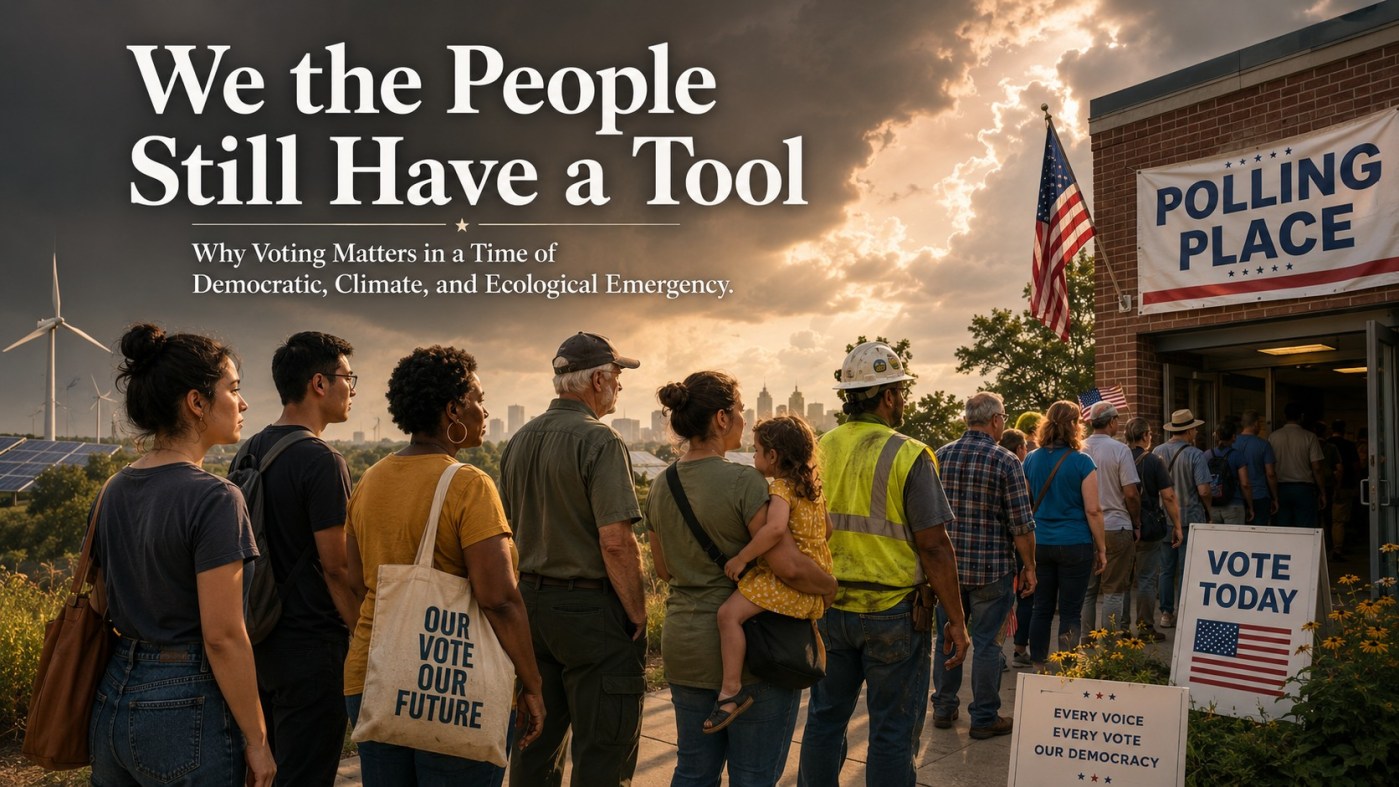
Democracy, Climate, and the Power of Our Vote
Why Voting Matters in a Time of Democratic, Climate, and Ecological Emergency
There are moments in American history when voting can feel too small for the scale of the problems in front of us.
A ballot is a piece of paper, a screen, a set of marks.
But climate disruption is planetary. Economic pressure reaches into rent, food, insurance, healthcare, transportation, and energy bills. Communities are confronting heat, flooding, wildfire smoke, stronger disasters, ecological decline, and an uncertain economic future. Public trust is strained. Political power can look distant, insulated, and increasingly concentrated.
And many Americans are asking an uncomfortable question:
Does government still answer to us?
That question is precisely why voting matters.
Democracy was never built on the idea that one vote magically fixes everything. It was built on something both simpler and more demanding:
Public power must remain answerable to the public.
Elections are one of the fundamental mechanisms that make that accountability possible. Through them, citizens can retain, replace, restrain, or redirect the people who exercise government power in our name.
The ballot is not our only democratic tool. We also have organizing, protest, public comment, journalism, litigation, civic associations, community building, watchdog organizations, petitions, public meetings, education, and direct communication with elected officials.
But elections determine who will write laws, control budgets, conduct oversight, appoint or confirm officials and judges, shape environmental and economic policy, and decide what government will—or will not—do when communities are in danger.
That gives voting enormous consequences.
And in 2026, those consequences are becoming increasingly difficult to ignore.
This Is About More Than Parties
Americans do not have to agree on every policy.
We do not have to belong to the same political party.
We do not need identical ideas about taxation, energy, immigration, healthcare, education, regulation, policing, foreign policy, or the role of government.
Democracy assumes disagreement.
What democracy cannot function without is a common foundation: reality, lawful government, accountable power, peaceful political competition, and the understanding that elected office is a public trust.
We should expect candidates to understand that they are seeking permission to exercise temporary power on behalf of other people.
Not ownership of that power.
Not immunity from accountability.
Not an opportunity to enrich themselves, their relatives, their friends, political allies, donors, favored industries, or businesses seeking special treatment.
And not a license to govern only for people who pledge loyalty to them.
If citizens become concerned that government is increasingly serving wealth, personal interests, ideological factions, powerful corporations, or political personalities rather than the public, the democratic response is not resignation.
It is scrutiny.
It is participation.
It is accountability.
And it is voting.
We should be looking for representatives who are prepared to stand alongside the public rather than above it.
History Shows That Elections Can Change the Direction of Democracy
American democracy has never been perfect. Its history includes slavery, disenfranchisement, political violence, corruption, segregation, voter suppression, exclusion of women and Indigenous Americans, contested elections, and repeated struggles over who counts as part of “We the People.”
But that same history contains moments when elections—and the expansion or protection of voting rights—helped redirect the country.
1800: Political Power Changed Hands Without a War
The presidential election of 1800 was bitterly contested.
Thomas Jefferson and Aaron Burr tied in the Electoral College, forcing the House of Representatives to choose the president. After 36 ballots, Jefferson prevailed. The crisis exposed flaws in the electoral process that helped lead to adoption of the Twelfth Amendment.
But something else happened.
Power transferred from one political faction to its opponents without a military coup or civil conflict. The National Archives describes Jefferson’s inauguration and the change in party control as the first peaceful transfer of power between political parties in American history.
That precedent still matters because democracy is tested not only by how elections are conducted, but by whether those who lose political power accept lawful outcomes and allow the peaceful transfer of authority to continue.
Democracy is not truly tested when everybody agrees.
It is tested when people lose political power and nevertheless accept lawful processes, continue the contest through democratic institutions, and live to campaign another day.
1864: America Voted During the Civil War
By 1864, the United States was in the middle of the Civil War.
Hundreds of thousands had died. The country itself was at stake. There were plenty of reasons someone might have argued that an election was too difficult, too dangerous, or too disruptive to conduct.
Yet the presidential election went forward.
States developed mechanisms allowing many soldiers to vote while away from home, and Abraham Lincoln was reelected with roughly 55 percent of the popular vote and 212 electoral votes. The National Park Service notes the significance of continuing the democratic process even during national catastrophe. election was not universally inclusive, and the democracy of 1864 remained profoundly unequal.
But the principle was important:
Emergency does not automatically justify abandoning democratic choice.
1965: Protecting the Vote Changed Who Could Participate
For generations after adoption of the Fifteenth Amendment, Black Americans in many parts of the country were prevented from exercising voting rights through intimidation, violence, literacy tests, discriminatory registration practices, poll taxes, and other barriers.
The civil-rights struggle—including the Selma voting-rights campaign and Bloody Sunday—helped build national pressure for federal action.
The Voting Rights Act of 1965 prohibited major discriminatory voting practices and established powerful federal enforcement mechanisms. The Department of Justice describes it as one of the most successful civil-rights laws in American history. results were dramatic.
The Library of Congress reports that Black voter registration in the South increased from about 35 percent in 1964 to nearly 65 percent by 1969.
That extraordinary increase illustrates something essential about democracy: it is not simply about counting ballots. It is also about ensuring that eligible citizens have meaningful access to the ballot and an equal opportunity to participate in choosing the people who govern them.
It is also about who has meaningful access to the ballot in the first place.
1974: Watergate Changed Congress
Watergate demonstrated what can happen when executive power, campaign misconduct, secrecy, and abuse of public trust collide.
President Richard Nixon resigned in August 1974.
Then Americans voted.
The election that followed brought a large class of new lawmakers to Washington, many remembered as the “Watergate babies.” The Senate Historical Office describes an electorate seeking new faces and a stronger legislative branch capable of checking an increasingly powerful presidency. Watergate era also helped drive changes involving campaign finance, ethics, public disclosure, Freedom of Information Act access, and congressional oversight. election did not magically repair public trust.
But voters changed who held power—and changed the political incentives surrounding accountability.
That is what elections can do.
The 2026 Midterms Have Already Begun
It is easy to think of the midterm election as something happening in November.
That is a mistake.
The general election will be held on Tuesday, November 3, 2026. All 435 voting seats in the U.S. House of Representatives will be contested, along with 35 Senate seats this cycle—33 regular Senate elections and two special elections. The results will determine the composition of the 120th Congress beginning in January 2027. the choices presented to voters in November are being determined now.
Primaries matter because they decide which candidates advance to the general election. In some districts where one party has a major electoral advantage, the primary can effectively determine who is most likely to hold the office.
And primary ballots can contain much more than candidates.
They can include constitutional amendments, local measures, judicial questions, taxes, election rules, and other proposals capable of altering government long after campaign signs disappear.
August 4, 2026
Kansas, Michigan, Missouri, Virginia, and Washington have major primary elections scheduled for August 4.
Virginia’s 2026 primary was specifically moved from June 16 to August 4 under state law. Washington uses its top-two system, in which the two candidates receiving the most votes advance to November regardless of party affiliation. voters should read beyond candidate names.
Kansas voters, for example, face a proposed constitutional amendment concerning how state Supreme Court justices are selected, while Missouri’s August ballot includes proposed constitutional changes involving the initiative-petition process and taxation.
And August 4 is only one point on the road to November.
The primary calendar continues throughout August and September, with elections scheduled in Tennessee on August 6; Hawaii on August 8; Connecticut, Minnesota, Vermont, Wisconsin, and certain Alabama races on August 11; Alaska, Florida, and Wyoming on August 18; Oklahoma runoff elections on August 25; Massachusetts on September 1; New Hampshire on September 8; Rhode Island on September 9; and Delaware on September 15.
Because election dates, procedures, and ballot details can change, voters should always verify current information with their state or local election authority.
The larger point is simple:
The choices Americans will face in November are being shaped long before November arrives.
Election Integrity Requires Evidence
There are legitimate reasons to pay close attention to the rules governing elections.
Who can register?
What identification or documentation is required?
How are district lines drawn?
How accessible are polling locations?
How does voting by mail work?
How are ballots verified?
How are mistakes corrected?
How transparent are audits?
How are campaign funds raised and spent?
How much influence do wealthy donors and organizations have?
These are serious democratic questions.
In 2026, election administration itself is a significant political and legal issue. Current debates include voter-registration requirements, proof-of-citizenship proposals, mail voting, voter access, and other rules governing how elections are conducted.
Redistricting is also consequential. In April 2026, the U.S. Supreme Court ruled in Louisiana v. Callais that the Voting Rights Act did not require Louisiana to create the additional majority-minority congressional district involved in that case and that the challenged map constituted an unconstitutional racial gerrymander. Whatever one’s political perspective, litigation over district boundaries can alter the structure in which congressional elections occur. we should be careful with words such as “rigged.”
That allegation requires evidence.
Democracy is weakened when genuine problems are dismissed.
It is also weakened when unsupported accusations persuade citizens that elections are pointless.
The stronger response is to identify the mechanism we are concerned about, find the evidence, examine the law, demand transparency, support independent oversight, challenge unlawful conduct through legitimate institutions, and insist that election rules be applied fairly.
Skepticism can strengthen democracy.
Evidence-free cynicism can destroy it.
And Then There Is the Climate Emergency
All of this is happening while the physical world is changing around us.
Climate change is no longer a distant environmental issue.
It is an infrastructure issue.
A housing issue.
An insurance issue.
A public-health issue.
A food and agriculture issue.
A water issue.
An energy issue.
An emergency-management issue.
An economic issue.
A migration issue.
A national-security issue.
And ultimately, a governance issue.
The World Meteorological Organization reports that 2015 through 2025 were the eleven hottest years on record. It estimates that 2025 was the second- or third-warmest year observed, around 1.43°C above the 1850–1900 average. WMO also reports continued ocean warming and an exceptionally large imbalance between the energy entering and leaving the Earth system. what we are experiencing now should not be confused with an endpoint.
WMO’s 2026–2030 climate outlook says global temperatures are expected to remain at or near record levels. It estimates an 86 percent chance that at least one year between 2026 and 2030 will exceed 2024 as the warmest year on record, along with a 91 percent chance that at least one year will temporarily exceed 1.5°C above the 1850–1900 average.
A separate 2026 climate-indicators assessment reported by the Copernicus Climate Change Service estimated human-caused warming at approximately 1.37°C in 2025 and warned that, if emissions continue at current levels, human-induced warming could reach 1.5°C around 2030.
This is why it is important to understand today’s climate disruption not as the worst we will ever experience, but as a warning of what additional warming could bring.
What we are experiencing now is already serious. Yet the scientific evidence indicates that greater warming can intensify many of the risks communities are already confronting—including extreme heat, flooding, wildfire, drought, ecosystem disruption, infrastructure stress, and threats to public health.
In other words:
The Climate Emergency is already here, but the future can still become significantly more dangerous if the causes of warming are not addressed and communities are not prepared for what is coming.
What we are experiencing today is serious—and additional warming can make the risks substantially worse.
And climate is only one part of the ecological picture.
The United Nations Environment Programme describes humanity as facing an interconnected triple planetary crisis involving climate change, nature and biodiversity loss, and pollution and waste.
These are not separate emergencies unfolding in isolation.
Climate disruption can damage ecosystems. The destruction of ecosystems can reduce nature’s ability to store carbon and protect communities from floods, heat, erosion, and other hazards. Pollution can harm human health while placing additional pressure on already stressed ecosystems.
The crises reinforce one another—and that means the decisions governments make about energy, land, water, infrastructure, industry, public health, conservation, and economic development can influence all of them.
Recognizing those connections is essential if we are going to build communities that are not only prepared to survive disruption, but capable of adapting, recovering, and becoming more resilient in the years ahead.
So are the decisions governments make about them.
Democracy and Climate Resilience Need Many of the Same Things
Think about what a community needs to become resilient in a destabilizing climate.
It needs reliable information.
It needs institutions capable of planning ahead.
It needs infrastructure investment.
It needs officials who understand risk.
It needs cooperation between local, state, federal, scientific, business, nonprofit, and community organizations.
It needs transparent decision-making.
It needs the capacity to admit mistakes and change course.
It needs to protect people who are especially vulnerable.
It needs to prepare before catastrophe arrives rather than pretending danger does not exist.
Now think about what a functioning democracy requires.
Much of the list is the same.
A government that cannot distinguish evidence from propaganda will have trouble protecting elections.
It will also have trouble planning for heat waves, flooding, wildfire, sea-level rise, infrastructure failures, ecosystem disruption, insurance instability, food-system stresses, and disaster displacement.
Reality eventually wins every argument with politics.
Physics does not care which party has the majority.
Floodwater does not ask who won the last election.
Wildfire smoke does not stop at congressional district boundaries.
Heat does not negotiate.
That is why competence regarding climate and ecological risk should not be treated as a political accessory.
Voters can reasonably ask whether people seeking public office understand the world they are asking to govern.
What Should We Expect From Candidates?
Instead of treating elections as contests between personalities, celebrities, slogans, parties, or political tribes, we can establish a democratic standard and apply it consistently.
Before casting a vote, we can ask:
- Does this candidate acknowledge verifiable facts even when those facts are politically inconvenient?
- Do they respect lawful elections, constitutional limits, courts, and peaceful transfers of power?
- How will they prevent conflicts of interest and make relevant financial relationships transparent?
- Do they treat public office as a public trust rather than an opportunity for personal enrichment, patronage, loyalty rewards, or preferential treatment?
- Can they tolerate criticism and political disagreement without treating opponents as enemies who must be silenced?
- Can they use qualified expertise without blindly accepting authority?
- Do they understand climate risk, ecological decline, infrastructure, emergency preparedness, public health, and community resilience?
- Can they explain costs, benefits, trade-offs, timelines, and measurable outcomes instead of relying exclusively on slogans?
- Will they represent constituents who did not vote for them?
- Can they cooperate when cooperation serves the public—and exercise oversight when accountability demands it?
None of those questions tells anyone which party to choose.
They establish something more fundamental:
a democratic floor.
Reality.
Competence.
Integrity.
Accountability.
Constitutional government.
And responsibility for the consequences of public decisions.
Voting Is Not Something We Do Only on Election Day
The ballot should be the culmination of a civic process, not the first time we begin paying attention.
Check your registration.
Know your primary rules.
Find your official sample ballot.
Research every office—not only president, governor, or senator.
Read ballot measures.
Look at voting records.
Read proposed legislation and policy plans.
Follow the money when financial disclosures and campaign-finance records are available.
Compare statements made today with actions taken yesterday.
Ask who benefits from a policy.
Ask who carries its costs.
Ask whether a candidate provides evidence.
Ask whether their promises are legally, economically, and physically possible.
And when information appears online designed to make you immediately furious, frightened, or triumphant, slow down long enough to find out whether it is true.
Democracy requires participation.
But healthy democracy requires informed participation.
The Ballot Is Not Everything. But Giving It Up Gives Away Power.
No election will solve the Climate Emergency in a single night.
No midterm election will erase corruption, inequality, ecological decline, political polarization, misinformation, or decades of institutional weakness.
Voting is not magic.
Democracy is not a vending machine where we insert a ballot and our preferred future comes out.
But consider what elections actually determine.
They determine who writes laws.
Who controls public money.
Who conducts investigations.
Who decides environmental policy.
Who shapes disaster preparedness.
Who confirms officials and judges.
Who determines whether agencies are strengthened, weakened, funded, redirected, or dismantled.
Who receives access to the machinery of government.
Who can be held accountable at the next election.
And ultimately, who is authorized to exercise government power in our name.
The 2026 elections arrive during a period when Americans are debating not only policy but the meaning of accountability itself.
At the same time, the physical world is imposing deadlines of its own.
We cannot negotiate with atmospheric chemistry.
We cannot spin our way out of ecological limits.
We cannot make infrastructure resilient by declaring vulnerabilities nonexistent.
And we cannot prepare communities for the future if public institutions abandon evidence, competence, transparency, and long-term thinking.
So perhaps the mission of voters in this era is not to search for political saviors.
It is to choose public servants.
To demand evidence.
To question power.
To defend lawful participation.
To reject corruption and self-dealing wherever they appear.
To insist that government remains accountable to the governed.
To elect people capable of confronting the world that actually exists.
And then, after the votes are counted, to continue watching them.
Because the responsibility of citizenship does not end when we leave the voting booth.
We the people do not need leaders who stand above us.
We need representatives who understand that political power is borrowed from the public.
That disagreement is not disloyalty.
That public office is not private property.
That facts remain facts even when they are inconvenient.
That tomorrow’s generations will inherit the consequences of today’s decisions.
And that in a functioning democracy, the people always retain the right to say:
You work for us.
The vote is not our only tool.
But it is one of the most powerful peaceful tools democracy gives us for deciding who will exercise the power of government in our name.
In 2026, we should use it with the seriousness this moment deserves.
By Mr. Alvarez | Thoughts Enhanced by AI Assistant


Leave a Reply