Cold Reality: Our governments promise to protect nature in one room and then write checks to destroy it in another.
As the COP17 Biodiversity Summit opens in Armenia, the numbers reveal a planet being dismantled with our own tax dollars
The short version: Nearly 200 nations are meeting in Yerevan to check on the promise they made in 2022 to halt and reverse the loss of nature by 2030. Halfway to that deadline, almost every target is off track. Meanwhile, governments are still spending trillions of public dollars every year on activities that wipe out forests, oceans, soils, and species. This is not a slow drift. It is a choice, and it is being made with our money.
What Is Happening Right Now
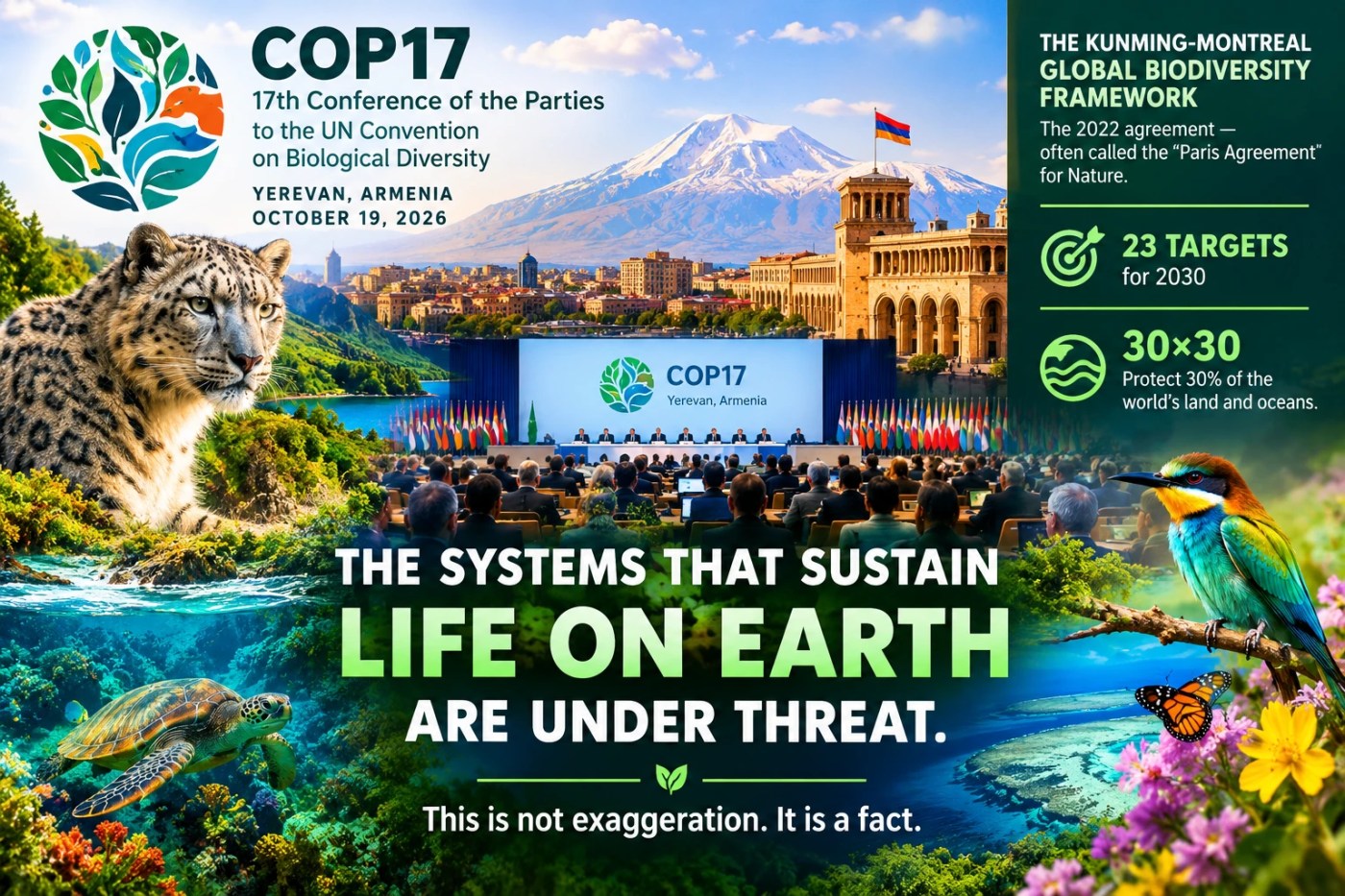
On October 19, 2026, the 17th Conference of the Parties to the UN Convention on Biological Diversity, known as COP17, opened in Yerevan, Armenia. Its job is to review progress on the Kunming-Montreal Global Biodiversity Framework, the landmark 2022 agreement often called the “Paris Agreement for Nature.” That framework set 23 targets for 2030, including the headline goal of protecting 30 percent of the world’s land and oceans, known as 30×30.
Common Dreams captured the mood of the opening days in one stark line from its headline: the systems that sustain life on Earth are under threat. After reading the reporting, I believe that is not exaggeration. It is an accurate description.
The Numbers That Should Stop Us Cold
Here is what the latest UN reviews and reporting from the summit tell us, in plain language:
- 22 out of 23 targets are off track. A UN scorecard released before the summit found that all but one of the framework’s goals are behind schedule, including 30×30.
- More than 1 million species face extinction. UN Secretary-General António Guterres repeated this warning to world leaders in Yerevan on October 16.
- About $2.6 trillion a year still flows into harm. Despite a 2022 promise to cut harmful subsidies, governments continue to pour public money into activities such as coal and gas extraction and industrial farming that damage biodiversity.
- $30 to destroy for every $1 to protect. According to Guterres, for every dollar invested in protecting nature, about thirty dollars go toward destroying it.
- Less than half the money promised. Funding for conservation sits at under half of the $200 billion per year agreed under the framework.
- A broken pledge to the Global South. Greenpeace notes that wealthy nations failed to deliver the $20 billion per year in international biodiversity finance they promised by 2025.
The Heart of the Warning: Subsidizing Our Own Destruction
This is the part of the story that hit me hardest, and I want every reader to sit with it for a moment.
We usually think of biodiversity loss as something that happens to us, caused by a warming climate, by pollution, by bad actors far away. But a huge share of it is being paid for, on purpose, through public budgets. Our governments promise to protect nature in one room and then write checks to destroy it in another.
Guterres put it bluntly ahead of the summit: “Subsidizing fossil fuels is subsidizing suicide.” He described coal, oil, and gas as both overheating the planet and acting as a scourge on biodiversity.
He went further, accusing governments of spending money on the wrong things and pointing to industries such as industrial fishing, fossil fuels, and logging that he said hold too much power over governments. In other words, the problem is not only ecological. It is political and financial.
An Lambrechts, who heads Greenpeace’s delegation at COP17, made the same point from the advocacy side. She warned that governments cannot keep promising to protect nature while funding its destruction through harmful subsidies and contradictory policies. Her conclusion was direct: “Any more delay is a threat to our survival on the planet.”
WWF’s Celine Beaulieu echoed this in Yerevan, saying nations cannot fund nature with one hand while bankrolling its destruction with the other.
Why This Matters to You and Your Family
Biodiversity can sound abstract, so let’s make it concrete. Guterres reminded leaders that the food we eat, the water we drink, and the air we breathe all depend on living systems. When we lose pollinators, wetlands, healthy soils, fisheries, and forests, we lose:
- Food security, as crops lose pollinators and fish stocks collapse.
- Clean water, as wetlands and watersheds that filter it are drained and degraded.
- Climate stability, because forests, soils, and oceans store the carbon that would otherwise heat the planet further.
- Protection from disasters, since mangroves, reefs, and floodplains buffer storms and floods.
- Public health, as degraded ecosystems raise the risk of disease spreading from wildlife to people.
Camila Jardim of Greenpeace Brazil also stressed the link between biodiversity loss and the fossil-fuel-driven climate crisis. These are not two separate emergencies. They feed each other. A warming world kills ecosystems, and dying ecosystems speed up the warming.
The Hypocrisy Gap
Promises abroad, cuts at home
Even regions that present themselves as leaders are under scrutiny. EUobserver raised the question of how Europe can claim leadership on nature at COP17 while reducing biodiversity funding at home. Wealthy nations are also expected to press large emerging economies like China to help close the finance gap, which risks turning the summit into an argument over who pays rather than a plan for what gets done.
A sliver of good news
To be fair and accurate, there is some progress. Nearly 90 percent of the countries in the Convention have set national biodiversity targets, and more than half have built roadmaps to meet them. Armenia’s Environment Minister and COP17 President, Hambardzum Matevosyan, told delegates the summit offers a real chance to correct course. Guterres also welcomed the Yerevan Declaration, which aims to bring biodiversity into every government decision on policy, budgets, and laws. But as Lambrechts warned, decisions made in Yerevan will only count if governments follow through at home.
What Needs to Happen
Based on the demands coming out of Yerevan from the UN, Greenpeace, WWF, and others, the path forward is clear:
- Redirect harmful subsidies. Shift the trillions now funding fossil fuels, destructive farming, and overfishing toward restoration and protection.
- Pay what was promised. Wealthy nations must deliver the biodiversity finance they pledged to developing countries.
- Fix the financial plumbing. Greenpeace is calling for reform of global tax rules and cancellation of unsustainable sovereign debt so poorer nations can afford to protect their ecosystems.
- Respect Indigenous Peoples and local communities. They are among the most effective guardians of biodiversity, and their rights must be protected.
- Connect the climate and nature agendas. Treat biodiversity and climate as one emergency with one set of solutions.
What We Can Do as a Community
Here at Climate Change Community, our work centers on Adaptive Resiliency: turning concern into competence through cooperation, dialogue, and collective action. This summit is a reminder that we cannot wait for governments alone. Here are steps any of us can take this week:
- Follow the money. Learn where your national, state, and local tax dollars go. Ask your representatives directly whether they support ending fossil fuel and other nature-harming subsidies.
- Share this warning. Most people have never heard that we spend roughly thirty times more destroying nature than protecting it. Talking about it is the first step to changing it.
- Protect what is near you. Support local land trusts, community gardens, native plantings, wetland and shoreline restoration, and pollinator habitat.
- Watch COP17 closely. The summit continues through the coming days. Pay attention to whether governments commit to concrete, funded subsidy reform, or only to more promises.
- Learn together. Bring these questions to our community spaces, where we can study, discuss, and organize side by side.
Final Thought
The most dangerous thing about this crisis is not that we lack solutions. It is that we are actively financing the opposite of them. Every year that harmful subsidies continue, we are buying more extinction, more collapse, and more risk for our children. The good news hiding inside that hard truth is this: what is paid for can be redirected. The money exists. What we need now is the public pressure and political courage to move it.
Read posts at climatechangecommunity.com
A note on how this post was made: AI is used to enhance my creativity and thinking, helping me research, organize, and amplify the reporting. The concern, the voice, and the call to action are my own.
Protecting our Children & Biodiversity’s future towards a more sustainable and habitable Earth!
Compiled & Mr. Alvarez’s Thoughts | AI Enhanced.
Sources
- Common Dreams – As Biodiversity Summit Begins, ‘Systems That Sustain Life on Earth Are Under Threat’ (Oct 19, 2026)
- Common Dreams – Ahead of Biodiversity Summit, UN Chief Warns Countries Are ‘Subsidizing Suicide’
- Phys.org (AFP) – UN biodiversity summit opens with nature goals off track
- Dawn (AFP) – Nations urged to curb harmful subsidies at UN nature summit
- Muser Press (AFP) – Nations urged to curb harmful subsidies at UN nature summit
- Euronews – ‘Subsidising suicide’: UN chief urges governments to stop propping up polluting fossil fuels
- Diário de Notícias – Guterres on $30 for destruction per $1 for protection
- News.am – Guterres: over one million species threatened with extinction
- Armenpress – Greenpeace urges action on biodiversity funding, harmful subsidies and Indigenous rights at COP17
- Climate Home News – Protecting nature is a public duty, not a Wall Street profit opportunity (An Lambrechts)


Leave a Reply