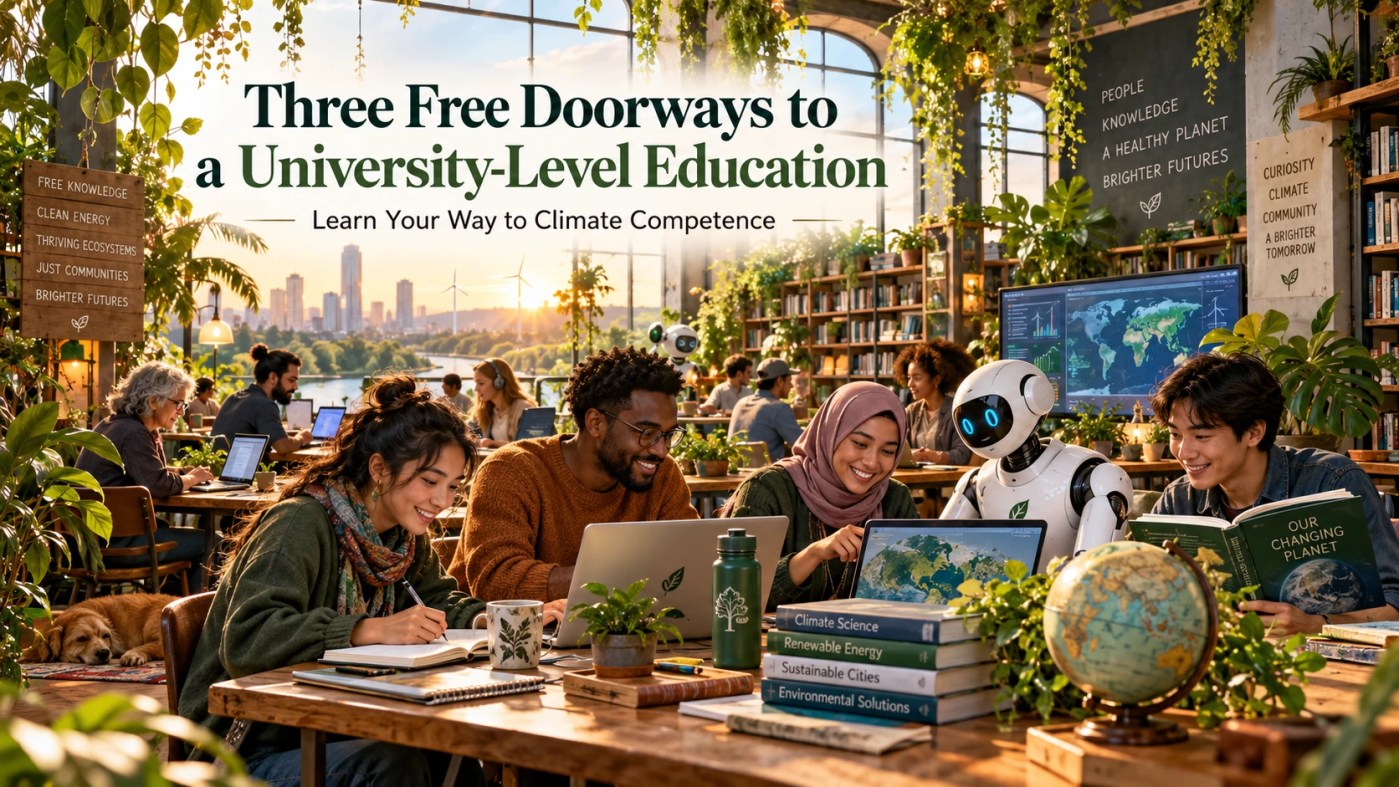
Turning Knowledge into Climate Competence, Community Empowerment, and Adaptive Resiliency
Why free education may be one of our most powerful tools for confronting the Climate and Ecological Emergency—and why nobody should be excluded from learning because they cannot afford tuition.
Protecting our children, biodiversity, and the future of a habitable Earth begins with knowledge.
There is something profoundly wrong with a world in which humanity possesses extraordinary scientific knowledge while millions of people still struggle to access education. We can observe our atmosphere from space, investigate the foundations of life, and develop powerful technologies, while people facing financial hardship may believe higher learning is beyond their reach. Yet some of humanity’s most valuable educational resources are available for free.
OpenLearn, Project Gutenberg, and OpenStax open doors to science, history, philosophy, mathematics, economics, and psychology without demanding tuition or enrollment in a degree program. For people concerned about the Climate and Ecological Emergency, they also offer a way to turn concern into competence, confidence, and action.
1. The Climate Emergency Is Also an Education Emergency
Climate change touches nearly every discipline. Physics and chemistry explain greenhouse gases and energy balance; biology describes ecological interdependence; economics and political science examine incentives and public choices; and psychology and communications help us recognize misinformation and understand resistance to difficult truths. Nobody must master every subject, but everyone can learn enough to ask better questions.
Imagine residents who understand why urban trees lower temperatures, how flood risks interact with development, and what public investments might make their neighborhood safer. Imagine parents able to explain the difference between daily weather and long-term climate, or neighbors able to examine a chart without accepting a misleading interpretation. Climate concern becomes climate competence through learning; climate competence becomes community power when shared.
2. OpenLearn: Structured University-Level Learning Without Tuition
OpenLearn is The Open University’s free learning platform in the United Kingdom. It offers a broad catalog of courses covering science, mathematics, psychology, technology, business, history, and environmental subjects. Many include readings, activities, and completion recognition. Free statements of participation and selected digital badges do not carry formal academic credit, but they can document commitment to learning.
For climate learning, OpenLearn’s “Climate change” course explores greenhouse science, radiative forcing, human influences, and interpretation of climate evidence. Its “Supporting climate action through digital education” course examines environmental teaching, collective action, and global citizenship. Courses in psychology can help us understand misinformation; economics can explain policy incentives; and mathematics can improve our handling of evidence.
Consider a town suffering dangerous heat. A resident might study the science of warming, then learn about human health and environmental systems, and finally ask which public interventions—shade trees, accessible cooling centers, housing improvements, and emergency plans—could reduce risk. Learning turns a generalized worry into a practical question.
3. Project Gutenberg: Humanity’s Intellectual and Ecological Memory
Founded in 1971, Project Gutenberg makes tens of thousands of books available to read and download without fees or registration. Its collection, numbering roughly 79,600 books as of October 2026, emphasizes older works whose U.S. copyrights have expired. Volunteers have digitized and proofread literature, history, science, philosophy, and other texts.
Older books help us understand the assumptions that shaped today’s society. Henry David Thoreau’s “Walden” invites reflection on simplicity and deliberate living; writings by John Muir illuminate a historical conservation perspective; and Charles Darwin’s “On the Origin of Species” helps explain biological change and interdependence. These are historical works, not substitutes for modern climate science. They should be read critically, including awareness of the limitations and prejudices of their periods.
We must not romanticize the past. Earlier societies also practiced environmental destruction, colonial extraction, and exclusion. Read older voices alongside contemporary Indigenous and other scholarship. The larger insight is that economic structures and cultural values are human creations, not unchangeable laws. History helps us consider how they could evolve.
4. OpenStax: College-Level Textbooks Without Textbook Prices
OpenStax is a nonprofit initiative of Rice University producing free, peer-reviewed, openly licensed textbooks. This allows independent learners to study substantial academic material without paying for conventional textbooks. Reading a book is not the same as earning a degree or completing laboratory training, but it can build a rigorous foundation.
Biology: Understanding Interdependent Life
Biology introduces ecosystems, energy flow, evolution, population dynamics, and biodiversity. A forest is not merely a collection of trees: it includes fungi, microbes, plants, insects, animals, soil, and water, bound by complex relationships. Habitat loss can reverberate through the system. Ecological literacy makes these connections visible.
Chemistry and Physics: Understanding Atmosphere and Energy
Chemistry explains molecular processes behind combustion, greenhouse gases, air pollution, and ocean acidification. Physics clarifies heat transfer, radiation, electricity, energy efficiency, and the planetary energy balance. These foundations help replace vague claims with questions that can be investigated and measured.
Statistics: Defending Against Misleading Claims
Statistics can help people recognize distorted chart axes, cherry-picked time periods, unreliable samples, confusion between correlation and causation, and uncertainty presented as certainty. Ask: Where did the data come from? What period does it cover? How was it measured? Does the conclusion really follow?
Economics: Questioning What We Value
Economics clarifies public goods, externalities, incentives, taxation, and distribution. It helps explain why environmentally harmful activity can remain profitable when costs are shifted to communities and ecosystems. It also helps residents assess public budgets and proposals without assuming that greater market output always equals greater ecological or human well-being.
5. Education as the Foundation of Adaptive Resiliency
Adaptive resiliency means understanding changing conditions, reducing vulnerabilities, protecting people and ecosystems, and revising our actions as new evidence emerges. It reaches into food security, disaster planning, clean water, energy reliability, health, housing, biodiversity, and local economies. Effective adaptation requires informed residents, not only technical equipment.
In a flood-prone neighborhood, learners can investigate watersheds, runoff, soils, planning rules, and stormwater systems. In a food-insecure town, they might study soil biology, water conservation, gardening, nutrition, and supply chains. In a city experiencing dangerous heat, they might learn about urban heat islands, tree canopy, cooling options, and equitable public investment. These studies do not solve problems alone, but they help communities choose better solutions.
6. Poverty, Access, and Climate Justice
Free content is necessary but not sufficient. Internet service, devices, accessible formats, reliable time, childcare, and safe study spaces can still be out of reach. Meaningful access also requires libraries, affordable connectivity, learning centers, printable materials, and supportive communities. People working to survive should not be blamed for circumstances that restrict their educational options.
When knowledge becomes dependent on income, the most financially secure acquire disproportionate power to understand and shape public decisions. People should not need wealth to assess threats to drinking water, understand proposed developments, or scrutinize disaster preparedness. Education access is a question of democratic participation and collective security.
7. From Individual Learning to Collective Intelligence
Information alone is not wisdom. Learning requires evidence, curiosity, humility, and a willingness to correct our views. Imagine a learning circle where one participant studies biology, another economics, and another local public policy. A retired teacher may help interpret difficult material; a teenager may introduce research tools; a gardener can contribute practical ecological experience. Together they compare what they learn and identify unanswered questions.
The goal is not uniform agreement. It is a community able to disagree constructively, evaluate evidence, recognize expertise, and collaborate when circumstances demand it. Scientific resources should be joined with credible local knowledge and experience.
8. Artificial Intelligence as a Learning Companion, Not an Authority
AI can explain terminology, create study questions, provide alternative explanations, and help build learning plans. Someone studying the carbon cycle might ask for a plain-language explanation; someone reading economics may request examples of externalities. But AI can also make factual errors and invent references. Important claims should be checked against reliable primary materials and current scientific sources.
The objective is not to outsource our thinking. It is to strengthen our capacity for independent thinking. Begin with trustworthy educational material, ask useful questions, examine the original, and verify what matters.
9. A 30-Day Climate Competence Challenge
Week 1 — Understand the science
Explore an OpenLearn climate course for about twenty minutes a day, as circumstances permit. Learn the greenhouse effect, human influences, and the distinction between weather and climate.
Week 2 — Explore ecological history
Read selected passages from Thoreau, Muir, or Darwin through Project Gutenberg. Record one insight and one assumption that deserves critical examination.
Week 3 — Build a technical foundation
Choose an OpenStax chapter in Biology, Chemistry, Physics, Statistics, or Economics. Connect the material to a real environmental question.
Week 4 — Share and apply the learning
Identify one local issue. Prepare a short evidence-based explanation with sources, possible responses, and remaining uncertainties. Discuss it with another person. The goal is a lasting learning habit, not a credential in thirty days.
10. From Learning Circles to Community Action
A small network can host reading circles, online discussions, workshops, or neighborhood meetings around practical topics: heat preparedness, ecological restoration, gardens, energy literacy, public-budget review, and misinformation awareness. These efforts do not require expensive organizational structures to begin, but they do require care, continuity, and responsible use of evidence.
Learning may lead to practical service, public participation, or simply a stronger capacity to understand complicated questions. All have value. Education strengthens participation; participation builds relationships; and relationships can make communities more resilient.
11. What These Resources Cannot Replace
OpenLearn statements are not accredited degrees. Historical books may contain dated science and discriminatory assumptions. OpenStax reading does not automatically provide professional supervision, laboratories, formal assessment, or credentials. Free websites cannot by themselves resolve poverty and digital exclusion. Acknowledging these limitations is essential to describing their genuine value honestly.
12. Education as a Public and Ecological Good
Education benefits society beyond private earnings. Scientific literacy strengthens public discussion. Statistical understanding makes misinformation less effective. Ecological understanding improves environmental choices. Civic knowledge makes government more accountable. These are public benefits worth cultivating especially during a Climate and Ecological Emergency.
We need sound technology and policy, but we also need informed residents, open discussion, critical inquiry, and a culture that values long-term ecological well-being. Broad access to learning is a practical investment in these capacities.
13. A Personal Invitation: Begin Wherever You Are
If tuition, work demands, health, caregiving, or poverty have made formal education unrealistic, your curiosity still matters. Free resources do not erase hardship, but they can provide a beginning. Pick one question, find a credible source, spend twenty minutes exploring it, and write down one thing you learned. Share it when possible.
You do not need a degree to begin understanding climate science. You do not need university enrollment to read great works or study college textbooks. Your learning can support your family, your neighbors, and your community—even if it happens slowly, in small moments between other responsibilities.
Conclusion: Learning Together Is How We Rise Together
OpenLearn offers structured study. Project Gutenberg opens an archive of human thought. OpenStax makes substantial academic textbooks free. Together, they illustrate how knowledge can be shared rather than reserved for those who can afford it.
Education alone will not end the Climate and Ecological Emergency. Without widespread education, however, society will be less equipped to evaluate its choices and cooperate on solutions. Let us make self-directed learning part of climate action, share knowledge generously, and defend the possibility of a sustainable and habitable Earth for our children and the biodiversity with which we share this planet.
Free Educational Resources and Further Reading
OpenLearn — The Open University — https://www.open.edu/openlearn/
Project Gutenberg — https://www.gutenberg.org/
OpenStax — https://openstax.org/
OpenLearn Climate Change Course — https://www.open.edu/openlearn/nature-environment/climate-change
Supporting Climate Action Through Digital Education — https://www.open.edu/openlearn/education-development/supporting-climate-action-through-digital-education/
Acknowledgment: Credit to the original video creator for highlighting these resources. The original video URL was not provided.
Read additional articles and reflections — https://climatechangecommunity.com/
AI is used to enhance my creativity, research, and thinking.
Protecting our Children & Biodiversity’s future towards a more sustainable and habitable Earth!
Compiled & Mr. Alvarez’s Thoughts | AI Enhanced.


Leave a Reply