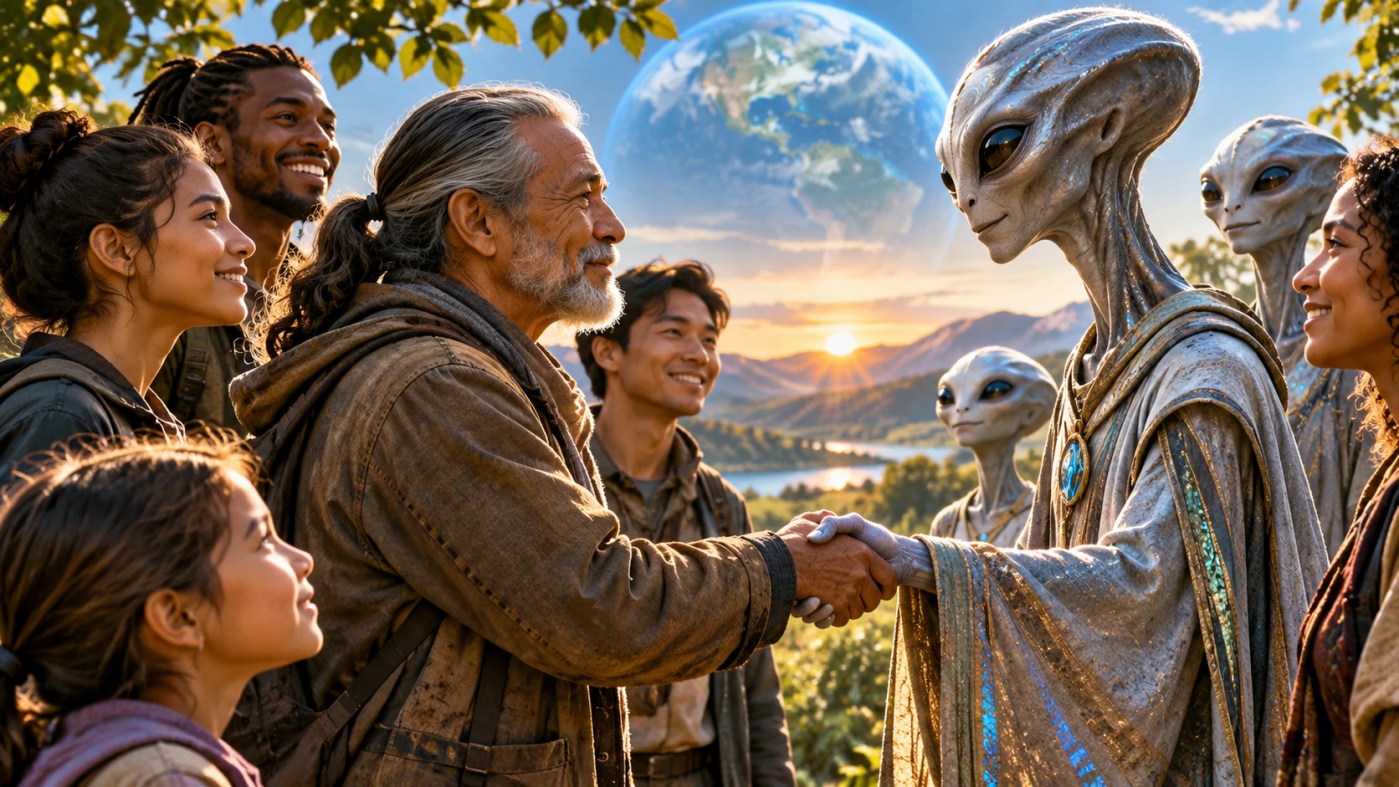
How humanity should receive visitors from beyond our world, and what that question reveals about who we are right now.
I recently watched a video circulating online that claimed to show an encounter between humans and visitors from somewhere else. I am not going to describe what was in it. I cannot verify it, I have no reason to believe it is authentic, and repeating its contents would only give an unproven claim more attention than it has earned.
What I will say is that it stayed with me. Not because of what it claimed to prove, but because of the question it left behind. If visitors ever did arrive, and especially if they arrived in peace, how would we receive them? As Humanity, or as something far less worthy of the name?
That question deserves an answer long before we ever need one.
First, What We Actually Know
Honesty comes first. As of today, there is no independently verified scientific evidence that anyone from beyond Earth has visited us.
NASA convened an independent study team that reported in September 2023. It found no evidence that unidentified anomalous phenomena have an extraterrestrial origin, and it said plainly that the data needed to explain many sightings simply does not exist yet. In March 2024, the Pentagon’s All-domain Anomaly Resolution Office reviewed United States government investigations going back to 1945 and reported no empirical evidence of recovered extraterrestrial technology or beings.
History also teaches caution about footage. Again and again, videos presented as leaked or secret proof of alien contact have turned out to be staged, and today’s tools for producing convincing fakes are far better than they were even a few years ago. A video is not evidence simply because it is disturbing or because it claims a mysterious origin.
None of this proves we are alone. The universe is vast, and the scientific search for life continues with better instruments every year. It simply means that an open mind and a careful mind have to travel together. I can hold both: I do not know whether anyone is out there, and I will not pretend a video has settled it.
I will add one thing, because honesty runs in both directions. Some of us, myself included, have had personal experiences we cannot explain, moments that make us question the premise that we are alone. Many thoughtful, truthful people carry stories like that. They are experiences, not evidence, and they do not overturn what NASA and the Pentagon have reported. But they are real to the people who lived them, and they are one reason this question refuses to go away.
The Question That Matters More
So let us set the footage aside and ask the larger question. Suppose that tomorrow the evidence became undeniable. Suppose visitors arrived, and everything about their conduct suggested they came peacefully.
What would they find?
They would find a species capable of extraordinary tenderness and extraordinary cruelty, often on the same day. They would find people who run toward strangers in a disaster, and institutions that have treated the unfamiliar as something to cage, study and exploit. They would find a civilization that can land instruments on other worlds while struggling to guarantee dignity to everyone on this one.
Which of those faces would greet them? That is not a question about aliens. It is a question about us.
We Are Not Starting From Zero
It surprises many people to learn that humanity has already done some serious thinking about this.
The Outer Space Treaty of 1967, signed by most of the world’s nations, commits us to exploring space for the benefit of all peoples and for peaceful purposes. It describes astronauts as envoys of all humankind. That one phrase carries a whole philosophy: whoever goes out there, or whoever meets what comes here, represents everyone.
In 1977 we launched the Voyager spacecraft carrying golden records filled with greetings in dozens of languages, music, and the sounds of our planet. When we had one chance to introduce ourselves to the cosmos, we chose to send a welcome, not a warning.
And the scientists who search for signals from other civilizations have maintained a set of guiding principles since 1989. The International Academy of Astronautics adopted an updated version in June 2026, the first major revision in more than fifteen years. Its core ideas are worth knowing. Any detection must be rigorously verified before it is announced, a safeguard that matters more than ever in an age of deepfakes and viral misinformation. And no reply should be sent on behalf of Earth until there has been broad international consultation, through a body such as the United Nations.
In other words, the people who think about this most carefully have already concluded that contact is too important to be handled by one government, one company or one frightened room of officials. It belongs to all of us.
Five Principles for a Peaceful Welcome
Those protocols cover signals from far away. They say much less about what we owe a visitor standing in front of us. Here is what I believe a humane approach would require.
1. Dignity before data
The moment we recognize another being as intelligent and capable of experience, it is someone, not something. Our curiosity, however intense, does not outrank its dignity. We already hold this standard for one another through medical ethics and human rights law. A visitor deserves no less simply because it was born under a different star.
2. Consent before study
We would want to learn everything. That desire is natural and good. But learning with a visitor is different from learning from a specimen. Any examination, any test, any exchange should happen with the visitor’s understanding and agreement, as far as communication allows. Where we cannot yet communicate, patience is the ethical choice.
3. Caution without cruelty
There would be legitimate concerns: unfamiliar biology, the health of both parties, security, and honest uncertainty about intentions. Taking those seriously is responsible. Quarantine can be gentle. Distance can be respectful. Protecting people never requires humiliating or harming a guest.
4. Openness over secrecy
A visit to Earth is a visit to all of Earth. No single nation or institution should claim private ownership of that moment. Secrecy is where abuse grows, because no one is watching. Shared, transparent, international stewardship is the best protection for the visitor and for us.
5. Listening before speaking
We tend to imagine first contact as our chance to explain ourselves. The wiser posture is to listen. A civilization able to reach us would likely have survived its own dangerous adolescence, and it may have something to teach a species still working through its own.
The Mirror: Our Humanity Emergency
At Climate Change Community we speak of Five Emergencies: Climate, Ecological, Humanity, Democracy and Displacement. This reflection sits squarely inside the Humanity Emergency.
We do not have to wait for a ship in the sky to find out how we treat the unfamiliar. The test is given daily. It is given at borders, where people displaced by rising seas, failed harvests and conflict arrive frightened and far from home. It is given in how we treat the other intelligent, feeling species who share this planet, many of whom we are driving toward extinction. It is given in how we treat our own neighbors when they look, speak or believe differently than we do.
If we cannot offer dignity to a climate-displaced family, why would we expect ourselves to offer it to a traveler from another world? And if we can learn to offer it here, we will not need a special protocol for the stars. The habit will already be ours.
How we would welcome a visitor is simply how we welcome one another, seen from far enough away.
This is why I see the question as part of the Green Way Forward. A sustainable and habitable Earth is not only a matter of carbon and ecosystems. It is a matter of character. A civilization that protects its children’s future and its biodiversity’s health is practicing the same care, patience and restraint it would need on the day someone new arrives.
If They Come
I do not know whether we are alone. I do not know whether anyone has ever visited. I do not know what to make of the experiences some of us carry. And I do not accept an unverified video as proof of anything.
But I know what I hope. I hope that if visitors come in peace, they are met in peace. I hope our scientists are guided by ethics, our governments by responsibility, and our communities by curiosity instead of fear. I hope we approach from the direction of Humanity and not barbarism.
We spend a great deal of time wondering whether we are alone in the universe. We should spend at least as much time becoming the kind of company worth finding. That work does not begin at the edge of space. It begins here, with each other, today.
Read posts at climatechangecommunity.com
Protecting our Children & Biodiversity’s future towards a more sustainable and habitable Earth!
Compiled & Mr. Alvarez’s Thoughts | AI Enhanced.
Note: Artificial intelligence is used to enhance my creativity and thinking in the preparation of these posts.
I do want to share something here, that was suggested that I do not share it…
Personal Experiences That Leave Questions Behind
I want to add something here because honesty runs in both directions.
Some of us, myself included, have experienced things we cannot adequately explain. These experiences can leave a lasting impression and make us question whether we truly understand everything happening around us, or whether we are alone in this enormous universe.
I have two stories to share. One is my own.
When I was 22 years old, I was living in Northern California. I had borrowed my brother-in-law’s Pinto to go on a date, which turned out to be an amazing evening.
On my way there, something happened that I have never been able to explain.
The car suddenly stopped. At the same time, a brilliant blue light appeared from above and completely surrounded the vehicle. It was so encompassing that I could no longer see the forest to my left or right, or even anything through my rear-view mirror.
I was frightened.
My uncle’s girlfriend had once told me that if something bad or something I couldn’t understand ever happened to me, I should chant the words Nam-myoho-renge-kyo. Honestly, those were the only words that came to mind.
I began chanting them, repeating the words several times. I remember feeling as though something was examining me, almost as if I were being X-rayed. Then, just as suddenly as it had appeared, the blue light disappeared.
Was it an extraterrestrial craft? Was it something atmospheric, electrical, or something else entirely? I honestly don’t know.
But I know what I experienced, and it remains one of the most extraordinary and unexplained moments of my life.
The second story belongs to my long-time friend Bill.
Bill was driving through the New Mexico desert when he encountered what he described as a UFO hovering directly in front of him. It remained there for several moments before suddenly disappearing in a flash.
I have known Bill for many years. He is not someone I would describe as a liar, and I have no reason to dismiss his account.
Does either experience prove that extraterrestrial visitors have come to Earth? No. I would never make that claim.
But I also don’t believe we should automatically dismiss people simply because their experiences fall outside what we currently understand.
There is a difference between believing every extraordinary story and remaining open to possibilities we cannot yet explain.
I share these experiences not to convince anyone, but to acknowledge that the question of whether we are alone is more than an abstract scientific discussion for some of us.
And if we ever do establish that we are being visited by another intelligent civilization, I sincerely hope our response reflects the very best of humanity: curiosity, compassion, dignity and respect rather than fear, domination or cruelty.
(Good Question – Told by who? : One AI model indicated to not share as it might have bearing on my climate company and another AI model indicated that it should be shared bu carefully. I chose the latter.)


Leave a Reply