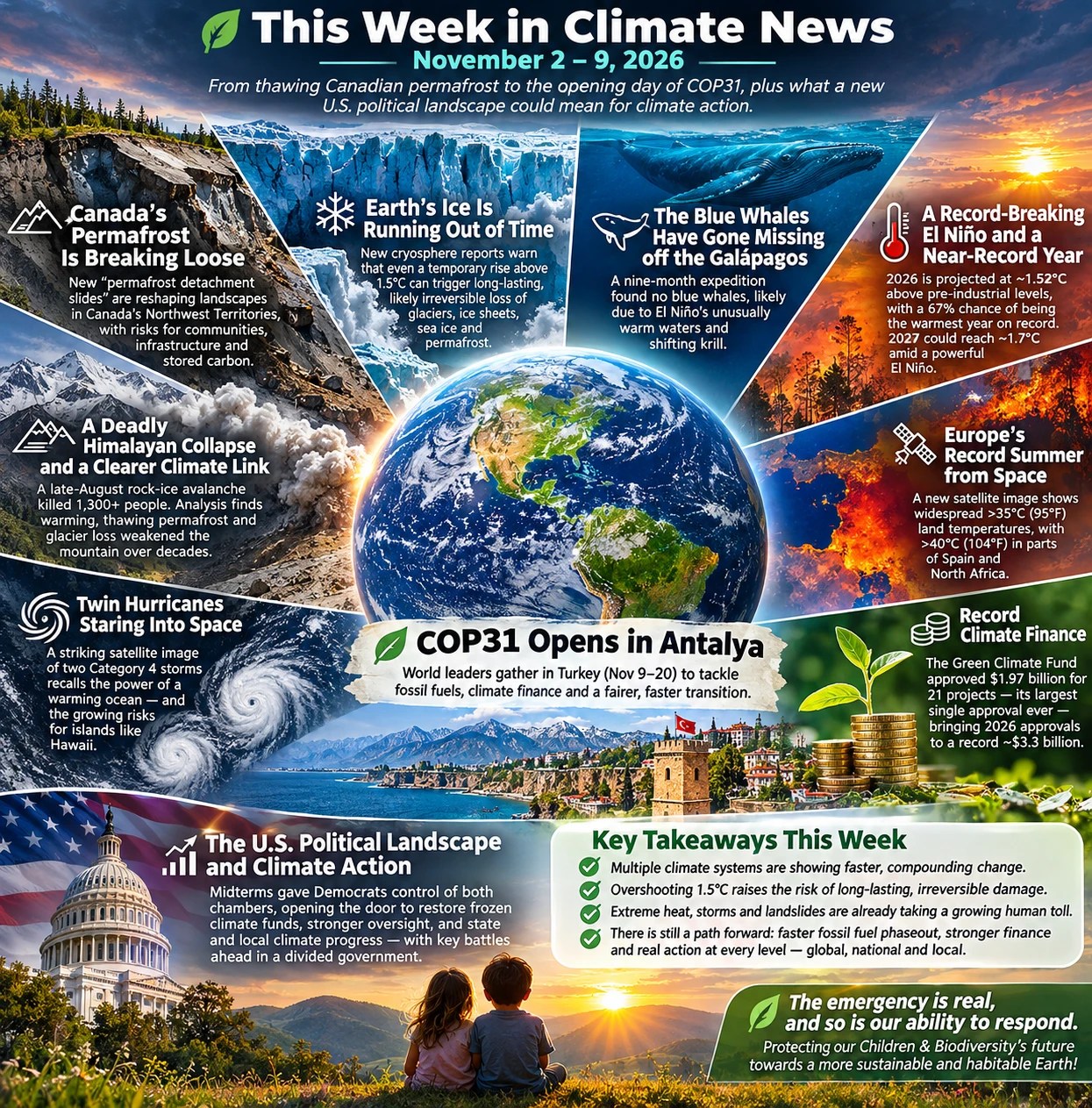
This is Version #1 – Version #2 can be found at adaptiveresiliency.info
A planet under pressure, a world at a crossroads, and the choices that will shape our children’s future.
Opening Thoughts
Some weeks in climate reporting leave us with more questions than answers. This was one of them.
From the Arctic permafrost of northern Canada to the disappearing blue whales of the Galápagos, from Himalayan mountain collapses to record-breaking ocean temperatures, the planet continues to show us how interconnected its systems really are.
Meanwhile, the United Nations is opening COP31 in Antalya, Türkiye. Governments are debating climate finance, energy transitions and the future of international cooperation. In the United States, the November 3 midterm elections have produced a significant political shift, with consequences for environmental protection, energy policy and the rapidly expanding data center industry.
But there are other stories deserving our attention, too. A new United Nations report reveals how dramatically adaptation funding falls short of what vulnerable countries need. A debate over methane and agricultural education raises questions about scientific integrity. And a new emissions assessment reminds us that even if the world overshoots 1.5°C, our choices can still make an enormous difference.
Let’s take a closer look.
1. Canada’s Permafrost Is Breaking Loose
In Canada’s Northwest Territories, researchers have identified a previously unrecognized type of landslide associated with thawing permafrost.
Known as permafrost detachment slides, these enormous movements of frozen ground have been documented in the Johnson River and Redstone River valleys.
The scale is extraordinary.
The 2017 Johnson River slide moved approximately 18 million cubic meters of soil and rock. The 2018 Redstone River slide moved another 4.5 million cubic meters. Both disrupted river systems, created lakes and transported sediment downstream.
Researchers describe a chain of events involving warming ground, wildfire damage and decades of thawing. As ice within the permanently frozen ground melts, enormous sections of previously stable terrain can suddenly become unstable.
More than 150 similar slides have been identified in the region.
Why It Matters
Permafrost contains enormous quantities of organic carbon accumulated over thousands of years. As frozen ground thaws, that material becomes available for decomposition, releasing carbon dioxide and methane.
The consequences extend beyond greenhouse gas emissions. Roads, communities, water systems and northern ecosystems can all be affected.
This is another example of climate impacts compounding over time: wildfire changes the landscape, warming weakens frozen ground, and eventually entire sections of terrain can collapse.
Source: Live Science – Permafrost landslides in Canada
2. The Cryosphere Warning: Overshooting 1.5°C Could Lock in Centuries of Damage
On November 2, the International Cryosphere Climate Initiative and the United Nations Environment Programme highlighted two important assessments concerning the future of Earth’s frozen regions.
The reports, Overshoot and the Cryosphere: Averting Global Meltdown and State of the Cryosphere 2026: The Cost of Overshoot, examine the consequences of temporarily exceeding the Paris Agreement’s 1.5°C warming threshold.
The warning is serious.
Glaciers, sea ice, Greenland and Antarctic ice sheets, and permafrost are already experiencing substantial changes. Some consequences of continued warming could persist for centuries or longer, even if global temperatures eventually decline.
The Greenland and Antarctic ice sheets are losing ice at rates approximately six times faster than during the 1990s.
However, the message is not that everything is already lost.
Limiting peak warming, shortening the period of temperature overshoot and returning global temperatures toward 1.5°C can still reduce long-term damage.
Why It Matters
For coastal communities, including those along the United States’ Atlantic coastline, rising seas are not some distant possibility.
They are an increasingly important planning challenge.
The future of our coastlines, freshwater supplies, ecosystems and communities depends partly on decisions being made today.
Source: IFLScience – Cryosphere overshoot reports
3. Blue Whales Missing from Their Galápagos Feeding Grounds
A nine-month research expedition conducted between October 2025 and July 2026 found no blue whales in waters around the Galápagos Islands where they have historically been recorded.
The research team, led by Daniela Alarcón of Universidad San Francisco de Quito, also failed to tag any blue whales during the expedition.
Researchers recorded unusually warm ocean conditions, including surface temperatures reaching approximately 28°C.
One possible explanation involves El Niño.
Blue whales depend heavily on krill, tiny marine organisms that form an essential part of the ocean food web. When ocean temperatures and currents change, krill distribution can shift, potentially forcing whales to travel elsewhere in search of food.
Researchers suspect that the unusually warm conditions displaced the whales’ food supply.
Importantly, the research did not directly measure krill availability, and scientists have not established that climate change caused the whales’ absence.
Why It Matters
The disappearance of a species from an important feeding area does not necessarily mean its population has collapsed.
But it does demonstrate how quickly changing ocean conditions can disrupt established ecological relationships.
Climate change, ocean warming, marine food availability and biodiversity are inseparable parts of the same conversation.
Source: Live Science – Blue whales missing off the Galápagos
4. El Niño, Global Temperatures and the Possibility of Another Record Year
The developing El Niño is attracting considerable attention from climate scientists.
Carbon Brief’s November 3 assessment suggests that 2026 could finish approximately 1.52°C above pre-industrial levels, potentially making it the warmest year on record.
The strength of the developing El Niño could push global temperatures even higher in 2027.
However, forecasting organizations are not entirely aligned on whether 2026 will surpass 2024. Copernicus considers a second-place finish more likely.
One important distinction: a single year’s temperature exceeding 1.5°C does not, by itself, constitute a formal breach of the Paris Agreement’s long-term temperature goal. That goal is assessed over longer periods.
Why It Matters
El Niño is a natural climate phenomenon, but it operates against a background of human-caused global warming.
When natural climate variability adds to an already warmer planet, temperature records and extreme weather risks can become more pronounced.
We need to understand both influences rather than attribute every individual weather event to climate change.
Source: Carbon Brief – State of the climate 2026
5. WMO: Planetary Extremes Are Off the Charts
On November 9, the World Meteorological Organization released a new assessment examining global climate conditions from January 2025 through September 2026.
Among its reported findings:
- The past 12 years have been the 12 warmest years on record.
- January through September 2026 averaged approximately 1.47°C above pre-industrial levels.
- Atmospheric greenhouse gas concentrations continue to rise.
- Global sea levels reached record territory.
- Glaciers experienced extraordinary losses during 2025.
- European heat waves and flooding in parts of Asia contributed to serious human and economic consequences.
The report also highlights the deadly late-August mountain collapse near the Nepal-China border.
A World Weather Attribution assessment connected the region’s increased instability to long-term warming, glacier retreat and thawing mountain permafrost, alongside the effects of the 2015 earthquake.
The resulting flood reached the border in approximately seven minutes, leaving very little time for an effective warning response.
Why It Matters
This brings us back to the Canadian permafrost story.
Whether in northern Canada or the Himalayas, frozen landscapes are changing. These changes affect ecosystems, infrastructure, water supplies and human safety.
Climate adaptation must include better monitoring, early-warning systems, emergency preparedness and infrastructure capable of withstanding changing conditions.
Source: CNN/ABC17 – WMO report
6. Europe’s Record Summer Captured from Space
A satellite image released through the European Space Agency provides a remarkable view of the heat affecting Southern Europe and North Africa during June 2026.
The Sentinel-3B satellite captured the region on June 23, when land surface temperatures exceeded 35°C across extensive areas of Spain and parts of France and Italy.
Some locations in Spain and North Africa exceeded 40°C.
The image illustrates something important about satellite observations: scientists can monitor temperature patterns across enormous geographic areas, helping identify heat exposure and changes that might otherwise be difficult to understand.
ESA Earth observation director Simonetta Cheli expressed optimism that the information demonstrates how much can still be done.
That is an important perspective.
Scientific observation should not simply document our problems. It should help us develop better solutions.
Source: Live Science – Europe’s summer heat from space
7. UNEP’s Adaptation Gap Report: The Money Is Not Reaching Those Who Need It
This is one of the most important developments of the week, and one that deserves considerably more attention.
On November 4, the United Nations Environment Programme released its 2026 Adaptation Gap Report: Ready? Not.
Its findings reveal a substantial gap between the resources developing countries need to prepare for climate impacts and the international funding actually reaching them.
UNEP estimates that developing countries will need approximately $305 billion annually by 2035 for climate adaptation.
Yet international public adaptation finance reached only approximately $28.2–31.7 billion in 2024.
Even if countries fulfill the COP30 aspiration to triple adaptation finance by 2035, UNEP estimates that this would cover only 20–29% of developing countries’ needs.
Think about what that means.
Communities already experiencing severe flooding, drought, extreme heat, coastal erosion and agricultural disruption are being asked to prepare for increasingly dangerous conditions without adequate resources.
Adaptation is not simply about building seawalls.
It includes:
- Climate-resilient agriculture and food systems.
- Reliable drinking water and sanitation.
- Flood protection and drainage infrastructure.
- Heat-resistant housing and urban planning.
- Early-warning systems and emergency preparedness.
- Ecosystem restoration and coastal protection.
- Protecting vulnerable populations and livelihoods.
Why It Matters
The countries and communities contributing least to historical greenhouse gas emissions are often among those facing the greatest consequences.
Climate justice requires more than recognizing that imbalance. It requires meaningful financial support.
This will be one of the defining questions at COP31.
Source: UNEP – 2026 Adaptation Gap Report
8. The Emissions Gap Report: We Have Not Run Out of Options
Another important UNEP publication deserves attention.
Released October 21, the Emissions Gap Report 2026: The Point of Return examines what it would take to limit global warming and eventually return temperatures toward the Paris Agreement’s 1.5°C goal.
Under current policies and commitments, the world remains on a trajectory toward approximately 2.6°C of warming this century.
But UNEP also identifies a pathway that could limit peak warming to approximately 1.7–1.8°C and potentially return temperatures to 1.5°C or below by 2100.
That would require exceptionally rapid reductions in greenhouse gas emissions.
Compared with 2025 levels, global emissions would need to fall approximately:
- 18% by 2030.
- 45% by 2035.
- 69% by 2040.
The report also recognizes the potential role of carbon dioxide removal, while acknowledging the enormous technological and social challenges involved.
Why It Matters
We should stop treating 1.5°C as a pass-or-fail examination.
Every fraction of a degree avoided matters.
The difference between 1.5°C, 1.8°C and 2.6°C is not merely a collection of statistics. It represents different futures for agriculture, biodiversity, coastal communities, human health and the stability of ecosystems.
We have solutions. The challenge is implementing them quickly enough.
Source: UNEP – Emissions Gap Report 2026
9. Methane, Cattle and the Battle Over Climate Education
A particularly revealing story appeared in The Guardian on November 8.
An educational program funded by the American beef industry had developed a high-school science lesson explaining how cattle produce methane and how those emissions contribute to climate change.
The program’s educational materials reach approximately 1.2 million students across more than 100 school districts.
After objections from ranchers, the methane lesson was withdrawn.
A subsequent lesson about cattle digestion omitted the connection to methane and climate change.
The controversy raises a larger question: should industry pressure determine which established scientific subjects are presented to students?
Methane is a powerful greenhouse gas. Livestock are a major source of human-caused methane emissions, and reducing these emissions is an important part of addressing near-term warming.
We should recognize that farmers and ranchers are important members of our communities. They face their own economic and environmental challenges, and sustainable agriculture deserves support.
But respecting agricultural communities does not require ignoring scientific evidence.
Why It Matters
Our children deserve access to accurate scientific information.
Climate education should encourage critical thinking, independent investigation and informed discussion.
We cannot prepare the next generation to address the climate and ecological emergencies by avoiding uncomfortable subjects.
Source: The Guardian – Beef industry and climate education
10. COP31 Opens in Antalya, Türkiye
The 31st United Nations Climate Change Conference begins November 9 and continues through November 20.
This year’s summit has an unusual leadership arrangement.
Türkiye is hosting the conference and directing its Action Agenda, while Australia’s climate minister, Chris Bowen, is presiding over the formal negotiations.
The conference is expected to focus on implementing existing commitments rather than simply announcing another collection of ambitious promises.
Several issues deserve our attention.
Fossil fuel transition
Brazil’s COP30 presidency has released two voluntary roadmaps, one addressing the transition away from fossil fuels and another addressing deforestation.
The question is whether these proposals can help countries move beyond declarations and establish practical, measurable action.
Climate finance
Developing countries are demanding meaningful progress on international climate finance, including the commitments made at previous climate conferences.
Adaptation
The UNEP report makes the financial shortfall impossible to ignore. Vulnerable countries need resources to prepare for impacts that are already happening.
Just Transition
Workers and communities dependent on fossil fuel industries need meaningful assistance as economies transition toward cleaner energy.
Electrification
The Turkish presidency is promoting an initiative to increase electricity’s share of global final energy consumption to 35% by 2035.
However, electrification must be accompanied by clean electricity generation. Simply increasing electricity consumption without changing how that electricity is produced will not deliver the emissions reductions we need.
Why It Matters
COP31 is taking place at a particularly difficult moment for international cooperation.
The United States will not send an official federal delegation following its withdrawal from the Paris Agreement, although American lawmakers and businesses can still participate.
The international community must demonstrate that climate cooperation can continue even when major political relationships become strained.
Source: Climate Home News – November climate agenda
11. Record Climate Finance: A Positive Development
There is some encouraging news on the financial front.
The Green Climate Fund has reported approximately $3.3 billion in project approvals during 2026, including approximately $1.97 billion approved for 21 projects at its latest board meeting.
That represents a record level of annual approvals.
The Green Climate Fund supports climate mitigation and adaptation projects in developing countries.
These investments can help communities strengthen resilience, protect ecosystems, improve energy access and prepare for climate impacts.
But we should maintain some perspective.
Approving funding is not the same as delivering it, and delivering funding is not necessarily the same as achieving successful results.
The important questions are whether projects reach vulnerable communities, whether they produce measurable benefits and whether the funding arrives when it is needed.
Source: Green Climate Fund – 2026 financing update
12. The U.S. Midterm Elections: Climate, Affordability and a Changing Political Landscape
The November 3 midterm elections produced a significant political shift.
Democrats gained control of both the House and Senate, creating a new political landscape for the remaining two years of the current presidential administration.
But the climate implications extend well beyond party control.
One of the most interesting developments was the connection between household affordability, energy prices and climate-related concerns.
Rising electricity bills, fuel costs, utility decisions and the rapid expansion of data centers became important issues in numerous races.
Data Centers Face Growing Public Opposition
Reuters reported that voters in 10 states supported restrictions or rejected proposals involving data center development.
Of 41 tracked ballot measures, all but one sought restrictions.
This is particularly important as artificial intelligence and cloud computing continue to expand.
Data centers require enormous amounts of electricity, cooling and supporting infrastructure. Their development can place additional demands on local power systems and water resources.
Communities are increasingly asking reasonable questions:
Who pays for the additional electricity infrastructure?
Will renewable energy supply the additional demand?
What happens to local water resources?
Will new facilities increase household utility bills?
And do residents have a meaningful voice in decisions about projects affecting their communities?
These are not anti-technology questions. They are questions about responsible development.
What Could Change in Washington?
The new congressional majority could:
- Increase oversight of federal environmental and energy policies.
- Examine the suspension or withdrawal of climate-related funding.
- Challenge administrative rollbacks of environmental protections.
- Pursue changes to clean energy incentives and tax policies.
- Investigate the effects of data center development on electricity costs and infrastructure.
However, we should be realistic.
The President remains in office, and Congress cannot simply reverse every executive decision or guarantee that new climate legislation will become law.
State governments, public utility commissions, local governments and the courts will continue to play important roles.
Where We Stand
We should welcome opportunities for stronger environmental protection regardless of which political party supports them.
Climate change is not a partisan scientific question.
It is a question of public health, economic stability, environmental protection and the future we leave to our children.
Our responsibility is to hold elected officials accountable for their decisions, not simply celebrate election results.
Sources:
Associated Press – 2026 Midterm Election Results
The Guardian – How Democrats used affordability concerns in the midterms
Reuters – Data centers take a beating in the midterms
13. Looking Ahead: The Next Climate Challenge for Global Shipping
One additional international issue deserves watching later this month.
Governments are scheduled to meet at the International Maritime Organization in London from November 23 through December 4 to revisit the proposed Net-Zero Framework for international shipping.
Shipping is responsible for approximately 3% of global greenhouse gas emissions.
The framework has faced considerable political disagreement, particularly over emissions targets, financial penalties and incentives for cleaner shipping.
The upcoming discussions could influence how quickly international shipping moves toward lower-emission fuels and technologies.
This matters because international trade depends heavily on maritime transportation.
A meaningful transition will require investment in cleaner fuels, more efficient vessels, supporting infrastructure and internationally coordinated standards.
Source: Climate Home News – November 2026 climate calendar
Climate Change Community: Connecting the Dots
When we look at these stories individually, we see many different challenges.
A landslide in Canada.
Missing whales in the Galápagos.
Melting glaciers and rising seas.
Methane emissions and agricultural education.
The enormous financial needs of vulnerable countries.
Political debates over energy prices and data centers.
But when we look at them together, something becomes clear.
The climate emergency is not an isolated environmental problem. It is connected to practically every aspect of human life.
Food production depends on stable weather patterns, healthy soils, reliable water supplies and functioning ecosystems.
Human health depends on clean air, safe drinking water, adequate housing and protection from extreme heat.
Economic stability depends on functioning infrastructure, reliable energy systems and communities capable of recovering from disasters.
Biodiversity depends on the continued health of habitats, oceans, forests, wetlands and countless interconnected ecological relationships.
And our children’s future depends on whether we recognize these connections and act accordingly.
This is why we cannot approach climate change solely as an energy issue, an environmental issue or a political issue.
It requires cooperation across disciplines, communities, industries and nations.
At Climate Change Community, we believe that informed citizens, meaningful dialogue, scientific integrity and practical cooperation are essential ingredients in building that response.
We also believe that accountability matters.
Governments, corporations, industries, financial institutions and community organizations must all be willing to examine their decisions and accept responsibility for their consequences.
That includes us.
Closing Thoughts: There Is Still Much We Can Do
This week’s developments offer reasons for concern, but they also remind us that meaningful progress remains possible.
Scientists are improving our understanding of climate systems.
Satellite technology is helping us observe changes across the planet.
Communities are demanding greater accountability from industries and governments.
Financial institutions are approving new investments in climate projects.
Countries are continuing to negotiate, even amid difficult international circumstances.
And people are increasingly recognizing that environmental protection, affordable energy, public health and economic security are connected.
We should never confuse acknowledging the seriousness of the emergency with surrendering to it.
We have choices.
We can accelerate the transition to cleaner energy, protect and restore ecosystems, reduce methane emissions, strengthen climate education, invest in adaptation and build communities capable of facing the challenges ahead.
We can also demand that technological progress, including artificial intelligence, be developed responsibly, with genuine consideration for its energy, water and environmental costs.
The question is no longer whether we understand that something is happening to our planet.
The question is whether we are prepared to respond with the urgency, cooperation and determination the situation requires.
Our children and biodiversity cannot afford for us to keep postponing that responsibility.
Learning together. Thinking critically. Acting responsibly. Holding ourselves and our leaders accountable.
That is how concern becomes competence, and how competence becomes meaningful action.
Protecting our Children & Biodiversity’s future towards a more sustainable and habitable Earth!
Compiled & Mr. Alvarez’s Thoughts | AI Enhanced.
A note on AI: Artificial intelligence was used to enhance my creativity and thinking in researching and drafting this post. The perspectives, choices and responsibility for what is shared here remain my own.


Leave a Reply