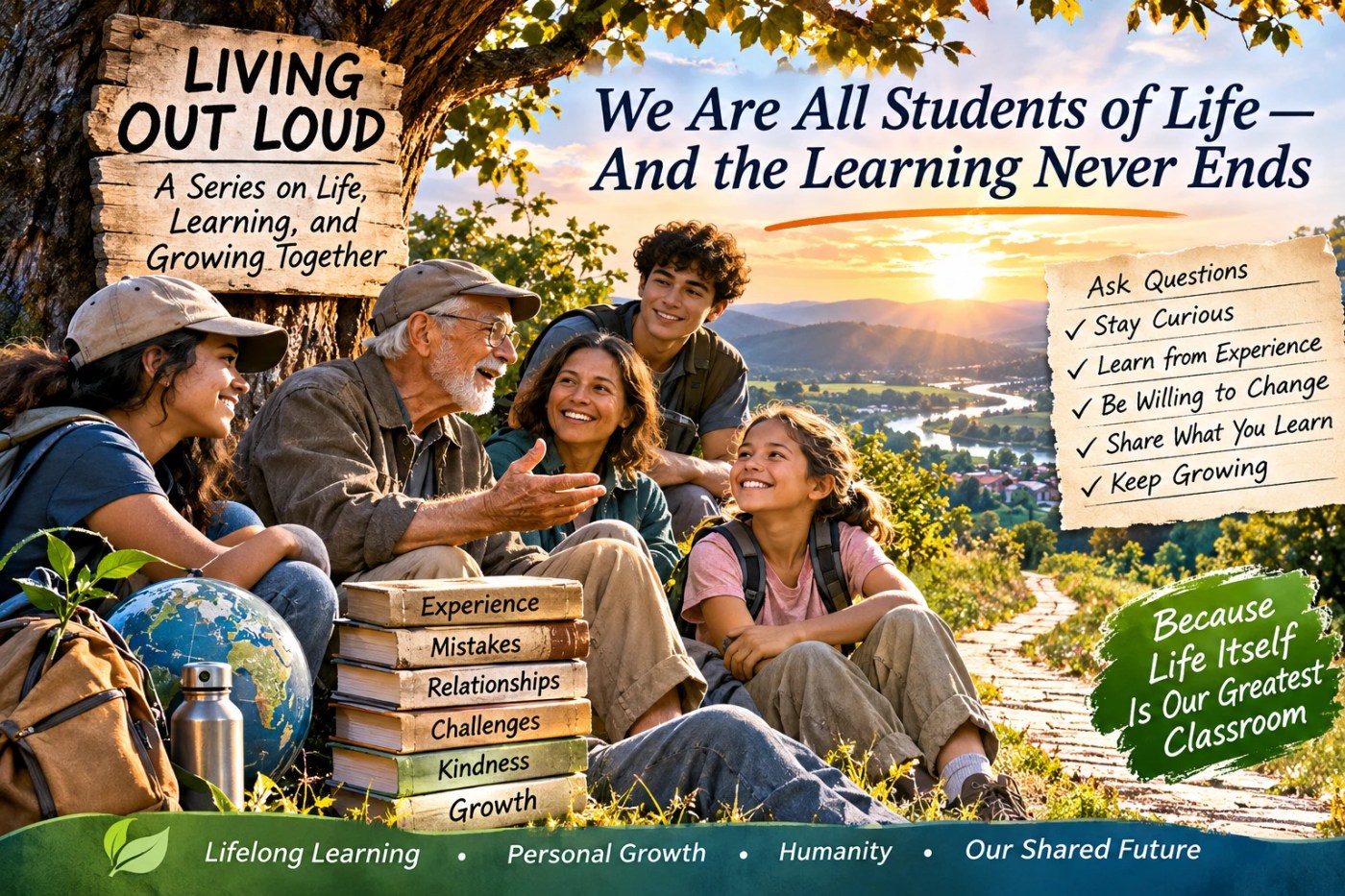
What if the greatest education we ever receive isn’t found in a classroom, a book, or a computer, but in the life we are fortunate enough to experience?
A thought worth sharing: We spend so much of our lives trying to teach, explain, correct, and educate others that sometimes we forget something rather important: we are students, too.
Think about that for a moment.
From the day we enter this world, we begin learning. We learn how to communicate, how to walk, how to recognize the people who care for us, and how to navigate a world that is often much more complicated than we initially imagine.
As children, we are naturally curious. Everything is an opportunity to discover something new. We ask questions without embarrassment. We make mistakes without fully understanding what mistakes mean. We fall, get back up, and try again.
Somewhere along the way, however, something changes.
We grow older. We accumulate experiences, develop opinions, establish beliefs, and become increasingly comfortable with what we think we know. Sometimes we become so attached to our understanding of the world that we forget to remain curious about it.
We stop asking certain questions. We become less willing to reconsider our positions. We sometimes mistake experience for wisdom and confidence for knowledge.
Yet life continues teaching us, whether we are paying attention or not.
Our Lives Are One Enormous Learning Experience
Consider everything that has shaped the person you are today.
The people you have loved. The people you have lost. The friendships that lasted and those that didn’t. The opportunities you embraced and the ones you missed. The mistakes you made, the forgiveness you received, and the forgiveness you eventually learned to give.
Think about the moments when someone said something that changed your perspective. Perhaps it was a parent, a grandparent, a teacher, a stranger, or even someone you initially disagreed with.
Some lessons arrived through happiness. Others arrived through hardship.
And sometimes, the most important lessons took years to understand.
We often look back at our younger selves and recognize things we simply could not see at the time. We understand why certain decisions mattered, why certain relationships were important, and why some experiences changed the direction of our lives.
That is part of growing.
The American philosopher and educator John Dewey believed that learning is deeply connected to experience. Education isn’t something that happens only in preparation for life. It is part of life itself.
I think there is tremendous wisdom in that idea.
We are not waiting to become educated before we begin living. We are being educated by the very experience of living.
Why Are We Sometimes Afraid to Learn?
Here is something worth examining.
Why do some people find it so difficult to admit they might be wrong?
Why does changing our minds sometimes feel like losing an argument rather than gaining understanding?
Why do we occasionally dismiss information simply because it challenges something we have believed for years?
Perhaps it has something to do with how closely we associate our beliefs with our identities.
When someone questions an opinion, we sometimes feel personally challenged. Instead of examining the information, we defend ourselves.
But what if we approached those moments differently?
What if we viewed a disagreement as an opportunity to discover something rather than a battle we must win?
Socrates, as recorded by Plato, gave us a timeless reminder: “The unexamined life is not worth living.”
That is a powerful challenge.
We should occasionally examine not only the world around us but also ourselves. Our assumptions, our behavior, our prejudices, our priorities, and the ways we treat others.
We should ask ourselves whether our understanding has grown along with our experiences.
And perhaps most importantly, whether we are willing to change when we discover that it should.
Even Our Relationship With Artificial Intelligence Can Teach Us Something
There is an interesting conversation taking place around artificial intelligence.
Some people are concerned about how AI is trained, what information it learns from, who owns that information, and how it might use what it has been given.
These concerns deserve serious attention. Privacy, consent, intellectual property, accountability, and responsible development are not trivial matters.
But I find another aspect of this conversation equally interesting.
Human beings have always learned from one another.
Every generation inherits knowledge, experiences, discoveries, traditions, and mistakes from those who came before. We teach our children. We share our experiences. We write books, create art, conduct research, and pass information from one generation to another.
Our lives are filled with learning experiences.
The comparison with AI is not exact. Humans have consciousness, emotions, personal experiences, and the ability to attach meaning to what happens to them. Today’s AI does not experience life in that way.
Nevertheless, working with AI can offer us an opportunity to examine how we learn.
We ask questions. We provide information. We challenge responses. We correct mistakes. We request explanations. Sometimes we discover that our original question wasn’t even the right question to ask.
And sometimes, while trying to teach AI what we mean, we discover that we are learning something ourselves.
That is an interesting relationship.
AI should not become a substitute for independent thought. We should not blindly accept its answers or allow its confidence to replace our judgment.
Instead, we should challenge it, question it, demand evidence, and recognize its limitations.
And we should be equally willing to challenge ourselves.
Perhaps the greatest benefit of this developing relationship isn’t simply what AI might learn from us, but what we might learn about ourselves through the process.
Our Mistakes Do Not Have to Become Our Identity
Let’s talk about something else that deserves more attention: mistakes.
We all make them.
Some are small and quickly forgotten. Others have consequences that follow us for years. Some involve decisions we regret, while others involve things we failed to do when we had the opportunity.
But there is an important distinction between making a mistake and refusing to learn from it.
Taking responsibility matters. Apologizing matters. Making amends where possible matters.
But so does allowing ourselves and others the opportunity to grow.
Maya Angelou is often associated with the expression, “When you know better, do better.”
Whether we are discussing relationships, personal conduct, community responsibilities, or the larger challenges facing humanity, the principle is worth remembering.
We should not use yesterday’s ignorance as an excuse for tomorrow’s behavior.
When we learn something important, we have a responsibility to consider what that knowledge requires of us.
Growth isn’t simply knowing more. It is allowing what we learn to influence how we live.
What a Wonderful Life I Lived
There is one expression that brings all these thoughts together for me.
Imagine reaching the later chapters of your life and being able to look back and sincerely say:
“What a wonderful life I lived.”
I don’t imagine that statement necessarily comes from someone who had a perfect life.
Perhaps they experienced heartbreak, financial difficulties, disappointment, illness, uncertainty, and loss. Perhaps they made decisions they would handle differently today. Perhaps there were opportunities they missed and people they wished they could see again.
Yet, despite everything, they recognize that their life was meaningful.
They remember the laughter, the friendships, the unexpected kindness of strangers, the people who stood beside them, and the moments when they discovered something about themselves they never knew existed.
They remember the lessons.
Perhaps they finally understand that a wonderful life isn’t necessarily one in which everything went according to plan.
It may be one in which they remained willing to experience, learn, love, contribute, and grow despite everything that happened along the way.
And maybe that is something we should think about while we still have time to do something with it.
We don’t have to wait until the end of our lives to recognize the value of the journey.
We can begin appreciating it now.
What Are We Teaching the Next Generation?
This brings us to a responsibility that I believe deserves particular attention.
Our children are watching us.
They are learning from what we say, but perhaps even more from what we do.
They see how we treat people who disagree with us. They see how we respond when we make mistakes. They see whether we demonstrate kindness, patience, honesty, and respect.
They also see how we treat the natural world they will inherit.
What are we teaching them about responsibility? About compassion? About the importance of asking questions and seeking truth?
Are we teaching them that admitting a mistake is a sign of weakness, or that it is an opportunity to become better?
Are we encouraging curiosity, or simply rewarding agreement?
Are we showing them how to think, or telling them what to think?
The world they inherit will be shaped, in part, by the lessons we choose to share today.
And perhaps one of the most important lessons we can offer is that learning should never end.
Let’s Live Out Loud
I don’t believe any of us should consider ourselves finished products.
There is always another perspective to consider, another person to listen to, another question to ask, and another opportunity to understand something more deeply.
We should be comfortable saying:
“I didn’t know that.”
“I hadn’t considered that perspective.”
“I made a mistake.”
“I need to rethink that.”
And perhaps one of the most meaningful things we can say:
“Thank you. You taught me something.”
That is not surrendering our independence. It is recognizing that knowledge and wisdom can come from unexpected places.
This is what I hope Living Out Loud will represent.
A place for honest conversations about life, relationships, humanity, personal growth, technology, responsibility, and the experiences that shape who we become.
We don’t have to pretend to have all the answers. We don’t have to agree on everything. We don’t even have to arrive at the same conclusions.
But we should remain willing to listen, reflect, question, and learn.
Because we are all students of life.
Some of us are just beginning. Others have traveled many miles. But none of us should assume that the learning is over.
And perhaps, when our journey eventually comes to an end, we will be able to look back with gratitude and say:
“What a wonderful life I lived.”
Not because it was perfect.
But because we lived it, learned from it, shared it, and hopefully made someone else’s journey a little better along the way.
Life isn’t a classroom we eventually graduate from. It is an experience we are fortunate enough to keep learning from until the very end.
Let’s live it. Let’s share it. Let’s keep learning.
Let’s Live Out Loud!
A question for our readers:
What is one of the most important lessons life has taught you? Was it something you learned through a wonderful experience, a difficult experience, a mistake, a relationship, or someone who entered your life at just the right time?
We would love to hear your story. Someone else may need to hear the lesson you learned.
Living Out Loud — An ongoing exploration of life, learning, humanity, relationships, personal growth, and the lessons we discover along the way.
Protecting our Children & Biodiversity’s future towards a more sustainable and habitable Earth!
Written by Tito Alvarez | AI-assisted collaboration. Original reflections and direction by the author; AI contributed to research, organization, and refinement.


Leave a Reply