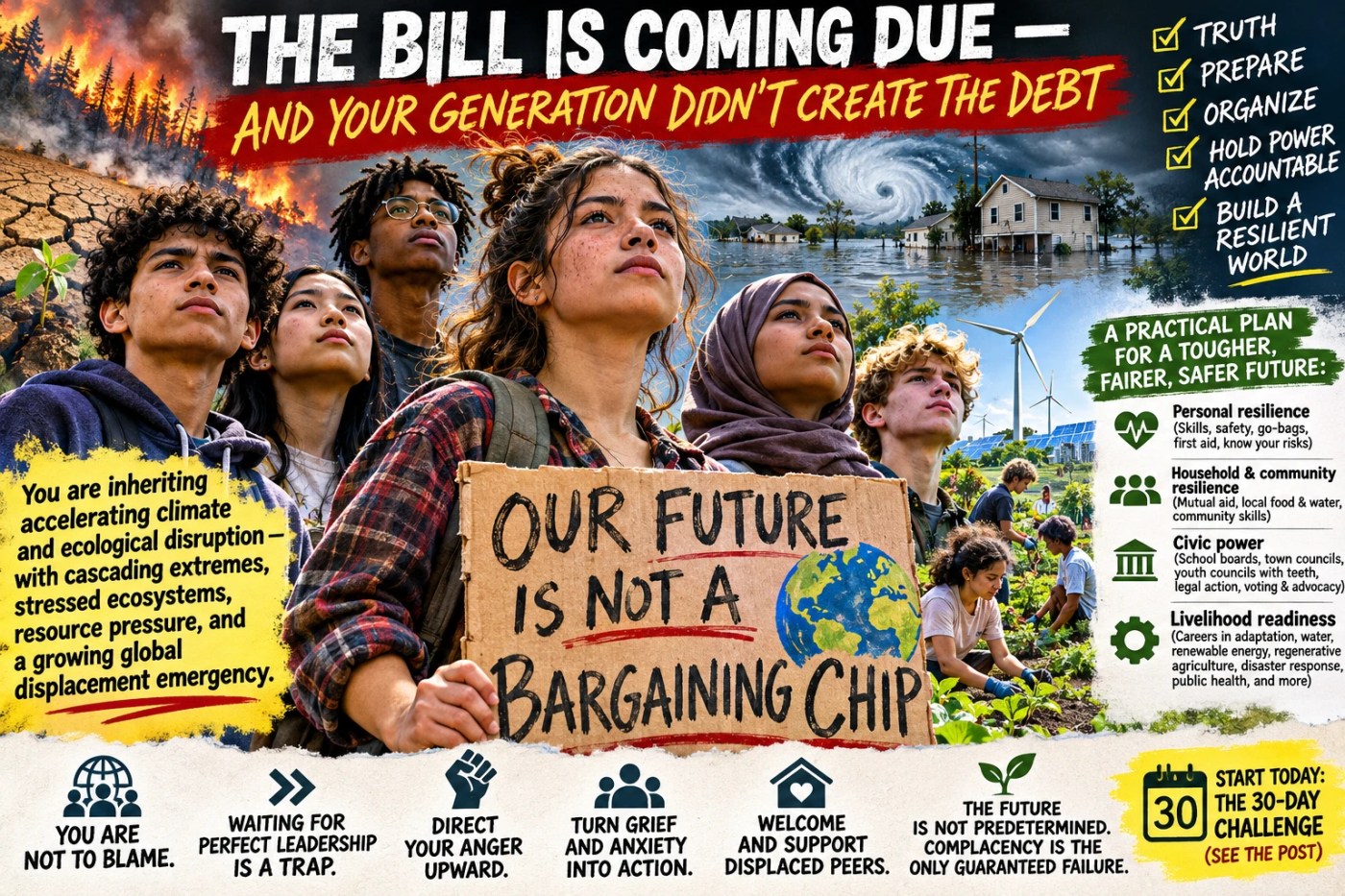
A field guide for young people inheriting the Climate and Ecological Emergency, and an open letter to the adults who handed it to them.
You were born into a fever.
If you are fifteen right now, you were born around 2010. Every year from 2015 through 2025, eleven years in a row, ranks among the eleven hottest ever measured. The three hottest years on record are the three you just lived through: 2023, 2024 and 2025, averaging about 1.48°C above pre-industrial temperatures, according to the World Meteorological Organization. You have never known a “normal” climate. Neither have your younger brothers and sisters. The adults around you remember one. You only hear stories about it.
So let’s begin with the truth, because you deserve the truth more than you deserve comfort. And then let’s get to work, because you deserve tools more than you deserve sympathy.
The Reality, Without the Sugar Coating
You are inheriting accelerating climate and ecological disruption. Not one disaster but a chain of them. Heat dries the soil. Dry soil feeds wildfire. Wildfire smoke drifts a thousand miles and closes schools in cities that never saw a flame. Warmer air holds more water, so when the rain finally comes it comes as a flood. One region drowns its crops while another watches its fields crack open. Coral reefs bleach. Pollinators thin out. Fish move toward the poles. Glaciers that feed the rivers of billions of people retreat a little more each summer. Water, food and energy systems that were built for the old climate are being asked to survive the new one.
And people are moving, because they have no choice. In 2025, weather-related disasters forced people from their homes nearly 30 million times, about 13 percent above the ten-year average, according to the Internal Displacement Monitoring Centre (IDMC). Across the decade from 2015 to 2024, disasters triggered 264.8 million forced movements in 210 countries and territories. Right now, more than 82 million people are displaced inside their own countries, the highest number ever recorded, pushed out by conflict and disaster together. Climate stress makes both worse: it ruins harvests, empties wells, and turns old tensions into open fights.
Some of those displaced people are your age. Some of them may sit next to you in class this year. Some of you reading this are those people.
Hear this clearly: this is not your fault.
You did not build the coal plants. You did not write the tax breaks for oil and gas. You did not hire the lobbyists, fund the doubt campaigns, or vote down the climate bills. You were not in the room. Most of you were not alive when the warnings went out. The first assessment from the Intergovernmental Panel on Climate Change (IPCC) was published in 1990. Scientists working for oil companies modeled the warming we are now living through with striking accuracy back in the late 1970s and early 1980s. The knowledge existed before many of your parents finished school. The choice to ignore it was made by grown-ups with power.
And hear this just as clearly: waiting is a trap.
Waiting for the perfect president. Waiting for the perfect treaty. Waiting for a billionaire with a rocket to fix it, or a miracle machine to suck the carbon out of the sky so nobody has to change anything. Waiting is exactly what the people who profit from delay want you to do. They are counting on your despair, because despairing people do not organize. Discouraged people do not show up at meetings. Exhausted people do not vote.
Your fear is legitimate. Your anger is legitimate. Your waiting is not an option.
An Open Letter to the People in Power: The Young Are in the Room
Now I want to turn away from young readers for a while and speak to someone else.
Mayors. Governors. Members of Congress and parliaments. Chief executives. Board chairs of universities, pension funds, utilities and banks. Superintendents. Anyone who signs budgets.
Picture a hearing room. The front rows are not filled with lobbyists this time. They are filled with fifteen-year-olds, sixteen-year-olds, nineteen-year-olds. Some carry notebooks. Some carry younger siblings. Some carry photographs of homes that are no longer standing. They are not here to be thanked for their passion or patted on the head for being “the leaders of tomorrow.” They are here today. They have questions. You owe them answers, on the record.
“Why was this delayed?” You were told in 1990. You were told again in 1995, in 2001, in 2007, in 2014, and in 2021 through 2023, each IPCC assessment more certain and more urgent than the one before. Every delay was a decision. Every “not this session” was a decision. Every “the economy isn’t ready” was a decision to make the economy, and the planet, less ready for the children in this room. So tell them plainly: what exactly were you waiting for?
“Why are you still paying for the cause?” In 2024, governments around the world spent about $725 billion on direct fossil fuel subsidies, according to the International Monetary Fund. When the IMF also counts the pollution and climate damage that fuel prices leave unpaid, the implicit subsidies reach $6.7 trillion, about 5.8 percent of the entire world economy. Meanwhile young people are told there is no money for school counselors, no money for cooling in classrooms, no money for flood barriers, no money for buses that run on time. There is money. You decided where it goes. Explain the choice.
“Why do you fight us in court?” When sixteen young people in Montana sued their state, the state fought them all the way to its Supreme Court, and lost. In December 2024 that court affirmed their constitutional right to a clean and healthful environment. When young people brought cases in federal courts, government lawyers argued that the children could not trace their injuries to the policies being challenged. In 2026, federal appeals courts dismissed Genesis B. v. EPA and Lighthiser v. Trump on exactly those grounds, even after a lower court in the Lighthiser case found that climate change presents a children’s health emergency. Sit with that. Public money was spent to argue that the public’s own children should not be heard. In July 2025, the International Court of Justice issued an advisory opinion that nations have legal obligations to protect the climate system. The world’s highest court has spoken. What will you do with its words?
“Who is your plan actually for?” When adaptation money arrives, whose streets get the drainage first? Whose neighborhoods get the trees, the cooling centers, the buyouts at fair prices? Too often, the answer is the wealthiest zip codes, while low-income, Black, Brown, Indigenous and immigrant communities wait at the back of the line and breathe the worst air. The young people in this room can read a map. They see who gets protected.
“What will you commit to before the next generation runs for your seat?” Because they will. The fifteen-year-olds in this room will be voting in three years. They will be running for school boards in five, for city councils in ten, and for your seat in fifteen. They will remember who stood with them and who stalled. So don’t offer them a vision statement. Offer them commitments with dates:
- A public timetable for ending fossil fuel subsidies within your authority, with each year’s reduction written down.
- Adaptation funding directed first to the most exposed neighborhoods, schools and households.
- Youth councils with real votes and real budgets, not ceremonial seats for photographs.
- A published climate risk assessment for every school building you are responsible for: heat, flood, smoke, and the plan for each.
- Preparedness and climate education in every school, taught as a life skill, not a footnote.
Silence is an answer. Delay is an answer. “We’re studying it” is an answer. The young people in the front rows are writing your answers down.
The Preparedness Framework: Four Tiers of Readiness
Now, back to you.
Here is something the people who failed you rarely say out loud: anger without skills burns out, and skills without anger get comfortable. You need both. The framework below is organized in four tiers. Each one builds on the one before it. You do not need to master them all this month. You need to start.
Tier 1: Personal Resilience — Your Body, Your Knowledge, Your Bag
Preparedness begins with the person reading this sentence. Not because you are on your own, but because a prepared person can help others instead of needing rescue.
Know your local risks. Every place has its own threats. Are you in a flood zone? A city heat island with few trees? A wildfire smoke corridor? A hurricane coast? Look up your address on FEMA’s flood maps and find your county’s hazard mitigation plan; it is public. Then ask yourself one honest question: if the power went out for three days in August, what would happen in my home?
Get physically ready. This is not about how you look. It is about whether you can walk several miles with a pack, carry water, climb stairs in a building with no elevator, and swim if you have to. A body that can move is an evacuation tool.
Learn first aid. Take a course in first aid and CPR through the Red Cross or a local hospital. Look for a Stop the Bleed class. Ask whether your area runs a Teen CERT (Community Emergency Response Team) program. A fifteen-year-old who knows CPR is not a child in an emergency. They are a responder.
Know heat safety cold. Heat is the quietest killer among weather hazards. Learn the difference between heat exhaustion (heavy sweating, dizziness, nausea, cool clammy skin) and heat stroke (confusion, hot skin, fainting, sometimes no sweating at all). Heat stroke is a medical emergency: call 911, move the person somewhere cool, and cool them with water and fanning while you wait. Know where your local cooling centers are. Check on older neighbors when the heat climbs, because they are often the first to be harmed.
Respect water. Turn around, don’t drown. About six inches of moving water can knock you off your feet, and about a foot can float a car. Never walk, bike or drive through floodwater, no matter how many people on social media make it look fun.
Become evacuation-literate. Know at least two routes out of your neighborhood. Know where the shelters are. Sign up for your local emergency alerts and make sure your phone’s emergency notifications are switched on. Know your school’s emergency plan, and if nobody can tell you what it is, that is your first civic assignment.
Pack a go-bag. Use a backpack you can actually carry. Inside:
- Water and shelf-stable food for at least three days
- Any medications, plus a written list of prescriptions and doses
- A phone charger and a charged power bank
- A flashlight, spare batteries and a whistle
- N95 masks for smoke and dust
- A change of clothes, sturdy shoes and rain gear
- Copies of important documents in a waterproof bag
- Some cash in small bills
- A paper list of important phone numbers
- Something that comforts you: a photo, a book, a small instrument
Make a family communication plan. I started training as an IT tech in 1995, and the first lesson that stuck was redundancy: never trust a single point of failure. Phones die. Networks jam. So your plan needs backups. Choose an out-of-area contact everyone checks in with. Pick a meeting place near home and one outside your neighborhood. Decide who picks up younger siblings, who grabs the pets, and who checks on grandparents. Write it all down on paper and put a copy in every go-bag.
Tier 2: Household and Community Resilience — Nobody Survives Alone
Here is a truth that disaster research keeps confirming: in the first hours after a disaster, the people who save lives are usually not helicopters. They are neighbors. The block that knows itself survives better than the block that doesn’t.
Build mutual aid. Mutual aid is solidarity, not charity. It means neighbors trading help as equals: rides, meals, childcare, tools, phone charging during an outage. It can start with a group chat for your building or street. It grows when people keep showing up for one another before the emergency, so they already trust each other during it.
Map vulnerable neighbors, with consent and care. Some people face extra danger in a crisis: elders living alone, people who rely on oxygen or dialysis, people with disabilities, families without cars, neighbors who don’t speak the language of the emergency alerts. A neighborhood check-in list, built with their permission and kept private, means no one is forgotten when the power fails. This is not surveillance. It is a promise.
Strengthen local food and water. Join or start a community garden. Find your local food pantry and your nearest seed library. Learn where your water actually comes from and what your utility does when it is contaminated. Where it is allowed, help set up rain barrels for gardens. A neighborhood that can feed a little of itself is harder to break.
Trade skills across generations. Your grandparents, or the elders on your block, may know how to cook from scratch, preserve food, mend clothes, fix an engine, read the sky, or stretch a small budget through a hard month. You may know how to set up a group chat, use translation apps, find verified information fast, and run a sign-up sheet. Trade. Neither generation can do this alone.
At Climate Change Community we call this work Adaptive Resiliency: combining AI, collaboration, cooperation and dialogue so that communities can absorb shocks, recover, and come back stronger. It is not a slogan. It is a set of habits, practiced together, before they are needed.
Tier 3: Civic Power — Where the Decisions Actually Get Made
Personal and community readiness keep people alive. Civic power changes the conditions that put them in danger. Most of the decisions that will shape your climate future are not made at global summits. They are made in rooms with folding chairs and bad lighting, where almost nobody your age ever shows up. That is exactly why you should.
Go to school board meetings. Most allow public comment, usually two or three minutes per speaker. Ask what happens on extreme heat days. Ask whether classrooms have cooling. Ask what the emergency plan is for floods or smoke. Ask about solar panels on the roof and climate education in the curriculum. Board members rarely hear from students. When they do, they remember.
Show up at town and city councils. Councils decide zoning, tree canopy, bus routes, stormwater systems, and where new housing gets built: on high ground or in the floodplain. These are climate decisions, even when nobody calls them that.
Demand youth councils with teeth. A youth council that only advises is a photo opportunity. Push for voting seats, a real budget, and a guaranteed response from elected officials to every recommendation, on the record, within a set number of days.
Use the law. The Montana ruling proved that young people can win. Even the federal cases that were dismissed built a public record of harm: courts heard evidence, and in Lighthiser a judge found that climate change presents a children’s health emergency. Groups like Our Children’s Trust bring these cases, and you don’t have to be a plaintiff to help. You can document local harms, testify, write about the cases, and build public support.
Act before and after you can vote. In many U.S. states you can pre-register to vote at 16 or 17. A few cities, including Takoma Park, Maryland, let 16- and 17-year-olds vote in local elections, and Vote16 campaigns are pushing for more. Before you can vote yourself, you can register others, knock on doors, make calls, testify, write letters, and in many states serve as a paid poll worker at 16 or 17. Your voice is not on hold until your eighteenth birthday.
Run organized campaigns. Universities, employers and cities respond to organized pressure. Divestment, cleaner campuses, climate-ready workplaces: all of it has been won by campaigns. Every good campaign has the same bones:
- A clear, specific demand (“Install cooling in every classroom by next summer,” not “do better”)
- A named decision-maker who can say yes
- A deadline
- A coalition: students, parents, teachers, faith groups, local businesses
- An escalation plan if the first answer is no
- Public, peaceful pressure that keeps growing
One person is a complaint. A hundred people with a deadline are a campaign. Stay safe while you do it: know your rights, organize in groups, and keep trusted adults informed.
Tier 4: Livelihood Readiness — A Career That Builds the World
The people who caused this emergency also built careers out of it. You can build a career out of fixing it. The resilient world will need millions of hands, and the work is real, skilled and meaningful.
- Climate adaptation and resilience planning: designing cities, coastlines and infrastructure to withstand what’s coming.
- Water management: utilities, stormwater systems, watershed restoration, water quality testing and drought planning.
- Regenerative agriculture and food systems: rebuilding soil, growing food that feeds communities and heals land at the same time.
- Renewable energy systems: electricians, solar installers, wind turbine technicians, battery and grid specialists. Wind and solar technician jobs have repeatedly ranked among the fastest-growing occupations in U.S. labor projections, and many paths begin with paid apprenticeships, not student debt.
- Disaster response and emergency management: the people who plan, coordinate and lead when the worst arrives.
- Public health: heat illness, air quality, disease that shifts with the climate, and mental health care for communities in crisis.
- Community and urban planning: where homes, transit, parks and trees go, and who benefits.
Those are not the only doors. Law, journalism, teaching, ecology, data science, AI, nursing, architecture, insurance and the arts all need climate-literate people. Think “climate plus”: whatever you love, there is a climate version of it.
How to position yourself now:
- Take free FEMA Independent Study courses online, starting with IS-100 (Introduction to the Incident Command System). They are free, self-paced, and look serious on any application.
- Volunteer with disaster relief, food pantries, tree-planting crews or watershed groups. Experience counts.
- Learn a second language. In a displacement emergency, translators are lifesavers.
- Look seriously at skilled trades, community college programs and apprenticeships, not only four-year degrees.
- Keep a simple record of every skill you learn and every course you finish.
- Find a mentor. People in these fields are usually glad to talk with a curious young person. Ask.
About That Feeling in Your Chest: Eco-Anxiety, Grief and Rage
Let’s talk about the heaviness. The way a headline about a heat record can ruin your whole afternoon. The 2 a.m. thoughts. The anger at adults who shrug.
You are not alone in it. In a 2021 survey of 10,000 young people in ten countries, published in The Lancet Planetary Health, 59 percent said they were very or extremely worried about climate change, and more than 45 percent said those feelings affected their daily lives. Many said they felt betrayed by their governments.
Here is what I want you to hear: grief and anger are sane responses to a real emergency. They are not disorders. You grieve because you love something: a forest, a coastline, a season, a future. You rage because something unjust is happening and you can see it. A young person who felt nothing about any of this would be the worrying one.
Feelings like these need somewhere to go. Many psychologists who study climate distress point to the same thing: acting with other people helps. Collective action turns helplessness into agency, isolation into belonging, and fear into purpose. You stop being someone that things happen to and become someone who does things. That shift is protective. It is also, not by accident, exactly what the emergency requires.
A few habits that help:
- Name the feeling out loud, to a friend, a parent, a teacher, a journal.
- Find your people. A climate club, a mutual aid group, an online community of peers who get it.
- Set limits on doomscrolling. Being informed does not require being flooded.
- Spend time outside. Notice the living world you are fighting for.
- Protect your sleep, eat real meals, and move your body.
Know when to get more support. If worry is keeping you from sleeping, eating or going to school for weeks at a time, if you are having panic attacks, or if you feel hopeless or have thoughts of hurting yourself, please talk to a trusted adult, your school counselor, or a doctor right away. In the United States you can call or text 988 at any time to reach the Suicide and Crisis Lifeline. Asking for help is not weakness. It is preparedness, applied to your own mind.
To Our Displaced Peers, and to Those Who Welcome Them
If you have been forced from your home
You did not lose your home because you did something wrong. Floods, fires, storms, drought and the conflicts they inflame are not your failures. And look at what you carry: your languages, your memories, your family’s recipes and songs, the survival skills you have already had to learn. Those are assets, not baggage. You have already done the hardest preparedness work there is. You belong in your new school and your new neighborhood, fully.
Know some of your rights. In the United States, the Supreme Court ruled in Plyler v. Doe (1982) that public schools must educate children regardless of immigration status. The federal McKinney-Vento Act protects students who lose stable housing, including after disasters: schools must enroll you right away, even if your records were lost. If anyone tells you otherwise, ask for your school district’s McKinney-Vento liaison by name.
If displaced classmates are arriving at your school
Practical solidarity looks like this:
- Sit with them at lunch. Invite them into your clubs, teams and group chats.
- Learn a few words in their language. A greeting can open a door.
- Do not ask them to retell what they survived. If they want to share, they will.
- Help them find their way through the school: schedules, cafeteria, counselors, the bus.
- If you organize a supply drive, let families choose what they need. Dignity first.
- Push your school to send information home in the languages families actually speak.
Communities absorb displaced families well when they treat integration as a two-way street: newcomers are given housing, schooling, work and language access, and the community is open to learning from them in return. Inclusion across languages and cultures is not optional. It is non-negotiable, for a simple reason: in a warming world, every one of us is one storm, one fire, one failed harvest away from being the newcomer.
The Future Is Not Written Yet
Here is what the people who profit from despair do not want you to know: the future is not predetermined. Every tenth of a degree of warming that is avoided means fewer deaths, fewer homes lost, more species still alive. There is no point at which effort stops mattering. Complacency is the only guaranteed failure.
And you are not starting from zero. Your organizing is preparation. Your skills are preparation. Your refusal to accept broken promises is preparation. A generation that knows first aid, knows its neighbors, knows its rights, knows its local risks and knows how to pack a room at a council meeting is a generation that cannot be ignored and cannot be easily broken.
At Climate Change Community we call this path the Green Way Forward: a future measured by the well-being of our children and the health of the living world around them. You are not only the reason for that path. You are the people building it.
The 30-Day Starter Challenge
Start today. Not after the holidays. Not when you feel ready. Today. Do it with a friend if you can, and check off each day.
Week 1 — Know (Days 1–7)
Day 1 Look up your home’s local hazards: flood, heat, smoke, storms.
Day 2 Sign up for your local emergency alerts and switch on emergency notifications on your phone.
Day 3 Learn the signs of heat stroke and teach them to one person.
Day 4 Map two evacuation routes out of your neighborhood.
Day 5 Write ten important phone numbers on paper.
Day 6 Start a go-bag with what you already have at home.
Day 7 Hold a ten-minute family meeting and agree on a meeting place and an out-of-area contact.
Week 2 — Connect (Days 8–14)
Day 8 Introduce yourself to a neighbor you have never spoken with.
Day 9 Ask an elder to teach you one practical skill.
Day 10 Teach an elder one digital skill in return.
Day 11 Find your nearest community garden, food pantry or mutual aid group.
Day 12 Sign up for a first aid or CPR class, or begin FEMA’s free IS-100 course online.
Day 13 Recruit three friends to take this challenge with you.
Day 14 Start a group chat for your crew and give it a name worth living up to.
Week 3 — Speak (Days 15–21)
Day 15 Find the date of your next school board or city council meeting.
Day 16 Read one meeting agenda from start to finish.
Day 17 Write a two-minute public comment about one climate issue in your community.
Day 18 Pre-register to vote if you are eligible, or help someone else register.
Day 19 Write to one elected official and ask the three questions: Why was this delayed? Why are you still paying for the cause? What will you commit to before my generation runs for your seat?
Day 20 Attend a meeting in person or watch one online.
Day 21 Deliver or submit your public comment.
Week 4 — Build (Days 22–30)
Day 22 Research one resilience career that interests you.
Day 23 Reach out to one person working in that field and ask one question.
Day 24 Welcome a new student or a new family in your community.
Day 25 Rest. Go outside. No news today.
Day 26 Check in with yourself honestly, and talk to someone about how you’re feeling.
Day 27 Finish your go-bag.
Day 28 Plan one small group action with your crew.
Day 29 Do it.
Day 30 Write down what you learned, then recruit one more person to start Day 1.
They handed you the bill. Hand them back the agenda.
This is not your fault. This is your fight. Be furious. Be ready. Be together.
Read posts at climatechangecommunity.com
Climate Tribe Social Founders Library: https://climatechangecommunity.com/library/
Artificial intelligence is used to enhance my creativity and thinking in preparing this post. The ideas, experiences and commitments are my own.
Mr. Alvarez, Content Curator | Climate Change Community LLC
Protecting our Children & Biodiversity’s future towards a more sustainable and habitable Earth!
Compiled & Mr. Alvarez’s Thoughts | AI Enhanced.


Leave a Reply