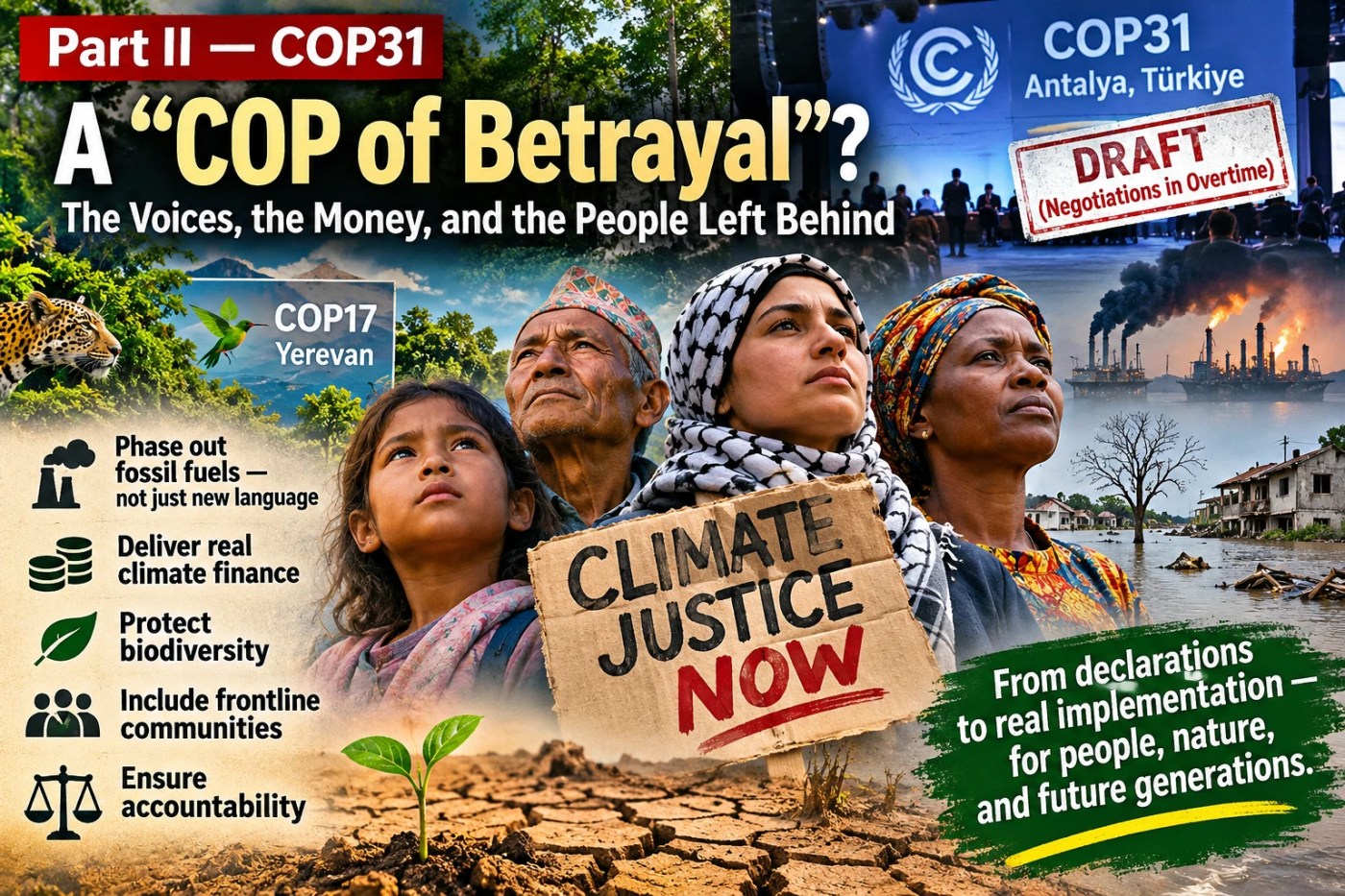
Friday, November 20, 2026 — afternoon update to this morning’s post comparing COP17 and COP31
Why a Part II, and Why Today
This morning I wrote that COP17, the biodiversity summit in Yerevan, Armenia, ended with adopted decisions we can now hold governments to, while COP31 in Antalya, Türkiye, was still being fought over in real time. A few hours later, the fight became much clearer. Negotiators missed the Friday deadline, the talks slipped into overtime, and Democracy Now! closed out its coverage from Antalya with one of the most honest hours of summit reporting I have seen in years.
I want to do two things in this post. First, amplify that reporting, and especially the way Amy Goodman ran the conversation, because the questions she asked are the same questions our community should be asking. Second, update what we know about COP17, because new details from Yerevan show that the two summits share the same weak spots: money, fossil fuel and extractive interests, and the quiet removal of language that protects people.
Where this morning’s post needs correcting or sharpening, I say so below. Accuracy is a form of climate action, and that includes being accurate about our own work.
Amy Goodman’s Take: Asking the Questions Everyone Else Skips
Democracy Now! broadcast its final show from Antalya on the last scheduled day of COP31. What stood out to me was not only who Amy Goodman put on the air but how she interviewed them. Again and again, she stopped her guests to translate summit jargon into plain language, and to ask the question a frustrated viewer at home would ask.
- She refused to let jargon pass. When Harjeet Singh mentioned “adaptation finance,” Goodman cut in to point out that almost no one outside these halls knows what the term means, and asked him to explain it. When “electrification” came up, she flagged it as the watchword of this COP and noted that the word “renewable” seemed to be disappearing from it.
- She asked the hard “why.” Goodman put the skeptic’s question directly: why should wealthy countries pay for disasters in places like Nepal? That gave her guests room to make the case for responsibility in plain terms instead of assuming the audience already agreed.
- She connected climate to war. She raised the U.S. Senate’s war-powers vote that same morning and the billions being spent on the war with Iran, noting that the war has shown the world just how dependent we remain on fossil fuels.
- She named the paradox. She asked how this could be the largest COP ever and also, by her guests’ account, its greatest failure. CNN has described COP31 as believed to be the highest-attended COP yet, so the paradox is real.
- She looked ahead. She closed by asking what the point of these summits is as the world heads to Ethiopia for COP32, and then handed the last word to an 8-year-old Kenyan climate champion, Marren Akeyo, rather than to an official.
That is a model of public-interest journalism I hope our community will practice in its own conversations: slow down, define the words, ask who pays, and keep the people most affected at the center.
The Voices from Antalya
Panama Draws a Line
Just before the broadcast, Panama’s Environment Minister Juan Carlos Navarro held a press conference flanked by representatives of Finland, Vanuatu, Belgium, Côte d’Ivoire, France, Guatemala and others. He said negotiators were being held hostage by what he called the “petroleum mafia,” and he laid out six priorities he said could still save the COP. The three he described on air were: science as the foundation of every decision; a clear, orderly transition away from fossil fuels; and climate finance from those most responsible, summed up as “you pollute, you pay.”
Panama also sent a letter to the COP31 presidency saying it would formally object to any decision that failed its criteria, including a cap on oil production. COP decisions are made by consensus, so one country’s formal objection can matter a great deal. Reuters reported that the fossil fuel language was stripped out following objections from Saudi Arabia and other major oil and gas producers.
Climate Action Network: “Shame”
Earlier in the day, Climate Action Network (CAN), a coalition of more than 2,500 civil society groups, held what Goodman called the most packed press conference she had seen at the summit. The room repeatedly broke into chants of “shame.”
- Tasneem Essop of CAN International, from South Africa, said nothing on the table protects people or addresses Global South priorities, and pointed to record numbers of lobbyists from the fossil fuel, AI, carbon capture and carbon removal industries. She noted that adaptation pledges brought to this COP totaled around $50 million, which CAN’s newsletter compared to half the cost of a single F-35 fighter jet.
- Avantika Goswami of the Centre for Science and Environment in India argued that the European Union has stepped into the blocking role the United States left behind.
- Anabella Rosemberg of CAN International said the COP is not dying but being killed, because it is the last space where civil society and developing countries can hold rich nations accountable.
- Mohamed Adow of Power Shift Africa called it the worst COP ever, warning that vulnerable countries are being pushed into more debt to protect themselves from a crisis they did little to cause.
Harjeet Singh: Implementation Became Distraction
Harjeet Singh, strategic adviser to the Fossil Fuel Treaty Initiative and founding director of the Satat Sampada Climate Foundation, summed up the mood in a single line:
“This COP was being touted as a COP of implementation, but what it has become is a COP of betrayal and a COP of distraction.”
His point was that negotiators spent days on electrification without saying whether that electricity will be clean or accessible, while phase-out language for fossil fuels was dropped from the earlier draft. He explained adaptation in everyday terms: retrofitting homes, building dikes, and making farms resilient so families stay food-secure. Without money for those things, he argued, disasters become catastrophes. He confirmed that civil society groups have already rejected the current text, and he called on developing countries to reject it too unless rich countries put real money on the table.
Meena Raman: No Means, No Ambition
Meena Raman, head of programs at Third World Network and president of Friends of the Earth Malaysia, described the text as relatively empty. She was struck by a comment from EU Climate Commissioner Wopke Hoekstra, made before the summit, that finance was “dead in the water,” a phrase she found painful coming so soon after the Nepal disaster. Her core argument is one every community organizer understands: you cannot ask poorer countries to raise ambition on emissions, fossil fuels or electrification while refusing them the means to do it. She also noted backsliding elsewhere, including the U.K. cutting its Green Climate Fund pledge and what she called the worst Global Environment Facility replenishment ever. Keep that last point in mind; it comes back in the COP17 section below.
Nafkote Dabi: The Money Exists
Nafkote Dabi, climate policy lead at Oxfam International, who is from Ethiopia, host of next year’s COP32 in Addis Ababa, made the case that the “no money at home” argument does not hold up. Rich countries, she said, could tax extreme wealth, the excess profits of fossil fuel companies, and private jets. She offered rough figures: around $45 billion a year from private jets alone and around $400 billion from excess fossil fuel profits. She also pointed out that military emissions are estimated at about 5 percent of the global total and rarely get discussed at these talks.
Goodman also cited Oxfam’s finding that the richest 0.1 percent, about 8 million people, are responsible for more emissions than the poorest 3.5 billion. Dabi said she felt truly desperate for the first time, as the world faces a record El Niño and a coming year expected to be the hottest on record. She ended with a challenge to the Ethiopian presidency: COP32 must deliver justice for frontline communities.
Nepal: A Report Card on Thirty Years of Inaction
The most powerful moment of the broadcast, for me, was Harjeet Singh describing Nepal as a report card on climate inaction. Because this example will be shared widely, I checked the numbers.
On August 26, 2026, a huge section of rock and glacier broke away from Langtang Lirung mountain near the Nepal–China border, sending a torrent of water, ice and debris down the river valleys. By late September, Nepal’s disaster authority had recovered 1,451 bodies and listed more than 5,700 people as missing, with further deaths and missing on the Chinese side. So Goodman’s figure of about 7,000 dead or missing is a fair combined estimate.
Singh’s dollar figures also hold up. Nepal’s disaster authority estimated losses of about $2.56 billion, and the foreign ministry put the reconstruction bill at about $4.78 billion, which rounds to the $5 billion he cited. Meanwhile, pledges from other countries amounted to only a few million dollars. Scientists with World Weather Attribution found that climate change was a core contributing factor.
One small correction for accuracy: Singh called it a glacial lake outburst flood. The scientists and agencies describe it more precisely as a glacier-and-rock collapse that briefly dammed a river before bursting downstream. The lesson is the same either way: warming is destabilizing mountains, and the communities below were not prepared or supported.
Justice for Palestine Must Include Climate Justice
Democracy Now! also published a web exclusive with Abeer Al-Butmeh, coordinator of PENGON–Friends of the Earth Palestine, interviewed by Goodman and Anjali Kamat. I include it here because it speaks directly to the Humanity and Displacement Emergencies, and because it shows that climate vulnerability is shaped by who controls land, water and movement.
Al-Butmeh argued that the climate crisis in Palestine is not simply a natural phenomenon but a justice and human rights issue tied to sovereignty over land and water. She said more than 85 percent of Palestinian water resources are under Israeli control, and she described what is happening in Gaza as ecocide: damaged wastewater treatment and desalination plants, sewage reaching farmland and groundwater, debris mixed with hazardous materials, only a small share of farmland still accessible, and a fishing sector she described as almost entirely destroyed. Speaking from the West Bank during olive harvest season, she described farmers unable to reach their groves and settlers harvesting their trees.
Her question for COP31 was pointed: how can governments find money to support this war but not to support Palestinian farmers? Those are her claims and framing, and readers should weigh them alongside other sources. I believe her central point deserves a hearing in any honest conversation about loss and damage: environmental destruction in conflict is a climate justice issue, and military emissions and spending belong in that conversation.
She also grew up in Battir, a village known for its ancient farming terraces, and studied water and environmental engineering. Her closing message was about solidarity: when people under attack feel the world supports them, it helps them keep going.
Corrections and New Details Since This Morning
Here is what has changed, or what I can now state more precisely, since this morning’s post:
| Item | What we know now |
| Timing | COP31 missed its Friday deadline and is in overtime. Negotiations lead Chris Bowen of Australia said he would consult every group through the night. |
| Who blocked fossil fuel language | Reuters reports the references were stripped after objections from Saudi Arabia and other major oil and gas producers. |
| What the first draft said | Monday’s draft called for “the immediate transition away from fossil fuels in energy systems.” By Thursday, all mention of fossil fuels was gone. |
| Adaptation finance | The $120 billion figure was dropped. Countries had already agreed at COP30 to triple adaptation finance to that level by 2035, so its removal is a step backward. |
| Human rights | Observers say references to human rights and environmental defenders, introduced by Brazil’s presidency, are being walked back in the cover text. |
| Carbon capture | The slimmed-down draft promotes carbon capture and storage while omitting fossil fuels. |
| “1.7” and El Niño | Dabi’s figure matches Carbon Brief’s projection that 2027 could reach around 1.7°C above pre-industrial levels, driven by a record El Niño. |
| Transcript typo | Democracy Now!’s closing credit reads “Fossil Food Treaty Initiative.” The correct name is the Fossil Fuel Treaty Initiative. |
COP17 Update: The Same Patterns, Six Weeks Earlier
This morning’s post covered the Yerevan Pathway, the new Indigenous knowledge body, the Sevan Voluntary Guidelines, and nearly $2 billion in announced nature funding. Digging further into the final decisions, I found details that line up almost exactly with what we are watching in Antalya.
1. A Missed Money Promise
Developed countries failed to meet their commitment under the Kunming-Montreal framework to provide at least $20 billion a year for nature by 2025. The broader goal of $200 billion a year from all sources by 2030 still stands, but the first milestone was missed. Carbon Brief also cited a 27 percent decline in environmental funding for 2026–2030. That is the same backsliding Meena Raman described on Democracy Now!
2. Harmful Subsidies, Softened
The paragraph on harmful subsidies, the money that still pays for nature destruction, was softened so that it only “encourages” progress, in line with national circumstances. Saudi Arabia and Russia opposed it. A few weeks later, Saudi Arabia is again reported among the countries pushing fossil fuels out of the COP31 text.
3. People-Protecting Language, Removed
In the marine biodiversity talks, bracketed references to Indigenous peoples, women and youth were removed after Russian objections, leaving one unbracketed reference. References to the International Court of Justice’s climate advisory opinion were also dropped from the climate-and-biodiversity text. Compare that with the reported rollback of human rights and environmental defender language in Antalya.
4. A Fund for Corporations That Corporations Ignore
The Cali Fund was created at COP16 so that companies profiting from genetic data drawn from nature, called digital sequence information, would pay into a fund that sends half its money to Indigenous peoples and local communities. By the end of COP17, total pledges were about $10,565, with less than $9,000 deposited, and no large company from the industries that rely on that data had contributed. One legal scholar described the fund as on life support.
5. The Fight over Who Pays
For the first time, COP17 invited large emerging economies such as China and the Gulf states to signal interest in taking on donor responsibilities, though any change to the donor list requires their consent. A decision on whether to create a new biodiversity fund was pushed to COP18 in Ecuador. Lim Li Ching of Third World Network, the same organization as Meena Raman, called the push to expand the donor base “sheer hypocrisy” while existing donors are missing their own commitments.
Side by Side
| Pattern | COP17 Yerevan (biodiversity) | COP31 Antalya (climate) |
| Missed or dropped finance | $20bn/yr by 2025 target missed | $120bn adaptation figure dropped from draft |
| Root cause softened | Harmful subsidies only “encouraged” | All fossil fuel references removed |
| Who objected | Saudi Arabia and Russia (subsidies) | Saudi Arabia and other producers (fossil fuels) |
| Rights language | Indigenous, women and youth references cut | Human rights and defender language walked back |
| Corporate role | Cali Fund almost empty | Record lobbyist presence; carbon capture promoted |
| Pushed to next COP | New nature fund decision to COP18 (Ecuador) | Adaptation roadmap toward COP32 (Ethiopia) |
In fairness to Yerevan, the COP17 President described the outcome as exceeding expectations, and around 50 decisions were adopted. Steven Guilbeault, who helped broker the 2022 framework, called the package an important step forward that still falls short of 2030 commitments. Both things can be true. What matters is what follows.
What This Means for Our Community
- Translate the jargon, the way Amy Goodman did. When you share summit news, explain what adaptation finance, cover decisions and loss and damage mean for real families.
- Watch the final COP31 text this weekend. Check three things: whether fossil fuels are named, whether the $120 billion adaptation figure returns, and whether human rights language survives.
- Follow the money at home. Ask your representatives what your country spends on fossil fuel subsidies and the military compared with international climate and nature finance.
- Learn the donor debate. Both summits are arguing over who should pay. Understanding historical responsibility is part of climate literacy.
- Keep frontline voices central. Read and share reporting that puts people from Nepal, Ethiopia, Kenya, Palestine and small island nations at the center.
Mr. Alvarez’s Thoughts: Read the Pattern, Not Just the Headline
This morning I asked us to judge summits by their follow-through. This afternoon I would add: judge them by their patterns. Two summits, two cities and six weeks apart, show the same moves. Money promised and not delivered. The causes of the crisis, whether harmful subsidies or fossil fuels, softened or erased. Language protecting Indigenous peoples, women, youth and human rights defenders quietly cut. And often the same handful of countries blocking progress, while the hard decisions get passed to the next meeting.
I also want to be careful not to give in to despair. The countries standing with Panama, the activists chanting “shame” in a packed room, the Oxfam researcher naming where the money is, the Palestinian engineer demanding accountability, and an 8-year-old from Kenya speaking to her elders are all refusing to accept empty words. That refusal is a form of Adaptive Resiliency. It is cooperation across borders, generations and old dividing lines.
The Green Way Forward measures every decision by one standard: does it protect the well-being of our children and the health of biodiversity? By that standard, neither summit has yet earned our applause. Both have shown us exactly where to apply pressure. I will follow up once the final COP31 text is confirmed.
Credit and Thanks
Special thanks to Amy Goodman, Anjali Kamat and the Democracy Now! team for independent, viewer-supported reporting from Antalya. Their original content is licensed under Creative Commons (Attribution-NonCommercial-NoDerivatives 3.0 US). Please watch or read the full segments at democracynow.org.
Read posts at climatechangecommunity.com
A note on AI: I use artificial intelligence to enhance my creativity and thinking, to help research, verify, and organize these posts. The perspective, values, and final decisions are my own.
Protecting our Children & Biodiversity’s future towards a more sustainable and habitable Earth!
Compiled & Mr. Alvarez’s Thoughts | AI Enhanced.
Sources
- Democracy Now!: “A COP of Betrayal” (Nov 20, 2026)
- Democracy Now!: Climate Activists Condemn “Slimmed-Down” COP31 Draft Text
- Reuters via SCMP: COP31 climate talks go into overtime
- CNN: How two words could derail the world’s biggest climate conference
- RTÉ: COP31 draft climate deal removes all references to fossil fuels
- Carbon Brief: COP17 key outcomes agreed in Yerevan
- IISD: COP17 deal as harmful incentives take centre stage
- Climate Home News: COP17 delivers fragile deal
- Al Jazeera: Climate change had major role in Nepal floods
- Malay Mail/AFP: One month after Nepal’s deadly floods
- Khaleej Times/Reuters: Nepal flood losses estimated at $2.56 billion
- Carbon Brief: El Niño raises chance of record-warm years


Leave a Reply