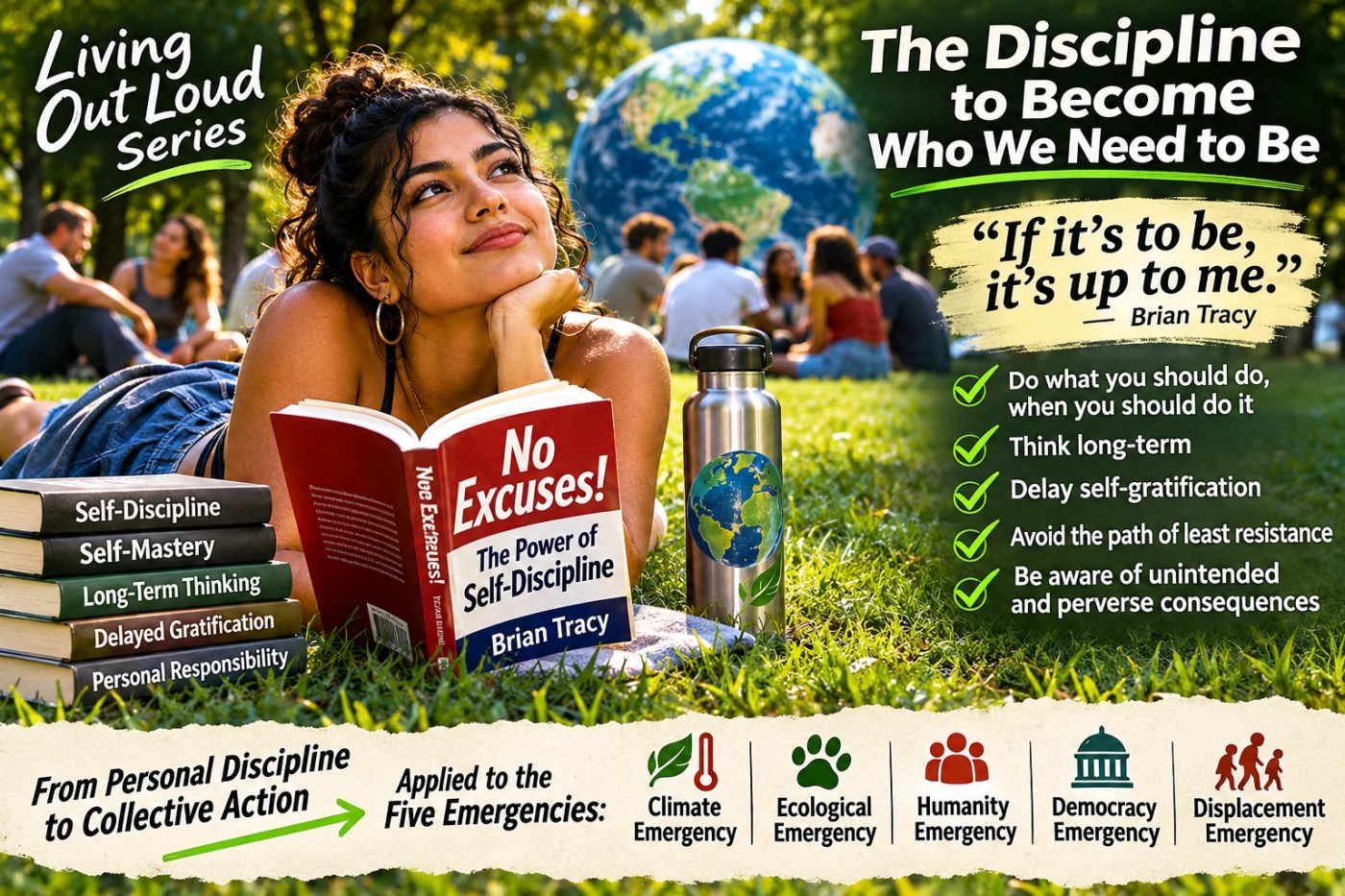
Living Out Loud Series | Personal Reflections
Some books entertain you. Some inform you. A few hold up a mirror. Brian Tracy’s No Excuses! The Power of Self-Discipline has been a mirror for me these past few days. I picked it up expecting a standard success book, the kind written for salespeople and executives. What I found instead was a set of ideas that line up almost exactly with what I believe the Five Emergencies are asking of every one of us.
I’m writing these reflections down because that is what Living Out Loud is for: learning in public, imperfectly, and inviting others to learn alongside me. My notes were scattered when I started. This post is my attempt to gather them into something useful.
A Line I Can’t Shake
“If it’s to be, it’s up to me!”
Tracy uses this line as a reminder to stop waiting and start moving. Eight one-syllable words. You could teach them to a child in a minute, and an adult could spend a lifetime trying to live up to them.
My own climate awareness took hold in February 2007, around the release of the IPCC’s Fourth Assessment Report, and I have spent well over a decade studying the Climate and Ecological Emergency since. One thing that study has taught me is how easy it is to know a great deal and still wait for someone else to act first. Knowledge can become a comfortable place to hide. This little phrase pulls me out of hiding. It doesn’t let me point at the government, the corporations or the people who disagree with me. It asks a simpler and harder question: what am I going to do today?
I don’t read it as a call to go it alone. I read it as the starting line of community. Every cooperative effort I have ever admired began with a handful of people who each decided the work was theirs to carry, and then found each other.
The Quality of the Person You Must Become
Tracy makes a point I keep returning to: success depends on the quality of the person you must become to achieve it. Not the title, not the money, not the recognition, but the character you build along the way.
That reframed my work for me. When I think about Climate Change Community and everything connected to it, the real question is not only “What should we build?” It is “Who do I need to become so that what we build is worthy of the people it serves and strong enough to outlast me?” I intend, in a few years, to hand stewardship of this work to the next generation and to the members themselves. That is a long-term commitment, and long-term commitments are only as reliable as the discipline of the people making them.
Lessons From the Server Room and the Courthouse
Reading Tracy, I kept thinking back to two chapters of my own life.
I started training as an IT technician in 1995, and if that field taught me one lesson above all, it was redundancy. You build the backup before you need it. You test the restore before the drive fails. Nobody feels like doing that on a quiet afternoon when everything is working. That is precisely why it is a discipline and not a mood. Redundancy is long-term thinking turned into a habit, and it is exactly the mindset our communities need for heat, floods, outages and displacement.
Then there were nearly fourteen years in the court system as a Tech Support Specialist, working in constant dialogue with judges, court officers, and law and bench clerks. It remains one of the most rewarding and memorable periods of my life. A courthouse runs on discipline. Calendars are kept, deadlines are met and procedures are followed, whether anyone feels like it or not, because people’s lives depend on it. I learned there that consequences are real, that shortcuts get noticed, and that the steady, unglamorous work of showing up is what keeps an institution trustworthy. Our democracy, one of the Five Emergencies, depends on that same quiet discipline at every level.
Kop Kopmeyer and the Principle Above All Others
Tracy tells the story of meeting Kop Kopmeyer, a success authority who had collected one thousand success principles and published them in four books of 250 principles each. Tracy asked him which of the thousand mattered most. The answer was self-discipline: doing what you should do “when you should do it, whether you feel like it or not.”
In the spirit of learning out loud, I’ll note that Tracy has elsewhere credited that same definition to the writer Elbert Hubbard. Wisdom like this gets handed down and re-spoken so often that the original voice can be hard to trace. I’m less concerned with the footnote than with the challenge. One principle out of a thousand, and it is the one most of us practice least.
The Two Enemies I Have to Watch For
Tracy identifies two enemies that grow wherever self-discipline is missing. The first is excuses. Without discipline, we become very creative at explaining why today is not the right day. The second is the path of least resistance, the steady pull toward whatever is easiest in the moment.
I see both in myself. There are nights when the easy path is to scroll the headlines instead of writing the post, or to tell myself the next step can wait until a better week. I also see both enemies at the scale of nations. Delaying action on emissions, on biodiversity loss and on protecting displaced people is, at its core, an excuse dressed up as policy and a path of least resistance dressed up as pragmatism.
Long-Term Thinking, Short-Term Action
Self-discipline, as Tracy frames it, is closely tied to self-mastery, self-control and, yes, self-denial. All of them rest on delayed gratification. The practical rule I took from my notes is to think long-term and act short-term: keep the far horizon in view, then take the next concrete step today. Sometimes the order reverses. In a crisis you act first and plan afterward. But the people who navigate life best tend to be long-term thinkers, and they are usually better at sacrifice because they understand what the sacrifice is for.
The encouraging part is that long-term thinking is a developed skill, not a birthright. It is the quality of a superior thinker, and it improves with practice.
Our institutions badly need that practice. In 2015, Mark Carney, then Governor of the Bank of England, described climate change as the “tragedy of the horizon.” The damage falls on future generations, while those making decisions today have little direct incentive to act. Most business and political thinking, he observed, runs on cycles of a few years to a decade, while climate risk plays out over far longer spans. In my notebook I wrote it more simply: short-term gain can cause long-term pain.
Two Laws I Am Trying to Respect
Unintended Consequences
The first law Tracy highlights is the law of unintended consequences: the side effects of an action can be far worse than the effects we intended. The sociologist Robert K. Merton gave the idea its modern shape in a 1936 paper on the unanticipated consequences of purposeful action.
Anyone who has worked in IT has lived this. A quick patch fixes one problem and quietly breaks three others. A rushed change goes in on Friday afternoon, and the help desk spends Monday cleaning up. The climate system is endlessly more complex than any network I ever supported, and our industrial civilization made the biggest unintended-consequence mistake in history when it powered itself on fossil fuels without counting the long-term cost.
Perverse Consequences
The second law is the law of perverse consequences: a short-term action aimed at immediate gratification produces the opposite of what it was meant to achieve. The well-known “cobra effect” makes the point. In colonial-era Delhi, a bounty on dead cobras led people to breed cobras for the reward. When the program was cancelled, the breeders set their snakes loose, and the city had more cobras than when it began.
I see the same pattern in a heat wave, when the fastest comfort is more air conditioning powered by fossil fuels, which in turn feeds the warming that brings the next, hotter summer. I see it when one property’s seawall pushes the storm surge onto a neighbor’s land. These are not reasons for paralysis. They are reasons to ask, before acting, what happens next, and after that, and to whom.
My Commitments Going Forward
Learning out loud only matters if it changes how I live. So here is what I am committing to, and I’m writing it down so you can hold me to it:
- Practice “If it’s to be, it’s up to me” daily, especially on the days I’d rather wait for someone else.
- Treat redundancy as a life discipline, not just a tech habit: backups for my sites, my plans and my community’s readiness.
- Run every new idea for our platforms through the two laws before I launch it, asking honestly whether it could backfire.
- Make at least one deliberately long-term decision each week and name it.
- Keep studying, even when the news cycle moves on, because climate competence is built in the quiet hours.
An Invitation
If these ideas speak to you, I’d love to continue the conversation inside Climate Tribe Social’s Book Club Lab, where the Living Out Loud series is gathered and where we are exploring influential thinkers past and present. Bring your own excuses, your own long-term goals and your own examples of quick fixes that went wrong. We learn faster together.
The Green Way Forward
For me, the Green Way Forward has always meant the well-being of our children and the health of biodiversity. Neither will be protected by good intentions alone. Both depend on people willing to do the right thing, at the right time, whether they feel like it or not.
If it’s to be, it’s up to me. I’m choosing to become that person, one disciplined day at a time.
Protecting our Children & Biodiversity’s future towards a more sustainable and habitable Earth!
Compiled & Mr. Alvarez’s Thoughts | AI Enhanced.
A note on how this post was made: artificial intelligence was used to enhance my creativity and thinking while researching and shaping these reflections. The ideas, the convictions and the final choices are my own.
Read posts at climatechangecommunity.com


Leave a Reply