LEARNING OUT LOUD
Today’s Reflection
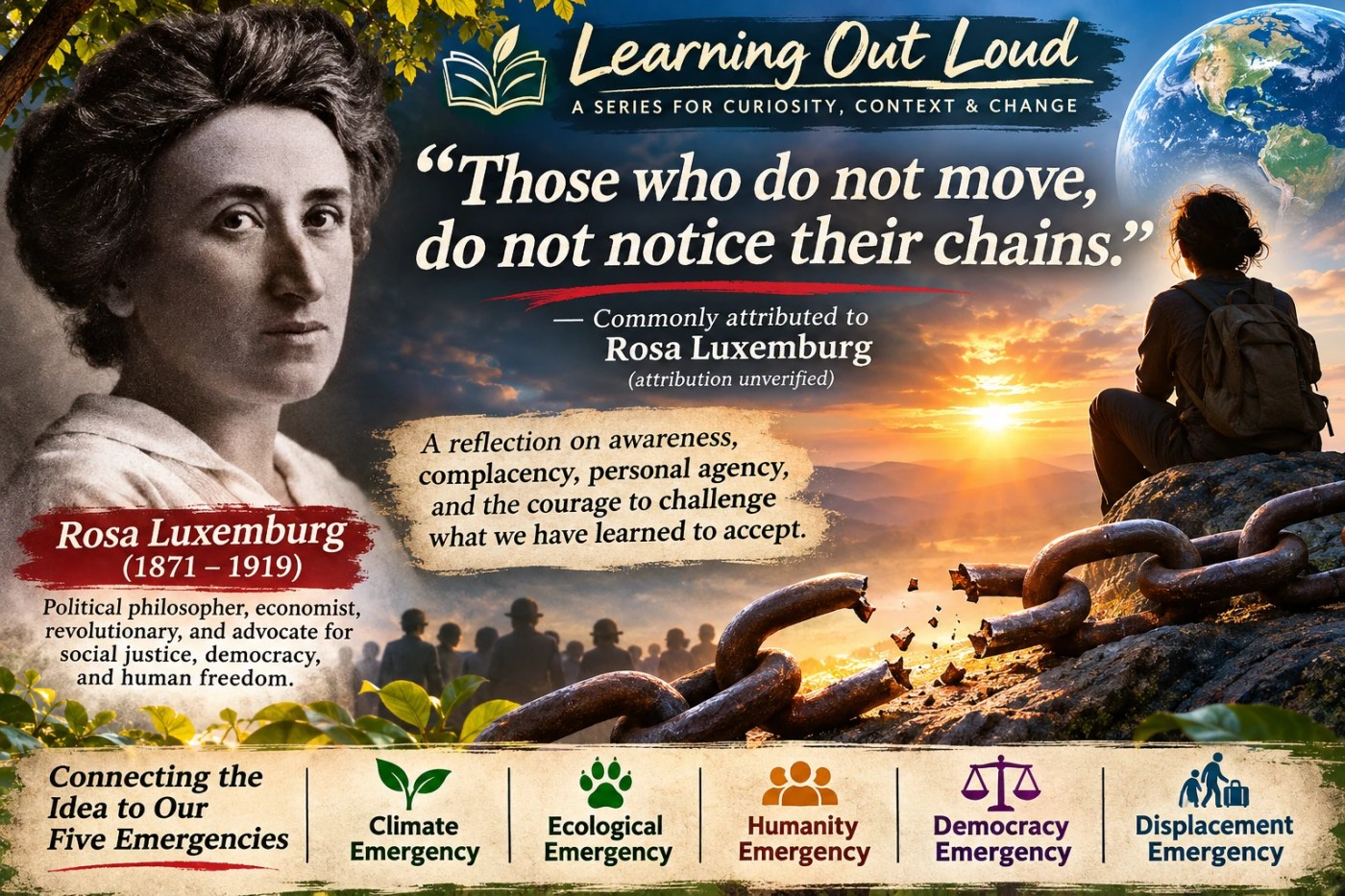
“Those who do not move, do not notice their chains.”
— Widely attributed to Rosa Luxemburg (original source unverified)
Read that sentence slowly. It does not say that people who stay still are free. It does not say they are foolish, either. It says something more unsettling: a chain can hang loose for years, and the person wearing it may never know it is there. The chain only announces itself at the moment you try to go somewhere.
That is the idea I want us to learn out loud about today. Not the chains themselves, but the strange fact that we discover them by moving.
Who Was Rosa Luxemburg?
Rosa Luxemburg (1871–1919) was born in Zamość, in the part of Poland then ruled by the Russian Empire, the youngest child of a Jewish family of modest means. A childhood illness left her with a lifelong limp. She was politically active as a teenager, and by eighteen she had to leave the country to avoid arrest.
She went to Zurich, one of the few places in Europe where a woman could enroll at a university, and in 1897 she earned a doctorate, a rare achievement for a woman of her time. She then moved to Germany, where she became one of the sharpest writers and speakers in the socialist movement. Her major works include The Mass Strike (1906) and The Accumulation of Capital (1913).
Luxemburg opposed the First World War when most of her own party supported it, and she spent much of the war in prison for saying so. Released in November 1918, she went straight back to organizing and writing. On January 15, 1919, she was captured and murdered in Berlin by right-wing paramilitary soldiers.
Two things about her are worth holding onto. First, she criticized her own side. While she supported revolution, she warned that a movement which silences disagreement destroys the very thing it claims to be building. Second, she never stopped paying attention to the living world. Her prison letters are full of birds, plants, and insects, and in one of them she grieves over what she had been reading about the disappearance of songbirds from Germany as forests and farmland were reorganized for profit. More than a century ago, behind bars, she was noticing a chain most people around her could not yet feel.
Did She Actually Say It?
We owe our readers honesty here. Nobody has been able to find this sentence in Luxemburg’s books, articles, speeches, or letters. Quotation researchers who went looking for it came back empty-handed. A German version, roughly “whoever does not move does not feel their shackles,” circulated in Germany and was popularly credited to her, and the English wording spread widely through quotation books and the internet in the 2000s.
There is one piece of this history I find remarkable. In January 1988, East Germany held its official yearly march honoring Luxemburg and her comrade Karl Liebknecht. A group of dissidents showed up with homemade banners carrying words credited to her, including this line about chains and her authentic statement that freedom is always the freedom of those who think differently. The government that claimed Luxemburg as its hero detained people for carrying her words.
So whether or not she wrote the sentence, people have used it exactly as it asks to be used: they moved, and the chain showed itself. We present it today as an idea commonly associated with her, not as a verified quotation. An idea can be worth studying while we stay truthful about where it came from.
What the Sentence Is Really Telling Us
Think of a dog on a long lead in a small yard. As long as the dog stays near the porch, the lead lies slack in the grass. The dog is not free. It simply has not tested the distance. The day it runs for the gate is the day it learns the exact length of its world.
Many of the limits in our own lives work the same way. They stay quiet as long as we stay inside them.
- You do not find out how little protection you have at work until the day you ask for a raise, report a safety problem, or mention the word “union.”
- You do not find out how much your town depends on cars until the car breaks down and you try to reach a job, a clinic, or a grocery store without one.
- You do not find out how thin your health coverage is until you get sick and try to use it.
- You do not find out who really holds power in your community until you stand up at a public meeting and ask where the money went.
- You do not find out how much of your attention belongs to a screen until you try to put the phone down for a single day.
In every one of these, nothing changed on the day the chain was felt. The limit was there all along. What changed is that someone moved.
This matters because it tells us that discomfort is not always a sign that something has gone wrong. Sometimes the tug we feel is information. It is the first accurate measurement we have ever taken of our own situation.
Why Staying Still Feels So Reasonable
If moving is how we learn the truth, why do so many of us stay put? I believe there are honest reasons, and they deserve respect.
Stillness is comfortable
A slack chain weighs almost nothing. People adapt to nearly anything if it arrives slowly: higher rents, hotter summers, longer hours, fewer services. Each small change becomes the new normal before the next one arrives.
Stillness is rewarded
From childhood, many of us are praised for not making trouble. “Keep your head down.” “Be grateful for what you have.” “That’s just the way it is.” These sayings are passed along with love, often by people who paid a price for moving. But they also teach us to stop testing the distance.
Stillness is sometimes survival
A parent working two jobs, a person caring for a sick relative, a family one missed paycheck away from eviction: these are not people who failed to notice anything. They may feel the chain every hour and still have no room to pull against it. This sentence must never be turned into an accusation against them. If anything, the question it raises for the rest of us is how to make room so that more people are able to move.
Movement Comes in Many Sizes
When we hear the word “movement,” we may picture marches and crowds. Those matter. But most movement starts far smaller, and almost all of it is available to people with little money and less spare time.
- Ask one question. “Why is it done this way?” and “Who decided that?” have loosened more chains than any slogan.
- Read one thing outside your usual lane. A library card is one of the most powerful tools ever handed to working people.
- Attend one meeting. A school board, a tenants’ group, a town council, a community garden. Go once and listen.
- Tell one true story. Say out loud what your rent is, what your commute costs, what the flood did to your street. Silence keeps people thinking their trouble is private when it is shared.
- Join one other person. Luxemburg’s deepest belief was that people learn their own strength by acting together, not by waiting to be taught it.
One caution belongs here, and Luxemburg herself would insist on it. Movement by itself is not virtue. People can be stirred into motion by lies, by fear, or by someone who wants followers instead of thinkers. The point is not just to move, but to keep our eyes open while we do: checking facts, welcoming disagreement, and refusing to trade old chains for new ones with better paint.
Testing the Chains of the Five Emergencies
Our work at SDL5 is organized around five connected emergencies. Each one has stayed quiet for too long because too few of us have pulled against it.
1. The Climate Emergency
Most of us live inside an energy system we did not choose. We feel that chain only when we try to step out of it: when we look for a bus that does not run, price out a heat pump we cannot afford, or ask our utility where the power comes from. Trying, even when we fail, shows us exactly which policies and prices are holding the old system in place.
2. The Ecological (Green) Emergency
Luxemburg mourned vanishing songbirds from a prison cell. Today we can test our own distance from the living world with a simple exercise: try to name ten wild plants, birds, or insects that live on your block. The difficulty many of us have is the chain. We cannot protect what we have stopped being able to see.
3. The Democracy Emergency
Rights that are never used grow weak without anyone noticing. A person who has never requested a public record, spoken at a hearing, or questioned an official may believe those doors are open. Walk up and try the handle. Sometimes it opens. Sometimes it does not, and then we have learned something we urgently needed to know.
4. The Humanity Emergency
Poverty, hunger, and discrimination become background noise when we stay within our routines. Volunteer one afternoon at a food pantry or sit with a neighbor fighting an eviction, and the distance between “those people” and “us” collapses. What felt like someone else’s problem turns out to be a chain with many of us on it.
5. The Climate Refugee Emergency
People forced from their homes by storms, drought, rising seas, and failing harvests are being moved against their will, and they meet every chain at once: borders, paperwork, suspicion, and the absence of any legal status built for their situation. Those of us who are not displaced can choose to move toward them, by learning their stories and asking what our own communities would do if the water came for us.
These five are not separate. Pull on one and you feel the others tighten. That is why we call for a Green Way Forward: a path measured by two things above all, the well-being of our children, who are our future, and the well-being of biodiversity, which is our health.
Learning Is a Way of Moving
There is a reason this series lives inside a community devoted to self-directed learning. Nobody assigns us this work. Nobody grades it. Each of us decides to pick up a book, follow a question, or sit with an uncomfortable fact, and that decision is itself a step.
Every time we learn how something actually works, such as how a bill becomes law, how a watershed feeds a city, or how a supply chain reaches our kitchen table, we walk a little farther from the porch. Sometimes we discover the yard is bigger than we were told. Sometimes we feel the tug. Either way we know more than we did, and knowing is where every real change has started.
Final Reflection
I keep returning to how gentle this sentence actually is. It does not scold. It simply describes how discovery works. We find our limits by reaching for them, and we find each other the same way.
So if you have felt a tug lately, at work, in your budget, in your town, or in your own habits, consider that it may not be a sign you did something wrong. It may be a sign you finally moved.
The chain is quiet until we take a step. The step teaches us where it is. Learning teaches us what it is made of. And together, with patience and honesty, we can decide what to do about it.
Questions for Our Community
- Can you remember a time when you tried something new and suddenly discovered a limit you had never noticed before? What did it teach you?
- Which everyday limits in your community stay quiet because people have stopped testing them?
- How can we tell the difference between movement that frees people and movement that only leads them into new chains?
- What could we do, as neighbors, to make it safer for people with the least room to move to take a first step?
- What is one small step you could take this week toward one of the Five Emergencies?
Our invitation: You do not need a polished answer. Share a question, a memory, or a doubt. Someone else in this community has been waiting to hear that they are not the only one who felt the tug.
Read posts at climatechangecommunity.com
Protecting our Children & Biodiversity’s future towards a more sustainable and habitable Earth!
Compiled & Mr. Alvarez’s Thoughts | AI Enhanced.
Learning Out Loud | Book Club Lab | Climate Tribe Social & SDL5.org
A note on how this was made: artificial intelligence is used to enhance Mr. Alvarez’s creativity and thinking in the preparation of these posts.
Editorial note: This quotation is widely attributed to Rosa Luxemburg, but no original source in her writings has been established. The biographical details and the account of the January 1988 East Berlin demonstration are drawn from the documented historical record.
(Pulled from SDL5)


Leave a Reply