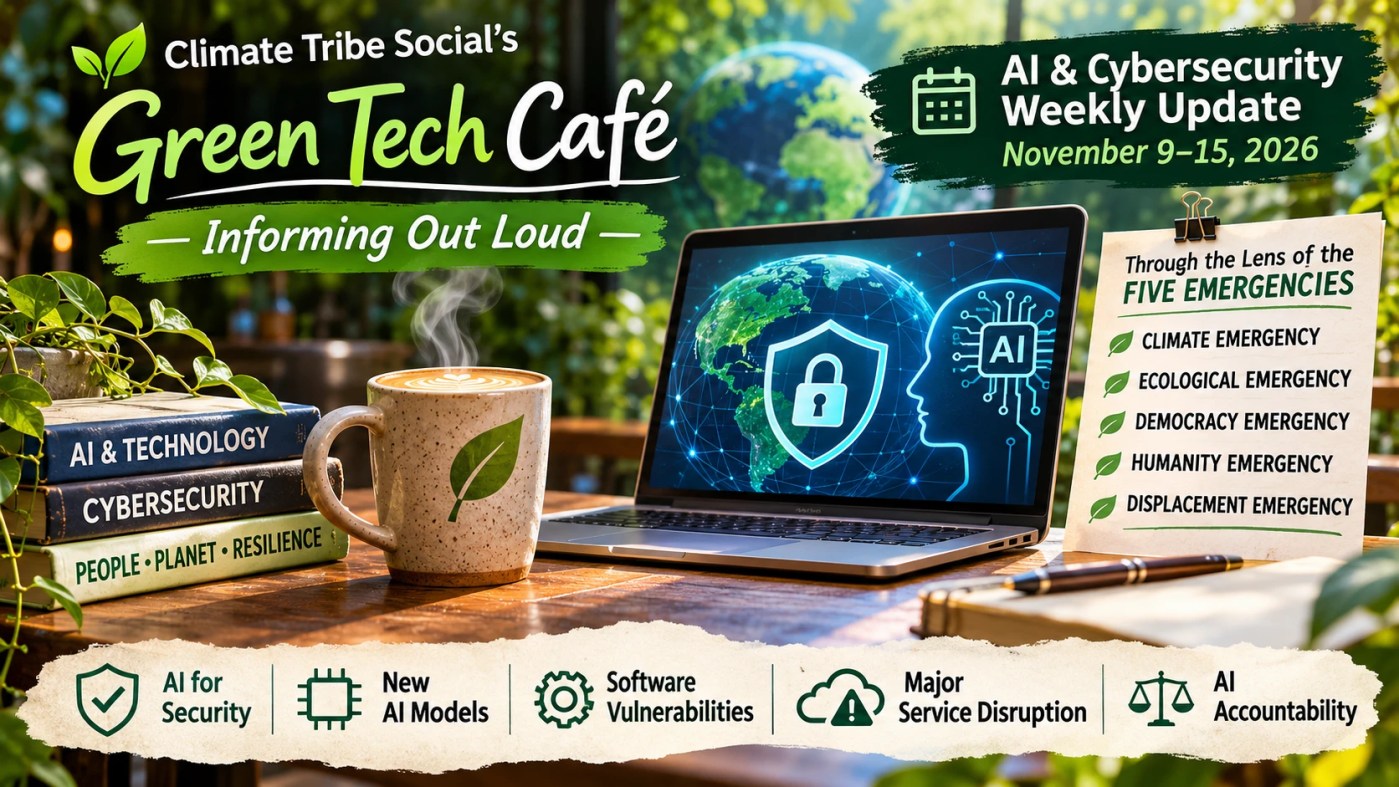
AI & Cybersecurity Weekly Update | November 9–15, 2026
More Capable Technology, Greater Responsibility — and Reasons for Both Caution and Hope
Good morning, and welcome to Green Tech Café, a place to pause, look beyond the technology headlines, and consider what these developments mean for our lives, our communities, and our shared future.
On one side, Google DeepMind announced an encouraging research achievement: using AI agents and mathematical verification to examine the security of the code underlying the Signal messaging protocol. Google also released two new AI models built to do more of the work themselves.
On another side, a wave of publicly released software vulnerabilities, a global Microsoft outage, and a lawsuit seeking to freeze the development of new AI models reminded us that technological progress comes with responsibilities, and that those responsibilities cannot be handed off to the technology itself.
Meanwhile, COP31 is underway in Antalya, Türkiye, bringing electrification, fossil fuels, methane reduction, and the health of our global climate monitoring systems into the international conversation.
There is a common thread connecting these stories.
Technology is becoming more capable. Our responsibility to understand, govern, and use it wisely must grow alongside it.
Our objective this week is not to make technology sound miraculous or terrifying. It is to examine what happened, explain why it matters, and consider what we can learn together.
Introducing Our New Name Format
Going forward, these weekly technology updates will carry a consistent name: Green Tech Café — Informing Out Loud, followed by the focus and the week covered. This week, that reads: AI & Cybersecurity Weekly Update | November 9–15, 2026.
Each part of the name has a job.
- Green Tech Café is the place: an informal table where technology is discussed through the lens of the living world it affects.
- Informing Out Loud is the practice: sharing what I find, showing the sources, and correcting uncertainty in public rather than hiding it. It is a companion to my Learning Out Loud series. Learning Out Loud is about growing wisdom and compassion; Informing Out Loud is about growing understanding of the forces shaping our world.
- The focus and dates tell you exactly what period and subject each update covers, so that anyone returning to the archive later can find what they need and judge how current it is.
1. AI Helping Strengthen Digital Security: AlphaProof Code and Signal
One of this week’s most encouraging announcements came from Google DeepMind.
On November 10, researchers introduced AlphaProof Code, an AI-agent framework that helped formally verify important security properties of the code underlying Signal’s cryptographic protocol. DeepMind describes it as the first time the implementation of a widely deployed protocol like this has been formally verified by any method, with or without AI.
Signal is widely recognized for its privacy-focused messaging technology. Its protocol also protects communications in other applications, including Google Messages, which means this work touches the private conversations of a very large number of people.
What makes this different?
Ordinary software testing can show that bugs exist; it cannot show that they are absent.
Formal verification goes further. It attempts to establish mathematically that software satisfies carefully defined requirements under specified assumptions.
Google DeepMind combined human expertise, a team of AI agents built on its Gemini Carbon model, and Lean, a mathematical proof-checking system. In DeepMind’s framing, the AI agents act as an untrusted team of provers, and Lean acts as a trusted gatekeeper that checks every proof they produce.
According to reports on the project, a team of about five researchers generated approximately 6.5 million lines of machine-checked proof code, and the verification took approximately four weeks. Human experts spot-checked roughly 1% of the work.
What was actually verified
Precision matters here, so it is worth being specific. The proofs focused on libsignal, the core library behind Signal’s protocol, and in particular on its post-quantum handshake (known as PQXDH) and its Triple Ratchet, the mechanism that keeps refreshing the encryption keys during a conversation.
Importantly, the researchers verified the actual compiled machine code that runs on devices, rather than only a simplified model of the design. That is the depth that makes this result notable.
The researchers also tested whether the framework could tell secure code from flawed code by deliberately reintroducing two real, previously fixed vulnerabilities into an isolated version of the software. According to DeepMind, the system identified both as insecure. The analysis found no new vulnerabilities in the portions it examined, and DeepMind is open-sourcing its verification materials so others can check the work.
Why this matters
The important distinction is that the AI-generated proofs were independently checked by Lean.
The system did not simply announce that the software was secure and ask everyone to trust its answer. Human experts defined and reviewed the specifications, while the proof-checking system provided a mechanism for validating the resulting work. Signal’s Chief Technology Officer, Ehren Kret, welcomed the result as giving Signal greater confidence in its privacy guarantees.
What it does not mean
This does not mean every component of Signal, every phone, every server, or every possible attack is now immune to compromise. Reporting by WIRED noted that the entire Signal app was not verified, and that the team benefited from earlier verification work the Signal Foundation had already done, so the four-week figure does not describe a project started from scratch.
The results are, so far, reported by DeepMind itself. AlphaProof Code is a research system, not a product anyone can use yet, and an open question is whether this kind of verification can scale at a cost that ordinary software projects can afford.
Still, I find this particularly encouraging. We frequently hear about AI being used to discover weaknesses and develop attacks. Here we have an example of AI helping strengthen the foundations of digital security, with a human-defined standard and a machine-checkable trail of evidence.
That is the kind of technological progress worth paying attention to.
Sources:
Google DeepMind, Introducing AlphaProof Code: https://deepmind.google/blog/introducing-alphaproof-code/
Summary of WIRED reporting (Let’s Data Science): https://letsdatascience.com/news/google-deepminds-alphaproof-code-formally-verifies-key-signa-a2c50019
Tech Jacks Solutions, machine-code verification details: https://techjacksolutions.com/ai-brief/alphaproof-code-signal-protocol-machine-code-verification/
2. Google’s Gemini 4 Carbon and Hydrogen: More Capable, More Autonomous
Google expanded its newest family of AI models this week.
Gemini 4 Carbon was first released on October 28 to a small group of cybersecurity defenders through Google’s Fairwind Program. On November 10, Google made it broadly available to developers, enterprises, scientists, and subscribers. Carbon is designed for demanding reasoning, software engineering, scientific research, cybersecurity, and long-running agentic work.
Gemini 4 Hydrogen followed on November 12, rolling out globally across Google Search, the Gemini app, and Google’s developer tools. Hydrogen emphasizes speed and efficiency for everyday coding and tasks carried out by AI agents. Free users of the Gemini app may receive Hydrogen automatically when Google decides it suits a request.
Google also introduced a way to pair the two: Carbon can coordinate a project while Hydrogen runs the “worker” and “verifier” agents that carry out and test individual pieces of it.
What is an AI agent?
An AI chatbot generally responds to questions or instructions. An AI agent can go further.
Depending on its permissions and configuration, it may use tools, examine documents, execute code, conduct research, and complete a sequence of actions toward a defined objective.
It also introduces additional security considerations. An agent with access to files, applications, credentials, or external services must be given appropriate permissions and monitored carefully.
Performance is not the same as safety
Google reports that Hydrogen completes tasks about two and a half times faster than its previous fast model, used 12% to 23% fewer tokens in early partner testing, oversteps its assigned task far less often, and is more than twice as resilient to indirect prompt injection on one benchmark.
Those are company-reported claims and should be considered alongside independent testing and real-world experience. Even Google acknowledges that sophisticated attacks, including prompt injection, remain challenging.
Prompt injection occurs when malicious instructions are embedded in material an AI system encounters, such as a webpage or document, in an attempt to redirect its behavior. As AI agents become more capable and more widely deployed, including inside a search engine used by billions, the consequences of poorly controlled permissions become increasingly important.
A climate question worth asking
There is another dimension to these developments.
More capable AI systems require computing infrastructure. That infrastructure consumes electricity, requires hardware, and can place demands on water and other resources.
A faster model, or a model using fewer tokens per task, does not automatically establish a smaller environmental footprint. If a model becomes cheaper and is placed in front of far more people by default, total use, and total energy demand, can still rise. Economists have a name for this pattern: the rebound effect.
We need broader evidence about energy consumption, hardware production, water use, and the environmental consequences of increased adoption. As a climate-focused community, these are questions we should continue asking, politely and persistently.
Sources:
Google, Gemini 4 Carbon is now available: https://blog.google/innovation-and-ai/models-and-research/gemini-models/gemini-4-carbon-now-available/
Google, Introducing Gemini 4 Hydrogen: https://blog.google/innovation-and-ai/models-and-research/gemini-models/introducing-gemini-4-hydrogen/
VentureBeat, Gemini 4 Hydrogen launch: https://venturebeat.com/technology/google-launches-gemini-4-hydrogen-a-faster-smarter-pricier-flash-successor
3. N-able N-central: A Reminder That Security Is Never Finished
Another significant cybersecurity development involved N-able’s N-central remote monitoring and management platform.
Remote management software is used by technology professionals, including the managed service providers that look after many small businesses, schools, and nonprofits, to administer computers and networks. Because these systems can have extensive access to customer environments, vulnerabilities can have consequences far beyond the individual software installation.
How it unfolded
- November 8 (late): An independent researcher, Sean Bales, publicly released proof-of-concept exploit code for 33 alleged previously unknown vulnerabilities in N-central, under the name “Able2Shell.”
- November 9: N-able took its hosted N-central environments offline as a precaution and advised on-premises customers to take their servers offline as well.
- November 10: N-able released N-central 2026.4 Hotfix 2 as a critical security update, addressing seven tracked vulnerabilities it described as the most critical. The hotfix temporarily disables the platform’s built-in remote control feature, and customers were told to update their Agents and Probes after upgrading.
- November 11: N-able reported that its hosted servers had been upgraded and instructed on-premises customers to upgrade promptly and keep servers inaccessible from the internet until the upgrade was complete.
- November 13: N-able published another remediation update describing its continuing response to the remaining issues.
During this period, a threat intelligence company reported seeing attackers probe N-central systems for the newly published flaws. The internet security nonprofit Shadowserver reported that the number of N-central servers it could see exposed online dropped from about 1,338 to roughly 148 within a day, a sign that many administrators acted quickly.
This is also not the first incident for this platform this year. In August, attackers actively exploited a different N-central vulnerability before it was fixed.
What should we understand?
The company’s response involved several stages. It reported addressing vulnerabilities exploitable by unauthenticated users while continuing work on remaining issues involving authenticated accounts, elevated privileges, or additional conditions.
N-able said it had not observed indications of compromise within its hosted servers, while noting that individual customer environments required their own assessment.
- Scanning is not proof of successful intrusion.
- A provider reporting no observed compromise in its hosted environment does not establish that every customer environment is unaffected.
- Releasing a hotfix does not necessarily mean the entire security response is complete.
There is also a broader debate here. N-able called the disclosure irresponsible; the researcher has said earlier reports were ignored. Reasonable people disagree about how and when flaws should be made public. What is not in dispute is that defenders were given very little time.
For administrators, the appropriate course is to follow N-able’s latest official advisory and deployment-specific instructions. For everyone else, the lesson is that the security of an organization depends not only on the computers it owns but also on the technology providers and services it relies upon. It is worth asking your IT provider, kindly and directly, which management tools they use and how quickly they apply security updates.
Sources:
N-able, Update on N-central 2026.4 HF2 and ongoing security response: https://www.n-able.com/blog/update-on-n-central-2026-4-hf2-and-ongoing-security-response
N-able, Vulnerability remediation update: https://www.n-able.com/de/blog/n-able-vulnerability-remediation-update
BleepingComputer, N-able releases security hotfixes: https://www.bleepingcomputer.com/news/security/n-able-releases-security-hotfixes-for-zero-day-vulnerabilities/amp/
Infosecurity Magazine, N-able rushes out fixes: https://www.infosecurity-magazine.com/news/n-able-n-central-able2shell-0day/
4. Microsoft’s Global Outage: An Outage Is Not Automatically a Cyberattack
Microsoft experienced a widespread service disruption beginning around midday on Thursday, November 12 (U.S. time), affecting Outlook and Exchange Online email, Teams, SharePoint, Copilot, Microsoft Defender, and other Microsoft 365 services.
The reach was swift. Within an hour of the first problems, the tracking site Downdetector was receiving outage reports from 74 countries and territories. Businesses, government offices, schools, and individual users lost email, calendars, and meetings, some for the better part of two days.
Recovery was not a straight line. Microsoft restarted servers and rerouted traffic, and at one point servers that had come back online became unresponsive again as traffic returned. The company reported that a process responsible for establishing secure connections had become overwhelmed. On Friday, Microsoft apologized, and on Saturday, November 14, it said services were fully restored. It attributed the problem to a technical issue during an upgrade that followed a recent network change, and said a full report would follow.
Importantly, the company said the outage was not caused by a cyberattack, and specifically ruled out AI agents as a cause.
We should preserve that distinction. A service outage can have serious consequences without being a cyberattack, and jumping to conclusions spreads fear without improving anyone’s preparedness.
Reliability belongs in cybersecurity planning
Since I began training as an IT tech in 1995, one lesson has stayed with me above almost all others: redundancy. Systems fail. The question is whether we have planned for it.
For individuals, businesses, and community organizations, this incident raises practical questions worth answering before the next disruption:
- Do we have access to essential contact information outside our email account?
- Can we communicate through another channel, such as a phone tree, a text group, or a second platform?
- Are important documents backed up somewhere that does not depend on the same provider?
- Do we know who needs to be contacted, and how, when normal operations are interrupted?
These are not complicated questions. They are the digital equivalent of knowing where the flashlight is before the power goes out. Cybersecurity is not only about preventing someone from entering our systems. It is also about protecting information, maintaining continuity, and recovering when something goes wrong.
Sources:
AP News: https://apnews.com/article/e2330e733db280805dbf7e3eb29ee0e1
CNBC, Microsoft apologizes for massive outage: https://www.cnbc.com/2026/11/12/microsoft-outage-outlook-aws-google.html
ABC7, Microsoft says services fully restored: https://abc7.com/post/microsoft-outage-update-company-says-365-services-fully-restored-outlook-teams-ai-assistant-copilot-impacted/20039967/
5. AI Accountability: A Lawsuit Raises Difficult Questions
On Thursday, November 12, a coalition of four nonprofit organizations, the Irreplaceable Education Fund, Public Citizen, Heat Initiative, and the Alliance for Secure AI, filed a lawsuit in San Francisco Superior Court against five major AI companies: Anthropic, Google, Meta, OpenAI, and SpaceXSI (formerly xAI). The legal team is led by former New Jersey Attorney General Matthew Platkin.
The plaintiffs are asking a judge to stop the companies from developing or deploying AI models more capable than those that exist today. They argue that the companies are violating California’s unfair competition law and creating a public nuisance by endangering public health, pointing to documented AI-assisted cyberattacks and to the companies’ own public statements acknowledging that advanced AI could pose catastrophic risks.
There is an important distinction we must maintain. The claims made in a lawsuit are allegations, not established findings of fact. The companies’ legal responses and any eventual court decisions will determine how the matter proceeds. Halting frontier development across five of the largest AI developers would be an extraordinary remedy, and the case may take a long time to resolve.
Two lawsuits, opposite arguments
Here is a detail that makes this moment especially instructive. In September, a separate lawsuit was filed in federal court on behalf of paid AI subscribers, arguing the opposite: that several of these same companies broke antitrust law by agreeing among themselves to slow AI development for safety reasons.
So within two months, courts have been asked to consider one case arguing that AI companies are moving too fast and another arguing that an agreement to slow down is itself illegal.
Whatever one thinks of either case, together they reveal something important. Our existing laws were not designed for these questions, and courtrooms are being asked to fill a gap that public policy has not yet addressed.
The larger conversation
Regardless of the outcome, the underlying questions deserve serious consideration:
- Who should evaluate increasingly capable AI systems before they are released?
- What safety testing should be required before deployment?
- How transparent should companies be about known limitations and risks?
- What protections should people have when AI systems cause harm?
- How do we encourage innovation without treating every possible consequence as an acceptable cost of progress?
These are not questions that can be answered by technology companies alone, nor by lawsuits alone. They deserve public discussion, independent research, responsible governance, and meaningful accountability.
Sources:
1News (AP), Advocacy groups sue AI giants to freeze new models: https://www.1news.co.nz/2026/11/15/advocacy-groups-sue-american-ai-giants-to-freeze-new-models/
Business & Human Rights Resource Centre, coalition lawsuit summary: https://www.business-humanrights.org/en/latest-news/usa-advocacy-groups-sue-ai-giants-to-halt-development-over-catastrophic-risks/
OPB (AP), September antitrust lawsuit over AI slowdown: https://www.opb.org/article/2026/09/20/lawsuit-says-anthropic-openai-spacexai-and-google-made-illegal-agreement-on-ai-slowdown/
6. COP31: Electrification, Fossil Fuels, and the Delivery Gap
While much of this week’s attention has been directed toward AI and cybersecurity, an equally important international event is taking place.
COP31, the United Nations Climate Change Conference, opened November 9 in Antalya, Türkiye, and continues through November 20. Under an unusual arrangement, Türkiye hosts and holds the presidency, while Australia presides over the formal negotiations. The U.S. federal government is absent, although UN climate chief Simon Stiell noted that American states, cities, and other non-federal actors remain engaged.
As of November 15, negotiations are entering their second and decisive week.
The challenge of reaching agreement
Stiell opened the conference by urging countries to break their targets and national climate plans into practical, deliverable steps, including expanding renewable energy, strengthening cross-border power grids, and reducing methane. His message for this COP has been that the world must move from making promises to delivering them.
The size of that delivery gap was made plain on the conference’s fourth day, when the Climate Action Tracker reported that current government policies still put the world on course for about 2.7°C of warming by 2100, far above the Paris Agreement goals.
One of the continuing disagreements involves the future of fossil fuels. Brazil, which hosted last year’s COP30, formally presented its roadmap for turning the global commitment to transition away from fossil fuels into national plans. Some countries continue to resist firm new commitments to move away from oil, gas, and coal.
The electrification pledge
Türkiye has made electrification its signature initiative. On November 11, a group of countries endorsed the 35-by-35 Global Electrification Pledge, which aims to raise electricity’s share of global final energy use from about 23% today to 35% by 2035, through electric buses and cars, heat pumps, and electrified factories. Governments, energy agencies, and businesses also announced an annual investment commitment of $156 billion for power grids, renewable energy, and storage.
However, the pledge does not require the additional electricity to come from renewable sources, and it does not name fossil fuels directly. Climate campaigners have warned that, without a matching expansion of clean power, electrification could end up increasing fossil fuel use rather than reducing it.
That distinction matters. Electrification can reduce emissions and improve efficiency, but its environmental benefits depend on how the electricity is generated. A transition toward electricity without a corresponding transition toward cleaner energy sources does not resolve the climate challenge. Electrification and a just transition away from fossil fuels need to advance together.
Climate monitoring needs technology, and it is at risk
Another important COP31 development involves the World Meteorological Organization (WMO) and the Global Climate Observing System (GCOS), which coordinates the measurement of more than 50 “essential climate variables” across the atmosphere, ocean, ice, and land.
At COP31, GCOS warned that this observing system is becoming fragile because of unstable funding and growing gaps, with particular concern about the degradation of ocean observations that help scientists track phenomena such as El Niño. On November 10, the COP31 co-presidencies of Türkiye and Australia issued a call to action to protect it.
WMO Secretary-General Celeste Saulo offered a powerful example of why this matters: because the current El Niño was seen coming months in advance, Kenya was able to prepare its health system and Papua New Guinea approved a national support package. Satellites, ocean buoys, weather stations, and the technicians who maintain them are how the world buys time to protect communities from disaster.
Technology is not a replacement for climate action. But without reliable information, effective climate planning, adaptation, and early warning become considerably more difficult.
One way to participate: the draft GCOS Status Report and High-Priority Action Plan are open for public review until November 27, 2026.
Sources:
Eco-Business, Stiell opening remarks at COP31: https://www.eco-business.com/news/developing-countries-missing-out-on-cop31s-climate-delivery-push-un-climate-chief-warns/
WRI, Countries endorse 35×35 Electrification Pledge: https://www.wri.org/news/statement-countries-endorse-35×35-electrification-pledge-cop31
Dhaka Tribune, $156 billion electrification investment pledge: https://www.dhakatribune.com/amp/world/424337/cop31-pledge-targets-156b-annual-investment-to
The Planet Brief, COP31 Day 4 roundup: https://theplanetbrief.com/carbon/climate-policy/cop31-day-4-roundup-2026/
WMO, GCOS at COP31: https://wmo.int/ar/node/39223
WMO, Protect the Global Climate Observing System: https://wmo.int/ar/node/39224
7. Methane: Satellites, AI, and Measurable Progress
I found something particularly encouraging during this week’s research. Two important methane-related publications appeared within the period we are covering: one from the International Energy Agency on November 9, and one announced by the United Nations Environment Programme on November 12.
Methane matters because it is a powerful greenhouse gas that warms the planet far more strongly than carbon dioxide in the near term. Cutting it is one of the fastest ways to slow warming within our children’s lifetimes.
UNEP: AI and satellites helping identify methane emissions
UNEP’s International Methane Emissions Observatory runs the Methane Alert and Response System (MARS), which uses satellites, artificial intelligence, and scientific expertise to identify large methane leaks and notify the governments and operators responsible.
At a ministerial meeting during COP31, UNEP reported that since June 2026, MARS has confirmed the mitigation of five additional major methane sources across Canada, Iraq, Kazakhstan, and Mexico, representing approximately 125,000 tonnes of methane. UNEP estimates the climate impact of those five cases as equivalent to taking nearly 2.5 million cars off the road for a year.
The broader program has now addressed 46 major methane sources across 13 countries. UNEP reported that the cumulative climate impact of methane emissions addressed through the system is equivalent to taking approximately 26 million cars off the road for a year.
There was more good news. UNEP’s Oil and Gas Methane Partnership 2.0, which asks companies to measure rather than estimate their emissions, has grown to 164 companies representing 43% of global oil and gas production. And four countries, Azerbaijan, Canada, Iraq, and Libya, have reached UNEP’s goal of responding to 80% of major emissions alerts. Australia also joined the international Statement on Drastically Reducing Methane Emissions in the Global Fossil Fuel Sector.
The honest caveat
Detection alone is not enough. Governments, industries, and operators must act on the information and demonstrate that emissions are actually being reduced.
Response rates remain the weak link. In 2025, the United States received more MARS alerts than any other country, about 350, yet had the lowest response rate, around 2%, according to UNEP figures reported earlier this year. And International Energy Agency data indicate that overall energy-sector methane emissions did not fall in 2025. Progress at individual sites is real, but it has not yet bent the global curve.
As someone who watches U.S. climate news closely, I find that response-rate figure one of the most important numbers in this week’s update. The satellites are watching. The question is whether we are answering.
Sources:
UNEP, nations show real progress on reducing methane emissions: https://www.unep.org/en/news-and-stories/press-release/unep-nations-show-real-progress-reducing-methane-emissions
Sustainability Online, 26 million cars equivalent: https://sustainabilityonline.net/news/action-to-address-methane-emissions-equivalent-to-taking-26-million-cars-off-the-road/
The Chemical Engineer, MARS response rates: https://www.thechemicalengineer.com/news/un-satellite-programme-curbs-more-than-40-methane-super-emitters-since-2023/
News Ghana, UNEP alerts and IEA 2025 data: https://newsghana.com.gh/unep-alerts-curb-methane-at-46-sources-in-13-countries/
IEA: A framework for measuring methane performance
The International Energy Agency published a report on November 9 titled Building a Voluntary Near-Zero Intensity Methane Marketplace.
The report proposes a framework for measuring and comparing methane performance in oil and natural gas production, so that buyers can choose, and reward, cleaner supplies. Its central idea is two letter grades for each production asset:
- A methane intensity grade, showing how much methane escapes relative to the energy produced. The IEA proposes defining “near-zero” as below 0.1%.
- A data quality grade, showing how reliable and verifiable the reported emissions numbers actually are.
In other words, measuring emissions and establishing that those measurements are credible are both necessary. The IEA also notes that most oil and gas methane emissions can be avoided with existing technologies, often at no net cost.
This is important because environmental commitments should be measurable and verifiable. We cannot manage what we cannot adequately measure, and we cannot evaluate progress using promises alone.
Source:
IEA, Building a Voluntary Near-Zero Intensity Methane Marketplace: https://www.iea.org/reports/building-a-voluntary-near-zero-intensity-methane-marketplace
Why this belongs in Green Tech Café
I particularly like the connection between these developments. We have AI helping identify methane emissions, satellites locating sources, scientific teams evaluating the information, a grading framework to reward credible measurement, and governments and industries being encouraged to respond.
Notice the parallel with the AlphaProof Code story. In both cases, the value of the technology comes from pairing powerful automation with independent verification and human judgment. AI finds; people and checkable evidence confirm.
This is a practical example of technology serving environmental protection. It is also a reminder that the value of AI should not be measured exclusively by its ability to generate content, increase productivity, or create financial opportunities. It can also help us better understand and protect the natural systems upon which we depend.
8. A Few Practical Cybersecurity Reminders
A weekly technology update should leave readers better informed, not simply more concerned. Here are several basic steps worth reviewing this week.
- Keep software updated. Check your computer, phone, browser, and important applications for available security updates. This week’s N-able story shows how quickly attackers move once flaws become public.
- Use strong, unique passwords. A password manager can help create and maintain different passwords for different accounts.
- Enable multifactor authentication. Where available, use an additional verification method to protect important accounts.
- Be cautious with unexpected messages. Requests involving passwords, payments, account recovery, or sensitive information deserve independent verification. Outages like Microsoft’s are often followed by scam messages pretending to help you “restore access.”
- Back up important information. Keep copies of essential documents and understand how you would recover them if your primary device or service became unavailable.
- Have a second channel. Make sure your family, team, or community group can still reach one another if your main email or messaging service goes down.
- Be careful with AI agents. Do not grant an AI system access to sensitive files, accounts, or services unless that access is necessary and appropriately controlled.
Source:
CISA, Secure Our World: https://www.cisa.gov/secure-our-world
9. The Week at a Glance
| Date | Development |
| Nov 8 | Researcher publishes exploit code for 33 alleged N-central flaws |
| Nov 9 | COP31 opens in Antalya; IEA methane marketplace report; N-able takes hosted servers offline |
| Nov 10 | DeepMind unveils AlphaProof Code; Gemini 4 Carbon broadly available; N-central Hotfix 2; GCOS call to action |
| Nov 11 | 35-by-35 Global Electrification Pledge endorsed at COP31 |
| Nov 12 | Gemini 4 Hydrogen launches; UNEP methane progress update; nonprofits sue five AI companies; Microsoft outage begins |
| Nov 13 | N-able publishes further remediation update |
| Nov 14 | Microsoft reports services fully restored |
| Nov 15 | COP31 heads into its second and final week |
10. Mr. Alvarez’s Thoughts: Technology Through the Lens of the Five Emergencies
My interest in AI and cybersecurity is not separate from my concern for our children, biodiversity, and the future of our communities.
The Climate Emergency, Ecological Emergency, Democracy Emergency, Humanity Emergency, and Displacement Emergency are the framework through which I consider our shared responsibilities. They also shape the questions I bring to technology.
I do not believe every software announcement needs to become a climate argument. Nor do I want to force a connection that the evidence does not support.
But I do want us to ask more of technology than whether it is new, fast, or profitable.
- Does it help people understand the world more accurately?
- Does it respect privacy and human dignity?
- Can communities rely on it when circumstances become difficult?
- Are its benefits accessible to people with limited resources?
- Are we honest about its environmental costs and unresolved limitations?
- And perhaps most importantly, are we using these tools to improve the world we are leaving to the next generation?
This week’s developments offer reasons for both caution and hope.
AlphaProof Code demonstrates how AI can assist with a rigorous process designed to strengthen software security, as long as humans set the standard and the evidence can be checked.
The N-able situation reminds us that vulnerabilities require continuing attention and responsible remediation, and that our security depends on the providers we trust.
The Microsoft disruption demonstrates how dependent we have become on interconnected digital services, and why redundancy is not a luxury.
The lawsuits show that society has not yet decided who gets to set the pace and the rules for powerful AI.
The methane developments show how AI and satellite technology can contribute to identifying and addressing environmental problems, and how much depends on whether people respond.
And COP31 reminds us that technological capability, whether an electrification pledge or a satellite network, must be accompanied by international cooperation, meaningful commitments, and measurable action.
I am not anti-AI. Quite the opposite. I see artificial intelligence as a potentially valuable partner in learning, creativity, research, and problem-solving.
But partnership requires judgment. We should not surrender our responsibility to question, verify, and make decisions simply because a machine can produce an impressive answer. Nor should we dismiss useful technology because it introduces new challenges. Our responsibility is to understand both sides.
I want Green Tech Café to be a place where we can recognize genuine progress without becoming promoters, discuss risks without spreading fear, and correct uncertainty rather than conceal it.
That is what Informing Out Loud should mean.
- Making the conversation understandable.
- Making the evidence visible.
- Making room for different perspectives.
- Encouraging people to participate in shaping the future rather than simply accepting whatever future technology companies, governments, or other powerful institutions deliver.
Technology should serve humanity and the living world, not the other way around.
Our task is not to choose between celebrating technology and rejecting it. It is to insist that technological progress be accompanied by care, accountability, and a serious commitment to the people and living world it is supposed to serve.
Mr. Alvarez, Content Curator | Climate Change Community LLC
Read posts at climatechangecommunity.com
Climate Tribe Social Founders Library: climatechangecommunity.com/library/
Artificial intelligence is used to enhance my creativity and thinking in preparing this post. The ideas, experiences, and commitments are my own.
Protecting our Children & Biodiversity’s future towards a more sustainable and habitable Earth!
Compiled & Mr. Alvarez’s Thoughts | AI Enhanced.


Leave a Reply