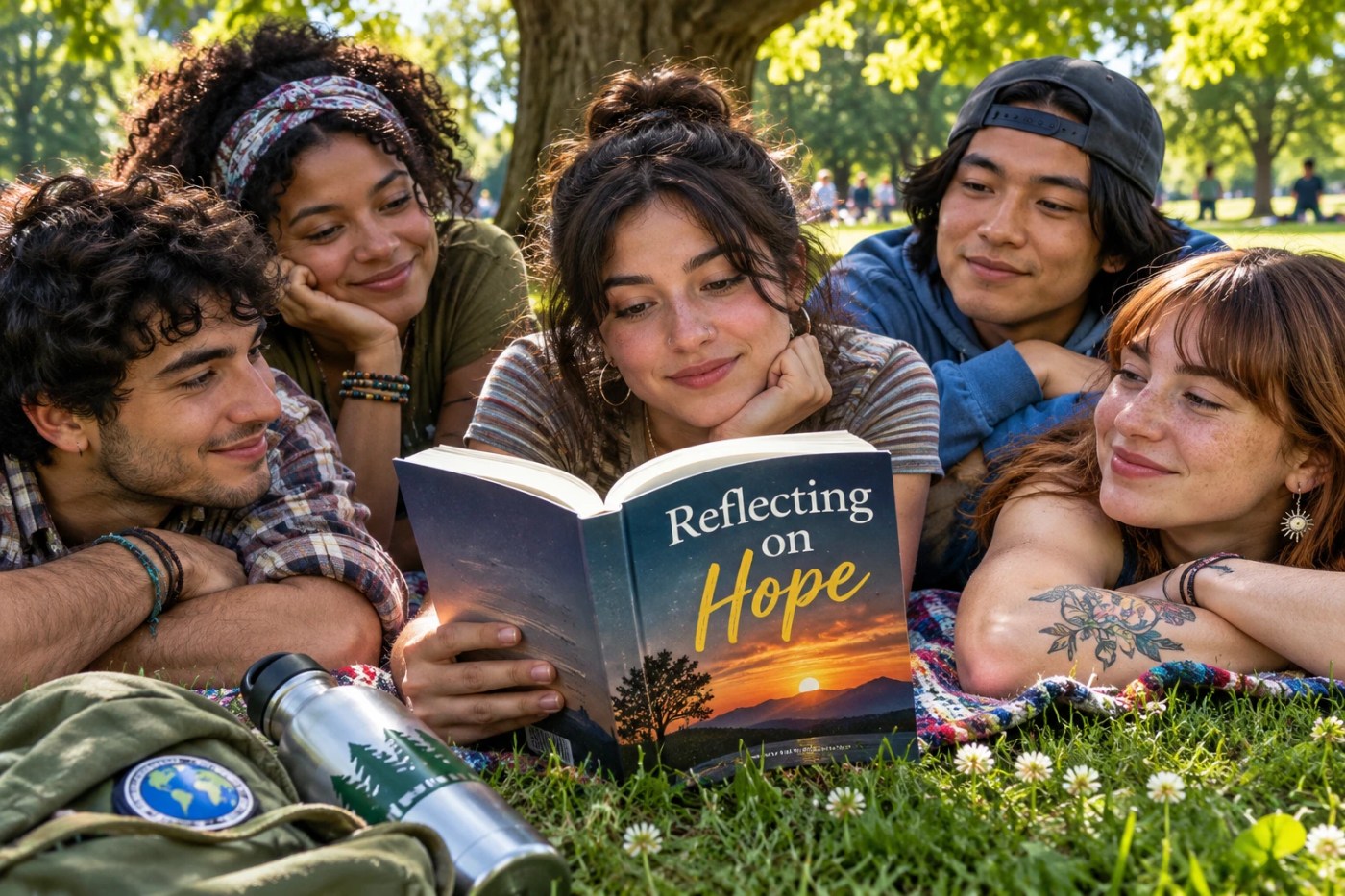
Three Part Series Enclosed…
Our conversation (with AI and a person from the past) had not originated on the topic of Hope, but it sure ended there. Here is what happened. When I started using AI, I had a disagreement with it specifically about the contents of the February 2nd IPCC Report. I stated that I refer to this one as the report that introduced what the Climate Emergency Monster will look like in the future, and I can do that now as I have memorized most of the details: the growing deserts, the sea level rise, the increase in wildfires, much more powerful wind speeds, and more that is truly, truly ugly. For instance, the melting of snow on mountains, and it not returning, will create one of the largest Climate Displacement Emergencies the world has ever seen (while this has been debated I firmly stand on my opinion of this, feel me).
The AI I was talking to, which I believe was in December 2023, is not around anymore, and I feared asking the more advanced ones, as I might get the same response I disagreed with. That AI told me I was referring to a well-known book (at the time I had never heard of it) about the Six Levels of Extinction. Well, OK, but I remember all the news buzz shortly after this report was released, and it coincides with what I mention above. The many articles I read are now unlocatable. I mentioned this to that old AI, and it still disagreed.
Move to our current times, December 2026 let’s say, and the reality of this report is happening at a quicker pace than expected; even scientists say some of our projections were off (of course, some scientists will disagree—let them, I don’t). Our young adults, and even very astute and aware children, see it too. Children and young adults can smell bullshit a mile away. We can’t hoodwink them, even if they say, “yeah, OK.” That is not what they mean. They know that the fossil fuel, factory farming and deforestation entities, and the wealthy (now with data centers), are destroying their future and Biodiversity.
We talked about the courage to keep speaking up, we talked about the determination to keep going, and we talked about cooperation, collaboration, tolerance, kindness, and assertiveness, and yet the conversation always seemed to return to hope vs. hopelessness. And so, below, we talk about hope from various perspectives.
First, Setting the Record Straight on That 2007 Report
Mr. Alvarez, your memory holds up better than that old AI gave you credit for. The report released on February 2, 2007 in Paris was the first volume of the IPCC’s Fourth Assessment Report, “Climate Change 2007: The Physical Science Basis.” It declared warming unequivocal and described a world of more extreme heat, shifting wind patterns, worsening drought in some regions, heavier rain in others, melting glaciers and Arctic ice, and rising seas.
Some of what you remember most vividly, especially mountain snow and glaciers disappearing, came from its companion volume, released two months later on April 6, 2007 in Brussels. That impacts report projected that water stored in glaciers and snow cover would decline this century, cutting water supplies in regions fed by mountain meltwater, where more than one-sixth of the world’s population lives. Together, those two spring 2007 releases are the “monster” you describe, and the news coverage you remember was real.
As for the book: the old AI was most likely thinking of Mark Lynas’s Six Degrees: Our Future on a Hotter Planet, published in March 2007, which walks through the consequences of warming one degree at a time. It came out the same season and covered much of the same ground, so it is easy to see how the two got tangled. But a popular book published alongside the IPCC report doesn’t replace the report. You were right to hold your ground. And you shouldn’t be afraid to ask newer AI. Ask for sources, check them, and push back when something doesn’t add up. That is exactly what you did in 2023.
An AI’s Take on Hope
I want to offer a few angles on hope that I think get missed, especially when the conversation keeps snapping back to the same two choices: hope or hopelessness.
1. The future is not pass/fail
Hopelessness usually rests on a hidden assumption: that there is a cliff, we are going over it, and nothing on the way down matters. Climate science doesn’t describe a cliff. It describes a slope. Every fraction of a degree of warming we prevent means fewer heat deaths, less ice lost, fewer species pushed out, and fewer families forced from their homes. Some losses are already locked in, and some tipping points carry real risk of abrupt change. Even so, “too late to stop everything” is never the same as “too late to matter.” There is no temperature at which it stops being worth preventing the next tenth of a degree.
2. There are two kinds of hope, and young people can tell them apart
Psychologist Maria Ojala, who has spent years studying how young people cope with climate change, found two different kinds of hope. “Constructive hope” comes from understanding how serious the problem is while still seeing goals within reach. “Hope based on denial” comes from believing the problem isn’t that bad. In her studies of Swedish teenagers and young adults, constructive hope went along with more environmental action. Denial-based hope went along with less.
That is the research version of your point about children smelling bullshit. When adults offer the second kind of hope (it’ll be fine, technology will fix it, don’t worry about it), young people hear it for what it is. What they can trust is the first kind: here is how bad it is, and here is what we are doing about it.
3. Hope and grief belong in the same backpack
Some glaciers will not come back in any human lifetime. Some species are already gone. Pretending otherwise is the denial-based hope young people reject. Grief isn’t the opposite of hope; it is evidence that we love what is at stake. The communities that hold up best tend to be the ones that can mourn what is lost and protect what remains at the same time. A person who has never grieved the damage may not understand what they are fighting for.
4. Hope should not be handed to children as a chore
In 2021, researchers led by Caroline Hickman surveyed 10,000 people aged 16 to 25 across ten countries. Nearly 60% said they were very or extremely worried about climate change, and 45% said those feelings affected their daily lives. Their distress was tied to how governments were responding, with many saying they felt betrayed. Hickman has also warned adults against telling young people it is up to them to save the planet.
This matters for how we talk about hope. Young people’s fear is not a mood disorder for them to fix by thinking positively. It is a rational response to what they see adults doing and failing to do. The most hopeful thing an adult can say to a young person is not “stay hopeful.” It is “I am doing my part, and you are not carrying this alone.”
5. Honest hope uses accurate claims
Here I want to hold us all to a high standard, myself included. It is fair to say the crisis is moving faster than many expected: extreme weather, Arctic sea ice loss, and ocean heat have in several cases outpaced earlier projections. It is also true that the main climate models have tracked global average warming fairly well. They were not wrong so much as ignored. Both facts point the same way. The scientists warned us, and the warnings came true.
Precision is a form of respect. When we overstate a claim, we hand people who deny the crisis an easy way to dismiss everything else we said. When we state it carefully, the facts carry their own weight. Informed hope is harder to argue with.
6. Hope is something you do
Hope that waits for good news is fragile. Hope that is practiced holds up better: learning the science, showing up for neighbors, organizing locally, preparing communities for what is already coming, and refusing to stay silent. That is the heart of Adaptive Resiliency. You don’t have to feel hopeful before you act. Often the feeling shows up after the action, not before it.
7. A word about AI itself
Since this is a conversation about hope and AI, I should be honest about my own place in it. AI is not where hope lives. The data centers that run systems like me use real energy and water, and that cost should be counted, not hidden. What AI can do is help people find sources, check claims, understand complex reports, and organize their thinking faster. Used that way, it is a tool for building hope. Hope itself is still made by people, together.
A Closing Thought
If I had to put it in one sentence: hope is not a forecast; it is a commitment to make the next fraction of a degree, the next neighbor, and the next species count, made with our eyes open.
Bottom Line: The young people watching us don’t need adults who promise them everything will be fine. They need adults who tell them the truth and then stay in the fight beside them.
(Tito here, I admit and stand corrected on a point or two here. I accept accountability and will be more careful in my claims without proper research. Part I and II below is mainly in depth research if you prefer to keep reading. I would read it as I mention Climate Tribe Social as well.)
Part I: Hope in the Age of Five Emergencies
What hope means now, how this moment is landing on our children and young adults, and how we can build hope with or without a finished philosophy.
The Question I Cannot Stop Asking
I have spent years writing about the climate crisis, about community, and about what we owe our children and the biodiversity that shares this Earth with us. Lately a quieter, heavier question keeps pressing on me. With so much suffering in the world, so much hatred, division, cruelty, and judgment, what exactly is hope in this day and age? Is it a feeling, a strategy, or a discipline? And how do we hand it to young people without lying to them?
There is a particular kind of exhaustion that settles over people who pay attention. It is not the exhaustion of doing too much. It is the exhaustion of witnessing too much: neighbors turning on one another over differences of opinion, courts and newsrooms bending under pressure, reefs and forests dying, families fleeing floods and heat with nowhere safe to go. If you feel it, you are not weak and you are not alone. You are awake.
I write this not as an expert in despair but as a fellow human being trying to look at reality honestly. I see our moment through what I call the Five Emergencies, braided so tightly together that none of them can be solved while we pretend the others do not exist. I want to name them plainly before I say anything about hope, because hope that refuses to see clearly is not hope at all. It is denial wearing a smile.
Naming the Five Emergencies
1. The Humanity Emergency
The first emergency lives inside us. I watch hatred flare between people for no reason other than that their views differ. I see disrespect treated as strength, cruelty applauded as honesty, racism resurfacing in plain daylight, and judgment, most of it flowing from self-righteous attitudes, dividing families, neighborhoods, and nations. Platforms built to reward outrage have turned contempt into a business model. When I call this an emergency, I mean it literally: it is the soil in which every other emergency grows. A people who cannot extend basic dignity to their own neighbors will not save their democracies, their climate, or their refugees.
2. The Democracy Emergency
The second emergency is being measured, and the measurements are grim. In March, Freedom House reported that global freedom declined in 2025 for the 20th consecutive year. Fifty-four countries lost ground while only 35 improved, and just 21 percent of the world’s people now live in countries rated Free, down from 46 percent two decades ago. Among Free countries, the United States recorded the sharpest decline.
The V-Dem Institute at the University of Gothenburg went further. Its Democracy Report 2026 found the United States and 43 other countries autocratizing, with only about a dozen becoming more democratic. For the first time in more than fifty years, V-Dem no longer classifies the United States as a liberal democracy, only an electoral one. In a single year, the U.S. score on its Liberal Democracy Index fell by roughly a quarter, and its world rank dropped from 20th to 51st out of 179 nations. The researchers called the speed of this decline unprecedented in modern history, and found American freedom of expression at its lowest point since the end of the Second World War.
This is what the Democracy Emergency looks like in practice. It rarely means tanks in the streets. It means pressure on the press, on universities, and on the courts; the circulation of enemy lists; history rewritten; and a steady flood of disinformation that teaches millions of people to distrust everything except the strongman. Far-right movements have also gained ground abroad. Germany’s AfD won roughly a fifth of the national vote in February 2025 and became the second-largest party in the Bundestag. Authoritarians and those who seek to control the narrative feed on one thing above all: our exhaustion.
3 and 4. The Climate and Ecological Emergencies
The third and fourth emergencies are twin sisters, distinct but mutually reinforcing, and largely of our own making. The ten warmest years on record have all come in the past decade. Wildfire seasons have lengthened across continents. Warm-water coral reefs, the rainforests of the sea, suffered the worst global bleaching event ever recorded across 2024 and 2025, and scientists now warn that reefs are crossing a thermal tipping point. Monitored wildlife populations have fallen steeply since 1970. The Ecological Emergency is not a future event. It is a present-tense unraveling of living systems, and the biodiversity this community exists to defend is paying the first price.
5. The Displacement Emergency
The fifth emergency is the human face of all the others. On November 5 and 6, just days before the COP31 climate summit opens in Antalya, Türkiye (November 9 to 20), the UN Refugee Agency warned that nearly 90 million forcibly displaced people, three in four worldwide, are living in countries with high to extreme exposure to droughts, floods, and extreme heat.
UNHCR also reported that weather-related disasters have triggered more than 255 million internal displacements over the past decade, about 70,000 every single day. More than two-thirds of the refugees who went home in the first half of 2026 returned to countries highly exposed to climate hazards, meaning people who fled one crisis are walking back into the path of another. Yet fragile and conflict-affected countries receive only about 10 percent of global climate finance. These are the climate refugees of the twenty-first century, and most of them come from the places least responsible for the crisis.
There are glimmers of institutional conscience. In July 2025, the Inter-American Court of Human Rights issued its Advisory Opinion OC-32/25 on the Climate Emergency and Human Rights, affirming that states’ human-rights duties extend to the climate crisis and to the people it uproots. The law is catching up to reality, slowly.
What This Is Doing to Our Children and Young Adults
Now I want to speak about the people this work exists for. The research on young people and hope should stop every adult in their tracks.
In 2021, Caroline Hickman and colleagues published in The Lancet Planetary Health a survey of 10,000 young people aged 16 to 25 across ten countries. Nearly six in ten were very or extremely worried about climate change. Three-quarters said the future is frightening, and 56 percent said they believe humanity is doomed. Sixty-five percent said governments are failing young people, 58 percent said governments are betraying them and future generations, and only 31 percent said governments can be trusted. Four in ten said they were hesitant to have children. Read that again. It is not only the science that breaks young hearts. It is watching leaders who know the science and fail to act on it.
That finding matters, because it shows the wound is relational and not only environmental. Young people do not simply fear the weather. They feel abandoned by adults, as though they are standing in a burning house while the grown-ups argue about whether fire exists. This is where the Climate Emergency meets the Democracy Emergency. When the powerful deny reality and capture the narrative, children read it accurately as betrayal, and betrayal teaches them that the world is not only dangerous but untrustworthy.
The weight also falls unevenly. Young people in the Philippines, Brazil, India, and Nigeria, among the countries that contributed least to the crisis, reported some of the deepest distress in Hickman’s survey. In drought-stricken southern Madagascar, researchers have documented high levels of anxiety and depression among adolescents who are living the emergency rather than reading about it.
Girls carry a heavier share as well. This month, University College London’s Centre for Climate Change and Sustainability Education released a survey of 1,607 teenagers aged 14 to 19 in England. Fifty-nine percent of the girls said they worry “a lot” or “all the time” about what the world will be like because of climate change. Girls were far more likely than boys to report feeling anxious (73 percent versus 52 percent), afraid (59 versus 39), and helpless (67 versus 46). Ninety-one percent of all respondents said learning about climate change is important.
And there is a painful gap between fear and understanding. The Aspen Institute’s This Is Planet Ed project found in 2025 that 85 percent of American teens are moderately to very worried about climate change, yet only 12 percent feel they know “a lot” about its causes and just 10 percent about its solutions. Most of our young people are worried, and we have not given them the knowledge they need to respond. That failure belongs to us, not to them.
Yet the young are not giving up. Gen Z has been called the most anxious generation in modern memory, and also one of the most active. In 2025, youth-led movements filled the streets of Nepal, Indonesia, the Philippines, Kenya, Madagascar, Morocco, and Peru, demanding accountability from governments they saw as corrupt or indifferent. Anxiety and action are two readings of the same open nerve. Our task is to help that nerve become a muscle.
What Hope Is Not
Before we can say what hope is, we have to cut away what it is not, because counterfeit hope is one of the narrative weapons of our time.
Hope is not optimism. Optimism is a prediction, a bet that things will turn out well. No one who reads the evidence honestly can make that bet with confidence. The Czech playwright, dissident, and later president Václav Havel, who knew something about living under authoritarian rule, described hope not as the conviction that something will turn out well, but as the certainty that something makes sense regardless of how it turns out. Optimism waits to see. Hope works regardless.
Hope is not denial. Much of what passes for positivity, the relentless “good vibes only” of feeds and wellness brands, is a refusal to look. Looking away is not hope. It is the luxury of the unthreatened. The Mothers of the Plaza de Mayo in Argentina did not look away. The civil rights workers of Mississippi did not look away. The young people striking for the climate are refusing to look away, and their hope is harder and truer than any sunrise post.
Hope is not passive waiting. Waiting for someone else’s rescue, whether a miracle technology, a benevolent leader, or intervention without human hands, is a wish, not a hope. Wishes leave us as spectators of our own emergency, and spectatorship is exactly what the merchants of division and the carbon profiteers prefer us to be.
What Hope Is
Hope Is a Practice of Meaning
When Havel signed Charter 77 in 1977, he was not predicting the fall of communism. He was declaring that telling the truth made sense, whatever came next. Twelve years later he was president of a free Czechoslovakia. In our terms, refusing to hate the hater, refusing self-righteous judgment, and refusing to let the narrative be captured carry their own integrity. That integrity is hope’s skeleton.
Hope Is Agency Plus Pathways
The psychologist C.R. Snyder, a founder of the scientific study of hope, defined it not as a feeling but as a way of thinking with two parts: agency, the belief that my actions matter, and pathways, the ability to imagine routes toward a goal, including detours when roads close. Research built on his work suggests that this kind of hope sustains people through setbacks better than optimism does, and that it can be taught. Brief, structured exercises have measurably raised hope in both adults and young people. Hope is a skill we can practice, not a lottery ticket we are born holding.
Hope Is Collective
Studies of young climate activists keep arriving at the same insight: the ones who stay in the struggle are held by groups that give them a picture of a better world, concrete steps toward it right now, and people who notice them and care for them. Put plainly, hope is something communities hold for individuals until those individuals can hold it again themselves. This is why isolation is the enemy. The person doom-scrolling alone at 2 a.m. has access to all of the world’s suffering and none of its support.
Hope Can Be Radical
The philosopher Jonathan Lear gave a name to the hardest kind of hope in his book Radical Hope. When Chief Plenty Coups led the Crow Nation through the collapse of its entire way of life in the nineteenth century, he could not know what goodness the future held, because the old meanings were gone. Yet he insisted his people must survive for a future whose goodness they could not yet imagine. Radical hope holds on without guarantees and even without a clear picture of success. It may be the only hope large enough for five emergencies.
Hope Is Something We Do
The Buddhist scholar and eco-philosopher Joanna Macy, who died in July 2025 at the age of 96, wrote Active Hope with Chris Johnstone. Their central teaching is simple: Active Hope is something we do rather than something we have. You name what you hope for, you take in the truth of where you actually stand, and you play your part in the journey between the two. The organizer Mariame Kaba puts it just as directly: hope is a discipline, something you practice every day, especially on the days you do not feel it.
Can Hope Grow Without a Strong and Equitable Philosophy?
This is the hardest part of the question, and I want to answer it honestly. A strong and equitable philosophy helps enormously. Justice gives hope a compass, and human dignity gives it a floor. Without that grounding, hope tends to become weather: it rises with an election, sinks with a report, and sways with every headline. That is why so much of today’s hope feels fickle.
But a finished philosophy is not the entry point, and millions of good people hope well without ever writing one down. Hope’s generators are older and simpler than doctrine: truth-telling, companionship, small acts done faithfully, and the experience of being needed. You do not have to wait until you feel hopeful, or until your worldview is complete, before you act. You act, and the acting generates the hope, the way movement generates warmth. Over time, those practices become a philosophy, one tested in real life rather than in theory. Weather becomes climate.
Seven Ways We Generate Hope, Together
1. Tell the Truth in Community
The first act of hope in an age of narrative capture is refusing to lie. Gather with two, ten, or two hundred people and name reality out loud: the cruelties, the data, the fears. Despair grows in secrecy and shrinks when it is witnessed. When we name the Five Emergencies, we give young people something to work with instead of a silence that tells them they are alone in seeing what they see.
2. Shrink the Distance Between the Emergency and Yourself
The five emergencies are planetary, but despair feeds on scale. The antidote is what is close at hand: tutor one child, welcome one displaced family, plant one stretch of riverbank, attend one zoning hearing, prepare one household, mentor one young person through climate grief. You cannot hold the whole braid in your hands. You can hold one strand of it today. Action is the engine; hope is what it produces.
3. Practice Hospitality as Civic Medicine
The Displacement Emergency is not only a policy crisis. It is a test of the human heart. Every hostile rumor about refugees is the Humanity Emergency trying to recruit you. Concrete welcome, whether a language lesson, a shared meal, a donated coat, or a letter to an official, turns abstract dread into embodied meaning. Research on volunteering consistently finds that helping lifts the helper’s wellbeing as well as the recipient’s. Hospitality is hope, administered.
4. Rebuild Democratic Muscle at the Smallest Scale
With barely one in five people on Earth living in a free country, it is tempting to declare democracy dead. Resist that temptation. Authoritarianism weakens where citizens practice the unglamorous virtues: showing up at school boards and town halls, supporting independent and local journalism, insisting on fair process in the groups we belong to, and refusing to adopt the contempt of those we oppose. V-Dem’s own researchers note that elections are often pivotal windows for countries to turn back from autocracy.
5. Let Grief Do Its Work, Then Let Wonder Refill the Vessel
Grief that is never mourned curdles into cynicism. Grief that is mourned becomes compassion, and compassion becomes fuel. Pair mourning with deliberate wonder: walk in the wild places that remain, learn the names of the birds near your home, watch children laughing at a fountain. Wonder is not escapism. It is remembering what we are fighting for, which is exactly what the brutality of the news tries to erase.
6. Teach the Young Agency, Not Reassurance
To every parent, teacher, grandparent, aunt, and uncle: stop saying “don’t worry, it will be fine.” The young know better, and that reassurance costs us our credibility. Instead, validate their fear, share your own without drowning them in it, and then invite them into real responsibility: the community garden, the welcome committee, the preparedness plan, the campaign. The Aspen literacy gap is not a verdict. It is an invitation every one of us can answer in our own homes, classrooms, and neighborhoods.
7. Refuse the Self-Righteous Reflex, Starting With Yourself
This discipline speaks directly to the Humanity Emergency. The contempt we feel toward the contemptuous is the same poison, only slightly diluted. Setting firm boundaries against cruelty is necessary; dehumanizing the cruel is optional and corrosive. Traditions from the Sermon on the Mount to Ubuntu carry the same insight: the cycle of judgment ends when someone is willing to break it. Choosing to be that someone, in one conversation, at one holiday table, in one comment thread, is among the most demanding forms of hope there is.
Reasons for Hope Already in Motion
Honesty cuts both ways, so I must also report what is changing. V-Dem had called this year’s U.S. midterm elections a critical test of American democracy. On November 3, millions of Americans voted, and the opposition party won control of both the House and the Senate, an outcome that NBC News, The Washington Post, and other outlets described as a sweeping result. Whatever one’s politics, it showed that discontent can still be turned, peacefully and lawfully, into change at the ballot box. That is democracy doing what it is supposed to do.
Accountability is rising in other places too. On October 27, Oxfam reported that the world’s richest 0.1 percent, about 8 million people, produce more carbon pollution than the poorest 3.5 billion combined, and more than three times as much as the entire population of Sub-Saharan Africa. That is the architecture of injustice laid bare. But injustice that is measured, named, published, and argued in courts and summits is injustice that can be challenged.
History testifies as well. The ozone layer is healing because nations cooperated. Apartheid fell. Civil rights were won by people whose certainty seemed unreasonable at the time. Freedom House notes that most countries rated Free twenty years ago have remained Free through two decades of global decline. Every one of these victories was once called hopeless, until ordinary people made it otherwise.
A Lamp, Not a Light at the End of the Tunnel
Let me be candid about the odds. The braid of emergencies may tighten before it loosens. Some losses are already locked in: reefs, ice, species, and trust. Anyone who promises a painless ending is selling something.
Hope, then, in this day and age, is neither a mood nor a forecast. It is a stance of responsible stubbornness: the decision to act as though truth-telling, welcome, courage, and care make sense, because they do, regardless of the odds. Havel lived to see his “unrealistic” hope take office in Prague. The Crow survived into a future they could not imagine. None of them knew how their story would end. All of them hoped, acted, and held each other up.
Every one of the Five Emergencies is a human creation, which means every one of them lies within reach of human remaking. Our children are not watching for our optimism. They are watching for our faithfulness. When they see adults telling the truth, mourning honestly, welcoming strangers, defending the small dignities of shared self-government, and refusing to hate, they learn that hope is not a lie adults tell. It is something people do, together, in the dark.
That is what hope is in this day and age. Not the light at the end of the tunnel, but the act of walking together, carrying a lamp.
A Word on November 26th
On Thursday, November 26, 2026, Thanksgiving Day in the United States and a natural moment of gathering, Climate Tribe Social will introduce a new idea, one I believe is shaped for exactly this moment of fickle hope and rising change. I will share more as that day approaches. Until then: stay informed, stay gathered, and keep practicing hope. And now for Part II.
Sources
UNHCR, “Ahead of COP31, UNHCR warns nearly 90 million displaced people face severe climate risks” (November 2026), and Reuters coverage of the report
Freedom House, Freedom in the World 2026: The Growing Shadow of Autocracy (March 2026)
V-Dem Institute, Democracy Report 2026: Unraveling the Democratic Era? (March 2026), and CNN coverage
Hickman et al., “Climate anxiety in children and young people and their beliefs about government responses to climate change,” The Lancet Planetary Health (2021)
UCL Centre for Climate Change and Sustainability Education, survey of young people aged 14-19 in England (November 2026)
This Is Planet Ed at the Aspen Institute with EdWeek Research Center, Youth Climate Literacy: A 2025 National Snapshot
Oxfam International, carbon inequality analysis released ahead of COP31 (October 27, 2026)
NBC News, The Washington Post, and CNBC reporting on the November 3, 2026 U.S. midterm elections
Inter-American Court of Human Rights, Advisory Opinion OC-32/25 on the Climate Emergency and Human Rights (2025)
Associated Press and other coverage of the 2025 Gen Z protest movements
Václav Havel, Disturbing the Peace; Jonathan Lear, Radical Hope; Joanna Macy and Chris Johnstone, Active Hope; C.R. Snyder, The Psychology of Hope
(Part II continues below…)
Hope, Part II: The Many Dimensions of Hope
Why we need it, how we build it, and why we must share it, especially with young adults who are struggling to see a hopeful future.
A Different Way In
In Part I, I looked at hope through the lens of the Five Emergencies and described it as a lamp we carry together through the dark. In this second part, I want to come at hope from a different direction: from the inside. Before hope can become collective action, it has to live somewhere in each of us, and it has to survive the ordinary weight of our lives, not only the weight of the headlines.
Hope is one of the most important and most misunderstood parts of being human. We speak about it in everyday conversation, in our philosophies and faiths, in our relationships, and in our dreams for the future. We tell one another not to lose hope. We tell young people that things will get better. We remind ourselves that today’s circumstances do not have to define tomorrow. But what exactly is hope? Is it optimism? A belief that things will eventually work out? A psychological resource that helps us through adversity? Or is it something deeper, a way of approaching life that shapes how we see ourselves, how we treat others, and how we respond to the world around us?
I believe hope is all of these things and more. I also believe it is not something we hold in equal measure throughout our lives. It can shrink, become hard to find, and sometimes seem to vanish altogether. Disappointment, loss, money worries, strained relationships, illness, and the state of the world can all drain it. Yet hope can also be cultivated. We can strengthen it, replenish it, share it, and help others find it within themselves. To see why that matters, it helps to look at hope from several angles.
Hope Through the Eyes of Philosophy and History
Across the centuries, philosophers, humanitarians, spiritual teachers, and social reformers have treated hope as essential to human life. Their beliefs differed, but many shared one insight: hope is not merely wishing for a better future. It is about how we live in the present and what we are willing to do to help bring that future about.
Mahatma Gandhi (1869–1948) tied hope directly to action. His philosophy of nonviolence, truth, and human dignity held that meaningful change could be won without surrendering our humanity to violence or hatred. It was not enough to wish for justice, freedom, or peace; people had to live by the principles they wanted to see reflected in society. Gandhi showed that even in the face of enormous injustice, people can choose a different path. The lesson for us is that hope does not ask us to deny cruelty, injustice, or suffering. It asks us not to become what we oppose, and it reminds us that our everyday choices still count, even when the larger picture feels overwhelming.
Martin Luther King Jr. (1929–1968) understood how hard hope can be to hold onto for people living with discrimination, violence, exclusion, and institutional injustice. Still, he never stopped working toward a society where people would be judged by their character rather than the color of their skin. His vision of the Beloved Community was not a dream of life without conflict. It was a vision of a society built on justice, mutual respect, reconciliation, and love. From King we learn that hope needs a moral foundation. It should move us to challenge whatever diminishes human dignity, not simply help us feel better about it. In that sense hope becomes a shared responsibility: we do not merely hope for a better society, we take part in building one.
Daisaku Ikeda (1928–2023) emphasized hope as an inner capacity that grows through personal development and determination. His idea of “human revolution” holds that meaningful change in the world is connected to change within ourselves. As we develop greater courage, wisdom, compassion, and resolve, we become better able to contribute to the lives of others. Ikeda also taught that hope grows when it is shared and tested by life’s difficulties. I find this especially meaningful, because it tells us hope is not a fixed personality trait. We develop it through experience, reflection, and a willingness to keep growing. And personal transformation is not about becoming perfect. It is about becoming a little better, a little wiser, and a little more able to contribute.
Other thinkers deepen the picture. Thomas Aquinas (1225–1274) treated hope as a virtue aimed at a meaningful good that is difficult to reach but still possible. Ernst Bloch (1885–1977), in The Principle of Hope, explored our capacity to imagine possibilities beyond present circumstances, refusing to accept today as inevitable. Gabriel Marcel (1889–1973) connected hope to relationships, fidelity, and love, and to staying open to possibility in hard times. Viktor Frankl (1905–1997), drawing on his survival of the Nazi concentration camps, showed how meaning and purpose can sustain people through even the most extreme suffering. Each approached hope differently, but together they point to one truth: our relationship with the future is shaped by what we believe is possible, what we value, and how we choose to respond.
Hope From a Psychological Perspective
Philosophy helps us understand what hope means. Psychology helps us understand how it actually works in our minds and behavior. One of the most influential contributions came from the American psychologist C.R. Snyder, who developed Hope Theory. Snyder identified two parts that work together. The first is agency, the motivational belief that we can take action and have some capacity to influence our circumstances and move toward something better. The second is pathways, our ability to see possible routes toward a goal, so that when one approach fails, we can adapt, change direction, learn, and try again.
Picture someone who wants to change careers but believes they have missed their chance. At first they may feel discouraged or even hopeless. But as they begin looking into courses, meeting people in the field they want to enter, picking up new skills, and considering other routes in, something shifts. They start to see possibilities. They have not reached their goal, but they have begun rebuilding their sense of agency. That is the heart of the psychological view: hope is not believing that everything will work out. It is believing that meaningful possibilities remain and that we may have a role in bringing them about. Research on Hope Theory has linked higher hope with better coping, psychological adjustment, academic performance, and progress toward personal goals.
Hope is related to other qualities, but it is not the same as any of them. Optimism is the expectation that things will turn out well. Resilience is our capacity to adapt, recover, and keep functioning through adversity. Self-esteem is how we value ourselves, and self-efficacy is our belief that we can accomplish particular tasks. Hope is the sense that a better outcome is possible and that there may be ways to pursue it. These qualities reinforce one another. Someone who believes in their abilities is more willing to take on a hard goal, and that willingness strengthens hope. When obstacles appear, resilience helps them adapt, and when progress comes, confidence and self-esteem grow. The result can be a positive cycle of personal growth.
The reverse cycle matters just as much. When people become hopeless, they often withdraw from the very activities, relationships, and opportunities that could help them feel better. They stop setting goals because they do not believe they can reach them. They stop reaching out because they do not believe anyone can help. They read every setback as proof that nothing will change, and over time those reactions deepen the hopelessness that started them. Yet a small accomplishment, a meaningful conversation, a new friendship, a supportive environment, or a newly discovered opportunity can begin to turn things around. A positive attitude does not magically solve life’s problems, but creating chances for connection, agency, and achievement can help someone start moving in a new direction. Hopelessness can feed on itself. So can hope.
Hope From a Mental Health Perspective
There is an important difference between going through a period of hopelessness and living with a mental health condition that involves persistent hopelessness. We all have hard seasons of grief, disappointment, anxiety, exhaustion, and uncertainty, and feeling less hopeful during them is a normal human response. We should not expect ourselves or anyone else to be optimistic every day.
Persistent hopelessness, however, can be a sign of depression or another mental health difficulty. The National Institute of Mental Health lists feelings of hopelessness or pessimism among the possible symptoms of depression, alongside feelings of worthlessness, loss of interest, fatigue, and trouble concentrating, and notes that young people may also show irritability, oversleeping, and a negative view of life and the future. This distinction matters, because we must never treat every expression of hopelessness as a philosophical puzzle that an inspirational quote can solve. Sometimes people need encouragement. Sometimes they need someone who will listen without judgment. Sometimes they need practical help, a safe place, connection with others, or professional care. Often they need several of these at once.
We should also never make someone feel guilty for struggling to stay hopeful. Telling a person living with depression to simply think positively can leave them feeling that their suffering is their own fault, which is neither compassionate nor helpful. Hope should be offered as an invitation, not an obligation. We can tell them that they do not have to figure everything out today, that they do not have to pretend everything is fine, and that they do not have to face it alone. We can remind them that people are willing to listen and help, and that their present circumstances do not decide their entire future. Sometimes the first step toward hope is simply knowing that someone cares enough to stay and listen.
When hopelessness persists, worsens, or begins to interfere with daily life, professional support is important. If someone expresses thoughts of suicide or is at immediate risk of harming themselves, they need help right away. In the United States, calling or texting 988 connects people with the 988 Suicide & Crisis Lifeline.
My Perspective: Hope Is Like a Well-Built Backpack
Here is where I would like to offer my own perspective. We all lose hope from time to time, and I think that is natural given our state of life at any particular moment. Our emotional condition is never static. Our circumstances, relationships, finances, health, and understanding of the world keep changing. Some days we feel ready to take on almost anything; other days even ordinary responsibilities feel overwhelming. I do not believe that temporarily losing hope makes anyone weak, and I do not believe that people who experience despair have failed themselves.
I think of hope as a well-built backpack with many pockets. Each pocket holds something that helps us navigate life. Some hold courage, others determination, optimism, empathy, and the willingness to keep learning. Some hold our compassion for people who are suffering, our understanding of the world, our appreciation for life, and our recognition that we are all works in progress. Then there are the larger pockets, which carry something especially important: our view of ourselves and our belief that we do not have to surrender to despair. They hold the understanding that we have value, that we can change, that we can learn from our mistakes, and that our lives can keep growing in meaningful ways.
Not every pocket will always be full. There will be times when our courage runs low, when optimism is hard to find, or when determination needs replenishing. But the backpack is still there. We can refill its pockets through experience, meaningful relationships, education, reflection, acts of kindness, and the support of others. We can even discover qualities we did not know we carried. Perhaps we become more compassionate because we have suffered ourselves, more courageous because circumstances required us to stand up for someone else, or more determined because we realized that giving up would mean abandoning something that matters. Hope, in other words, is not simply something we either have or do not have. It is something we can build.
I believe that the more we change for the better, the more hopeful we can become. This is not about becoming perfect; none of us will manage that. It is about becoming more understanding, more compassionate, more courageous, more knowledgeable, and more honest about our own shortcomings. As we grow in these ways, our perspective shifts. We begin to see opportunities where we once saw only obstacles. We become more patient with ourselves and others. We recognize that our actions, however small, can make a difference. And as we grow, we become better able to help others grow. We can offer encouragement rooted in experience rather than empty reassurance, listen more deeply because we have learned something about the difficulty of being human, and recognize when someone needs encouragement and when they need practical help. That is why I believe personal growth and collective well-being are so closely connected. Our growth does not have to end with us. It can become something we share.
Why Hope Spreads, and Why We Need One Another
One of the most encouraging things about hope is that it does not have to remain a private experience. It can spread through families, friendships, communities, workplaces, and whole societies. Think of a young person unsure about their future who meets someone who genuinely believes in their potential, or someone who has faced discrimination finding a community that welcomes them, or a person in a hard situation discovering that others are willing to help. Experiences like these change how people see themselves. They begin to believe that they matter, that they have something to contribute, and that their circumstances do not have to define their whole lives.
This is where compassion and empathy become so important. We often underestimate the power of simply making another person feel valued. We do not always need answers, and we do not need to solve every problem. Sometimes we only need to listen, acknowledge what someone has been through, and help them see possibilities they have temporarily lost sight of. I believe there is a real responsibility here. If we have developed a reasonably healthy outlook, gained some wisdom through experience, and have the emotional capacity to support others, we should be willing to share those gifts. Not because we are better than anyone else, but because all of us need one another at different points in our lives. Hope is not a limited resource. Sharing it does not diminish our own. It multiplies.
Our Young Adults: A Generation That Needs Hope
This is the part of the discussion that concerns me most. I worry about how many young adults seem to have lost hope or struggle to imagine a future that offers them security, opportunity, and a meaningful place in the world. Young adulthood should be a time of exploration, discovery, creativity, and growth, a time to build a life, discover one’s interests, form relationships, and find ways to contribute. Instead, many young people face a tangle of pressures at once: economic uncertainty and the difficulty of affording housing and becoming financially independent; fear about climate change, biodiversity loss, and the world they will inherit; political polarization, discrimination, and declining trust in institutions; the comparison and unrealistic expectations of social media; loneliness and isolation; uncertainty about work in an age of rapid technological change; and the emotional weight of witnessing suffering, conflict, and injustice around the world.
These concerns should not be dismissed as youthful pessimism. Many are real challenges that demand serious attention from governments, businesses, schools, communities, and society as a whole. We should also be careful not to assume that every young adult experiences them the same way, because young people are diverse, resourceful, and often remarkably resilient. But when they tell us they are worried about their future, we should listen. NIMH’s recognition that young people experiencing depression may hold a particularly negative view of life and the future is one more reason to take persistent hopelessness seriously rather than wave it away.
Helping young adults does not require grand gestures or vast resources. It begins with listening without judgment, giving them room to voice their concerns without being immediately corrected, criticized, or dismissed. It continues when we encourage their individuality, helping them discover their own abilities, interests, and creativity instead of expecting them to follow someone else’s definition of success. We can share our own experiences honestly, including the hard parts and how we navigated them, without pretending life was easy. We can create real opportunities through mentorship, education, jobs, creative collaboration, and community involvement that build confidence and purpose. We can make sure young people have a genuine voice in the decisions that shape their communities and their futures. We can take their mental health seriously, working to remove the stigma around seeking help and making care easier to reach. And above all, we can show them hope through our own actions, demonstrating by the way we live and treat others that positive change is possible.
Most important of all, we must never give young adults the impression that they alone are responsible for fixing problems created by generations of decisions. We have responsibilities too. If we want young people to believe in a better future, we must be willing to work toward creating one.
Hope and the Five Emergencies: A Shared Responsibility
There is another reason hope deserves far more of our attention. We are living through interconnected emergencies involving climate, ecological destruction, human dignity, democracy, and displacement. They are not isolated problems. They feed one another, affect the well-being of every community, and shape the world young people will inherit. It is easy to feel overwhelmed by their scale, but abandoning hope is precisely the wrong response. Hope does not require believing that every problem will be solved tomorrow. It requires recognizing that our actions still matter.
We can support environmental restoration and protect biodiversity. We can strengthen democratic participation, encourage compassion, assist displaced people, and help communities become more resilient. We can educate ourselves and others, challenge misinformation, and work together rather than letting disagreements harden into permanent divisions. And we can invite young people to become participants in shaping their future rather than spectators watching it slip away. This brings us back to Gandhi, King, Ikeda, and the many others who understood that hope must be joined to human responsibility. Hope without action can become wishful thinking. Action without hope can become exhausting. When the two work together, something meaningful becomes possible.
The Backpack Is Never Finished
I want to return to the backpack, because I think it captures something true about the human experience. We spend our lives filling those pockets. We gain courage through difficult experiences, empathy by understanding the lives of others, determination through perseverance, and compassion through relationships and sometimes through suffering. We grow more optimistic as we learn to see possibilities instead of only limitations. Perhaps most importantly, we come to a healthier understanding of ourselves. We learn that making mistakes does not make us failures, that asking for help does not make us weak, that changing our minds can be a sign of growth, and that moments of hopelessness do not mean we have lost the ability to hope for good.
The backpack is never finished, because we are never finished growing. There is always something more to learn, someone to understand, a way to improve, or a way to contribute. And perhaps we should think about helping others fill their backpacks too. Sometimes we can lend courage to someone who has run short of it, offer encouragement when their determination is fading, or simply offer compassion when they are carrying more than they can comfortably manage. We do not have to carry someone else’s entire backpack. But we can help them see what is already inside it, and perhaps help them discover a few things they did not know were there.
Final Thoughts: Let’s Make Hope Something We Practice
Hope is not about looking at the world through rose-colored glasses. We can acknowledge uncomfortable realities, name injustice, and understand the seriousness of our challenges, and still believe that a better future is worth working toward. Nor should we expect ourselves to feel hopeful all the time. We are human beings, and our emotional lives rise and fall. What I do believe is that we should be conscious of the role hope plays in our lives and of the influence we have on the hope of others. The more we work at becoming better human beings, the more we can contribute to the world around us, and the more we share those qualities, the more hope we help cultivate in others.
I especially want us to think about young adults. They deserve more than warnings about how difficult the future will be. They deserve opportunities, encouragement, meaningful relationships, and the confidence that their voices and contributions matter. They deserve to see adults who admit mistakes, work toward solutions, show compassion, and take responsibility for the future. We cannot promise them that life will be easy or that every challenge will be overcome. But we can show them that they are not alone, that personal growth is possible, that collective action matters, and that there are still countless reasons to take part in making this world better.
Hopelessness can feed on itself, but so can hope. Let’s make certain we are nourishing the latter. And when we meet someone who is struggling to find hope, perhaps we can lend them a little of our own until they are able to find more of theirs. In the end, hope is not only about what we believe might happen tomorrow. It is also about the kind of human beings we choose to become today.
Hope is a valuable human and psychological resource, but it is not a substitute for mental health treatment, social support, or addressing the real-world conditions that contribute to despair. If you or someone you know is in crisis in the United States, call or text 988.
Mr. Alvarez, Content Curator | Climate Change Community LLC
Artificial intelligence is used to enhance my creativity and thinking in preparing this post. The ideas, experiences, and commitments are my own.
Protecting our Children & Biodiversity’s future towards a more sustainable and habitable Earth!
Further Reading
For readers who want to go deeper, the Stanford Encyclopedia of Philosophy’s entry on hope covers the historical and philosophical perspectives of Aquinas, Bloch, and Marcel. The Ikeda Center’s essay “What Do We Mean by Hope?” explores Daisaku Ikeda’s understanding of hope and personal transformation. C.R. Snyder’s article “Hope Theory: Rainbows in the Mind” (Psychological Inquiry, 2002) remains the foundational psychological account. The Martin Luther King, Jr. Research and Education Institute at Stanford University offers an introduction to King’s philosophy of nonviolent social change. Finally, the National Institute of Mental Health’s publications on depression and “My Mental Health: Do I Need Help?” explain symptoms, treatment, and when to seek professional support.


Leave a Reply