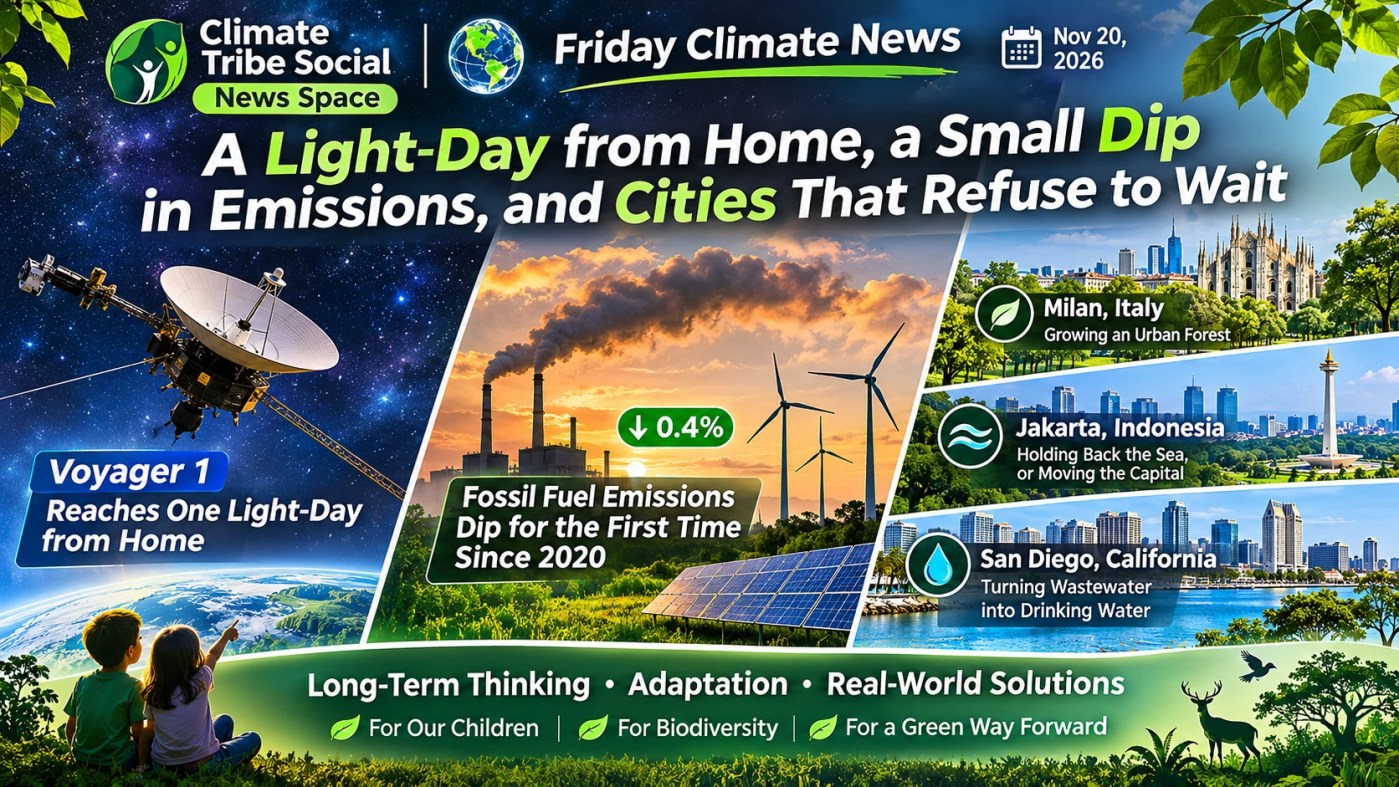
Happy Friday, friends. Grab your lunch, find a comfortable seat, and let’s spend a few unhurried minutes with three stories worth chewing on. One takes us to the farthest edge humanity has ever reached. One brings us back down to Earth with a surprising, if fragile, piece of climate news. And one walks us through three cities on three continents that are already reshaping themselves to live with a hotter, wetter, and less predictable world.
None of these stories is a silver bullet, and none of them is a reason to despair. Together, they remind us of something we talk about often in this community: when people commit to a long-term goal, stay patient, and keep learning from what goes wrong, remarkable things become possible. That is the heart of Adaptive Resiliency, and it is the spirit of a Green Way Forward that places the well-being of our children and the health of biodiversity at the center of every decision.
Voyager 1 Reaches One Light-Day from Home
On November 18, 2026, NASA’s Voyager 1 became the first human-made object ever to reach a distance of one light-day from Earth. That is roughly 16.1 billion miles (25.9 billion kilometers) away. In practical terms, a radio command sent from Earth now takes about a full day to reach the spacecraft, and its reply takes another full day to come back. Ask Voyager a question on Monday, and you’ll hear its answer on Wednesday.
The milestone is mostly symbolic. The spacecraft didn’t cross a physical line or change its course. Still, the growing delay is very real for the engineers who look after a probe that is nearly fifty years old. Every troubleshooting step now involves a two-day round trip, which makes each decision weightier and every mistake slower to correct.
Fifty Years of Firsts
Voyager 2 actually launched first, on August 20, 1977, with Voyager 1 following on September 5. Thanks to a faster path and gravity assists from Jupiter and Saturn, Voyager 1 pulled ahead and eventually became the first to reach interstellar space. Some of its earliest images captured a crescent Earth and Moon together in a single frame, an early hint of the perspective-shifting gifts this mission would keep giving.
At Jupiter in 1979, Voyager 1 came within about 174,000 miles of the giant planet and photographed its atmosphere every 96 seconds, revealing a world far more restless than scientists expected. It caught the first volcanic eruption ever seen on another world, on the moon Io, proving that geologically active places exist beyond Earth. It confirmed that the moon Callisto is geologically quiet, its ancient craters preserved like fossils, and it found a thin ring system around Jupiter, made partly of dust shed by Io.
At Saturn in November 1980, Voyager 1 discovered a previously unknown ring and five new moons. A close pass by Saturn’s largest moon, Titan, revealed a haze so thick it hid the surface entirely, evidence of an atmosphere denser than those of Earth or Mars. That same flyby bent the spacecraft’s path up and out of the plane of the planets, setting it on its long road toward the stars.
Then, in 1990, from about forty times Earth’s distance from the Sun, Voyager 1 turned its camera homeward one last time. It took 64 images that were stitched into a family portrait of six planets. Among them was the famous Pale Blue Dot, Earth reduced to a tiny speck suspended in a sunbeam. Shortly afterward, the camera was switched off for good.
In 2012, Voyager 1 crossed the heliopause, the boundary where the Sun’s influence gives way to the space between the stars, becoming humanity’s first interstellar spacecraft. Its twin, Voyager 2, followed in 2018 and is expected to reach its own light-day milestone around 2035.
Still Working, Still Teaching
Remarkably, Voyager 1 is still sending home science data from two working instruments, which are expected to stay powered into the 2030s. Scientists continue to detect the Sun’s reach out there, including shock waves and pressure fronts that ripple into the interstellar medium. Mission project scientist Linda Spilker, who joined the team back in 1977, summed up half a century of surprises in a single line: Voyager has taught her to “expect the unexpected.”
There is a quiet climate lesson tucked inside this story. The Pale Blue Dot remains one of the most powerful images ever made of our shared home: small, fragile, and the only place we know of that holds life. Every child we hope to protect and every species we hope to keep lives on that dot. Voyager also reminds us that careful engineering, built-in redundancy, and decades of patient stewardship can keep a mission alive far beyond anyone’s expectations. That is exactly the kind of long-haul commitment that climate work requires.
Fossil Fuel Emissions Dip for the First Time Since 2020
Now for some news from much closer to home. According to the 2026 Global Carbon Budget, published on November 10 in the journal Earth System Science Data and released just ahead of the COP31 climate talks in Antalya, Turkey, the world’s fossil fuel carbon dioxide emissions are projected to fall by 0.4% this year. If that projection holds, it will be the first annual decline since the pandemic year of 2020.
The Numbers at a Glance
Fossil fuel CO2 emissions are expected to total about 38.2 billion metric tons in 2026. Several major emitters are moving in the right direction: China is projected to fall by 0.9%, the United States by 1.3%, the European Union by 1.5%, and Japan by about 1%. The rest of the world combined is projected to drop by 0.7%, driven mainly by a 1.9% fall in emissions from oil. India is the notable exception, with emissions projected to rise by 4.4% as its economy and energy needs continue to grow.
There’s another encouraging thread in the report. Around forty countries have managed to cut their emissions over the past decade while still growing their economies, including the United States, the United Kingdom, Australia, New Zealand, South Korea, Japan, and about thirty European Union nations. That is real-world evidence that prosperity and pollution can be pulled apart.
Why Emissions Fell
Two very different forces worked together this year. The first is clean energy. Solar power, wind power, and electric vehicles covered roughly two-thirds of the growth in global energy demand that would otherwise have pushed emissions higher. That is a structural shift, built into power grids and garages around the world.
The second force is far less hopeful: the war involving Iran. Conflict restricted fuel supplies and drove prices up, and higher prices pushed demand down. Report co-author Judith Hauck of Germany’s Alfred Wegener Institute estimates the price spike alone trimmed demand by about 0.4%. In other words, clean energy did much of the heavy lifting, but it took an energy crisis to tip the global total into decline. A companion paper in Nature Climate Change, written by some of the report’s authors, explores the conflict’s role in more detail.
Reading the Fine Print
This is where we need to hold ourselves honest. Total CO2 emissions from all human sources, including land-use change such as deforestation, peat fires, and forest fires linked to El Niño, are still projected to rise slightly, to a record of about 43.3 billion metric tons. Imperial College London climate scientist Joeri Rogelj, who was not involved in the research, put it plainly: “at 0.4%, the projected decline is very small.” He cautions that it is far too early to say emissions have peaked, though the drop may be a sign of structural change that now needs to speed up.
Hauck also expects emissions to bounce back if the conflict ends and prices fall, much as they did after the COVID lockdowns. A decline driven partly by war and hardship isn’t one any of us should want to depend on. Meanwhile, the remaining carbon budget for limiting warming to 1.5°C above preindustrial levels is down to roughly 150 billion metric tons, which is less than four years of emissions at today’s pace. Hauck and many of her colleagues believe the 1.5°C target has already slipped out of reach without large-scale carbon removal, though she still holds out hope for keeping warming between 1.5 and 2°C.
So what is the takeaway? The clean energy transition is working, and it is working at scale. The task in front of us is to make sure the next decline comes from deliberate choices, more solar, more wind, more efficient homes, better public transit, and protected forests, rather than from crisis. That is what a Green Way Forward looks like: progress we choose, not progress forced on us.
Three Bold Ways Cities Are Already Adapting
Our third story comes from a Live Science feature that profiles three very different cities taking on climate change in very different ways. A quick note of transparency: that article was first published in September 2024, so I checked where each project stands today and folded in the latest updates below.
Milan, Italy: Growing an Urban Forest
Milan is a classic urban heat island, running about 7 to 14°F (4 to 8°C) hotter than the countryside around it, with further warming projected by 2050. The city’s answer is ForestaMi, a public-private partnership that aims to plant 3 million trees and shrubs across the metropolitan area by 2030, roughly one for every resident. Trees cool a city by providing shade and releasing moisture, and swapping pavement for soil helps absorb rainwater and reduce flooding.
The project hasn’t been without setbacks. In July 2023, a violent hailstorm knocked down around 5,000 trees in just fifteen minutes, and city leaders responded by choosing species better able to handle storms, heat, and drought. As of late October 2026, the project had planted nearly 640,000 trees and shrubs. That is real progress, but it also means Milan has a steep climb ahead to reach its 2030 goal. Recognition has followed all the same: ForestaMi was named a UN World Restoration Flagship in 2026, the only European initiative among that year’s honorees. Organizers are also emphasizing a lesson every community can take to heart: planting is only the first step, and trees must be cared for, monitored, and maintained to deliver their full benefits.
Jakarta, Indonesia: Holding Back the Sea, or Moving the Capital
Jakarta faces a double threat. The city is crossed by thirteen rivers and suffers from both flooding and water shortages. Heavy groundwater pumping, much of it from illegal wells, is causing parts of the city to sink by as much as 4 inches (10 centimeters) a year. Models suggest that most of the coastal district could be underwater by 2050, and saltwater creeping into aquifers threatens freshwater supplies.
Planners have proposed an enormous coastal defense: a chain of seventeen bird-shaped artificial islands forming a giant seawall around 25 miles wide, enclosing a lagoon to buffer the tides. It remains a proposal. Indonesia’s more dramatic move was announcing in 2019 that it would build a brand-new capital, Nusantara, on the island of Borneo.
Here the story has shifted considerably since 2024. Under President Prabowo Subianto, Nusantara has been reclassified as a “political capital” targeted for 2028 rather than a full replacement for Jakarta, and its state funding has been cut sharply. In May 2026, Indonesia’s Constitutional Court affirmed that Jakarta remains the national capital until a presidential decree formally transfers that status. Officials still say the project will continue, but its pace and scale are uncertain. The lesson for the rest of us is sobering: relocation is costly, politically fragile, and often slower than promised, which is why protecting and adapting the places where people already live matters so much. It also reminds us that climate displacement is not a far-off scenario. For millions of people, it is already a planning question.
San Diego, California: Turning Wastewater into Drinking Water
San Diego receives less than 12 inches (30 centimeters) of rain a year, and climate change is bringing hotter temperatures and less reliable rainfall. After a 1990 drought, when the city’s imported water supply was temporarily cut in half, San Diego began a long push toward water independence. Residents and farmers halved per-person water use through low-flow toilets, drought-friendly landscaping, and conservation partnerships. The region also opened the Claude “Bud” Lewis Carlsbad Desalination Plant, the largest in the United States, which supplies about 10% of the region’s water.
The boldest step is Pure Water San Diego, a program that purifies wastewater to drinking-water standards. Its first phase sends purified water into a reservoir before it reaches taps, and California has since approved rules for direct potable reuse, which sends purified water straight into the drinking water system. The city says the program will provide nearly half of San Diego’s water supply locally by 2035. The program is backed in part by a $614 million federal WIFIA loan, and it also reduces the amount of treated wastewater discharged into the ocean. As one regional water official noted, conservation alone can’t solve drought; it takes persistence and many tools working together.
What Connects These Three Stories
At first glance, a spacecraft drifting between the stars, a global carbon report, and three city projects might seem to have little in common. Look a little closer and a shared thread appears. Each one is a story about long time horizons. Voyager’s engineers have tended their spacecraft for nearly half a century. Global emissions bend only through years of steady clean energy investment. Milan’s trees, San Diego’s water plants, and Jakarta’s defenses all take decades to pay off.
Each story is also about humility and adaptation. Voyager’s team learned to expect the unexpected. Climate scientists are candid that this year’s emissions dip is small and fragile. Milan replanted with tougher species after a storm, and Indonesia’s plans have changed as politics and budgets shifted. None of these efforts went exactly to plan, and every one of them kept going anyway. That is resilience in practice.
Finally, each story reminds us that solutions are rarely single solutions. San Diego combined conservation, desalination, and recycling. Emissions fell through a mix of clean energy and outside pressures. Even Voyager’s longevity comes from layered redundancy built in from day one. For our own communities, that means mixing tools as well: education, local planning, green infrastructure, policy literacy, and neighbors who know and support one another.
Lunchtime Takeaways
- A light-day away: Voyager 1 is now about 16.1 billion miles from Earth, and a message takes roughly a full day to travel each way.
- A small but real dip: Fossil fuel emissions are projected to fall 0.4% in 2026, helped by clean energy and, less hopefully, by a war-driven price spike.
- The clock is still ticking: The remaining 1.5°C carbon budget is less than four years of emissions at today’s rate.
- Cities are acting now: Milan is planting a forest, Jakarta is weighing seawalls and relocation, and San Diego is recycling its wastewater into drinking water.
- Your move: Ask what your own city is doing about heat, flooding, and water, and how you can help.
A Closing Thought
From billions of miles away, Earth is a pale blue dot. From where we stand, it is home to every child we love and every living thing that shares this world with us. The good news this week is that people are building, planting, purifying, and innovating. The challenge is to do it faster, more fairly, and by choice rather than by crisis. Let’s keep learning together, keep asking good questions, and keep walking a Green Way Forward, one lunchtime read at a time.
If this post sparked a thought, bring it to the Climate News space in The Commons on Climate Tribe Social. I’d love to hear which of these three stories stayed with you, and what adaptation looks like where you live.
Read posts at climatechangecommunity.com
A note on how this post was made: I use AI as a tool to enhance my creativity and thinking, helping me research, organize, and present ideas, while the perspective, judgment, and heart behind every post remain my own.
Protecting our Children & Biodiversity’s future towards a more sustainable and habitable Earth!
Compiled & Mr. Alvarez’s Thoughts | AI Enhanced.
Sources
- Live Science: Voyager 1’s light-day milestone: 50 years of amazing solar system discoveries
- Live Science: World’s fossil fuel emissions will fall this year, scientists say
- Live Science: 3 bold ways cities are already adapting to climate change (Sept. 2024)
- Euronews: How one of Europe’s most polluted cities became a blueprint for nature restoration (Oct. 2026)
- The Jakarta Post: Court ruling raises further questions over Nusantara’s future (May 2026)
- Dezeen: Indonesia’s new capital Nusantara downgraded to political capital (Dec. 2025)
- City of San Diego: Pure Water San Diego program presentation (2026)
- U.S. EPA: Pure Water San Diego WIFIA loan


Leave a Reply