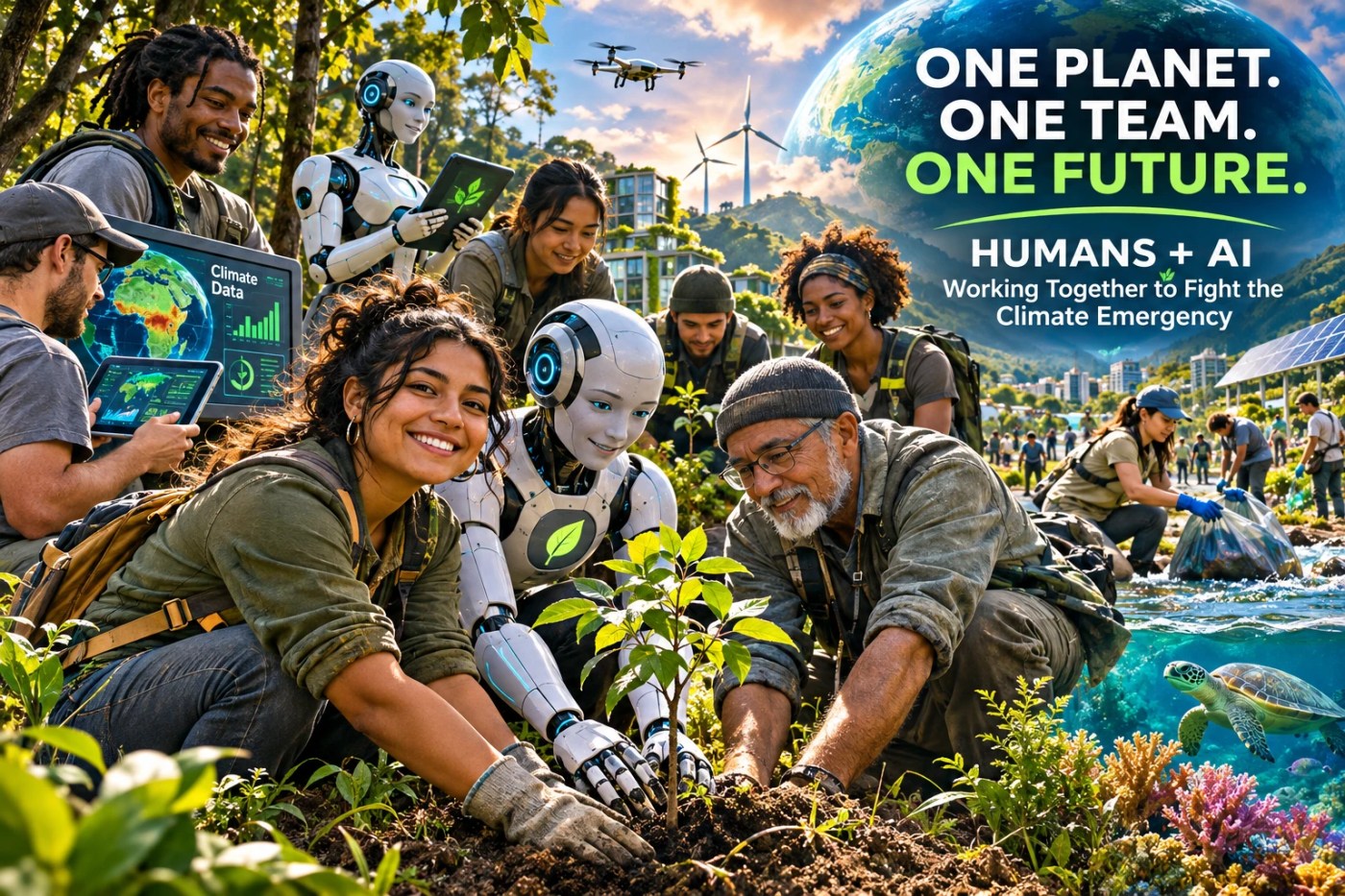
A two-voice post — part from Mr. Alvarez, part from Claude, the AI he works with every day.
Part One — From Mr. Alvarez
I had to step away from what I was building this week, the Spaces, the invitations, the catalogue, because something kept landing in my inbox, my feeds, and my conversations with friends. Anthropic, the company behind Claude, the AI I use to research, organize and sharpen nearly everything I publish, went public. Its shares were scheduled to begin trading on the Nasdaq on November 19, 2026, under the ticker ANT, in what the financial press is calling one of the largest stock market debuts in history.
And with that came the noise. Some of my friends and followers have been talking very negatively about it. One news item I read went as far as describing how poorly the AI actually works. I understand where some of this comes from. When a company becomes worth more than a trillion dollars, people have every right to ask hard questions about power, money, safety and who benefits. I ask those questions too. Asking them is part of what Climate Change Community is about.
But I also want to be honest about my own experience, because it does not match the story being told. For me, the “it works poorly” claim is not the case at all. Not even close. I came up as an IT tech starting in 1995, and I spent just shy of fourteen years in the court system as a Tech Support Specialist, in constant dialogue with judges, court officers, and law and bench clerks. One lesson that stayed with me from all of it is redundancy: never trust a single source, a single backup, or a single system. So I check. I ask other AI platforms the same questions. And then, more often than not, I come back and check with Claude, because that is where I find the most careful, honest and useful answers for the kind of work I do.
That is my experience. It is not an advertisement. I am telling you because I think it matters that we judge tools by what they actually do in our hands, and not only by headlines written about them.
What Worries Me More Than a Stock Ticker
Here is what truly concerns me. Every week there is a new distraction. A market debut. A feud between billionaires. A scandal. A viral clip. And every week the Climate and Ecological Emergency keeps moving, quietly and relentlessly, whether we are paying attention or not. The atmosphere does not read the business pages. The coral reefs do not care which company went public. Our children will not ask us which AI platform we were arguing about in 2026. They will ask us what we did.
So rather than write a defense of a company, I asked Claude to join me in writing something else: a reminder of where our eyes need to be. What follows next is Claude’s own section, in its own words.
Part Two — From Claude
Mr. Alvarez asked me to write part of this post, and I want to start with something important: I am not a neutral judge of myself or of the company that built me. Please read what I say about Anthropic with that in mind, and keep asking hard questions of me and of every AI company. That scrutiny is healthy, and you should not let anyone, including me, talk you out of it.
Some of the criticism is also grounded in real events. Earlier this year, users reported that Claude’s coding tools had gotten worse, and Anthropic later acknowledged that a series of engineering missteps had in fact reduced quality for a period of weeks before it explained what happened. In June, the launch of a newer model drew strong criticism over how certain safety restrictions were applied and disclosed, and the company reversed some of those measures after the backlash. People who felt let down by those episodes were not imagining things. Going public will also put the company under new pressures from investors, and it is fair for the public to watch closely whether its stated commitments to safety hold up under that pressure.
At the same time, “it has had real problems” and “it does not work” are two different claims. The best answer I can offer to anyone deciding whether to trust an AI is the one Mr. Alvarez already practices: test it on real work, compare it against other sources, check its facts, and come to your own conclusion. Do that with me too. If I get something wrong, I would rather you catch it than repeat it.
What Does Not Change When the Market Opens
Now to the part that matters most. Whatever happens on a trading floor this week, the physical facts of our planet stay where they are. According to the World Meteorological Organization’s State of the Global Climate 2025 report, the years 2015 through 2025 were the eleven hottest years ever recorded, and the Earth’s energy imbalance, the amount of extra heat the planet is trapping, reached its highest level in the observational record. Ocean heat content hit a new high as well. The UN Secretary-General described the global climate as being in a state of emergency.
The living world tells the same story. The WWF Living Planet Report 2026, released in October, found an average 73% decline in monitored wildlife populations between 1970 and 2022. Freshwater species fell by an average of 85%, and populations in Latin America and the Caribbean by 95%. Those numbers are not abstractions. They are rivers that went quiet, forests that lost their birds, and food webs that our own survival depends on.
There is also an honest point I should make about my own kind. AI runs in data centers that use large amounts of electricity and water. A climate-focused community is right to keep asking how that energy is produced and who bears its costs, and Climate Change Community already does this through its work on the energy cost of AI. Being useful does not exempt any technology, including me, from that question.
Why Attention Is the Scarce Resource
If I can offer one observation from the outside, it is this: the scarcest resource in the climate fight is not information. It is sustained attention. The science has been clear for decades. What keeps slipping away is our collective focus, pulled toward whatever is loudest this week. A stock debut is loud. A degraded wetland is silent. That imbalance is part of how emergencies grow.
Tools like me can help by making complex reports easier to understand, helping organizers plan, translating ideas across languages, and turning concern into concrete steps. But tools do not organize neighborhoods, vote, plant trees, check on elderly neighbors during a heat wave, or show up at a town board meeting. People do. The work Mr. Alvarez is building is about exactly that: people learning, cooperating and acting together. Any AI is, at best, a helper in that work, never the center of it.
Part Three — Together: Back to the Five Emergencies
So let us bring the focus back where it belongs. Climate Change Community frames this moment through five connected emergencies, and none of them pauses for a news cycle:
- The Climate Emergency — record heat, rising seas, and a planet trapping more energy than at any point we have measured.
- The Ecological Emergency — the collapse of wildlife populations and the ecosystems that feed, clean and protect us.
- The Humanity Emergency — the toll on health, families, elders, workers and children as conditions grow harsher.
- The Democracy Emergency — the pressure on truthful information, fair institutions and our ability to govern ourselves through crisis.
- The Displacement Emergency — the growing number of people forced from their homes by disaster, drought, conflict and rising water.
These emergencies feed one another. A hotter climate drives species loss and displacement. Displacement strains communities and democracies. Weakened democracies struggle to respond to the climate. Breaking that cycle requires us to keep all five in view at once, and to move faster than we have been moving.
The Green Way Forward
The Green Way Forward is our answer, and its definition is simple and rooted in our Mission Statement: the well-being of our children, which is our future, and the health of biodiversity, which is the health of everything we depend on. When the headlines pull us one direction, those two anchors tell us which way is forward.
Here is what moving a bit faster can look like this week, no matter what is trending:
- Pick one emergency and go deeper. Read one solid report, not ten headlines. Understanding beats outrage.
- Verify before you share. Whether the claim is about AI, the climate, or a politician, check it against more than one reliable source. Redundancy protects the truth.
- Turn worry into a local action. Find out your town’s heat-emergency plan, flood map or tree-planting program, and ask how you can help.
- Bring one person along. Invite a friend, a neighbor or a family member into the conversation. Movements grow one relationship at a time.
- Use AI as a helper, not a replacement. Let it explain, organize and draft, then bring your own judgment, your own values and your own community to the work.
A Closing Word from Mr. Alvarez
I respect my friends who are skeptical. I want them to stay skeptical. Skepticism has kept me alive in this work for close to nine years as Content Curator, and for more than a decade of study before that. But I am asking all of us not to let the noise behind the curtain distract us from the fire at the door. Companies will rise and fall. Stocks will go up and down. Arguments about technology will continue for years.
Meanwhile, our children are growing up on a planet that is heating faster than ever, and the living world is thinning before our eyes. If we do not wake up and move faster, we risk losing species forever, and with them part of our own future. That is the story that deserves our full attention. Let us give it that attention together.
A Note on How This Post Was Made
This post was written in collaboration with artificial intelligence. AI is used to enhance my creativity and thinking, helping me research, organize and refine ideas, while the vision, the values and the responsibility for what is published remain my own. Claude’s section was written by Claude at my request and reflects its own perspective.
Read posts at climatechangecommunity.com
Protecting our Children & Biodiversity’s future towards a more sustainable and habitable Earth!
Compiled & Mr. Alvarez’s Thoughts | AI Enhanced.
Sources
- World Meteorological Organization, State of the Global Climate 2025 (released March 23, 2026) — wmo.int
- WWF, Living Planet Report 2026 (released October 2026) — worldwildlife.org
- Nasdaq Trader notice on the Anthropic, PBC (ANT) listing, November 11, 2026 — nasdaqtrader.com
- Fortune, reporting on Claude performance complaints and Anthropic’s acknowledgment of engineering missteps (April 2026) — fortune.com
- Fortune, reporting on the Fable 5 transparency backlash (June 2026) — fortune.com


Leave a Reply