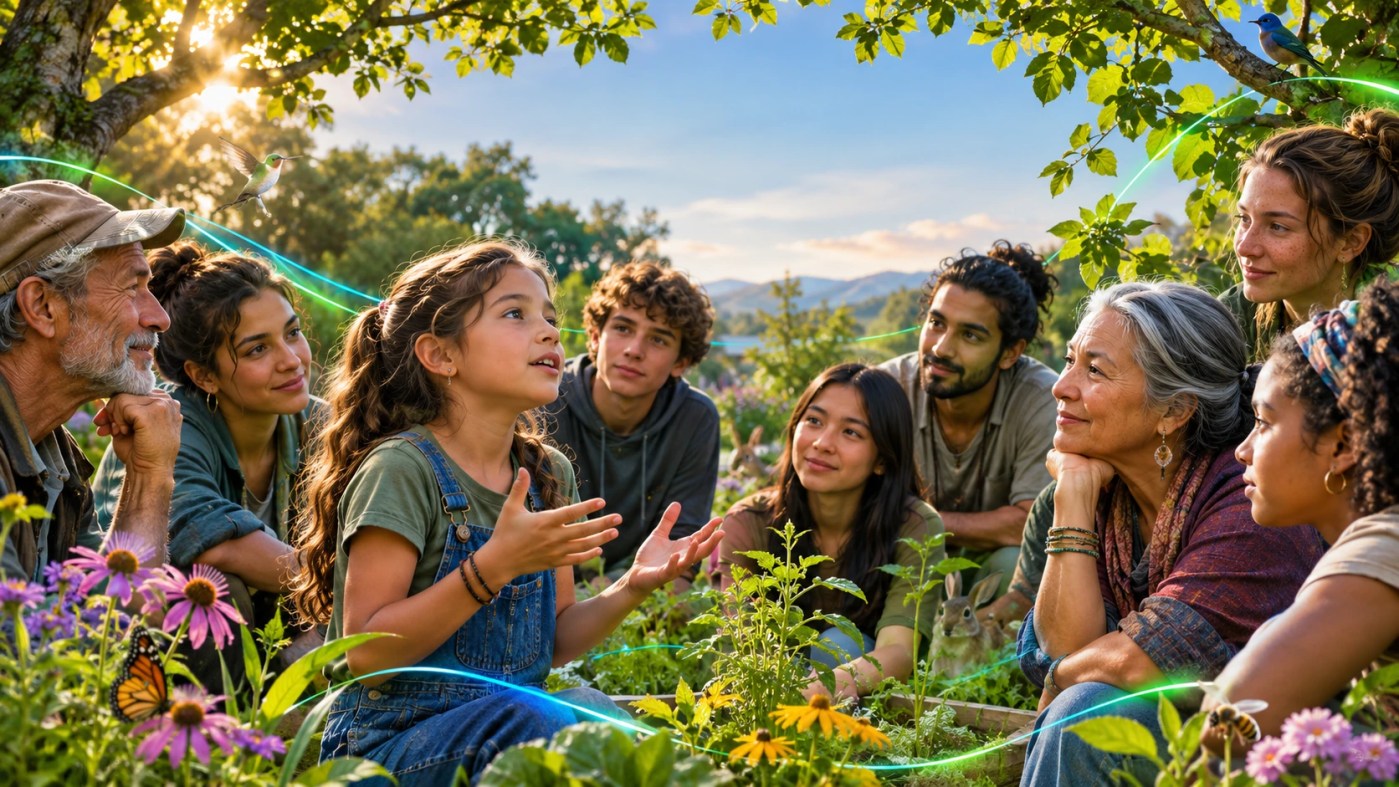
A Sunday reflection on attention, worry, young voices, and the change we owe the next generation.
A Question I Ask Myself
Sometimes I ask myself a hard question. Am I doing what I do to seek attention, or is the attention just a side effect of my overwhelming concern for our children’s future and the health of our biodiversity?
It is a fair question. I share bits of my personal life here and there. I Learn Out Loud through the Learning Out Loud Series and Self-Directed Learning actions. Lately I have been following cybersecurity and AI news, along with more in-depth climate news that I share on Sundays so that all of us can become better informed. That is a lot of putting myself out there, and anyone who does that should be willing to examine their own motives.
So here is my honest answer. Maybe it is a bit of both, but the attention-seeking part is really low, something like four percent, compared to the overwhelming concern I carry for our children and for the living systems that sustain them. I am not saying that to sound humble. I am saying it because I sat with the question long enough to know what actually moves me. And what moves me, more than anything, is a feeling I cannot shake when I see very young children out with their parents.
The Little Girl Who Almost Made Me Cry
The other day I saw a really cute little girl who reminded me of my daughter when she was that age. I almost shed tears. Literally. Not because of nostalgia alone, but because I was truly worried about what the planet will be like for her when she grows into a young adult, somewhere between 18 and 35 years of age.
Think about that window of life. Those are the years when we finish school, find our first real jobs, fall in love, decide where to live, and decide whether to raise families of our own. For that little girl, those years land somewhere in the 2040s and 2050s. The decisions being made, or avoided, right now will shape the air she breathes, the heat she has to work through, the price of her food, and whether the coastline she visits still looks the way it does today.
Then the news comes in about how slowly we are moving. The incompetence, or the lack of will, from too many elected leaders. Not to mention those who are only out to enrich themselves at our expense. So no, my motivation is not attention. Not by a long shot. It is worry, and worry that refuses to sit still turns into work.
I will also say this, because it matters: I do have a bit more confidence in our direction now, here in the United States and in other places where democracy is growing stronger than it was over the last two years. That is reassuring. But reassurance is not the same as arrival. It is a reason to keep going, not a reason to relax.
A Generation That Refuses to Be Ignored
I have watched, recently and over many years, as young adults and even children have grown stronger in voicing their disappointment. They are issuing an absolute call to action against leaders who enrich themselves at their expense, and they are demanding stronger accountability from those who plainly work on behalf of the people actively worsening the planet.
When we were young, most of us probably never imagined we would one day be talking about “saving the Earth” as an everyday responsibility. Yet today not millions, but billions of people are doing exactly that in their own way, and rightfully so. Young people especially are concerned that they should not have a second-hand say in their own future, with their concerns brushed aside as mere complaining.
And they are not just complaining. They are winning arguments in the highest places. In 2019, a group of 27 law students at the University of the South Pacific formed Pacific Island Students Fighting Climate Change and set out to bring the climate crisis before the world’s highest court. They persuaded the government of Vanuatu to champion their idea. On July 23, 2025, the International Court of Justice unanimously issued an advisory opinion confirming that nations have legal obligations to act on climate change, and that failing to do so can carry legal consequences. A classroom discussion became one of the most significant moments in the history of climate law.
Let that sink in. Students, not lobbyists, not billionaires, moved the world court. That is what happens when young people refuse to be seen and not heard.
It is beyond obvious now who cares and who simply does not. Who follows the money, and who fights for a greener environment.
Who Listens to the Children and Young Adults?
Then there is the reality of who actually listens to children and young adults. I strongly believe this is one of our great shortcomings, not only in the United States but in many places around the world.
I have had the good fortune to travel, mainly around Europe. What I noticed, especially in the South of France, is that children and young adults are listened to much more than they are here at home. They are part of every conversation. Sitting down to eat can sometimes take several hours, because everyone at the table is listening to everyone present. A child’s opinion is not an interruption. It is part of the meal.
I believe, and I do not think I am wrong about this, that we need to start paying much more attention to what young people are saying. Not as a convenience, and not as a feel-good gesture, but as a necessity, because of the Climate and Ecological Emergency. They will live with the consequences of our choices far longer than we will.
Why Do Adults Struggle to Listen?
Research has been telling us this for a long time. In Listening to Children’s Views: The Findings and Recommendations of Recent Research, Ann O’Quigley gathers the work of many researchers and opens with a blunt observation drawn from James and James: “Children are not used to being listened to.” The report goes on to explain why adults so often fail to listen. In my own words, here are the reasons that stood out to me:
- Children are seen as “other.” Adults tend to view children as less important, dependent, and less powerful, and so adults end up interpreting what children say instead of hearing it.
- Fear of upsetting them. Adults worry that talking about difficult things will cause harm, so the conversation never happens.
- Projection. Adults sometimes manage their own anxieties by projecting them onto children and acting as if adults always know a child’s needs better than the child does.
- Lack of training. Many professionals openly admit they were never taught how to talk with, and listen to, young people.
- Confusing participation with decision-making. Some adults avoid listening because they believe that asking a child’s view means handing the child the final decision. It does not.
- Protection that becomes silencing. Children are treated as vulnerable and in need of protection, yet the research notes that their lack of rights is part of what makes them vulnerable in the first place.
The report also describes how children felt when professionals did talk to them: conversations that felt like interrogations, adults who seemed judgmental or intrusive, and interventions that did not feel supportive. That research was written about family and welfare settings, but read it again with the climate crisis in mind. Are we not doing the same thing on a planetary scale? We interpret young people’s climate fears for them. We worry that honesty will upset them. We confuse giving them a voice with giving them the keys. And when we do listen, too often it feels to them like a performance rather than a partnership.
What the Science Told Parents Back in 2016
Then there is the matter of how climate change affects children’s health, including the challenges that show up at school. In May 2016, under the Obama-Biden administration, the U.S. Environmental Protection Agency released a fact sheet called “Climate Change and the Health of Children.” I remember it clearly. It was colorful and eye-catching, it was distributed as a PDF so families could share it, and it was packed with useful information for parents. I never forgot it, and an archived copy is still available today.
What caught my attention was how plainly it explained the way climate change touches children at every stage of growth. Here is that section:
Impacts as Children Grow
Climate change affects children differently depending on their age and stage of development. These stages begin in the womb and continue throughout childhood and adolescence.
Newborns
Newborns are more likely to have been born before their due date or at a low birth weight if their mother is exposed during pregnancy to extreme heat, air pollution, and flood-related contaminants.
Infants and Toddlers
Infants and toddlers breathe, eat, and drink more for their body size than adults. They are sensitive to pollutants or allergens in the air, which may trigger asthma episodes. Infants and toddlers are also sensitive to contaminants in water and food, which increases the risk of diarrhea. Heat-related illness is also a threat to very young children, as they are less able to regulate body temperature.
School Age and Older Children
School age and older children spend more time outdoors than adults, which increases their risk of being exposed to extreme heat and higher average temperatures, pollutants in air and water, and diseases carried by mosquitoes and ticks. High school athletes are particularly at risk for heat illnesses. About 9,000 children are treated for heat illness (such as heat stroke and muscle cramps) related to athletic activity each year.
The same fact sheet also named something we still do not talk about enough: children’s mental health. When extreme weather causes injury, loss, or displacement, children can struggle in school and face depression, anxiety, and post-traumatic stress, and those effects can follow them into adulthood if left untreated.
That was nearly a decade ago. The science was clear, it was written for ordinary parents, and it came from our own government. The question was never whether we knew. The question is what we did with what we knew.
Can You Blame Them?
I could go on and on about why we must listen to our children and young adults, and about how what is happening affects their physical health, their mental health, and every other part of their lives. They need to be heard because they are trying to save their own lives, and most of the time they are simply asking us to help them. They have every right to be heard and to protect themselves, their future, and the continuation of humankind. That sounds rough, but it is a stone-cold reality.
No wonder so many of them worry about bringing new life into this world as they grow toward independence. That is not my guess; it is in the data. A 2021 study published in The Lancet Planetary Health surveyed 10,000 young people aged 16 to 25 across ten countries, including the United States. Three-quarters said the future is frightening. Nearly half said their feelings about climate change affect their daily lives. And 39 percent said they are hesitant to have children of their own. The researchers linked that distress not just to the climate itself, but to young people’s sense that governments are failing them.
No wonder they question our actions, our motives, and our thinking. Again, can you blame them?
Many of us should be ashamed of ourselves. Why? Because too many are mired in willful denial, and I believe the fossil fuel industry has worked hard to feed that denial. Because the reality of these emergencies is sitting right in our laps and we still look away. Because we spend enormous energy fighting each other over our deepest moral disagreements, while the children who are already here, breathing smoke-filled air and sitting in overheated classrooms, wait for someone to notice them. Whatever side we stand on in those debates, surely we can agree that a child who is alive today deserves clean air, safe water, and a livable future. Sometimes the hypocrisy is so thick we could wear it as an overcoat.
Faith, Money, and the Courage to Change
There are two more forces I want to name, because pretending they are not part of the story would be dishonest.
The first is money in politics. When lobbying dollars and campaign contributions flow from the industries most responsible for the crisis, it should not surprise anyone that progress moves at a crawl. Young people see this clearly. They are asking a simple question: who do our leaders actually work for?
The second is harder to talk about, and I want to do it carefully and respectfully. Some interpretations of religious belief have slowed our progress toward a sustainable, habitable world. When faith is used to argue that the Earth is ours to use up, that the future is already decided, or that caring for creation is somehow a distraction from more important things, it becomes easier to do nothing. That is a real obstacle, and it deserves an honest conversation.
But here is what gives me hope: some of the strongest voices for climate action come from people of faith. Pope Francis’s 2015 encyclical Laudato Si’ called the whole world to care for our common home, and it continues to inspire parishes and communities to plant trees, cut waste, and save energy. Interfaith networks bring together Christian, Muslim, Jewish, Hindu, Buddhist, Sikh, Indigenous, and other traditions in shared action. Dozens of faith institutions have divested from fossil fuels. For millions of people, protecting creation is not separate from their faith; it is their faith in action.
So my invitation is not to argue about belief. It is to ask every tradition, and every one of us, the same question: does what I believe lead me to protect the children and the living world in front of me? If it does, we are allies. If it does not, maybe that is where the reflection needs to begin.
What Listening Actually Looks Like
Talking about listening is easy. Doing it takes practice. Here are a few simple ways any of us can start this week:
- Ask, then wait. Ask the young people in your life what they think about the future and the climate, and then let the silence do its work. Do not rush to reassure or correct.
- Bring them to the table, literally. Take a lesson from the South of France. Make dinner a place where every voice counts, including the youngest.
- Take their fears seriously without feeding despair. Their worry is a rational response to real events. Acknowledge it, then talk about what people are doing and what you can do together.
- Show them your own learning. Let them see you reading, questioning, and changing your mind. That is what Learning Out Loud is all about.
- Amplify, do not replace. When young people speak at school boards, town councils, or online, show up, share their words, and give them credit.
- Act where you have power. Your vote, your purchases, your conversations, your community. Children cannot do all of this alone, and they should not have to.
We Need to Change: Me, You, and Us
I started this reflection with a question about my own motives, and I will end with a question for all of us. If a young person looked at how we spent our time, our money, and our voices this year, would they believe we were listening to them?
This is not about guilt for its own sake. It is about responsibility. The children are not asking us to be perfect. They are asking us to pay attention, to tell the truth, and to act like their future matters as much as our comfort. That is the heart of the Green Way Forward: the well-being of our children, who are our future, and the health of our biodiversity.
We need to change. Me, you, and us.
And if you take one thing from this post, let it be this: the next time a child or a young adult tries to tell you what they are worried about, put everything else down and listen. Really listen. It may be the most important climate action you take all week.
Sources
- U.S. Environmental Protection Agency, “Climate Change and the Health of Children,” EPA 430-F-16-055, May 2016 (archive.epa.gov).
- O’Quigley, Ann. Listening to Children’s Views: The Findings and Recommendations of Recent Research, including citations of James and James (1999).
- Hickman, C. et al. “Climate anxiety in children and young people and their beliefs about government responses to climate change: a global survey,” The Lancet Planetary Health, 2021.
- International Court of Justice, Advisory Opinion on the Obligations of States in respect of Climate Change, July 23, 2025; Pacific Island Students Fighting Climate Change (pisfcc.org).
- Pope Francis, Laudato Si’: On Care for Our Common Home, 2015; Laudato Si’ Movement (laudatosimovement.org).
A note on how this was made: I use AI as a tool to enhance my creativity and thinking. The reflections, worries, and convictions here are my own; AI helped me shape, research, and strengthen them.
Read posts at climatechangecommunity.com
Protecting our Children & Biodiversity’s future towards a more sustainable and habitable Earth!
Compiled & Mr. Alvarez’s Thoughts | AI Enhanced.


Leave a Reply