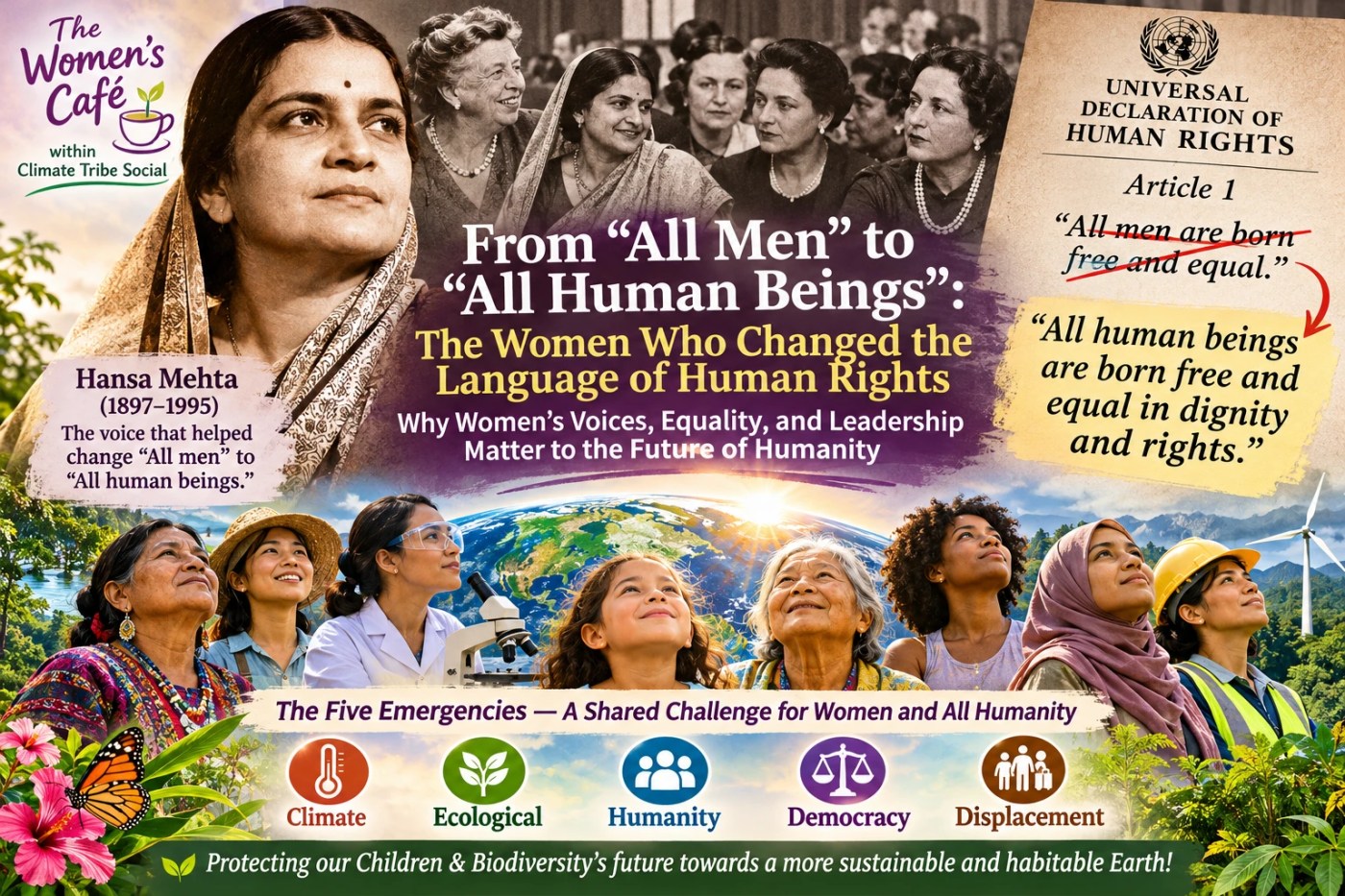
Protecting our Children & Biodiversity’s future towards a more sustainable and habitable Earth!
Compiled & Mr. Alvarez’s Thoughts | AI Enhanced.
Two Words That Changed Who Counts
Early drafts of the Universal Declaration of Human Rights opened with a line that sounded noble and familiar: “All men are born free and equal.” It echoed the great revolutionary declarations of the eighteenth century, and it carried their blind spot with it. Those earlier promises of liberty were written in a world where women could not vote, where enslaved people were counted as property, and where colonized peoples were ruled without their consent. “Men” was said to mean everyone. History had already shown how easily it could mean far fewer.
Hansa Mehta would not let the phrase stand. A veteran of India’s freedom movement, an educator, and a member of the assembly then drafting her newly independent country’s constitution, Mehta served as India’s delegate to the United Nations Commission on Human Rights in 1947 and 1948. She and the Commission’s chair, Eleanor Roosevelt, were its only two women delegates. Mehta’s objection was practical. Governments looking for a reason to deny women their rights could point to that one word and say the document was never about them. Language that can be read narrowly, she understood, eventually will be.
She prevailed. When the General Assembly adopted the Declaration in Paris on December 10, 1948, Article 1 began: “All human beings are born free and equal in dignity and rights.” The United Nations credits Mehta with that change. Two words replaced one, and half of humanity was written into the first sentence of the modern human rights era instead of being left to hope they were implied.
The Women in the Room
Mehta did not work alone, and the story is richer when we remember the others. Minerva Bernardino of the Dominican Republic pressed for the words “the equal rights of men and women” in the Declaration’s preamble. Begum Shaista Ikramullah of Pakistan championed equal rights in marriage, with child marriage and forced marriage in mind. Bodil Begtrup of Denmark argued that the text should speak of “all” or “everyone” as the holders of rights. Marie-Hélène Lefaucheux of France pushed for sex to be named in the non-discrimination article. Evdokia Uralova of the Byelorussian Soviet Socialist Republic argued for equal pay for equal work. Lakshmi Menon, also of India, insisted that non-discrimination on the basis of sex run through the whole document.
They came from different continents, faiths, and political systems, and they disagreed about a great deal. What they shared was a refusal to accept that universality could be assumed. It had to be spelled out, clause by clause, by people willing to be the difficult voice in the room. That is worth remembering in any community that does its work through dialogue. Inclusion rarely arrives on its own. Someone has to ask for it out loud.
A Sentence That Asks Something of Us
Article 1 has a second sentence, and it does different work than the first. Human beings, it says, are “endowed with reason and conscience,” and they “should act towards one another in a spirit of brotherhood.”
Notice the change of verb. The first sentence says what we are: free and equal. The second starts the same way, with what we have: reason and conscience. Then it turns to what we owe: should act. The Declaration moves from description to duty before its first article is over. Rights are announced, and in the same breath a responsibility for one another is laid beside them.
The pairing of reason and conscience was itself a cross-cultural negotiation. The Chinese delegate, the philosopher Peng Chun Chang, argued that reason alone was too thin an account of a human being. He urged the drafters to add the Confucian idea of ren, a felt awareness of other people, which entered the English text as “conscience.” So the sentence names two capacities: the ability to understand what is happening, and the ability to care that it is happening to someone else. A world facing overlapping emergencies needs both. Reason without conscience produces accurate reports that nobody acts on. Conscience without reason produces passion aimed at the wrong targets.
Then there is “brotherhood.” It is fair to note the irony: the drafters corrected “all men” and left a gendered word standing one sentence later. The edit was unfinished. But the meaning is plain enough. It is kinship, the bond of people who answer for each other. The article does not claim we already live that way. It says we should. That one word turns a statement of fact into a call to action, and it leaves the answer to every generation that reads it.
Moral Infrastructure Built in the Ashes
The Declaration was written by people who had just seen what happens when human dignity is treated as negotiable. Two world wars, the Holocaust, cities burned from the air, famine, tens of millions dead. The delegates represented rival ideologies, and the Cold War was already hardening around them. They still agreed on thirty articles, adopted with forty-eight votes in favor, eight abstentions, and none against.
Critics have always pointed out that the Declaration is not a treaty and that no court enforces it directly. That is true. But consider what infrastructure is. Most of us never look at the water main under the street or the footing under the bridge, yet everything above depends on them. The Declaration works that way. Its language runs beneath the human rights treaties that followed, beneath national constitutions written since 1948, and beneath the arguments ordinary people make when they tell a government: you may not do this to us. It has been translated into more than five hundred languages. It gave the world a common vocabulary for saying that a wrong is a wrong wherever it occurs.
Two features of its design matter for climate readers. First, it refuses to rank rights. Freedom of speech and fair trials sit beside food, housing, health, education, and work, because a person cannot exercise one set while being denied the other. Second, Article 28 says everyone is entitled to a social and international order in which these rights can be fully realized. The drafters understood that rights depend on conditions. They were thinking of peace and economic stability. We now know those conditions include a livable atmosphere, living soils, and a stable ocean. The world has begun to say so formally: in 2022 the UN General Assembly recognized a clean, healthy, and sustainable environment as a human right, and in 2025 the International Court of Justice advised that states have legal obligations to protect the climate system.
Five Emergencies, One Broken Promise
At Climate Change Community we speak of Five Emergencies: Climate, Ecological, Humanity, Democracy, and Displacement. They are usually reported as separate stories. Read through Article 1, they are one story told five ways: people being treated as less than free and less than equal.
The Climate Emergency
A child born today on a river delta, on a low island, or in a neighborhood with no shade and no cooling inherits a narrower life than a child born somewhere safer and wealthier, and she did nothing to earn the difference. The people who have burned the least fossil fuel are, again and again, the ones who lose homes, harvests, and health first. That is inequality assigned at birth, the very thing Article 1 says does not exist. Climate disruption is a physical process. Who pays for it is a human decision.
The Ecological Emergency
Human dignity has a material basis. The right to food assumes pollinators and fertile soil. The right to health assumes clean air and water. The cultural rights of Indigenous and local peoples assume that the forests, rivers, and reefs their ways of life grew from are still there. When ecosystems unravel, those rights fail quietly, long before anyone files a complaint. The drafters of 1948 wrote about our duties to one another. Biodiversity loss teaches that we cannot keep those duties while dismantling the living systems everyone depends on.
The Humanity Emergency
This is the emergency underneath the others: the weakening of our ability to see one another as fully human. Racism, misogyny, caste, religious hatred, and the casual cruelty of online life all work the same way. They redraw the line around “human beings” so that some people fall outside it. Mehta’s fight was against this same thing in its most polite and bureaucratic form, a word that left people out while claiming to include them. Every act of dehumanization is an attempt to reverse her edit.
The Democracy Emergency
Article 21 holds that the authority of government rests on the will of the people, expressed in genuine elections with universal and equal suffrage. Equal voice is Article 1 applied to power. When votes are suppressed, when information is poisoned, when money outshouts citizens, some people’s reason and conscience are made to count for less than others’. The damage spreads to every other emergency, because democratic institutions are how the many restrain the few who profit from pollution and delay. Communities that cannot speak cannot protect themselves.
The Displacement Emergency
According to the UN Refugee Agency, 117.8 million people were forcibly displaced at the end of 2025, about one in every seventy people on Earth. The total fell for the first time in a decade, which is real good news, though many people returned to places that are still unsafe and new crises in 2026 have forced more to flee. Storms, drought, and rising seas uproot millions more each year, and international law still has no settled status for people driven out by a changing climate. Article 14 affirms the right to seek asylum from persecution. Article 1 goes deeper. A person who has lost her home, her papers, and her country has lost none of her dignity. The test of whether we believe “all human beings” is how we speak to her at the border.
Rights-Bearers and Planetary Stewards
Here is the hopeful part. The Declaration itself is proof that people can change the terms. In 1948 a small group of delegates, working in the wreckage of the worst war in history and with every reason for cynicism, agreed on a sentence that most governments of the day did not live up to. That sentence has been pulling the world toward itself ever since. Movements against apartheid and colonial rule, and for civil rights, women’s rights, and disability rights, all reached for its words. An aspiration stated clearly becomes a standard, and a standard becomes a lever.
Our generation’s task is to carry the sentence one step further. To hold rights is also to hold responsibilities, and the Declaration says as much in Article 29: everyone has duties to the community that makes the full development of a person possible. In this century, that community includes the children who will inherit the atmosphere we leave, and the living world that makes every human right physically possible. Rights-bearing humans must also act as planetary stewards. These are one role seen from two sides.
What does that look like in an ordinary week? It looks like using reason: learning the science, reading the policy, knowing your local flood maps and heat plans. It looks like using conscience: asking who in your town is most exposed and whether they have a seat at the table. And it looks like acting in kinship: checking on elders during a heat wave, welcoming newcomers who arrived because home became unlivable, voting and helping others vote, restoring a wetland, planting for pollinators, showing up at the meeting where the decision gets made. This is what we mean by Adaptive Resiliency: communities learning together, through dialogue and cooperation, to protect one another through what is coming and to prevent what can still be prevented.
Hansa Mehta changed two words and widened the circle of who counts. That circle still has to be widened by hand, in every town, by people who decide that “all human beings” includes the neighbor, the stranger, and the child not yet born. The promise was made in 1948. Keeping it is our work, for our children’s future and for the biodiversity that sustains them.
Read posts at climatechangecommunity.com
A note on process: artificial intelligence is used to enhance Mr. Alvarez’s creativity and thinking in preparing these posts.
Sources
United Nations, “Women Who Shaped the Universal Declaration”: un.org/en/observances/human-rights-day/women-who-shaped-the-universal-declaration
United Nations, “Universal Declaration of Human Rights” and “History of the Declaration”: un.org/en/about-us/universal-declaration-of-human-rights
UNHCR, Global Trends: Forced Displacement in 2025 (published June 2026): unhcr.org/global-trends


Leave a Reply