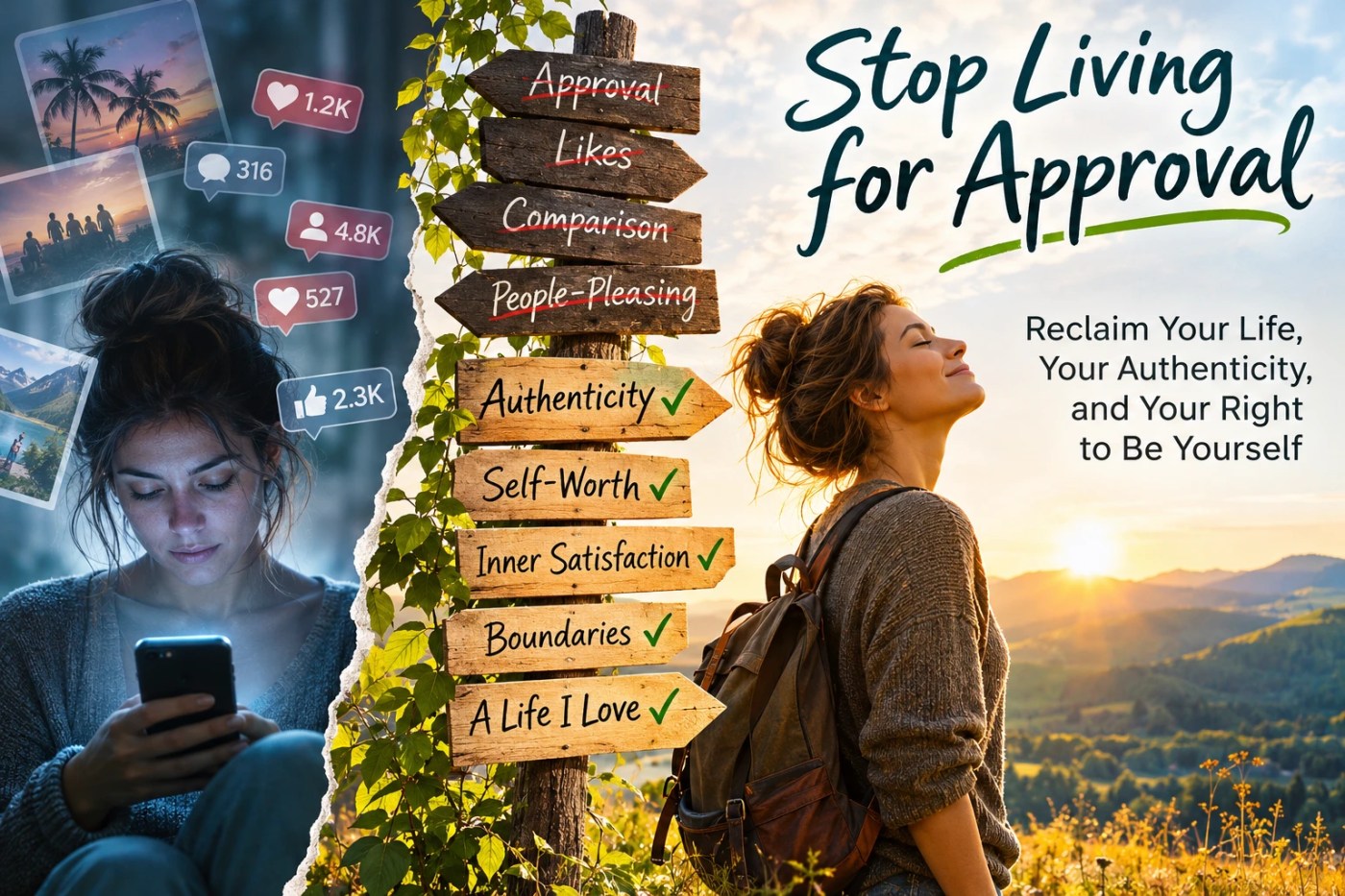
Two old posts, one honest update, and a few things the years have taught all of us about approval, applause, and the quiet courage of being ourselves.
A Note Before We Begin
Back in 2018, I wrote a post about the need for approval and how it quietly steers our lives. A year later, in 2019, I followed it with a piece about seeking approval through social media and the endless hunt for likes. Both posts came from the same root, and both have been sitting in the archive long enough to gather dust.
So I am doing something I would encourage anyone to do with their own old beliefs: bringing them back out, checking them against what we know now, keeping what still holds, correcting what doesn’t, and retiring the rest. This post replaces both of the originals.
And yes, times have indeed changed. When I wrote those pieces, the phrase “short-form video” was not yet running our evenings, like counts could not be hidden, governments were not passing laws to keep children off social platforms, and very few of us imagined that a machine could write a caption, smooth a face, or invent a vacation photo that never happened. The core problem is the same. The stage it plays out on is bigger, louder, and far more automated.
How Approval-Seeking Starts, and Why It Works for a While
It usually begins as a sensible strategy. We please the people around us, they are happy for a moment, and we feel good about ourselves. We avoid conflict. We earn a pat on the back now and then. For many of us, that approach can run for years, and it seems to lower the everyday anxiety of being judged.
Here is the catch. The very habit that once made us feel accomplished slowly becomes the problem itself. When we urgently aim to please, we are asking the outside world to hand us something only we can give ourselves: a sense that we are acceptable as we are. Every time we outsource that, we set ourselves up for disappointment, because the outside world is fickle, busy, and mostly thinking about itself.
Over time, approval comes at a steep price. We do what is expected of us. We avoid choices that might earn a disapproving look or rank low on the social status meter. We pursue the life other people picture for us rather than the one we actually want. And the most important skill of all, learning to approve of ourselves even when others don’t, never gets practiced.
The Hidden Cost: Losing Track of Yourself
Needing approval rarely looks like weakness from the outside. Very often it looks like success. Approval-seekers tend to be high achievers: reliable, hardworking, the ones who never say no. But those results often come at the expense of everything else.
When we are driven to achieve mainly to impress, we take on too much. We overwork, skip time for ourselves, overthink our challenges, and feel overwhelmed. We pass on opportunities that matter to us because we are afraid our performance will not be perfect. Sometimes we fear failure so much that we quit before we begin.
Worst of all, when other people’s acceptance decides where our time goes, we lose touch with what we value, what drives us, and what makes us happy. We stay in work we don’t enjoy and keep habits that don’t serve us, because those things look good to someone else. If that sounds familiar, it is not a character flaw. It is a signal, and signals can be answered.
What Changed Between 2019 and 2026
When I wrote about likes in 2019, the problem looked simple: we post, we count, we feel good or bad depending on the number. Since then, the landscape has shifted in ways worth naming.
We can hide the scoreboard now, but the game didn’t end
In 2021, Instagram and Facebook began letting everyone hide public like counts, both on their own posts and in their feeds. That was a genuine acknowledgment that the number itself puts pressure on people. Yet the option stays off unless you choose it, and the deeper pull remains. Views, shares, comments, followers, and the silent judgment of the algorithm have simply taken over where the visible like count left off.
The feed stopped being about our friends
In 2019, most of what we saw came from people we actually knew. Today, much of what fills our screens is chosen by recommendation systems built to hold our attention. That changes the comparison game. We are no longer measuring ourselves against a neighbor’s vacation; we are measuring ourselves against the most polished moments of strangers around the world, served to us endlessly.
Some of what we compare ourselves to isn’t even real
Filters were already common in 2019. Now AI tools can retouch faces, generate entire scenes, and write the perfect caption in seconds. Comparing our ordinary, unedited lives to content that may have been partly or wholly manufactured is a losing contest by design. It is worth remembering that a picture-perfect life on a screen may not exist anywhere off it.
Governments started stepping in
In December 2025, Australia became the first country to require major social platforms to take reasonable steps to keep users under 16 off their services, and other countries have since discussed similar limits. Early reports from Australia’s own regulator found that most young teens were still finding ways onto social media anyway. Whatever one thinks of the policy, the message is clear: concern about what these platforms do to us, and especially to our children, has moved from personal worry to public policy. Laws can help, but they cannot replace the inner work of each of us deciding what we let these tools mean.
We learned habits take longer than we thought
In 2019 I repeated the popular claim that it takes about 21 days to build a new habit. I am correcting that here. A 2024 systematic review of habit research found that new healthy habits typically began forming around the two-month mark, with medians of roughly 59 to 66 days, and that individual timelines ranged anywhere from 4 days to nearly a year. The 21-day figure traces back to a 1960 observation about people adjusting to changes in their appearance, not to habit science. The lesson is a kind one: if three weeks pass and it still feels hard, you are not failing. You are right on schedule.
Living Behind the Lens
Picture a fun day with friends, an outing with the kids, a long-awaited trip, all experienced through a smartphone screen. The photographs have almost become part of the activity. There is nothing wrong with keeping memories. But it is fair to ask an honest question: who are the pictures really for?
What begins as innocent sharing can quietly turn into a search for a self-esteem boost. Ironically, the posting itself can wear down the very self-esteem it was meant to lift. We start to feel as if something did not quite happen unless it was captured and shared. If a post doesn’t get the response we hoped for, we can end up thinking less of the photo, the day, and sometimes ourselves. The quick reward of each new reaction can keep us coming back for more.
Along the way, privacy erodes. We share personal moments, sometimes our children’s faces and locations, with people we have never met, because the reaction feels good in the moment. Once we are caught in that loop, it gets harder to enjoy time with loved ones simply for its own sake.
A beautiful moment does not need an audience to be real. Some of the most precious memories we will ever have are the ones nobody else knows about.
Approval-Seeking and the Climate Conversation
I would be leaving something out if I didn’t connect this to the work we do here. One of the quietest obstacles to climate action is not ignorance. It is the fear of disapproval.
Many people care deeply about the Climate and Ecological Emergency yet stay silent at the dinner table, at work, or online because they don’t want to seem preachy, alarmist, or out of step with the people around them. That silence feeds on itself. When no one speaks, everyone assumes no one else cares, and the silence grows.
Breaking free of the need for approval is not only personal growth. It is a form of climate competence. It lets us start honest conversations, change habits that others might find odd, choose a simpler life when everyone else is upgrading, and stand up for our children and for biodiversity even when it is not the popular thing to do. Adaptive resiliency begins with people who can think and act for themselves while still caring deeply about the community around them.
Getting to Know Yourself Again
The way out of approval-seeking is not to stop caring about people. It is to start caring about yourself with the same attention. Begin by asking questions you may not have asked in a while:
- What do I truly value?
- What keeps me up at night, and what gets me out of bed in the morning?
- How would I spend my time if nobody were watching or keeping score?
- When was the last time I did something meaningful and told no one?
- Am I living by my own values or by someone else’s definition of success?
Listen to the answers, and start aligning your actions with your values, principles, and goals. When you do, life tends to become simpler and steadier. Success stops being about looking busy or looking impressive. It becomes a measure of doing what matters to you.
Practical Steps for 2026
1. Pause before you say yes
Before accepting a new task, favor, invitation, or commitment, step back and look at your schedule. Ask yourself what is truly necessary and important, and what is being driven by people-pleasing. Then work slowly through the people-pleasing list and replace those items with things that support your own growth.
2. Be honest about your motives
For every commitment, ask: am I doing this because it is right for me, or to win approval or avoid disapproval? Simply noticing the answer is a powerful first step.
3. Make the scroll a little harder
Turn off nonessential notifications. Move your most-used apps off your home screen. Try your phone’s built-in screen time limits. Hide like and view counts if your platform allows it. You don’t have to abandon social media to take back control of how much attention it gets.
4. Keep some moments private on purpose
Choose an outing, a meal, or a whole weekend to keep entirely for yourself and the people you are with. Notice what it feels like to experience something without turning it into content.
5. Make a picture memory instead of a photo
When you feel the urge to share, pause and tune into how you feel right now. What about this moment feels good? Hold it long enough to imprint it in your mind. Chances are you will remember it more vividly, and for longer, than you would another post in your feed.
6. Be patient with yourself
Rewiring a habit is hard, and as the research now shows, it often takes two months or more before a new behavior starts to feel natural. Reward small wins. A day or a week without checking or posting is worth celebrating.
7. Look at where the need comes from
Are you bored? Lonely? Using the feed to feel connected without the effort of real connection? Those are real needs, and they deserve healthier outlets: a walk with a friend, a community group, a local resilience project, or a conversation with a counselor, coach, or trusted mentor.
8. Collect evidence of your own approval
Pay attention to the moments when you stayed true to yourself, made a choice you are proud of, or liked something about yourself regardless of how anyone reacted. Write them down. Over time, that list becomes a quiet, steady source of the validation you used to chase outside.
Authenticity Is Not the Same as Not Caring
None of this is a case for becoming cold or indifferent. Relationships matter. Community matters. Constructive feedback, accountability, and kindness matter. We should welcome people who challenge our thinking and help us grow.
The difference is this: we can listen to others without handing them the keys to our identity. We can belong to a community without disappearing into it. We can share our joy without needing others to confirm that we are joyful. In fact, people who are at peace with themselves tend to make better friends, neighbors, and collaborators. They have less to prove and more room to appreciate others.
Your Life Is Not a Performance
Since 2018, the platforms have changed, the algorithms have grown smarter, and the pressure to perform has followed us into nearly every corner of life. But the most important truth from those two old posts still stands: no amount of outside approval can replace the approval we learn to give ourselves.
You don’t need to impress everyone. You don’t need to document everything. You don’t need to explain every decision. Be kind, be accountable, keep learning, and treat people with dignity. Just don’t lose yourself along the way.
Live deliberately. Experience fully. Share when you want to, stay private when you prefer, and build a life you would value even if nobody else were watching.
Because at the end of the day, you are the one who gets to live it.
Protecting our Children & Biodiversity’s future towards a more sustainable and habitable Earth!
Compiled & Mr. Alvarez’s Thoughts | AI Enhanced.
This post was created with the help of artificial intelligence, which I use as a tool to enhance my creativity and thinking. The ideas, values, and final words are my own.
Read posts at climatechangecommunity.com


Leave a Reply