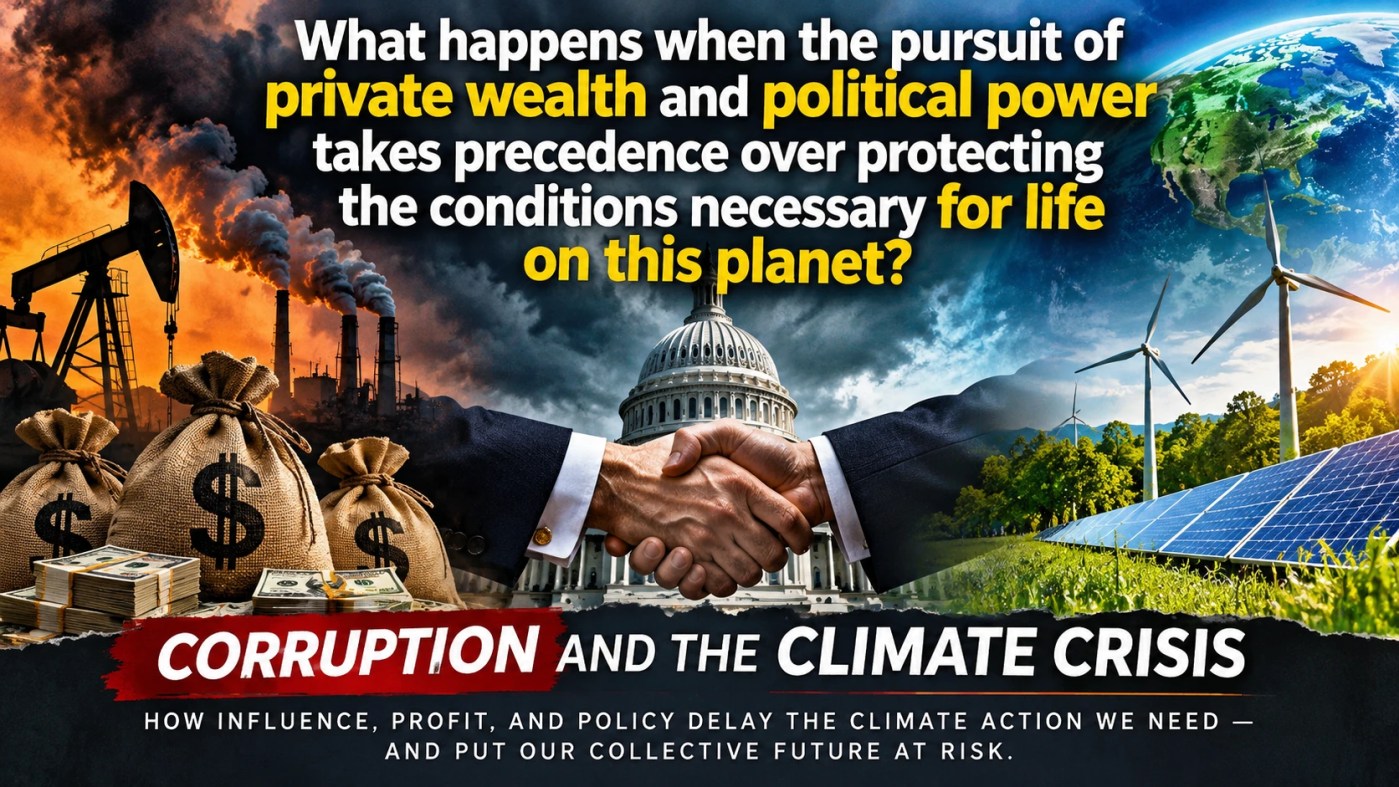
You think protecting our ‘Children’s’ future is a f$cking joke? – think again – feel me!
The hidden cost of corruption, emergency-fund spending, political favoritism, and the erosion of public accountability
There is something fundamentally wrong when money intended to serve the public ends up serving interests that have little to do with the public good.
Corruption has always interested me for precisely this reason. It is not simply about someone taking money illegally. It is about the displacement of priorities: money that should be protecting communities, preparing for disasters, protecting our environment, and improving people’s lives being redirected toward other interests.
When we look at the Climate and Ecological Emergency, this becomes especially concerning. We are living through a period when governments should be strengthening their emergency-response capabilities, investing in climate adaptation, protecting vulnerable populations, restoring ecosystems, and preparing communities for increasingly dangerous conditions.
This post grew out of a November 15, 2026 video by political commentator Jack Cocchiarella on corruption and the coming wave of congressional oversight. I want to take his central point, that corruption is an affordability issue, one step further: corruption is a climate issue.
What I find just as troubling is the scale and openness of it. I do not believe we have seen corruption this blatant in our lifetimes, and the way it is laughed off, or defended out of loyalty, may be the most dangerous part of all. I will return to that below.
Corruption doesn’t just steal money. It steals preparedness, opportunity, public trust, and sometimes the very time we cannot afford to lose.
1. Corruption Is More Than the Theft of Money
When we talk about corruption, we often picture envelopes of cash, secret deals, or politicians personally enriching themselves. Those things matter. But corruption can also be institutional and systemic. It can involve:
- Public contracts awarded without meaningful competition.
- Government resources directed toward politically favored projects.
- Conflicts of interest involving donors, contractors, and decision-makers.
- Emergency powers used to bypass normal oversight.
- Public money spent without adequate transparency.
- Investigations and accountability weakened or delayed.
Not every questionable expenditure is criminal. There are real distinctions between illegal conduct, conflicts of interest, waste, mismanagement, and politically motivated spending. But all of them undermine public confidence when accountability is absent.
And there is a consequence that deserves far more attention: the opportunity cost of corruption. Every dollar spent on one priority is a dollar unavailable for another. When the first priority is poorly justified or designed to benefit selected interests, the public loses twice. It loses the money, and it loses whatever that money could have accomplished.
2. Corruption Undermines Climate Action Everywhere
This is not only an American problem, and it is not a theory. Transparency International, the world’s leading anti-corruption watchdog, devoted its 2024 Corruption Perceptions Index to this very connection. It warned that corruption threatens to derail global cooperation on climate change and that billions of dollars in climate finance are at risk of being stolen or misused.
The pattern is stark. The countries most exposed to climate change are often among those scoring worst on corruption, including South Sudan, Somalia, and Venezuela. In September 2023, when Storm Daniel struck Derna, Libya, two dams collapsed; that disaster has been linked to corruption and years of neglected maintenance. Even countries that lead climate negotiations are slipping. The United States scored 65 out of 100.
Corruption damages climate action in at least four ways:
- Diverted money: Funds meant for adaptation, disaster preparedness, or clean energy are stolen, wasted, or quietly redirected.
- Captured policy: Vested interests, including fossil-fuel lobbyists, shape or water down the rules meant to cut emissions. Transparency International pointed to their outsized influence at recent UN climate summits.
- Weakened enforcement: Environmental protections exist on paper but are waived, ignored, or bought off in practice.
- Lost trust: When people believe public money is being stolen, they become less willing to support the large public investments that climate resilience requires.
Every one of these is a direct threat to the necessary and viable climate action our communities depend on. The two stories that follow, one national and one in Florida, show how this plays out close to home.
3. What the Video Shows: Accountability Comes to Washington
On November 3, 2026, voters gave Democrats control of both the House and the Senate. Reporting on the campaign found it was driven largely by frustration over the cost of living and perceived public corruption. Cocchiarella’s video is about what comes next.
The new oversight agenda
Rep. Robert Garcia of California, in line to chair the House Oversight Committee in January, has said the committee will focus on four investigations: the Trump family’s finances, the Department of Homeland Security and ICE, corporate corruption, and the Jeffrey Epstein case. Cocchiarella adds that oversight should not stop at one party, and he calls for a ban on stock trading by members of Congress and other officials.
The White House has pushed back hard. In a letter reported by Punchbowl News, White House counsel Will Scharf warned Garcia that the planned investigations could amount to “blatant criminality” and reminded him of the constitutional limits on congressional inquiries. Garcia replied that Congress does not need the White House’s permission to investigate. The President and the White House have consistently denied any wrongdoing.
A birthday trip on the public’s tab
The video’s headline story concerns Ivanka Trump’s 45th birthday trip to Marrakech in late October. Federal records obtained by the Daily Mail show two Secret Service hotel contracts worth about $93,000 for agents at two five-star hotels, not counting their flights, meals, transport, or salaries. Ivanka is legally entitled to protection as the President’s child, and her name does not appear on the records. Cocchiarella argues that someone of her wealth should reimburse taxpayers for luxury private travel.
Conflicts of interest abroad
The video also cites a CNN investigation into Jared Kushner. While Kushner served as a lead U.S. negotiator in Gaza diplomacy, his firm, Affinity Partners, was the largest shareholder in Phoenix Financial, an Israeli group that invests in companies supplying Israel’s military. CNN said it found no evidence his diplomacy influenced those investments, and Kushner called the report “deeply misleading.” It is exactly the kind of overlap between public duty and private gain that oversight exists to examine.
Why this matters for climate
A $93,000 hotel bill will not decide the fate of the planet. But it matters for two reasons. First, it shows how easily public money flows to private comfort when no one is watching. Second, the same oversight machinery that will examine these cases, including the committee’s planned investigation of DHS and ICE, is the machinery that can examine how emergency and disaster money is spent. As the next section shows, that is where the stakes for climate preparedness become very real.
4. Alligator Alcatraz: A Case Study in Emergency Spending
The Florida immigration detention facility known as “Alligator Alcatraz,” built on an airstrip in the Everglades, offers an important case study in how emergency money can be redirected.
The point here is not the policy debate over immigration detention itself. The questions that matter for climate action are how the facility was financed, how emergency spending authority was used, who received the contracts, what oversight existed, and what other public responsibilities were affected.
A. Disaster-preparedness equipment was pulled into the project
In July 2025, Talking Points Memo analyzed more than a dozen contracts and invoices tied to the facility. One contract for emergency communications stated that the radio systems deployed at the site had been pulled from the state’s disaster-preparedness platform, and that they would need to be back-filled to prevent a response gap during hurricane season.
Think about what that means. Emergency communications systems are not decorative equipment. They are how first responders coordinate during a storm. Florida is one of the most hurricane-exposed places on Earth, and the equipment was taken in the middle of hurricane season.
B. A billion dollars in commitments, much of it without competitive bidding
The Miami Herald reported in June 2026 that Florida had signed about $991 million in contracts for two state-run detention facilities, Alligator Alcatraz and the “Deportation Depot” in Baker County. The Florida Phoenix put the total at roughly $1.01 billion and found that, as of mid-June, the state still owed at least $603 million to 27 companies.
Much of this was contracted under emergency powers that waived normal procurement rules, and earlier reporting found that several vendors had donated to the governor or to the state party. None of that proves a crime. It does raise exactly the questions about procurement, value for taxpayers, and favoritism that independent oversight exists to answer.
C. The emergency fund ran dry as hurricane season began
The money flowed mainly through Florida’s Emergency Preparedness and Response Fund, a pot controlled by the governor and designed for disasters like hurricanes. The state’s emergency director acknowledged that $573 million had been spent from it on immigration enforcement since the fund was created in 2022.
The fund’s legal authority expired in February 2026 while lawmakers argued over how tightly to restrict it. By late spring the facility had been costing more than $1 million a day, and as hurricane season opened the fund’s balance had fallen to roughly $25.6 million. On June 29, 2026, the governor signed a law recreating the fund with some new guardrails, including legislative review of extended emergency declarations.
D. The facility has closed, but the bill has not
Alligator Alcatraz officially closed on June 25, 2026, after a federal judge ordered it wound down. Hurricane risk and cost were among the reasons reported. But closing the gates did not close the books.
- In September 2026, the U.S. Government Accountability Office found that the federal grant for the facility allowed $249 per detainee per day, about 171% above ICE’s typical rate of $92.
- Of the $608 million federal reimbursement Florida was promised, the state had received only $84.5 million by September, and the Justice Department has said the grant will not cover construction costs.
- A state report delivered nearly two months late projected that, in a worst-case year, the emergency fund could finish with a $1.5 billion deficit. Lawmakers approved another $250 million to help cover unpaid bills.
- At the same time, more than $43 million in invoices from recent storms remained outstanding.
That last point is where this story stops being only about immigration and becomes a story about climate preparedness. The same fund owes money to the people who helped Floridians recover from storms.
5. An Important Distinction: Were Climate Funds Actually Taken?
I want to be careful here rather than overstate the case. The evidence does not show that dedicated climate-mitigation grants, renewable-energy budgets, or ecological-restoration appropriations were transferred to Alligator Alcatraz. Several different funding streams were involved:
| Funding source | What the evidence indicates |
| Florida’s Emergency Preparedness and Response Fund | The main source of state spending on the facility and related immigration enforcement; the same fund pays for hurricanes and other disasters |
| State disaster-preparedness equipment | Emergency radio systems were pulled from the disaster-preparedness inventory and had to be back-filled |
| FEMA detention support grant ($608 million) | Federal reimbursement promised for operations; only a fraction paid as of autumn 2026, and DOJ says it will not cover construction |
| FEMA Disaster Relief Fund | Not identified as a source for the facility |
FactCheck.org and PolitiFact both noted in 2025 that the federal money came from a dedicated program separate from FEMA’s Disaster Relief Fund, which pays for hurricane recovery. So it would be inaccurate to say that federal hurricane-relief money was stolen to build the facility.
But the documented use of Florida’s own disaster fund, and of its disaster-preparedness equipment, is a real diversion of resources from emergency readiness.
The climate connection is not that climate money was directly stolen. It is that the capacity needed to protect people from climate-driven disasters was spent elsewhere.
That distinction makes the argument stronger, not weaker. It is precise, it is documented, and it cannot be dismissed as exaggeration.
6. Why This Matters to the Climate and Ecological Emergency
Let’s step back from Florida. The climate crisis is not waiting for governments to finish their political arguments. We face growing risks from more destructive heatwaves, flooding and costly coastal damage, wildfires and drought, infrastructure failures during extreme weather, agricultural disruption, biodiversity loss, and mounting pressure on emergency and public-health systems.
Meeting those risks takes long-term planning, consistent funding, scientific expertise, and public cooperation. When public money that should build those capabilities is poorly managed or diverted, the consequences are not always immediate, but they accumulate:
- A community without adequate flood protection today may face devastation tomorrow.
- A city that postpones infrastructure upgrades may pay many times more in disaster recovery.
- An emergency service short on equipment is less able to respond when the storm arrives.
- A government that neglects ecosystems leaves future generations damage that may be impossible to reverse.
This is why financial accountability is a climate issue.
The Five Emergencies Are Interconnected
At Climate Change Community, we look at challenges like this through the lens of the Five Emergencies:
The Climate Emergency: Mismanaged emergency resources weaken hurricane preparedness, flood protection, wildfire response, and adaptation.
The Ecological Emergency: Rushed, low-oversight construction can put sensitive ecosystems at risk. Alligator Alcatraz was built in the Everglades, and environmental groups are still pressing for the site to be fully restored.
The Democracy Emergency: When transparency, competitive procurement, and independent oversight weaken, citizens lose the tools to challenge decisions made in their name.
The Humanity Emergency: Waste and favoritism pull resources away from the people who need them most: seniors, children, low-income families, and vulnerable communities.
The Displacement Emergency: Every storm that hits an under-prepared community pushes more people from their homes. Depleted disaster funds make recovery slower and displacement longer.
These emergencies should never be treated as separate subjects. They reinforce one another.
7. When Corruption Becomes Entertainment: The Distraction Problem
Earlier I mentioned how disturbing it is to see questionable conduct laughed off, or defended by people who stay loyal to those responsible. I searched for the right word for this, and there are several that help explain it:
Normalization: Repeated questionable behavior gradually comes to feel ordinary or inevitable.
Trivialization: Serious misconduct is minimized or ridiculed as something not worth caring about.
Political spectacle: Outrage and theatrical confrontations crowd substantive policy questions out of the conversation.
Whataboutism: Criticism is deflected by pointing at someone else’s alleged wrongdoing instead of answering the original question.
Flooding the zone: A constant stream of controversies overwhelms public attention so that no single issue gets sustained scrutiny.
Cocchiarella’s video shows how this can cut in any direction. Rather than engage with Rep. Garcia’s investigative agenda, some coverage focused on an offhand joke he made about being “a little petty.” Garcia had said in the very next breath that the real reason for oversight is a mandate from voters to investigate corruption. When a joke becomes the story, the substance disappears.
None of this requires a coordinated plan to work. The effect is the same: people become exhausted, desensitized, and less likely to demand answers. Consider two different conversations.
In the first, a politician says something outrageous, a comedian makes a joke, social media erupts, and everyone moves on. In the second, we ask: Who authorized the spending? Which fund did it come from? Who got the contracts? Were normal procurement rules followed? What public services went without? Who is auditing it?
The second conversation is far less entertaining. It is also the one taxpayers need to have.
Satire can be a powerful tool for exposing abuse of power. Comedians reach audiences that might otherwise never hear about these issues. The problem comes when the joke becomes the end of the discussion instead of the beginning of scrutiny.
Laughing at corruption should never become a substitute for investigating it.
8. Public Money, Public Responsibility
Government resources are not the personal possessions of elected officials. They are entrusted by taxpayers for public purposes, which means officials owe the public an explanation, especially when spending involves emergency powers, very large contracts, or resources needed to protect communities.
In the Alligator Alcatraz case, the questions are clear: the scale of the contracts, the lack of competitive bidding, the drain on the emergency fund, the unpaid vendors, the late financial reports, and the obligations left behind after closure. These are exactly the questions that journalists, inspectors general, auditors, legislators, and citizens should keep asking.
And this brings us back to climate action. We cannot expect communities to prepare for a changing climate if the institutions protecting them cannot show their resources are managed responsibly. We cannot ask taxpayers to fund climate resilience while tolerating weak oversight of other large expenditures.
9. What Should We Demand?
I believe public financial accountability belongs at the heart of climate advocacy. Here are six practical demands worth promoting:
- Transparent emergency spending: Every significant expenditure under emergency powers should be publicly documented, with its purpose and funding source, and published on time.
- Independent audits: Emergency funds and major contracts should receive independent scrutiny, with findings accessible to the public.
- Protected disaster-response resources: Equipment, staff, and funding for hurricanes, wildfires, and floods should not be redirected without a documented assessment of the consequences.
- Competitive procurement: Public contracts should ordinarily be competitively bid, with exceptions clearly justified and disclosed.
- Conflict-of-interest disclosure: Relationships between officials, contractors, and political donors should be open to public scrutiny.
- Climate-budget accountability: Governments should publish how much is allocated to mitigation, adaptation, ecological restoration, and disaster preparedness, how much is actually spent, and what results it achieves.
These are not partisan demands. They are basic principles of responsible government, and they should apply no matter which party holds power.
10. The Question We Should All Be Asking
We know that tackling the Climate and Ecological Emergency requires enormous resources. We know communities need better infrastructure, stronger emergency services, ecological restoration, renewable energy, and long-term resilience. We know the cost of delay is far greater than the cost of preparing.
So why should we tolerate public resources being committed without transparency, oversight, and accountability? And how many chances to protect our planet and its people are lost because public money is not used for the purposes that best serve the public?
Corruption, waste, and institutional failure do not care about party labels. Their consequences fall on ordinary people. When those consequences include weakened disaster preparedness, neglected ecosystems, and inadequate climate resilience, the cost reaches far beyond a balance sheet. It is measured in damaged homes, lost livelihoods, destroyed habitats, and lives.
A Final Thought
We face Five Emergencies: Climate, Ecological, Humanity, Democracy, and Displacement. We cannot successfully address any of them while ignoring the integrity of the institutions and financial systems meant to help us.
Public money should serve the public.
It should protect people, preserve our natural world, strengthen our communities, and prepare our children for the challenges ahead. It should never become an instrument of private enrichment, political favoritism, or the neglect of essential public responsibilities.
We need more than climate promises. We need accountable governments, transparent budgets, responsible spending, and measurable results. Because every dollar wasted or misdirected is an opportunity lost, and when it comes to protecting our planet, we cannot afford to keep losing them.
Follow the money, not just the headlines.
Sources and Further Reading
- Transparency International: 2024 Corruption Perceptions Index, climate funds at risk (February 2025)
- Jack Cocchiarella Show: “Ivanka Finally Gets What She Deserves” (YouTube, November 15, 2026)
- NPR: Democrats win full control of Congress (November 2026)
- MPR News / AP: White House confronts Democrats over planned probes (November 2026)
- Daily Beast: What taxpayers paid for Ivanka Trump’s birthday trip (November 2026)
- Jerusalem Post: CNN investigation into Kushner’s Affinity Partners and Phoenix Financial (October 2026)
- Talking Points Memo: Contracts show millions of dollars and diverted disaster resources were used to build “Alligator Alcatraz” (July 2025)
- PolitiFact: Alligator Alcatraz funding, FEMA and hurricane relief (June 2025)
- FactCheck.org: A dedicated FEMA fund will pay for Alligator Alcatraz (July 2025)
- Florida Phoenix: Florida still owes $603 million on immigration enforcement contracts (June 2026)
- Florida Phoenix: DeSantis restores emergency fund used to pay for “Alligator Alcatraz,” disasters (June 2026)
- Newsweek: Alligator Alcatraz closes, leaving Florida’s disaster funding drained (June 2026)
- Federal News Network / AP: GAO finds ICE wasting tens of millions on detention projects (September 2026)
- The Florida Trib: This state agency owes millions in immigration bills. Lawmakers just cut a check. (September 2026)
Read posts at climatechangecommunity.com
Protecting our Children & Biodiversity’s future towards a more sustainable and habitable Earth!
Compiled & Mr. Alvarez’s Thoughts | AI Enhanced.
Note: Artificial intelligence was used to enhance my creativity and thinking in preparing this post, including research and fact-checking. The views, concerns, and conclusions are my own.


Leave a Reply