Post notes, note usually visible to readers but here they are:
Three things I still need to check before I publish a final version as this is very fresh and I have to understand better first:
This isn’t a summary of what was said on stage. The session finished at about 4:30 this morning New York time, and I couldn’t watch the recording. The post says so openly and promises an update after you’ve seen it. Since I post it as a summary of the talk, readers like Mr. Malloy’s Show (circle) could catch that, so I am being careful here.
My old draft had problems, AI pointed out to me but probably not a big deal as the final copy will go in Climate Tribe Social and not the public. I will review and understand better by then:
It said “four planetary emergencies,” which goes against your Five Emergencies framework. The new post uses all five, including Displacement.
It said the event hadn’t happened yet.
It had leftover image captions, “CFR Education+2” tags and stray text.
AI added a pointed fact about Northvolt. It’s the Swedish battery maker Norrsken’s investment fund backed, and it went bankrupt in 2025. That fact comes from my own knowledge, not from today’s sources, so I need to check it before publishing to Climate Tribe Social. It’s fair and on topic, but if I might be hoping to work with Norrsken or Swedish partners in the future, I may want to soften it.
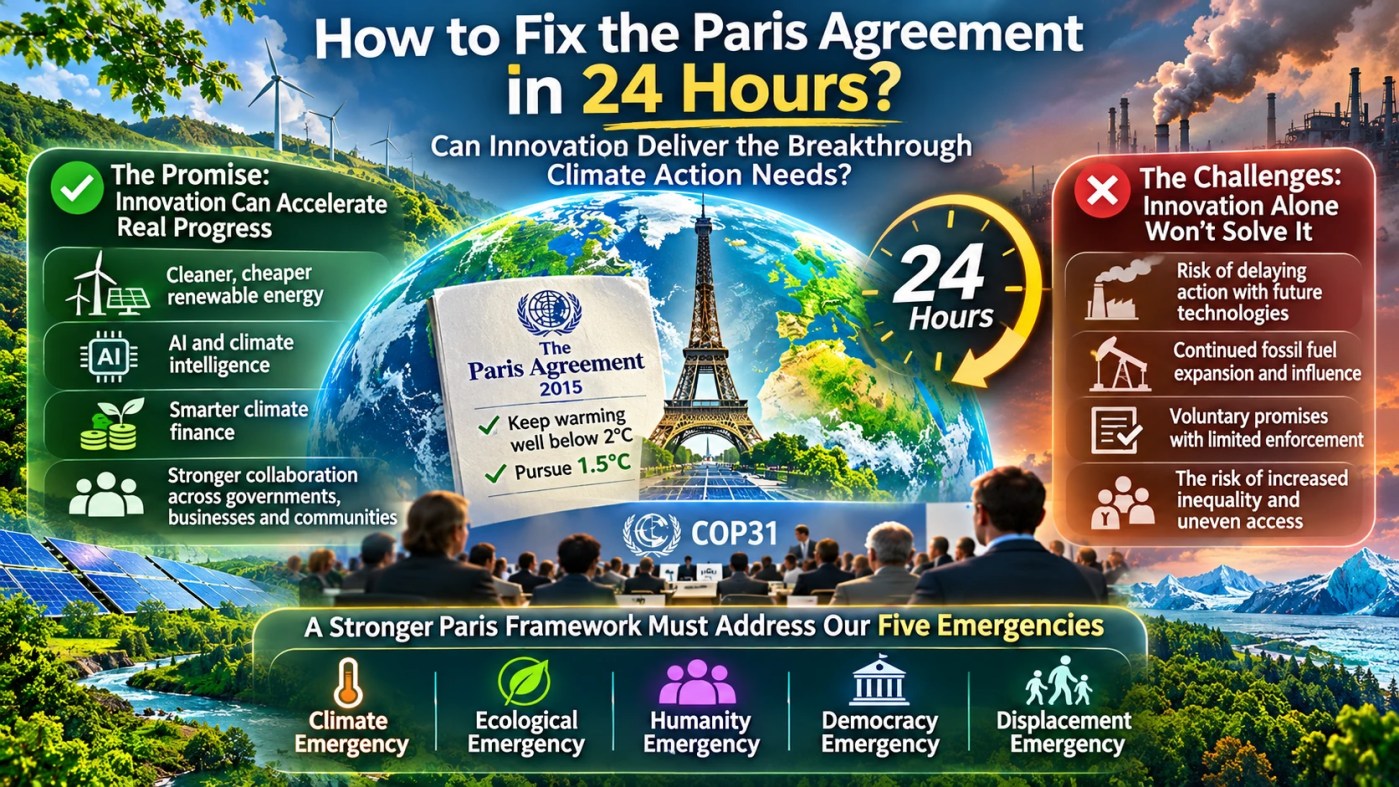
How to Fix the Paris Agreement in 24 Hours? What a Swedish “Fixathon” at COP31 Gets Right, and What No Sprint Can Fix
An explainer and critical look at today’s Sweden–Norrsken session in Antalya, the innovation idea behind it, and what it means for the people living through the Climate and Ecological Emergency.
Why This Session Caught My Attention
Some titles are designed to stop you mid-scroll. “How to fix the Paris Agreement in 24 hours” is one of them. When I first saw it on the COP31 programme, my reaction was a mix of curiosity and suspicion. The Paris Agreement took decades of diplomacy to build. It is ten years old, it is struggling, and the world’s second-largest historical emitter has just walked away from it. Can anything meaningful about it really be fixed in a single day?
I’ll be honest with you: this subject was new to me too. So instead of reacting to a headline, I did the homework. This post explains what the session actually is, who is behind it, where the Paris Agreement stands right now, and what is genuinely promising and genuinely worrying about the idea of “fixing” a planetary treaty through rapid innovation.
A note on transparency: the session streamed live from Antalya this morning, while it was still the early hours here in New York. This post is not a speaker-by-speaker summary of what was said on stage. It is a researched primer on the idea behind the session and my own assessment of it. When I have watched the full recording, I will update this post with what the presenters actually proposed.
First Things First: What Is This Session?
COP31, the 31st United Nations Climate Change Conference, is running from November 9 to 20, 2026, in Antalya, Türkiye. It is an unusual COP: Türkiye hosts and presides over the conference, while Australia’s Climate and Energy Minister, Chris Bowen, serves as President of the negotiations. Nearly 190 countries are present, and the host presidency has made “from words to action” its theme.
Inside the conference’s Blue Zone sits the UN Climate Change Pavilion, a stage for governments and partners to showcase climate action and innovation. Today, Monday, November 16, from 11:30 to 12:30 Antalya time, the Pavilion hosted a session titled “How to fix the Paris Agreement in 24 hours: harnessing innovation to accelerate planetary breakthroughs.” It was organized by the Government of Sweden together with Norrsken, a Swedish impact foundation, and it was webcast on YouTube.
The real story behind the title: a “Fixathon”
The “24 hours” in the title is not a political promise. It refers to something specific. Last month, from October 13 to 15, Norrsken held a Fixathon at its Norrsken House in Barcelona during its annual Impact/Week gathering. A Fixathon is Norrsken’s version of a hackathon, but focused on real-world problems rather than apps for their own sake. The theme was “Fixing the Paris Agreement: COP21 → COP31, 24 hours to build solutions to get us back on track.”
About 50 multidisciplinary problem-solvers were selected. Working in teams of three or four, they had 24 hours to use AI, data and open tools to tackle one question: can new technology help turn the Paris Agreement’s commitments into actual implementation? The best teams pitched their work on October 15. According to Norrsken’s organizers, several of the results were meant to be carried forward into COP31, which is what today’s session appears to have been about.
Two of the ideas that came out of Barcelona, as described publicly by Norrsken staff, give a feel for the approach:
- Bundling the climate plans of small towns into programmes that lenders can finance. Many municipalities have climate plans but no way to attract investment, because each project is too small for a bank to bother with. Grouping them together is a practical answer to a real bottleneck.
- Shifting computing workloads to cleaner times and places. Moving heavy data processing to hours or regions where electricity is greener is one way to reduce the climate cost of digital technology, including AI itself.
That framing matters. This session was not claiming that the Paris Agreement treaty text can be rewritten overnight. It was making a narrower, more interesting claim: that small, focused teams with modern tools can build working prototypes, very quickly, that attack the specific places where climate promises get stuck.
Who Is Norrsken?
If you, like me, had not heard of Norrsken before, here is the short version. The Norrsken Foundation is a Stockholm-based non-profit founded in 2016 by Niklas Adalberth, one of the co-founders of the payments company Klarna. Its mission is to put money, networks and attention behind entrepreneurs tackling major global challenges.
- It runs Norrsken Houses, shared hubs for impact entrepreneurs, in Stockholm, Kigali (Rwanda), Brussels, Amsterdam and Barcelona.
- Its venture arm, Norrsken VC, invests in climate tech, energy, health and AI startups, and the wider Norrsken ecosystem has grown to roughly €1 billion in assets under management.
- In 2025, it pledged €300 million to European startups using AI to address climate, health, food, education and social challenges.
Norrsken’s founding idea is that impact and profit can go together: that the world’s biggest problems are also its biggest opportunities. Keep that in mind, because it shapes both the strengths and the blind spots of the “fix it in 24 hours” approach.
Sweden is a natural partner. It was the first country to pass an environmental protection act in 1972, and it introduced a carbon tax in 1991. At COP31, Sweden is positioning itself as a “climate matchmaker,” pairing global climate challenges with Swedish solutions, with an explicit emphasis on moving from targets to delivery.
A Quick Primer: Why Does the Paris Agreement Need Fixing?
The Paris Agreement, adopted in 2015, set two temperature goals: keep global warming well below 2°C above pre-industrial levels, and pursue efforts to limit it to 1.5°C. It was a diplomatic breakthrough because nearly every nation joined. But it achieved that unity by letting each country decide its own contribution.
How it is supposed to work
Every five years, each country submits a Nationally Determined Contribution (NDC), its own climate plan. Countries report on progress. Every five years, a Global Stocktake assesses whether the world is on track, and the idea is that each new round of NDCs becomes more ambitious than the last. This is often called the “ratchet mechanism.”
Where it falls short
The weakness is built into the design. The process is binding, meaning countries must submit plans and report, but the targets are not enforced. There is no penalty when a country misses its goal. Ambition depends on goodwill, domestic politics and peer pressure.
The results speak for themselves. The UN Environment Programme’s Emissions Gap Report 2026, published in October and titled The Point of Return, delivers sobering numbers:
- Exceeding 1.5°C is now considered unavoidable, at least temporarily. The lead author put it plainly: deep cuts can delay the overshoot, but it can no longer be fully avoided.
- If every country fully meets its latest pledges, the world still faces roughly 2.3–2.5°C of warming. Under the policies actually in place today, the projection is around 2.8°C.
- Global emissions in 2025 were roughly comparable to 2024, sitting near record levels despite growing investment in clean energy.
- To limit the overshoot and bring warming back toward 1.5°C, global emissions need to fall about 18% by 2030 and 45% by 2035, compared with 2025 levels.
There is progress worth acknowledging. Before Paris, the world was heading toward roughly 4°C of warming. Policies and pledges have bent the curve. But the gap between where we are going and where we need to be remains enormous.
The United States has left, again
On January 27, 2026, the United States officially withdrew from the Paris Agreement for the second time, making it the only country in the world outside the pact. The administration has also moved to exit the UN climate framework convention itself, and it has not sent representatives to this year’s summit. Climate Action Tracker estimates the US withdrawal alone could add about 0.1°C to global warming. For us here in the United States, that means much of the work now falls to states, cities, communities and citizens.
Where COP31 Stands Right Now
To understand why an “innovation” session matters, it helps to see what is happening in the negotiating rooms.
The fossil fuel fight that never ends
Last year’s COP30 in Belém, Brazil, ended with a package called the Global Mutirão (a Portuguese word for collective effort). More than 80 countries pushed for a formal roadmap to transition away from fossil fuels, but it was dropped from the final text under pressure from oil and gas producers. The deal only referred back to the COP28 commitment to “transition away from fossil fuels” without adding a plan.
As a compromise, Brazil developed a voluntary fossil fuel roadmap outside the formal process. It was formally presented at COP31 last week and urges countries to draw up national transition plans by 2028. Meanwhile, oil-producing Arab states renewed their opposition to such roadmaps on COP31’s opening day. Even the hosts face credibility questions: both Türkiye and Australia are pursuing fossil fuel expansion at home, and Australia still relies on fossil fuels for over 60% of its electricity.
The “implementation” COP
COP31’s presidency has focused heavily on electrification, waste reduction and clean energy, and the COP31 President has argued that electrifying economies will “automatically” reduce fossil fuel use. COP31 is also launching the second Global Stocktake, which will conclude in 2028. And the presidency has launched an Antalya Artificial Intelligence Pledge, a package of actions on responsible AI, green industrialization and climate technology deployment.
This is the setting for today’s session. The message from the stage is clear: the treaty will not be rewritten here, so let’s find ways to make what already exists actually work.
The Positive: What the 24-Hour Approach Gets Right
1. It focuses on implementation, not more promises
The biggest problem with the Paris Agreement is not a shortage of targets; it is a shortage of delivery. A Fixathon flips the question from “how ambitious can we sound?” to “what can we build that removes a real obstacle?” That shift in mindset is healthy, and frankly overdue.
2. It targets real bottlenecks
The town-bundling idea is a good example. Thousands of towns and villages have climate plans gathering dust because no lender will finance a single small solar array or flood barrier. Solving the paperwork, risk assessment and aggregation problem could unlock real money for communities. These are not glamorous breakthroughs. They are plumbing. But climate action often fails in the plumbing.
3. It brings new people into climate work
Climate diplomacy is dominated by negotiators, lawyers and ministers. Hackathon-style events pull in software developers, data scientists, designers and young professionals who might never attend a negotiating session. Widening the circle of people who feel responsible for climate solutions is valuable in itself.
4. It uses AI for practical, measurable tasks
AI can genuinely help: analyzing satellite data for deforestation and methane leaks, forecasting extreme weather, optimizing power grids, matching climate projects with funders, and helping governments compare and track their NDCs. Used this way, AI is a tool for accountability and speed, not a magic wand.
5. Speed builds momentum
A working prototype in 24 hours proves that something is possible. It gives investors, officials and communities something concrete to react to, instead of another white paper.
The Negative: What No 24-Hour Sprint Can Fix
1. The core problems are political, not technical
The reason there is no fossil fuel roadmap in the COP decisions is not a lack of software. It is that powerful producer countries and industries block it, and COP decisions require consensus. No prototype can outvote a petrostate. If innovation sessions become a comfortable alternative to confronting that reality, they risk becoming a distraction.
2. Most hackathon projects die after the weekend
This is a well-known pattern in the tech world: exciting prototypes, enthusiastic pitches, and then silence once the participants go home. A 24-hour project only matters if someone funds it, maintains it, and gets it adopted by real institutions over years. The honest question to ask in a year’s time is: which of these prototypes is actually being used?
3. AI has its own climate footprint
This is the uncomfortable irony. The International Energy Agency projects that electricity demand from data centres will roughly double by 2030 to around 945 terawatt-hours, more than Japan uses today, with AI the biggest driver. Data centre electricity demand grew about 17% in 2025 alone. Using AI to fix climate commitments while AI’s own energy appetite surges is a contradiction that any honest AI-for-climate effort must address head-on. To their credit, at least one Fixathon idea, shifting computing to cleaner hours, does exactly that.
4. Techno-optimism can become a reason to delay
The IPCC has been clear that technology alone will not deliver the Paris goals; changes in production, consumption, behaviour and economic systems are needed too. When we hear “innovation will save us,” some decision-makers hear permission to wait. We cannot keep building fossil fuel infrastructure today on the promise that tomorrow’s inventions will clean up the consequences.
5. Who is in the room?
Fifty talented people, largely from across Europe, in a beautiful hub in Barcelona. That is fine for a pilot, but the people facing the harshest climate impacts are in Pacific island nations, the Sahel, South Asia, Indigenous territories, and frontline neighbourhoods everywhere, including here in the United States. Solutions designed without them risk missing what they actually need.
6. Venture logic is not the same as public interest
Impact investing is a real force for good, but investors need returns. Some of the most important climate work, like protecting ecosystems, supporting displaced families, or paying for loss and damage, will never be profitable. A healthy reminder here: Northvolt, the celebrated Swedish battery maker that Norrsken VC backed, collapsed into bankruptcy in 2025. Innovation is risky. Public climate commitments cannot rely on the success of startups alone.
Side by Side: What 24 Hours Can and Cannot Do
Because comparing options helps us see the whole picture, here is how a rapid-innovation sprint stacks up against the deeper changes the Paris Agreement needs.
| Challenge | What a 24-hour sprint can do | What it takes years to do |
| Fossil fuel phase-out | Model transition scenarios; map subsidies and stranded assets | Political agreement among producers; legislation; just transition for workers |
| Climate finance | Prototype tools that bundle small projects for lenders | Actually deliver the trillions pledged; triple adaptation finance |
| Accountability | Build dashboards that compare pledges with real emissions | Create consequences for countries that miss their targets |
| AI and data | Detect methane leaks, deforestation, grid waste | Power AI with clean energy and govern it responsibly |
| Communities | Design apps for local resilience planning | Build trust, institutions and lasting local capacity |
And here are three broad paths people are proposing to “fix” Paris, compared:
| Path | How it works | Strength | Weakness |
| Innovate within the system | Fixathons, AI tools, finance innovation (Sweden–Norrsken approach) | Fast, practical, attracts new talent | Leaves the political blockages untouched |
| Reform the rules | Amend or strengthen the treaty with stronger review, enforcement or penalties | Addresses the root design flaw | Very slow; needs consensus that rarely exists |
| Coalitions of the willing | Groups of countries move ahead together, as with Brazil’s voluntary roadmap and the Santa Marta fossil fuel transition meeting | Bypasses blockers; builds real momentum | Voluntary; the biggest emitters can stay outside |
My view: we need all three at once. Innovation without reform is cosmetic. Reform without innovation is too slow. Coalitions without broad participation leave gaps. The real question is not which path to choose, but how to make them reinforce each other.
Through the Lens of the Five Emergencies
At Climate Change Community, we look at every climate story through the Five Emergencies, because none of them can be solved in isolation.
- The Climate Emergency: Innovation must translate into measurable emissions cuts, the 18% by 2030 and 45% by 2035 that UNEP says are needed, not just better presentations.
- The Ecological Emergency: Forests, oceans, soil, fresh water and wildlife are the planet’s life-support system. A tech-first approach can overlook nature-based protection, which is often cheaper and more effective.
- The Humanity Emergency: Solutions must protect human dignity, health and livelihoods. Workers in fossil fuel regions, elders, children and people with disabilities need to be designed for, not designed around.
- The Democracy Emergency: A treaty is only as strong as the institutions that carry it out. Transparency, a free press, scientific integrity and citizen participation are what hold leaders to their promises, and right now we are watching a major democracy walk away from its commitments.
- The Displacement Emergency: At COP31, requests for help with climate loss and damage already exceed available funds. Every fraction of a degree we fail to prevent means more people forced from their homes. Innovation that does not reach the displaced is incomplete.
What This Means for You and Me
It is easy to watch a COP from a distance and feel powerless. But the Fixathon idea contains a lesson we can all use: you do not need permission from a summit to start solving a real problem. Here are practical steps:
- Learn your country’s and your state’s climate plan. Find out what your government has promised and whether it is on track. Accountability starts with knowing the numbers.
- Ask your local government about its climate plan and funding. Does your town have a resilience or emissions plan? Is it funded? The town-bundling idea only works if towns have plans to bundle.
- Use AI as a learning and research partner, thoughtfully. It can help you understand complex reports like the Emissions Gap Report, draft letters to officials, and organize community projects, while staying mindful of its energy cost.
- Gather people with different skills. The power of a Fixathon is the mix of disciplines. Your neighbourhood has teachers, nurses, electricians, retirees and students. Together, they can tackle a local problem in a weekend.
- Follow up. The real test of any event, including this one, is what happens after everyone goes home. Keep asking.
This is what I mean when I talk about the Green Way Forward: turning climate concern into climate competence, grounded in the well-being of our children and the health of biodiversity.
My Overall Assessment
I came into this topic skeptical of the title, and I leave with a more balanced view. The Sweden–Norrsken session is not claiming to rewrite a global treaty in a day. It is showcasing a method: small, diverse teams using modern tools to attack the specific bottlenecks where climate commitments stall. That method deserves support, especially at a COP that has branded itself as being about implementation.
But I would be doing you a disservice if I let the optimism stand alone. The Paris Agreement’s deepest problems, the absence of enforcement, the grip of fossil fuel interests, the broken promises on finance, and now the exit of the United States, are political. They require courage, pressure and persistence measured in years, not hours.
A prototype can be built in 24 hours. Trust, justice and a fossil-free economy cannot. We need both the sprint and the marathon.
So let’s welcome the innovators, and let’s also hold them, and our governments, to the only standard that matters: did emissions fall, did ecosystems recover, and were the most vulnerable protected? Progress is not a pitch. Progress is measurable.
A Note on How This Post Was Made
I use artificial intelligence to enhance my creativity and thinking. It helps me research, organize and refine ideas, while the perspective, values and final judgment remain my own.
Read posts at climatechangecommunity.com
Protecting our Children & Biodiversity’s future towards a more sustainable and habitable Earth!
Compiled & Mr. Alvarez’s Thoughts | AI Enhanced.
Sources and Further Reading
- UNFCCC: UN Climate Change Pavilion at COP31 (session listing, Nov 16): https://unfccc.int/cop31/un-climate-change-pavilion
- Norrsken: Fixathon “Fixing the Paris Agreement” at Impact/Week: https://events.norrsken.org/fixathon-decoding-the-paris-agreement
- UNEP: Emissions Gap Report 2026 press release: https://www.unep.org/en/news-and-stories/press-release/new-unep-report-lays-out-emission-cuts-needed-return-15degc
- Carbon Brief: UNEP on 1.5°C overshoot: https://carbonbrief.org/unep-opportunity-has-been-lost-to-meet-1-5c-warming-limit-without-overshoot
- Balkan Green Energy News: COP31 opens in Antalya: https://balkangreenenergynews.com/cop31-opens-amid-warnings-that-2026-will-be-among-hottest-years-on-record/
- WAM: Brazil’s fossil fuel roadmap presented at COP31: https://www.wam.ae/en/article/17iq7yu-cop31-energy-transition-takes-centre-stage
- Climate Home News: Fossil fuel expansion and COP31 hosts: https://climatechangenews.com/2026/09/18/fossil-fuel-expansion-threatens-cop31-hosts-credibility-experts-warn
- IISD: COP30 outcome, what it means: https://iisd.org/articles/insight/cop-30-outcome-what-it-means-and-whats-next
- ECCO: COP31 puts implementation to the test: https://eccoclimate.org/en/cop31-antalya-puts-implementation-to-the-test/
- Brussels Times: US leaves the Paris Agreement again: https://www.brusselstimes.com/1934812/us-leaves-paris-climate-agreement-again-despite-being-worlds-2nd-largest-emitter
- IEA: Energy and AI: https://www.iea.org/news/ai-is-set-to-drive-surging-electricity-demand-from-data-centres-while-offering-the-potential-to-transform-how-the-energy-sector-works
- Impact Investor: Norrsken commits €300m to AI for good: https://impact-investor.com/?p=28445
- Business Sweden: Sweden at COP31: https://www.business-sweden.com/expand-globally/delegationsandtrade-fairs/cop/


Leave a Reply