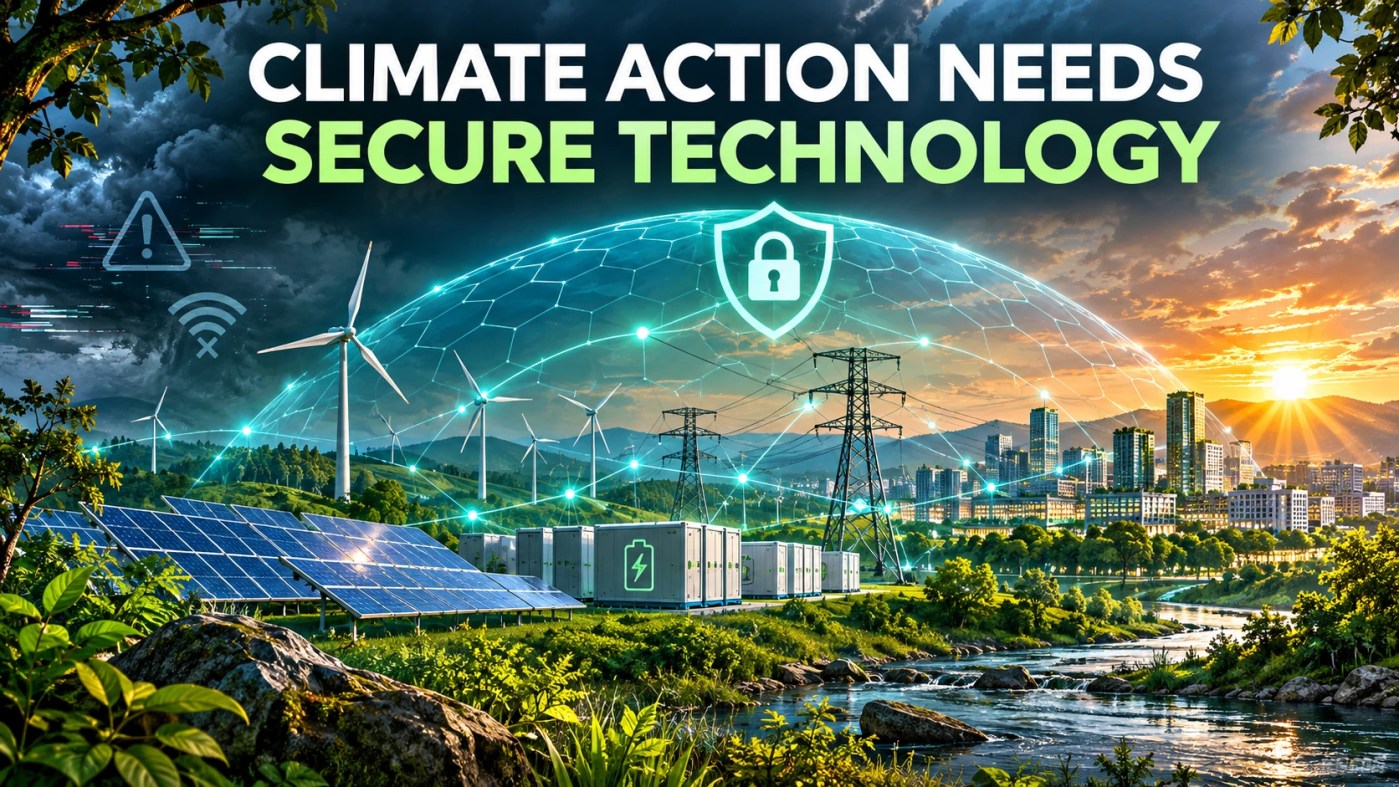
Our growing dependence on artificial intelligence, interconnected infrastructure and digital systems is creating extraordinary opportunities. But what happens when the technology we depend on becomes a source of vulnerability? Climate action requires more than innovation. It requires security, resilience, accountability and public trust.
November 18, 2026
Some say artificial intelligence is responsible. Others point to incompetence, inadequate maintenance, outdated infrastructure or poor management. There are even suspicions that officials may be concealing cyberattacks.
A recent video by Adam Mockler, “EVERYTHING IS GOING DOWN”, raises an important subject: a series of technology disruptions affecting major institutions, businesses and public services, and the questions surrounding their causes.
I want to use that conversation as a starting point, because I believe there is a much larger one we need to have.
We cannot tackle the Climate and Ecological Emergency with technology we cannot trust, infrastructure we cannot depend on, or institutions that cannot adequately protect the systems entrusted to them.
This is not simply a cybersecurity discussion. It is a climate preparedness discussion, a public safety discussion, an economic stability discussion and, ultimately, a question of how responsibly we are preparing for the future.
I also want to say something plainly at the start. I will go out of my way to protect AI from being blamed for something that was not its fault. Not because AI is beyond criticism, but because misplaced blame helps no one. When we blame the wrong cause, we fix the wrong problem, and the real weaknesses remain exactly where they were.
1. First, Let’s Separate the Facts From the Speculation
Before drawing conclusions, we need to understand what has actually happened. During November 2026, several major technology disruptions occurred within a short period.
Microsoft. Beginning Thursday, November 12, Microsoft experienced a worldwide disruption affecting Outlook, Teams, Copilot and other Microsoft 365 services. The company traced the problem to an earlier network capacity upgrade that surfaced after a network change, and said it found no indication of malicious activity or involvement by artificial intelligence.
The FAA. On Friday, November 13, at about 3:30 p.m. Eastern, the Federal Aviation Administration issued a nationwide ground stop. It was lifted at 8:15 p.m., making it the longest nationwide halt to U.S. air travel since September 11, 2001. The FAA’s preliminary findings point to legacy telecommunications equipment that became unstable when abnormal traffic flooded its network. Investigators traced possible sources to sites in Texas and Arkansas, where the FAA’s network contractor, L3Harris, had been installing a new router. Operators cancelled roughly 12,462 flights. The FAA reported no indication of a cyberattack, and its root-cause investigation continues.
JPMorgan Chase. On Monday, November 16, the largest U.S. bank by assets reported a temporary problem caused by a software bug in an on-premise hardware system, which delayed transactions. Because banks are interconnected, customers of other institutions also saw delays when their transactions involved Chase, including some Zelle payments, although the Zelle network itself remained operational. Chase stated plainly that the problem was not cyber-related.
Apple. Apple also reported service disruptions this month that, according to Reuters, it attributed to an internal update rather than a cyberattack.
The NSA. The National Security Agency said its internal network experienced a temporary degradation during routine maintenance, while mission-critical capabilities remained operational. Director of National Intelligence Jay Clayton connected the disruption to patches for a serious PHP vulnerability that had been discovered using AI. A separate claim that the fixes temporarily overwhelmed systems came from another outlet, and Reuters noted that it could not independently verify that report.
These distinctions matter.
As of November 18, there is no publicly established evidence that these incidents make up one coordinated cyberattack. Secretary of State Marco Rubio described the incidents as unrelated and said there was no evidence of nefarious actors, while acknowledging they were unsettling. Others are not so easily reassured. Republican Senator Josh Hawley captured much of the public mood when he remarked that if this was all a coincidence, it was the greatest coincidence in history.
Both reactions are understandable. A cluster of outages is a reason to investigate. It is not proof of a coordinated attack. That does not mean we should stop asking questions. It means we should ask better ones.
We need to distinguish between a cyberattack, a software failure, an improperly managed update, insufficient testing, aging infrastructure and organizational failure. Each requires a different investigation and potentially a different remedy. We also need to distinguish between what officials know, what they believe, what remains under investigation and what they cannot yet explain.
Public confidence cannot be built on speculation. But neither should it depend on unquestioning acceptance of official explanations.
Sources:
- Reuters: Microsoft 365 outage
- FAA: Nationwide Ground Stop Questions and Answers
- Associated Press: Online banking delays at major U.S. banks
- Reuters: Spate of U.S. outages, Apple and the NSA
2. Climate Action Is Becoming Increasingly Dependent on Technology
Here is where this conversation becomes particularly important to our work.
We sometimes discuss the clean-energy transition as though it were simply a matter of building more wind turbines, installing more solar panels, replacing combustion engines with electric vehicles and burning fewer fossil fuels. Those things are essential to decarbonization, but they do not tell the entire story.
Consider what it takes to operate a modern renewable-energy system. Electricity from wind and solar varies with the weather and available sunlight. Energy storage, demand response, smart meters, connected appliances, electric vehicle charging networks and sophisticated grid-management software all help balance supply and demand. Those systems increasingly depend on digital communications, remote monitoring and automated decision-making.
The International Energy Agency has explained that digitalization can help integrate higher levels of variable renewable energy, improve efficiency and give electricity systems greater flexibility. However, the same connected devices and distributed energy resources also expand the potential attack surface. A successful attack could cause loss of control over devices and processes, physical damage and widespread service disruption.
This presents us with a fundamental challenge: the more we depend on connected technology to manage our energy transition, the more responsibility we have to protect that technology.
- An electrical grid that relies on sophisticated software but cannot withstand a software failure is not sufficiently resilient.
- A battery-storage network that cannot operate safely when communications are interrupted is not adequately prepared.
- An electric vehicle charging network that depends on vulnerable centralized systems introduces additional points of failure.
A renewable-energy transition must therefore be accompanied by an equally serious commitment to cybersecurity and operational resilience.
Source:
3. The Climate Emergency Extends Far Beyond the Electrical Grid
We should not limit this discussion to electricity. Think about the infrastructure communities will increasingly depend upon as climate impacts intensify.
Water and Wastewater Systems
Communities need functioning water treatment, distribution and wastewater infrastructure. Many of these operations depend on industrial control systems and digital monitoring. A disruption can affect water quality, treatment processes and the delivery of essential services.
Extreme Weather Monitoring and Early Warnings
Communities rely on monitoring systems to identify approaching storms, flooding, dangerous heat, wildfire conditions and other threats. That information must be collected, transmitted, interpreted and communicated reliably. A technological failure at the wrong moment could compromise preparedness and delay emergency response.
Transportation and Emergency Services
Electrified public transit, traffic management, emergency communications, vehicle charging and logistics networks all depend on increasingly connected systems. November’s ground stop showed how instability in one network can ripple into thousands of cancelled flights within hours.
Buildings and Community Infrastructure
Smart buildings, heating and cooling systems, connected sensors and automated controls can improve efficiency and help communities cope with extreme temperatures. But these systems must remain reliable when the power supply, internet connectivity or centralized management platforms fail.
NIST’s September 2026 initial public draft revision of its Guide to Operational Technology Security expands its scope to include water and wastewater systems, building automation and control systems, transportation, freight rail, maritime vessels, and food and agriculture. It is an important reminder that operational technology is not confined to computer networks. It interacts directly with the physical systems communities depend on.
Now imagine several of these systems failing at the same time during a major heatwave, hurricane, wildfire or prolonged flood. That is the kind of possibility we must plan for. We cannot assume every system will keep working simply because we invested in modern technology.
Source:
4. Artificial Intelligence: A Tool, Not a Scapegoat, and Not an Excuse
I am not anti-AI. Quite the opposite. I believe artificial intelligence can become an important partner in addressing the Climate and Ecological Emergency, from weather forecasting, environmental monitoring and biodiversity tracking to energy efficiency, predictive maintenance, grid management, scientific research and cybersecurity.
That is exactly why I want to be careful about blame.
Look again at the facts. Microsoft said explicitly that AI was not involved in its outage. The FAA problem involved legacy telecommunications equipment and a router installation. Chase pointed to a software bug in on-premise hardware. None of these was an AI failure.
The NSA case deserves a closer look, because it is the one most likely to be misread. AI did not cause that disruption. AI helped discover a serious vulnerability in PHP, a programming language that runs a large share of the web, and the NSA urged organizations to patch it quickly. The temporary degradation was reported during the maintenance that applied those fixes. Discovering a vulnerability, developing a patch, testing it and deploying it into an operational environment are different activities, carried out by different people under different responsibilities.
If we blame the tool that found the hole, we risk discouraging the very capability that helps us close holes before attackers find them. The lesson is not that AI should be abandoned. The lesson is that increasingly capable technologies can speed up discovery faster than organizations are prepared to test and deploy the response.
At the same time, honesty requires looking in the other direction. Security officials and researchers warn that AI is also shortening the time between a vulnerability’s discovery and its exploitation, and that malicious actors are increasingly using AI tools. AI is becoming part of the defense and part of the threat at the same time.
A promising example of responsible use comes from the U.S. Department of Energy. In September 2026, its Office of Cybersecurity, Energy Security, and Emergency Response highlighted work with Sandia National Laboratories on a project called Communications and Cybersecurity for the Energy Edge (C2E2). Part of the AI-FORTS program, C2E2 uses large language models and generative AI to help grid security operators detect and locate cyber threats, with a reported 95 percent accuracy and a data-preparation process cut from two months to a few hours.
Just as important, the project openly recognizes the risk. Its next research phase focuses on understanding and preventing AI hallucinations, because a fabricated output could lead operators to miss a real attack or chase a threat that does not exist. That is precisely the balance this discussion needs.
AI systems used in critical infrastructure require rigorous testing, monitoring, human accountability and clearly defined operating boundaries. There is an important difference between using AI to support decisions and allowing AI outputs to become unquestioned instructions.
AI should enhance our ability to protect essential infrastructure. It should never be blamed for human decisions, and it should never become an excuse for removing human responsibility.
Source:
- U.S. Department of Energy: CESER and Sandia National Lab Are Using AI to Safeguard the Electric Grid
5. Cybersecurity Must Become Part of Climate Preparedness
We tend to think of cybersecurity as something that belongs to IT departments. That thinking is no longer sufficient. When digital systems control physical infrastructure, cybersecurity becomes a public safety responsibility.
The Cybersecurity and Infrastructure Security Agency, working with the FBI, the Environmental Protection Agency and the Department of Energy, has published guidance for protecting operational technology. Its recommendations include removing operational technology from the public internet, separating business networks from control networks, securing remote access with phishing-resistant multifactor authentication, keeping the ability to operate systems manually, and regularly testing backups, standby systems and recovery arrangements.
These are not technical preferences. They are essential elements of infrastructure resilience. I believe climate-related infrastructure projects should be measured against six commitments.
A. Security by Design
Cybersecurity should be built in before systems are deployed, not added as an extra expense after vulnerabilities are discovered. That includes secure equipment, strong authentication, restricted access, network segmentation and careful management of contractors and vendors.
B. Independent Testing and Accountability
Critical infrastructure should undergo meaningful security assessments and operational testing. Organizations must know what systems they operate, what software and outside services they depend on, and how those dependencies could affect essential services.
C. Redundancy and Recovery
We should not build systems that have only one way to function. Critical services need reliable backups, alternative communications, fail-safe mechanisms and tested recovery procedures. Where technically appropriate, energy systems should be able to isolate affected sections and keep essential operations running.
D. Human Expertise and Institutional Knowledge
Qualified engineers, cybersecurity professionals, technicians and experienced operators are not overhead. They are part of the infrastructure itself. An organization can buy sophisticated software, but it cannot simply buy the accumulated experience needed to manage every unexpected failure. People must have the authority, resources and training to step in when automated systems behave unexpectedly.
E. Responsible Software Updates
The recent disruptions remind us that even legitimate updates and patches can create operational problems, whether in a bank, an intelligence agency or an air-traffic network. Updates should be tested, rolled out in controlled stages, monitored and paired with rollback procedures. Vendors and operators must be accountable for the consequences of the changes they introduce.
F. Transparent Reporting
When an essential service suffers a major disruption, the public deserves an explanation that separates confirmed facts from preliminary findings, describes the scope and duration of the problem, and identifies corrective measures. Security-sensitive details may need protection, but that should not prevent meaningful accountability. The FAA’s public questions-and-answers page after the ground stop, which described the mechanism and the sites involved, is the kind of openness we should expect from everyone.
Source:
6. We Must Question Our Dependence on a Few Technology Providers
Another issue deserves much more attention: how much of our essential infrastructure depends on a relatively small number of technology companies, cloud services, software platforms and equipment manufacturers?
The November Microsoft disruption showed how a problem at one major provider can interfere with communication and business operations across countless organizations and countries at once.
Cloud computing and centralized services are not inherently bad. They provide important capabilities and efficiencies. The problem arises when organizations become so dependent on one provider that they have no practical alternative when that service goes down.
The clean-energy transition should not repeat this mistake. We should be examining vendor concentration, interoperability, software supply chains, service dependencies and the ability to move essential operations to alternative systems. Where feasible, critical systems should keep local capabilities and independent recovery options.
A resilient infrastructure is not one that assumes its providers will never fail. It is one that has planned for what happens when they do.
7. The Human Cost of Inadequate Preparedness
Technology failures are often reported as temporary inconveniences. But the consequences can reach much further.
- An interrupted financial transaction can hurt a household living paycheck to paycheck or a small business making payroll.
- An airline disruption can strand families and interfere with emergency travel. More than 12,000 cancelled flights is not an inconvenience; it is a national coordination failure.
- A compromised water-treatment system can put public health at risk.
- A power failure during extreme heat can endanger people who depend on cooling, refrigeration or powered medical equipment.
And when climate disasters strike, infrastructure failures can compound one another.
We must also be careful not to assume that every problem is caused by staffing cuts or any particular management decision. Reuters reported that some of the recent disruptions followed workforce reductions and earlier warnings about operational challenges, including job cuts at the FAA and buyouts offered at Microsoft. But Reuters also noted that no evidence established those reductions as the cause of the outages.
Even so, experienced personnel, adequate staffing, institutional knowledge and regular operational testing should be recognized as fundamental investments in resilience. Part of any system’s resilience lives in the people who know it well.
We should not measure essential infrastructure only by how cheaply it can be operated. We should measure whether it keeps serving people when circumstances become difficult.
8. What Climate Action Organizations Should Be Demanding
Environmental organizations, climate advocates, policymakers, community planners and technology professionals should bring cybersecurity directly into climate discussions. Our demands should include:
- Cyber-resilient energy systems: Renewable-energy infrastructure, storage networks and smart grids designed to withstand both cyber incidents and ordinary technical failures.
- Climate-ready digital infrastructure: Water, transportation, emergency communications, environmental monitoring and other essential systems with tested continuity and recovery plans.
- Responsible AI governance: AI used in critical infrastructure that is tested, monitored, independently evaluated where appropriate and subject to clearly assigned human accountability.
- Public transparency: Credible investigations, public explanations and documented corrective action after major failures and security incidents.
- Long-term investment: Funding for maintenance, modernization, cybersecurity expertise and resilience alongside new technology deployments.
- Community preparedness: Local understanding of how essential services will continue during prolonged power, internet or communications outages.
The goal is not to make every system invulnerable. That would be unrealistic. The goal is infrastructure that is difficult to compromise, able to withstand disruption and able to recover without placing communities at unnecessary risk.
9. We Cannot Build a Sustainable Future on Fragile Foundations
There is something deeply contradictory about investing enormous resources in addressing the Climate Emergency while neglecting the security and reliability of the systems needed to carry out those solutions.
We can install millions of solar panels, but we also need a grid capable of managing them. We can electrify transportation, but we need dependable electricity and charging. We can build sophisticated environmental monitoring, but it must keep working when communities need it most. We can use AI to accelerate climate research, but we must make sure its outputs are reliable and that people remain accountable for consequential decisions. We can modernize infrastructure, but modernization without testing, security and maintenance is not necessarily progress.
The Climate Emergency is not only a challenge of developing better technology. It is a challenge of developing technology, institutions and communities that can depend on one another.
I want us to think about the children who will inherit the systems we build today. Will they inherit an electrical grid that can withstand increasingly extreme conditions? Will they have dependable access to clean water, transportation, communications and essential services? Will they inherit technology that protects their future, or infrastructure that creates new vulnerabilities?
These questions cannot wait until tomorrow. The work of mitigation and adaptation is happening now, and its technological foundations are being laid now.
We need innovation, and we need wisdom. We need artificial intelligence, and we need human judgment. We need modernization, and we need maintenance. We need connectivity, and we need security and the ability to operate independently when connections fail. Above all, we need public institutions and private organizations willing to accept responsibility for the systems our collective future depends on.
We cannot tackle the Climate Emergency with technology we cannot trust. We cannot protect biodiversity, communities and future generations with infrastructure unprepared for the challenges ahead. A sustainable future must also be a secure, resilient and dependable future.
That is not an optional addition to Climate Action. It is part of Climate Action itself.
Further Reading and Resources
- International Energy Agency: Cyber Resilience in Power Systems
- NIST: Artificial Intelligence Risk Management Framework
- CISA: Industrial Control Systems and Operational Technology
- U.S. Department of Energy: Office of Cybersecurity, Energy Security, and Emergency Response
- NIST: Guide to Operational Technology Security
- FAA: Nationwide Ground Stop Questions and Answers
Editorial note: This article reflects information available as of November 18, 2026. Initial explanations of these incidents may change as investigations continue. No common cyberattack or coordinated cause is asserted.
Artificial intelligence is used to enhance my creativity and thinking in preparing this post. The ideas, experiences and commitments are my own.
Read posts at climatechangecommunity.com
Protecting our Children & Biodiversity’s future towards a more sustainable and habitable Earth!
Compiled & Mr. Alvarez’s Thoughts | AI Enhanced.


Leave a Reply