By Mr. Alvarez, Content Curator | Climate Change Community LLC | November 17, 2026
Private reflection follows the post below…
Three Words the World Was Given in 2022
You do not need to follow climate news to understand this story. It starts with a report, a sentence, and a question that belongs to all of us.
On February 28, 2022, the world’s leading body of climate scientists, the Intergovernmental Panel on Climate Change (IPCC), published a major report on how a heating planet is affecting people and nature, and how well we are coping. The head of the United Nations, Secretary-General António Guterres, said he had never seen a scientific report like it. He described it as:
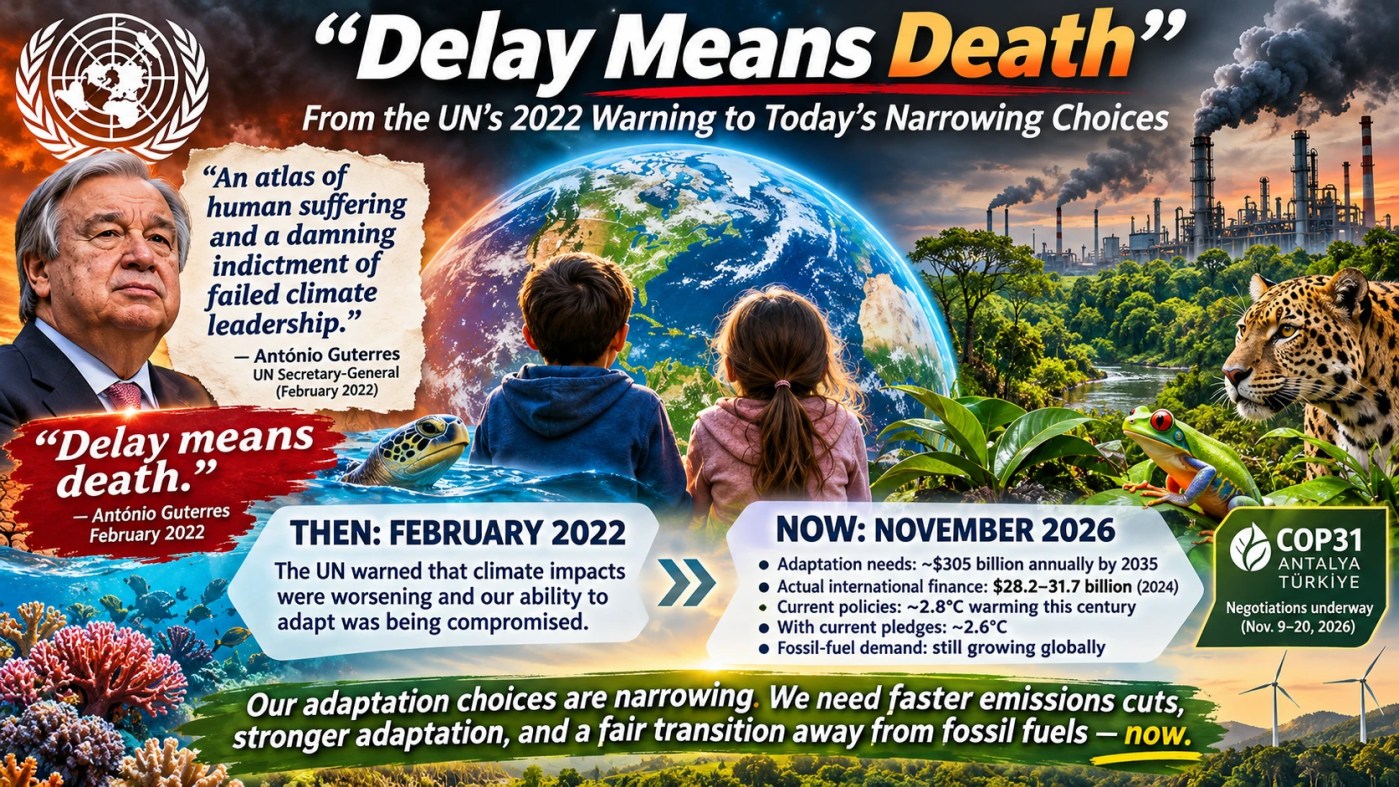
“An atlas of human suffering and a damning indictment of failed climate leadership.”
And then he summed up the stakes in three words:
“Delay means death.”
That was almost five years ago. I have been studying this emergency since 2007, and I can tell you that few warnings have ever been stated so plainly. So here is the question I want to put in front of you, wherever you are reading this: what did the world do with that warning?
I am writing this as a concerned and determined citizen, not to frighten anyone. Think of it as one pebble dropped into a very large ocean. Ripples are how awareness travels.
What the Scientists Said, in Plain Language
The 2022 report found that between 3.3 and 3.6 billion people, close to half of humanity, live in places that are highly exposed to climate harm: dangerous heat, floods, drought, failing harvests, rising seas. It found the damage was arriving faster than our efforts to prepare for it. And it warned that the chance to secure a livable future was a brief window that was closing quickly.
Two words come up again and again in this conversation, and they are worth knowing.
- Adaptation means preparing for and reducing the harm. Cooling centers during heatwaves, stronger flood defenses, drought-resistant crops, restored wetlands and forests.
- Mitigation means dealing with the cause, which is the pollution from burning coal, oil and gas that traps heat in the atmosphere.
The scientists were clear that we need both. Preparing for the flood matters. So does turning off the tap.
Are We Really “Running Out of Options”?
You may have heard it said that we are running out of ways to adapt. That deserves a careful answer, because exaggeration helps no one.
We are not out of options. The same 2022 report said that investments in preparation work and save lives. What is true is that our options shrink as the planet gets hotter.
Sometimes a solution exists but a community cannot reach it, because the money or the support is not there. That kind of limit can be fixed. Other times the damage goes beyond anything preparation can prevent. A coral reef cannot adapt to water that is simply too hot for it to live. The scientists found in 2022 that some natural systems had already reached that point.
So the truth sits between two comforting myths. It is not “we can save everything.” It is not “nothing can be done.” It is that acting keeps doors open, and waiting closes them.
Then and Now: The Money to Protect People
When Mr. Guterres said “Delay means death,” he was talking about something concrete. The poorest countries and small island nations, which did the least to cause the problem, were struggling to get the funding they needed to protect their people.
This month the UN Environment Programme published its yearly check on that funding. Its title is blunt: Ready? Not. Here is what it found.
- Poorer countries will need about $305 billion a year by 2035 to protect their people from climate impacts.
- In 2024, wealthier countries provided roughly $28 to $32 billion in public funding for that purpose. That is around a tenth of the need.
- That funding grew by only about $1 billion from 2023 to 2024.
- Governments have talked about tripling it by 2035. Even if they do, it would cover only 20 to 29 percent of what is needed.
Those two figures are from different years, so it is not a precise side-by-side. But picture a town that needs ten fire trucks and has been given one, with a promise of maybe three in ten years. That is roughly where we are.
Then and Now: The Temperature Line
In 2022, the goal the world was working toward was to keep global heating below 1.5°C (2.7°F) above the levels of the 1800s. Scientists identified that line as the point beyond which the dangers grow much more severe.
In 2026, the United Nations is saying openly that we are going to cross it.
A UN report released on October 21, titled The Point of Return, no longer asks how to stay under the line. It asks how to get back. In its best remaining scenario, heating peaks at 1.7 to 1.8°C around the middle of this century and comes back down to 1.5°C by 2100. To get on that path, the world would need to cut its climate pollution 18 percent by 2030 and 45 percent by 2035.
And the path we are actually on? About 2.8°C (5°F) of heating this century under today’s policies. About 2.6°C if every country keeps every promise it has made.
That is the clearest “then versus now” I can offer. In under five years, the question changed from “can we stay below the line?” to “how far over will we go, and for how long?” None of this is fixed fate. These are projections based on choices, and choices can change. But every fraction of a degree means more heatwaves, more floods, more loss.
Still Hooked on Fossil Fuels
Here is a detail many people have forgotten. The 2022 report came out four days after Russia invaded Ukraine. Within weeks, families around the world were paying more for fuel, heating and food. We were told then that depending on coal, oil and gas was not only heating the planet. It was leaving ordinary households at the mercy of events far away.
Now look at today. This year’s UN climate summit, called COP31, is under way in Antalya, Türkiye. It is meeting during another energy crisis driven by conflict. Reuters reports that disrupted oil shipments from the Middle East since the start of the Iran war have helped push prices up again. Mr. Guterres told world leaders there that three out of four people on Earth live in countries that must import fossil fuels, exposed to price shocks they did not cause and cannot control.
The UN’s top climate official, Simon Stiell, said it in one line:
“The political costs of fossil fuel dependency are unforgiving.”
Two wars. Two energy shocks. The same lesson, still waiting to be learned. We pay for fossil fuels twice, once at the pump and once in the damage.
None of this means blaming workers in those industries or asking families to buy things they cannot afford. A fair change protects jobs and makes clean energy affordable for everyone. But “fair” cannot keep meaning “later.” We cannot prepare our way out of a problem we are still making worse.
What Is Happening at the Summit This Week
One caution first. COP31 does not end until Friday, November 20, and nothing has been agreed. What exists is a first draft, dated November 16, that nearly 200 countries still have to negotiate. Drafts change.
Even so, the draft is revealing. It voices deep concern that the world will go past 1.5°C. It acknowledges that going past that line will increase the need for protection while reducing how many protective options are available and how well they work. It proposes that funding to help poorer countries prepare should reach at least $120 billion, and it calls for faster action to phase out fossil fuels.
In plain terms, the world’s governments are now putting in their own draft the very thing we were warned about in 2022. Whether those words survive to Friday is uncertain. The fossil fuel language is expected to face strong opposition. Watch what is actually adopted, and remember that an agreement on paper is still not money delivered or pollution cut.
Why This Is About Children and the Living World
When I think about all of this, I do not think first about charts. I think about the children who will inherit whatever we leave, and about the forests, reefs and creatures that have no vote and no voice.
The 2022 report recorded heat, drought and floods pushing plants and animals beyond what they can survive, with mass die-offs of trees and corals. It stressed that people and nature are in this together. Healthy forests, wetlands and oceans give us food, clean water and protection from storms. They also have breaking points.
I call the path I believe in the Green Way Forward. It rests on two things: the well-being of our children, who are our future, and of the variety of life on Earth, which is our health. Neither should have to compete with the other for our attention.
What Any of Us Can Do
You do not have to be an expert or an activist. Here are four things almost anyone can do.
- Ask local questions. What is your town, your school or your workplace doing to prepare for extreme heat, flooding or water shortages? Who checks on elderly and vulnerable neighbors?
- Follow the money. When leaders announce climate funding, ask whether it has actually reached the people it was promised to.
- Hold both ideas together. Support efforts to protect people now, and support cutting the pollution that makes the danger grow. One without the other does not work.
- Read past the headline. A speech is not an agreement. An agreement is not funding. A funding promise is not delivery.
And talk about it. With family, with friends, with the person next to you. Most people are more worried than they let on, and conversation is where action begins.
Concern Is Not the Same as Despair
There is good news, and it deserves to be said. The UN reports that clean energy has advanced and that climate policies have already cut pollution in many countries and industries. The solutions work. The failure is that we have not used them at anything like the scale the emergency requires.
So I refuse to confuse being serious with being hopeless. I also refuse to call doing nothing “optimism.”
In 2022 we were told a window was closing. In 2026 it is narrower and the bill is larger. But it is still open, and what we do with it is still up to us.
“Delay means death” should not be a line we remember only after the next disaster that could have been prevented. Let it change what we ask for, and what we do, starting now.
Read posts at climatechangecommunity.com
Artificial intelligence is used to enhance my creativity and thinking in preparing this post. The ideas, experiences and commitments are my own.
Protecting our Children & Biodiversity’s future towards a more sustainable and habitable Earth!
Compiled & Mr. Alvarez’s Thoughts | AI Enhanced.
Sources
- UN News: IPCC adaptation report ‘a damning indictment of failed global leadership on climate’ (Feb. 28, 2022)
- UNEP: Adaptation Gap Report 2026 – Ready? Not
- UNEP press release: As world heads for overshoot of 1.5°C, adaptation is too slow (Nov. 4, 2026)
- UNEP press release: New UNEP report lays out emission cuts needed for return to 1.5°C (Oct. 21, 2026)
- UN Climate Change: Simon Stiell remarks at the COP31 Leaders’ Summit (Nov. 11, 2026)
- UN Climate Change: COP31 draft cover decision (Nov. 16, 2026)
- Reuters via Al-Monitor: COP31 leaders try out new sales pitch for climate action (Nov. 11, 2026)
- Dawn: COP31 draft seeks faster shift away from fossil fuels (Nov. 17, 2026)
A Personal Reflection: How Will the Children of Tomorrow Remember Us?
Sometimes I find myself thinking 10, 20 or 30 years into the future.
I wonder what the children of today, who will become the adults of tomorrow, will think about the decisions we are making right now.
How will they judge us?
Will they look back with pride and gratitude toward those who stood up, spoke out, challenged established interests and fought to protect the natural world and the conditions necessary for life?
Will they recognize the Climate Justice Advocates, Climate Activists, scientists, educators, Indigenous communities and countless ordinary people who refused to remain silent?
Perhaps some of us will be remembered as pioneers who helped change the direction of humanity. Others may be recognized for simply doing what they could, with whatever resources, influence and opportunities they had.
I hope they will find reasons to be proud of us.
But I also wonder how they will judge those who had the knowledge, resources and influence to make a difference but chose instead to protect their wealth, political power and personal interests.
Those who viewed nature not as a living system deserving respect and protection, but as something to be exploited, plundered and depleted for private gain.
Those who understood the consequences of their decisions but placed short-term profits above the long-term survival and well-being of future generations.
I suspect history will have very different things to say about these two groups.
We cannot know exactly how tomorrow’s children will interpret our actions. We can only make an educated assumption about what they may value when they look back at this period in human history.
But I believe one thing is reasonably certain: they will inherit the consequences of our choices, not simply our explanations for making them.
I don’t expect future generations to consider every decision made today perfect. They may disagree with some of our approaches, question our priorities and identify things we could have done differently.
That is fair.
What I hope they will recognize is that many of us genuinely tried. We cared about their future, about biodiversity, about human dignity and about leaving behind a planet that remained habitable and capable of sustaining life.
Personally, I would rather be remembered as someone who tried to make a difference, even when the odds seemed overwhelming, than someone who had the opportunity to help and chose personal enrichment instead.
Ten, twenty or thirty years from now, I hope a child somewhere will be able to look back at this generation and say:
They knew what was happening. Some of them stood up. Some of them refused to surrender. And because they cared enough to act, we inherited a better world.
That is the legacy I would like us to leave.
The question is not simply what kind of world we will leave our children. It is what kind of people they will discover we were when we had the opportunity to protect it.


Leave a Reply