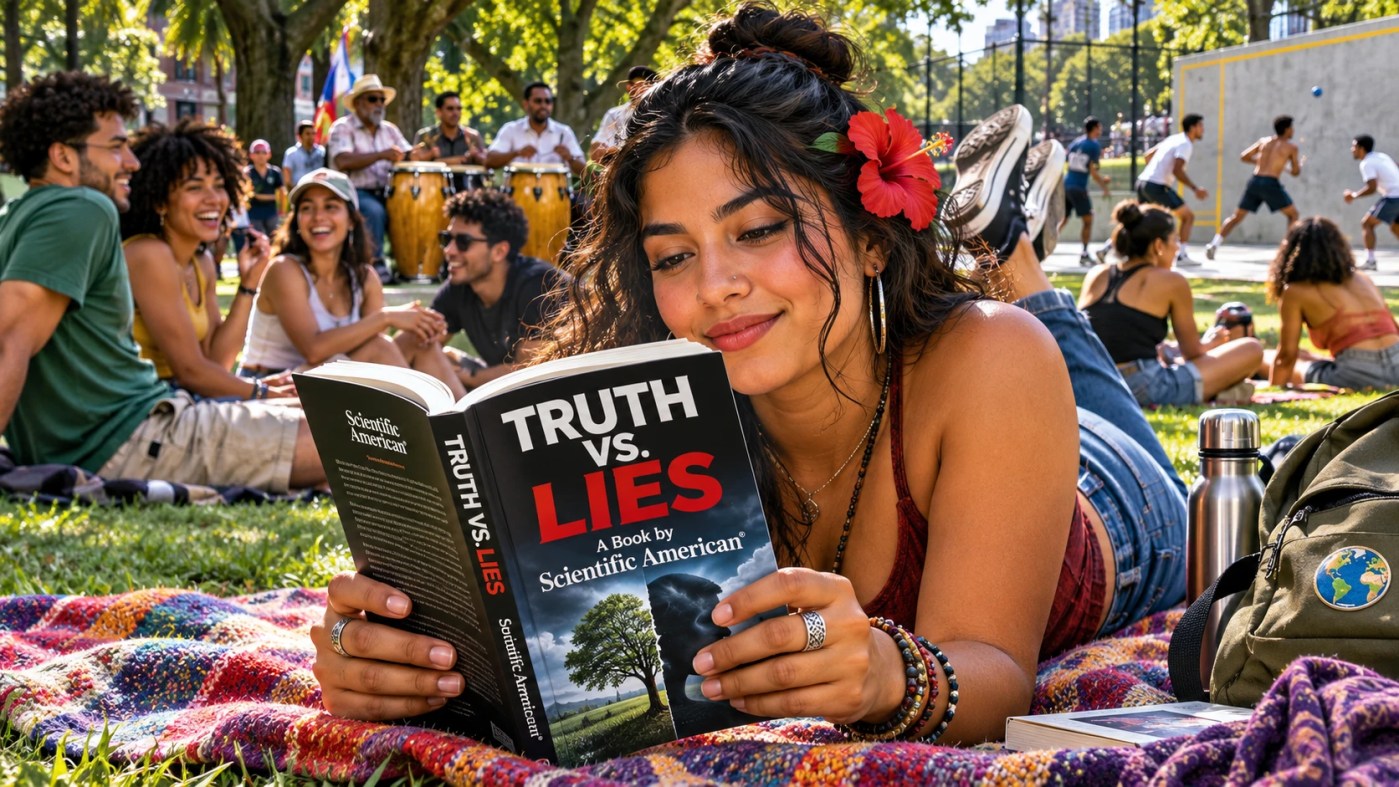
Going Deeper: The Psychology of Dishonesty, the Social Life of Belief, and Our Shared Responsibility to Keep the Truth Alive
There are two questions we should be asking ourselves far more often: Why do people lie? And perhaps even more importantly, what makes the rest of us willing to believe them?
The easy answers come quickly. Liars want money, power, or protection. Believers are gullible, uninformed, or not paying attention. Those answers are not entirely wrong, but they are comfortable, because they place the problem somewhere else, in other people. Truth vs. Lies, a Scientific American compilation examining the psychology, politics, technology, and science of truth and deception, will not let us off that easily.
The deeper lesson running through the book is this: the same qualities that make human beings trustworthy are the qualities that make us deceivable. We learn from one another. We want to belong. We protect the people and identities we love. We rely on experts because no one can verify everything alone. Each of these is a strength. Each can be turned into a weakness by someone who understands how it works.
Editor Andrea Gawrylewski framed the danger in the book’s introduction, describing a form of public gaslighting that goes beyond ordinary spin:
“These manipulators don’t just ignore data and evidence; they deny their very existence.”
— Andrea Gawrylewski, “21st-Century Gaslighting”
Those words were written in 2020. Reading them in late 2026, they feel less like history and more like a forecast that came true. So let us go beneath the surface: not only what makes dishonesty possible, but how it actually works inside our minds and communities, and what it will truly take to protect the truth.
Part One: What Makes People Lie?
Not every false statement is a lie. People can be mistaken, misinformed, or unaware of important evidence. But deliberate dishonesty tends to grow under recognizable conditions: self-interest, fear of consequences, protecting an identity or worldview, protecting power and the status quo, the desire to belong, confirmation bias, blind trust in authority, and the normalization of dishonesty. Naming these conditions is the first level. The second level asks how they operate, and what they reveal about all of us.
The First Lie Is Usually the One We Tell Ourselves
We like to imagine liars as people who know the truth and choose to hide it. Often, the process begins earlier and more quietly, inside the mind of someone who sincerely believes they are being fair. Douglas Kenrick, Adam Cohen, Steven Neuberg, and Robert Cialdini describe how our reasoning behaves when it is protecting a belief we already hold:
“Less like an impartial judge and more like a lawyer working for the mob.”
— Kenrick, Cohen, Neuberg and Cialdini, “The Science of Antiscience and Thinking”
Their chapter describes a classic study in which students who supported or opposed capital punishment read the same mixed evidence on whether it deters crime. Instead of moving toward the middle, both groups became more convinced of what they already believed. They found flaws in the studies that disagreed with them and strengths in the studies that agreed.
Here is the detail that takes us deeper: when researchers simply told participants to be fair and unbiased, it had no effect. Good intentions were not enough. Only a specific mental exercise, which we will return to in Part Three, reduced the bias. That should humble every one of us, including me. Wanting to be honest is not the same as being honest.
Behavioral economists Dan Ariely and Ximena Garcia-Rada add another uncomfortable piece. They cite research showing that most people act dishonestly only to the extent that they can benefit while still preserving their moral self-image. In other words, most dishonesty is not committed by villains. It is committed by ordinary people who have found a story that lets them keep thinking of themselves as good.
When the Fight Is About the Implications, Not the Evidence
Atmospheric scientist Katharine Hayhoe, one of the most respected climate communicators in North America and an evangelical Christian, has spent years speaking to audiences that do not want to hear her message. Her conclusion is one of the most important sentences in the entire book:
“The problem people have with science is never the actual science.”
— Katharine Hayhoe, “The Roots of Science Denial”
What people resist, she explains, is what the science would require of them: a change in their worldview, their ideology, or a status quo that benefits people with power. Hayhoe observes that as renewable energy becomes more viable, the pushback grows stronger, because the threat to established interests becomes real. Objections dressed in scientific language, like “it’s just a natural cycle,” are usually a smoke screen. Push past them for a few minutes and you reach the real objection: resistance to the solutions.
This matters because it changes how we respond. If the disagreement is not really about evidence, then more evidence will not resolve it. We have to address what the person fears losing.
Philosophers Cailin O’Connor and James Owen Weatherall reveal how powerful interests protect the status quo without ever telling an outright lie. In the 1950s and 1960s, the tobacco industry published a newsletter that reported only the research suggesting smoking might not be harmful, or that emphasized uncertainty. The authors call this selective sharing: taking real, independent research and curating it so that only the convenient parts reach the public. My own thought: this is the most dangerous kind of deception, because every individual fact can be checked and found accurate. The lie lives in what was left out.
Silence Is Where Lies Go to Survive
Fear and the desire to belong rarely produce dramatic lies. More often, they produce silence. We stay quiet in the meeting, in the family group chat, at the dinner table, because disagreement feels costly and agreement feels safe.
O’Connor and Weatherall show how this silence shapes entire communities. When people prefer to act as their group acts, members who encounter contradicting evidence quietly keep it to themselves. Over time, the group becomes a closed circle where false beliefs are never challenged, not because no one knows better, but because no one who knows better speaks.
Yet the same research carries real hope. Kenrick and his colleagues recall Solomon Asch’s classic conformity experiments: when even a single person in the group disagreed with a clearly wrong majority, the false consensus broke down. Silence protects lies. One honest voice can undo them.
Authority Is a Shortcut, Not a Verification
Kenrick and his colleagues describe a hospital study in which a stranger calling himself a doctor phoned nurses and instructed them to give a patient an unfamiliar drug at a dangerous dose, violating hospital policy. Ninety-five percent of the nurses obeyed without raising questions and had to be stopped on their way to the patient’s room.
The second-level lesson is not simply “distrust authority.” O’Connor and Weatherall remind us that humans are social learners. We take most of what we know from teachers, parents, experts, and friends, and we must, because no one can personally verify everything. Trust is not the problem. Unexamined trust is. The healthy middle is to trust, and then verify in proportion to the stakes. A title is a reason to listen. It is never a substitute for evidence.
Dishonesty Is Contagious
Ariely and Garcia-Rada’s research on bribery offers a finding with consequences far beyond corruption:
“Mere exposure to corruption is corrupting.”
— Dan Ariely and Ximena Garcia-Rada, “Contagious Dishonesty”
In their experiments, simply encountering dishonesty made people more willing to behave dishonestly afterward. They also cite research suggesting that people are more tempted by a single large opportunity to cheat than by a series of small ones. As one research team put it, the route to corruption can lead over a steep cliff rather than down a slippery slope.
Philosopher Kathleen Higgins describes what happens when this contagion reaches public life. In a post-truth culture, we no longer even expect leaders to be honest:
“‘Don’t bother me with facts’ is no longer a punchline. It has become a political stance.”
— Kathleen Higgins, “Post-Truth: A Guide for the Perplexed”
Higgins notes a quiet irony. Leaders who benefit from post-truth still depend on truth. They rely on most people’s good-natured assumption that others are usually honest. Our decency is the very resource being spent.
Part Two: What Makes People Believe Lies?
The person telling a lie and the person believing it are rarely moved by the same things. The first level of this question lists the conditions: information overload, repetition, echo chambers, emotional manipulation, tribalism, distrust of institutions, and technological manipulation. All of these are real. But the book points to something underneath them all: belief is social before it is logical.
We Believe People Before We Believe Evidence
O’Connor and Weatherall open their chapter with a story from 1869. Newspapers across the Northeast warned that the tomato hornworm, a large green caterpillar, was as poisonous as a rattlesnake and had killed people. It was harmless. Entomologists had known that for decades, and they said so. The truth was freely available, and the rumor spread anyway, carried from one trusted neighbor to the next.
Today the same mechanism runs at the speed of a share button. The authors summarize the modern danger in six words:
“Social media transforms disinformation into misinformation.”
— Cailin O’Connor and James Owen Weatherall, “Why We Trust Lies”
A lie may begin as a deliberate act of deception. Two shares later, it has become an honest mistake made by someone who loves you. That is what makes it so difficult to fight. The person who forwarded it was not trying to mislead anyone. They trusted the friend who sent it to them.
Even Careful Communities Can Reach the Wrong Answer
It would be comforting to believe that education and effort are enough. O’Connor and Weatherall show otherwise. Even communities that work hard to find the truth, sharing studies and asking questions, can reach dangerously wrong conclusions. Two forces drive this: social trust, in which we give more weight to evidence from people like us than from outsiders, and conformism, in which we prefer to act as our group acts. In their models, these forces produce isolated clusters that hold false beliefs and never hear the correction, because evidence from outside the group is discounted and members who doubt stay quiet.
Their practical conclusion is essential for anyone doing climate outreach: sharing new evidence with a community that distrusts its source will likely not help. What helps is a messenger who shares enough with that community to be trusted.
When Facts Stop Mattering
Psychologists Troy Campbell and Justin Friesen studied what people do when the facts turn against them. Sometimes they dispute the facts. But often they do something slipperier: they reframe the issue as a matter of personal choice, principle, or moral opinion, so that evidence no longer applies. They found this on both sides of the political spectrum:
“We observed a denial of the relevance of facts.”
— Troy Campbell and Justin Friesen, “Why People ‘Fly from Facts’”
Their research also carries good news. In one experiment, simply reminding people that a politician’s performance could be tested against evidence reduced polarized ratings by about 40 percent. When facts are invited back into the room, bias weakens. The lesson is not that facts are useless. It is that we must keep insisting, patiently, that the question in front of us can be tested.
Why Debunking Can Backfire
Data scientist Walter Quattrociocchi studied millions of social media users and found something that should humble anyone who believes correction is simple. Among people deeply engaged with conspiracy content, those exposed to debunking campaigns were about 30 percent more likely to keep reading conspiracy news. He also found that people who embrace one conspiracy theory tend to seek out others, and that the more active users are online, the fewer sources they engage with. He suggests that we may be living less in an Information Age than in what he calls “the Age of Segregation.”
Researcher Claire Wardle explains why this is by design. Those who spread disinformation craft content to anger or excite their targets so intensely that ordinary users pass it along, lending it their own credibility. The aim is that:
“The audience will become the messenger.”
— Claire Wardle, “A New World Disorder”
Wardle adds that much of this content is not trying to persuade anyone of anything specific. It is designed to confuse, to overwhelm, and to undermine trust in institutions, from elections to journalism. Exhaustion is the goal. A public that believes nothing can be known is easier to manipulate than a public that believes the wrong thing.
Fear Opens the Door
Science writer Melinda Wenner Moyer reports research showing that anxiety and a sense of disenfranchisement make people more willing to believe conspiracy theories. A conspiracy can feel comforting: it offers a clear villain and the promise that if those people were stopped, everything would be fine. The alternative, accepting that terrible things can happen through complex causes, is harder to live with.
Kenrick and his colleagues add a warning that every climate communicator should hear. Fear increases conformity, and a message built on fear of a dystopian future may work for an audience that already accepts climate science but is likely to backfire with a skeptical one. In an age of real emergencies, this is a delicate balance. We cannot hide the danger. But we can pair every hard truth with a path forward that people can actually walk.
Part Three: What Can We Do to Protect the Truth?
Understanding dishonesty is only half the responsibility. The other half is building habits, relationships, and institutions that make the truth harder to manipulate. The first level tells us to slow down, check sources, question authority, and demand transparency. All of that still stands. Here is what the book suggests when we go deeper.
Ask Three Questions, and Watch for Three Warning Signs
In Moyer’s chapter, educational psychologist Karen Murphy suggests three questions for any claim: What is your evidence? What is your source for that evidence? And what reasoning links the evidence back to the claim? Cognitive scientist Stephan Lewandowsky adds three warning signs of a false conspiracy theory: it contradicts itself, it rests on shaky assumptions, and its believers treat evidence against it as proof for it. These six checks fit on an index card, and they work on claims from every direction, including the ones we would like to be true.
Consider the Opposite, Deliberately
Remember the capital punishment study, where telling people to be unbiased had no effect? What did work, according to Kenrick and his colleagues, was asking participants to imagine what they would have concluded if the very same research had pointed the other way. With that single exercise, the bias disappeared.
So ask yourself, specifically and honestly: If this exact study had reached the opposite conclusion, would I trust it as much? Would I accept this argument if it came from someone in a group I usually oppose? What evidence would actually change my mind? These questions are not signs of weakness. They are the working tools of intellectual honesty.
Send the Trusted Messenger
Because belief travels through trust, truth must travel the same way. Hayhoe tells the story of John Cook, founder of the Skeptical Science website, who could not convince his own fiscally conservative father that climate change was real. Then his father installed solar panels through a rebate program, saved money, and began praising them to everyone. Eventually he told his son that climate change was probably real and that he was doing his part. No lecture changed his mind. A solution that fit his identity did.
Hayhoe meets people where their values live. With people of faith, she speaks about stewardship. With farmers, she asks how drought patterns have changed. With parents, she talks about pollution and children’s health. For our communities, the lesson is clear: a farmer speaking to farmers, a pastor to a congregation, a parent to other parents, or a young person to classmates will often reach people that no expert ever could.
Speak to the Listening Middle
Hayhoe’s most practical advice is to stop pouring energy into the small, loud group of people who are dismissive. Their identity is staked on denial, and pressure only confirms their sense of being under attack. Instead, speak to the much larger, quieter group listening at the edges: people who are open, unsure, and paying attention. When you calmly correct misinformation in public, you are rarely changing the mind of the person spreading it. You are showing everyone else that there are answers.
Argue to Learn, Stay Firm on the Facts
Researchers Matthew Fisher, Joshua Knobe, Brent Strickland, and Frank Keil distinguish between “arguing to learn,” where each side listens and adjusts, and “arguing to win,” where each side simply tries to score points. Their experiments showed that just fifteen minutes of one mode or the other changed how participants understood the question itself.
The authors are honest that this cuts both ways. On settled science, such as human-caused climate change, cooperative dialogue can slide into “false balance,” treating an outlier position as equal to the evidence. My own approach, consistent with Adaptive Resiliency: be firm about the facts and generous with the person. Argue to learn about their values, fears, and needs, while refusing to pretend the evidence is uncertain when it is not.
Earn Trust by Listening First
Transparency is necessary, but the book suggests it is not sufficient. In Brooke Borel’s chapter “Message Control,” former Monsanto chief executive Robert Shapiro reflected in 1999 on how his company’s early rollout of genetically engineered crops had backfired with the public:
“Because we thought it was our job to persuade, too often we’ve forgotten to listen.”
— Robert Shapiro, quoted in Brooke Borel, “Message Control”
Borel contrasts this with researchers who now engage communities before their work begins. One scientist exploring a genetic approach to Lyme disease visited Nantucket to ask residents what they thought before doing any lab work, and he was surprised at how much attention that simple step received. Trust cannot be demanded. It is earned, and listening is where earning begins.
Separate the Facts from the Decisions
O’Connor and Weatherall close their chapter with a principle every democracy needs. We should keep two questions apart: What are the facts? And what should we do in light of them? Both deserve public oversight, transparency, and accountability. But only the second should be put to a vote. We can and should debate, honestly and democratically, what to do about rising seas. We cannot vote the seas lower.
Hold Dishonesty Accountable, Without Exception
If people can knowingly deceive others without consequence, dishonesty becomes easier to repeat, and, as Ariely’s research shows, easier for others to imitate. Accountability must apply regardless of political affiliation, wealth, position, institutional influence, or popularity. The standard should never be whether we like the person speaking. It should be whether the statement is accurate, whether the evidence supports it, and whether the person or institution takes responsibility when it does not. Higgins urges scientists and philosophers to speak up when evidence is ignored by those in power. That responsibility belongs to the rest of us too.
Part Four: Why This Matters to Our Collective Future
The Climate Emergency, the Ecological Emergency, the Humanity Emergency, the Democracy Emergency, and the Displacement Emergency all depend on informed public decisions. None of them can be met by a public that cannot agree on what is happening.
Wardle makes the connections explicit. Among the societal pressures she identifies as making people more vulnerable to misinformation are falling trust in institutions, the worsening effects of climate change, and anxieties about global migration. Read that again through the lens of the Five Emergencies. The Climate and Displacement Emergencies create fear and uncertainty. Disinformation exploits that fear. The Democracy Emergency deepens. A weakened democracy then struggles to respond to the climate and to people on the move. The emergencies are not separate problems. They feed one another, and truth is the thread running through all of them.
This is why I have come to see a shared sense of reality as infrastructure, as essential as seawalls, cooling centers, power grids, and clean water. A community that cannot agree on the facts cannot prepare, cannot protect its most vulnerable members, and cannot hold anyone accountable. When truth fails, every other emergency gets worse.
That is why defending the truth sits at the heart of the Green Way Forward. Our measure of success is the well-being of our children, who will inherit the consequences of what we decide today, and the health of biodiversity, which sustains all life. Neither can be protected by communities divided into echo chambers, worn down by contagious dishonesty, and taught that facts no longer matter.
A Final Reflection: Truth Requires Courage
It takes courage to admit when we are wrong. It takes courage to question someone we admire. It takes courage to challenge a group when everyone else appears to agree. It takes courage to accept evidence that contradicts our political, social, or personal beliefs. And it takes courage to tell the truth when doing so might cost us something.
The research in Truth vs. Lies tells us something hopeful about that courage: it is contagious too. If dishonesty spreads through exposure, so does integrity. If one dissenting voice can break a false consensus, then every honest person in a room changes what is possible for everyone else in it. You do not need to win every argument. You need to keep the truth present.
We must also protect the people who speak the truth, especially when it is uncomfortable or inconvenient. Otherwise we build a culture where dishonesty is rewarded, dissent is punished, and silence becomes the safer option.
After nearly fourteen years in the court system, in constant dialogue with judges, court officers, and clerks, I learned that truth is not only a matter of evidence. It is a matter of process, trust, and people willing to stand up and say what they saw, plainly, again and again. That is what I hope Climate Tribe Social and all of our communities can be: places where we argue to learn, where one honest voice is welcomed rather than shouted down, and where concern becomes competence.
Truth is not protected by demanding that everyone agree with us. It is protected by creating a society where everyone is free to question, investigate, challenge, correct, and hold one another accountable.
And perhaps that is where we should begin. Not by asking whether the people we disagree with are telling the truth, but by having the courage to examine whether we are doing so ourselves.
Source and Further Reading
Truth vs. Lies, from the Editors of Scientific American (eBook edition © 2022; chapters originally published in the Truth vs. Lies Special Collector’s Edition, Fall 2020). Contributions drawn on in this post:
- 21st-Century Gaslighting, Andrea Gawrylewski: the book’s introduction on gaslighting and the post-truth era.
- Why We Trust Lies, Cailin O’Connor and James Owen Weatherall: social learning, social trust, conformism, selective sharing, and separating facts from decisions.
- The Science of Antiscience and Thinking, Douglas T. Kenrick, Adam B. Cohen, Steven L. Neuberg and Robert B. Cialdini: mental shortcuts, confirmation bias, the nurse and capital punishment studies, “consider the opposite,” and Asch’s conformity research.
- The Roots of Science Denial, Katharine Hayhoe as told to Jen Schwartz: identity, ideology, and values-based climate communication.
- Why People “Fly from Facts,” Troy Campbell and Justin Friesen: how people make beliefs untestable when facts turn against them.
- Post-Truth: A Guide for the Perplexed, Kathleen Higgins: the normalization of dishonesty in public life.
- Contagious Dishonesty, Dan Ariely and Ximena Garcia-Rada: how exposure to dishonesty spreads it.
- Inside the Echo Chamber, Walter Quattrociocchi: echo chambers and why debunking can backfire.
- A New World Disorder, Claire Wardle: how disinformation turns audiences into messengers.
- Why We Believe Conspiracy Theories, Melinda Wenner Moyer: anxiety, conspiracy thinking, and questions for testing claims.
- The Tribalism of Truth, Matthew Fisher, Joshua Knobe, Brent Strickland and Frank C. Keil: arguing to learn versus arguing to win.
- Message Control, Brooke Borel: earning public trust by listening.
Quotations are brief and attributed; the broader reflections and recommendations are my interpretation of the book’s themes. The research reflects what was known as of 2020.
AI is used to enhance my creativity and thinking. The ideas, judgment, and final editorial choices in this post are my own.
Read posts at climatechangecommunity.com
Protecting our Children & Biodiversity’s future towards a more sustainable and habitable Earth!
Compiled & Mr. Alvarez’s Thoughts | AI Enhanced.


Leave a Reply