COP17 outcomes and a closing-day COP31 update | Friday, November 20, 2026 (written Friday afternoon, Eastern Time)
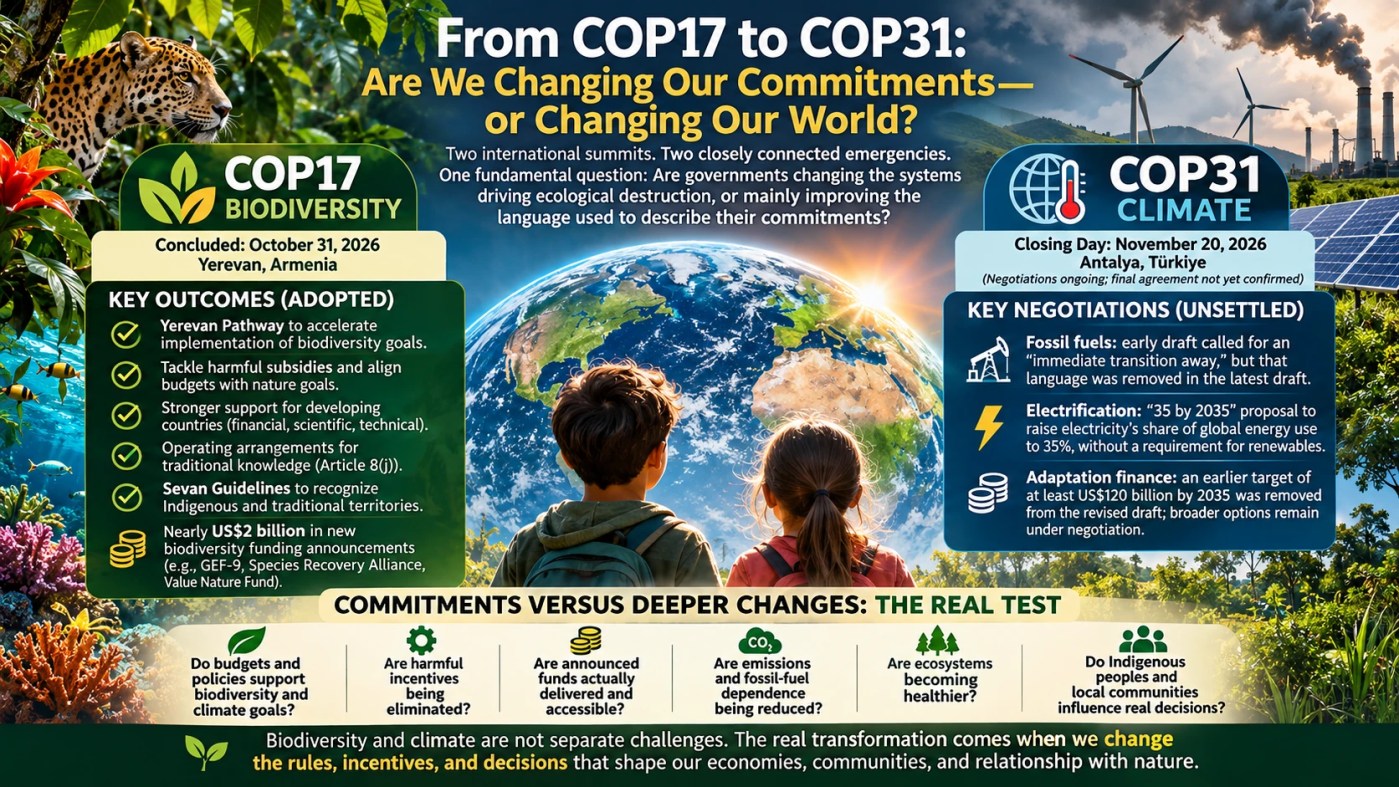
Two international summits. Two deeply connected emergencies. One question that matters more than any headline: are governments changing the systems that drive ecological destruction, or mainly improving the language they use to describe their commitments?
The United Nations biodiversity summit, COP17, closed in Yerevan, Armenia, on October 31, three weeks ago. The United Nations climate summit, COP31, reached its scheduled final day today in Antalya, Türkiye. They belong to different international agreements, but their agendas overlap: protecting nature, reducing climate pollution, financing action, and deciding who bears the costs of change.
There is one distinction I want every reader to hold onto before going further. COP17 has adopted its decisions. COP31 has not. As I write this, negotiators in Antalya are still working from a contested draft, several countries are threatening to block it, and reporters on the ground say the talks are expected to run into overtime on Saturday. Anything described below as a COP31 proposal is exactly that: a proposal, not a completed agreement.
It is worth noticing that COP17 also ran over. It was scheduled to end on October 30 and finished a day late, after what one outlet called a two-week stalemate. Overtime has become a normal part of how these summits end, and so has the last-minute weakening of ambitious language. Watching both summits side by side helps us see that pattern clearly.
First, What Is the Difference Between These Two COPs?
“COP” stands for Conference of the Parties, the decision-making meeting of the countries that have joined a particular international treaty. The numbers do not mean one summit comes after the other. COP17 is the seventeenth meeting under the biodiversity treaty; COP31 is the thirty-first meeting under the climate treaty. They are separate negotiating histories addressing problems that cannot actually be separated in nature.
| Aspect | COP17: Biodiversity | COP31: Climate |
| Where and when | Yerevan, Armenia; October 19–31, 2026 (one day of overtime) | Antalya, Türkiye; November 9–20, 2026 (overtime expected) |
| Treaty | Convention on Biological Diversity (CBD) | UN Framework Convention on Climate Change and the Paris Agreement |
| Central focus | Conserving nature, using it sustainably, and sharing benefits from genetic resources fairly | Cutting greenhouse-gas pollution, adapting to climate impacts, financing action, and addressing loss and damage |
| Main framework | Kunming–Montreal Global Biodiversity Framework (23 targets for 2030) | Paris Agreement, national climate plans (NDCs), and adaptation plans |
| Leadership | Armenian Presidency (Environment Minister Hambardzum Matevosyan) | Türkiye hosts (President Murat Kurum); Australia leads negotiations (Minister Chris Bowen) |
| Status today | Concluded; about 50 decisions adopted, including the Yerevan Pathway | Unresolved; draft text contested, formal objection threatened |
COP17: A Clearer Pathway, but an Uncomfortable Report Card
COP17 carried out the first global review of how well countries are implementing the Kunming–Montreal Global Biodiversity Framework, the nature agreement adopted in 2022. The finding was sobering. According to the Convention’s own State of Biodiversity Action report, the world is off track to meet the framework’s 23 targets by 2030 without much faster action. One analysis put it at 22 of 23 targets off track; others described the world as on course to meet none of them.
It is important to be honest about what was new and what was not. The headline goals, including protecting 30 percent of land and seas, restoring 30 percent of degraded ecosystems, and halting human-caused extinction of known threatened species, were agreed in 2022. COP17 did not create those goals. Its job was to measure progress against them and decide how to speed things up. When you see posts celebrating “30 by 30” as a COP17 achievement, that is a reaffirmation, not a new commitment.
What Governments Actually Adopted
The main decision, which the Presidency named the Yerevan Pathway, is the negotiated response to that disappointing review. It sets out priorities through 2030, including:
- Tackling subsidies and incentives that harm nature.
- Aligning national budgets and economic decisions with biodiversity goals.
- Increasing financial, scientific, and technical support for developing countries.
- Strengthening monitoring, reporting, and review, backed by new State of Nature indicators and metrics.
- Asking countries to revise their national biodiversity plans, subject to available funding, with attention to gaps in marine, coastal, and inland-water coverage.
COP17 also adopted the working arrangements for the Convention’s body on traditional knowledge under Article 8(j), and the Sevan Voluntary Guidelines, which aim to strengthen recognition of Indigenous and traditional territories in land-use planning, restoration, conservation, and environmental impact assessment. In total, the conference adopted around 50 decisions on topics ranging from protected areas and invasive species to marine biodiversity, synthetic biology, and biodiversity education. The next meeting, COP18, will be held in Ecuador, with only two years left before the 2030 deadline.
What the Money Means, and What It Does Not
The Convention’s Secretariat reported nearly US$2 billion in new biodiversity funding announcements, including roughly US$560 million through the next Global Environment Facility cycle (GEF-9) and its Global Biodiversity Framework Fund, US$500 million through the Species Recovery Alliance, and more than US$330 million through the Value Nature Fund, which seeks private investment.
That is meaningful, but an announcement is not a delivery, and a delivery is not a recovered ecosystem. Coverage of the summit described the deal as fragile and noted that finance fell short. Developed countries pushed to widen the circle of donors to include wealthier emerging economies, and negotiators could not even agree on a definition of “developing countries.” Pacific Island nations warned at the closing plenary that delegates were leaving with realities the official text did not reflect, including a low replenishment of key funds.
The Subsidy Question
Harmful subsidies may be the single most revealing test of whether governments are serious. Public money that pays for nature’s destruction directly undermines public money spent protecting it. At COP17, analysts at the International Institute for Sustainable Development observed that much of the momentum for subsidy reform emerged outside the negotiating rooms, through a Presidency-led call on incentives and a group of countries championing the relevant target. That is encouraging, but voluntary coalitions are not the same as binding decisions.
The Convention’s Executive Secretary, Astrid Schomaker, framed the challenge well: the real test is what governments change when they return home. I could not agree more.
My assessment: COP17 strengthened the machinery of implementation and gave us something concrete to hold governments to. Its deeper test is whether national budgets, subsidies, and planning decisions now begin to match the promises.
COP31: The Struggle Over What Survives the Final Draft
COP31’s closing-day story is not yet an agreement. It is a contest over whether ambitious language survives the search for consensus. Following how the draft text has changed over the past week tells us more than any single press release.
| Issue | Early draft (released Monday, Nov 16) | Revised draft (Thursday, Nov 19) | Where it stands Friday |
| Fossil fuels | Called for accelerated action to phase out fossil fuels, including an “immediate transition away” in energy systems | All references to fossil fuels removed; several paragraphs promote carbon capture | A cross-regional group is demanding the language return; Panama says it will formally object without it |
| Adaptation finance | Tripling adaptation finance for developing countries to at least US$120 billion by 2035 | Explicit US$120 billion figure dropped | Still contested; calls for the largest emitters to pay their fair share |
| Electrification (“35 by 2035”) | Raise electricity to 35% of global energy use by 2035 | Goal retained, but without a requirement that the power be renewable | Coalition wants clear language on clean, renewable sources and faster methane cuts |
Fossil Fuels: Naming the Cause, or Avoiding It
When the Presidency published its first draft on Monday, it surprised many observers by calling for an immediate transition away from fossil fuels in energy systems. By Thursday, the revised text had removed every reference to fossil fuels. COP31 President Murat Kurum described the revision as the product of intensive negotiations, and Australia’s Chris Bowen called it the best basis for finding agreement in the remaining hours.
Not everyone accepted that. On Friday, countries that rarely negotiate together, led by France and Panama and joined by Belgium, Côte d’Ivoire, Finland, Greece, Guatemala, Spain, Sweden, and Vanuatu, held a joint press conference to say the deal on the table is not good enough. Panama said it will formally object to any agreement that omits fossil fuels. Because UN climate decisions are normally adopted by consensus, a single formal objection could delay or derail the final outcome. France’s minister pointed out that the draft promotes carbon capture technologies while never naming the fuels whose emissions would be captured.
This is the second year in a row this fight has played out. Last year’s COP30 in Belém, Brazil, also ended without fossil-fuel language in its final text, after earlier drafts had included it. A pattern is forming: the cause of the crisis appears in early drafts and disappears in final ones.
My assessment: A transition should be judged by what polluting activity it replaces, not only by how much new infrastructure it adds. A text that promotes capturing emissions while refusing to name their source is managing a symptom while protecting the cause.
Electrification: A Big Idea With a Missing Word
One of COP31’s signature proposals is “35 by 2035,” raising electricity’s share of global energy use to 35 percent by 2035. Electrifying transport, heating, and industry is essential. But the revised draft keeps the goal without requiring that the electricity come from renewable sources. Electrifying a car fleet with power from coal plants moves emissions from tailpipes to smokestacks.
UN Secretary-General António Guterres has stressed that expanding clean energy, grids, storage, efficiency, and electrification must actually drive down fossil-fuel production, use, and emissions. It is also worth knowing that the electrification initiative began as a voluntary pledge championed by the Presidency. A voluntary pledge, a Presidency initiative, and a negotiated decision adopted by all countries are different things, and we should not blur them in our coverage.
Adaptation Finance: Going Backward on a Number Already Promised
Here is a detail many reports have missed. At COP30 last year, countries already called for tripling adaptation finance to roughly US$120 billion a year by 2035, as part of the broader US$300 billion annual climate-finance goal agreed in Baku. COP31’s early draft reaffirmed and built on that figure. Thursday’s revision dropped it.
So the question in Antalya is not whether to add a bold new number. It is whether countries will even restate a number they agreed to twelve months ago. For communities facing floods, droughts, heat, and rising seas, adaptation money is not abstract. It pays for sea walls, early-warning systems, drought-resistant crops, and cooling centers. Beyond the amount, the deeper questions are who pays, whether support comes as grants or as loans that deepen debt, and whether vulnerable countries can actually access it.
My assessment: A finance commitment should be judged by its source, its terms, its accessibility, and its delivery, not just its size. And a commitment that cannot survive one year of negotiations was never secure.
Side by Side: How Each Summit Handled the Hard Questions
| Question | COP17 (Biodiversity) | COP31 (Climate, as of Friday) |
| Did it name the drivers of destruction? | Yes, in part: harmful subsidies are a named priority, though much reform energy came from voluntary coalitions | Currently no: fossil fuels removed from the latest draft |
| Is there a new money number? | Nearly US$2 billion in announcements; finance still described as falling short | US$120 billion adaptation figure dropped from the latest draft |
| Is there a delivery mechanism? | Yerevan Pathway, revised national plans, new monitoring indicators | Depends on the final text; electrification goal lacks a clean-power requirement |
| Whose voices shaped it? | New Article 8(j) arrangements and Sevan Guidelines on Indigenous and traditional territories | Cross-regional coalition of developed and developing countries pushing for stronger language |
| Biggest weakness | Off track on nearly all 2030 targets, with two years left | Risk of a consensus text that avoids naming the cause of the crisis |
Commitments Versus Deeper Changes
The most useful comparison is not which summit produced the more impressive headline. It is which outcomes reach the underlying decisions that shape economies and communities: budgets, subsidies, permits, infrastructure, and who holds power over land and resources.
| Area | Commitment or announcement | The deeper-change test |
| Biodiversity protection | Reaffirming existing conservation and restoration targets | Do national budgets, incentives, and land-use decisions actually support them? |
| Biodiversity finance | Announcing new funds and investment initiatives | Is the money delivered, and does it produce measurable improvements for nature and people? |
| Energy transition | Promoting electrification and clean-energy expansion | Does it reduce fossil-fuel production, use, and emissions, or just add capacity alongside them? |
| Climate adaptation | Negotiating a finance target | Who pays, on what terms, and can the most vulnerable communities access it? |
| Participation and rights | Adopting institutions and guidelines on traditional knowledge and territories | Do they change real decisions, or remain procedural achievements? |
These are accountability tests, not claims that any of these changes have already happened.
Why Climate and Nature Action Must Connect
Countries prepare their climate plans, adaptation plans, biodiversity strategies, and land-restoration plans through separate processes, often in separate ministries that rarely talk to one another. Analysis from the International Institute for Sustainable Development has identified real opportunities to align those plans, their monitoring systems, and their financing between Yerevan and Antalya, instead of running disconnected tracks.
This is not a technical footnote. Forests, wetlands, mangroves, and oceans store enormous amounts of carbon and buffer communities from climate impacts. A warming climate, in turn, is one of the fastest-growing drivers of biodiversity loss. Treating these as two problems means building two half-solutions.
Public accountability should follow the same principle. We should ask whether ministries, budgets, infrastructure plans, conservation policies, and financial institutions are working toward compatible outcomes, not whether each has produced its own statement of concern. That integrated view is at the heart of what I call the Green Way Forward: decisions measured by whether they protect the well-being of our children and the health of biodiversity together.
What This Means for Our Community
Summits happen far away, but implementation happens close to home. Here is how each of us can turn this moment into practice:
- Learn the difference between an announcement and an outcome. When you share summit news, say whether something is a draft, a pledge, or an adopted decision. Accuracy is a form of climate action.
- Follow your own country’s national plans. Every country is now expected to revise its biodiversity plan under the Yerevan Pathway and update its climate plan under the Paris Agreement. Ask your representatives where those plans stand.
- Ask about subsidies. Find out what public money in your country or state still supports activities that harm nature or increase emissions.
- Watch the final COP31 text. Over the weekend, check whether fossil fuels, the adaptation figure, and the renewable-power requirement made it into the final agreement. I will follow up once the outcome is confirmed.
- Support local resilience. Adaptation is not only a global finance question. Local flood planning, cooling centers, tree canopy, and wetland protection are adaptation too.
Mr. Alvarez’s Thoughts: Judge the Follow-Through
I see a meaningful difference between these two summits at this moment. COP17 has given us adopted decisions and a pathway whose delivery we can now scrutinize. COP31 is showing us, in real time, how difficult it is to keep clear commitments on fossil fuels and adaptation finance alive through the final hours of negotiation.
I also see something hopeful in Antalya. A coalition of countries from Europe, Latin America, Africa, and the Pacific is standing together and refusing to accept a text that will not name the cause of the crisis. Whatever the outcome, that kind of cooperation across old dividing lines is exactly what this emergency demands.
Neither summit deserves an automatic declaration of success. Neither should be dismissed without examining what was actually agreed. For our children and biodiversity’s future, the standard should be straightforward:
- What policy changed?
- What harmful incentive ended?
- What funding actually arrived?
- What emissions were reduced?
- What ecosystem became healthier?
- Whose knowledge and rights shaped the decision?
Those are the questions I believe should follow every summit home. Our responsibility as a community is not to confuse an announcement with an accomplishment. It is to keep our attention on the distance between them, and on the decisions that can close that distance.
* * *
Mr. Alvarez, Content Curator | Climate Change Community LLC
Read posts at climatechangecommunity.com | Founders Library: climatechangecommunity.com/library/
Artificial intelligence is used to enhance my creativity and thinking in preparing this post. The ideas, experiences, and commitments are my own.
Protecting our Children & Biodiversity’s future towards a more sustainable and habitable Earth!
Compiled & Mr. Alvarez’s Thoughts | AI Enhanced.
Sources
- Convention on Biological Diversity, “COP 17 closes” (cbd.int/article/cop-17-closes)
- UN News, “COP31: Countries demand stronger climate deal as talks in Antalya reach final day,” Nov. 20, 2026
- RTÉ News, “COP31 draft climate deal removes mention of fossil fuels,” Nov. 19, 2026
- CNN, “How two words could derail the world’s biggest climate conference,” Nov. 20, 2026
- Associated Press via KSAT, “Nations demand fossil fuel cuts as UN climate talks COP31 are wrapping up in Turkey,” Nov. 19–20, 2026
- Climate Home News, “COP17 delivers fragile deal to boost conservation and funding for nature,” Oct. 31, 2026
- Carbon Brief, “COP17: Key outcomes agreed at the UN biodiversity conference in Yerevan,” Oct. 31, 2026
- Down to Earth, “Yerevan Pathway: COP17 ends with decisions on 50 agenda items”
- International Institute for Sustainable Development, COP17 statement and Yerevan–Antalya climate-nature-land analysis
- Health Policy Watch and Dialogue Earth coverage of COP30 adaptation finance outcomes, Nov. 2025
- UNFCCC, UN Secretary-General remarks at COP31


Leave a Reply