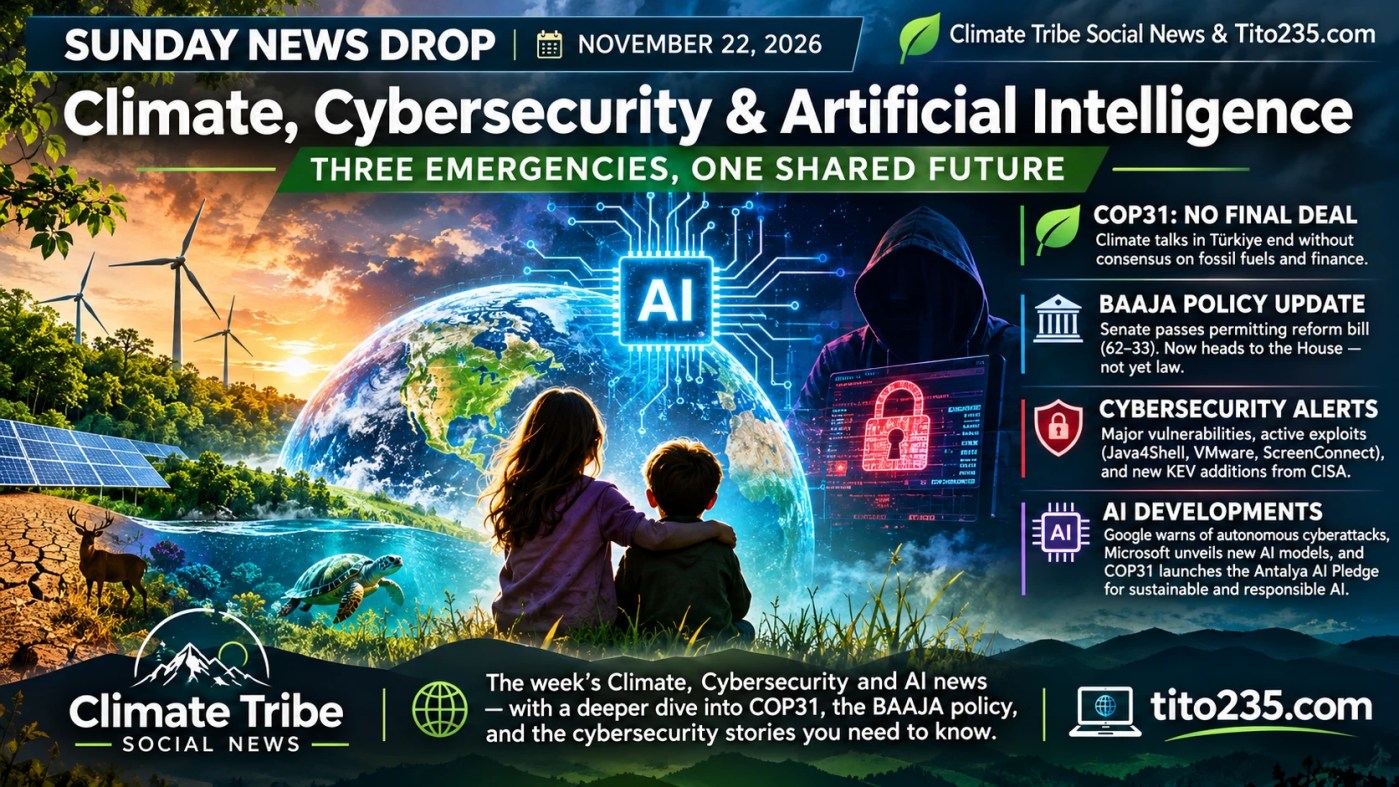
Climate, Cybersecurity & Artificial Intelligence | Week of November 16–22, 2026 | Climate Tribe Social News
Some weeks the news arrives in separate boxes. This was not one of those weeks. On Sunday, the longest UN climate summit ever held ended in Antalya without a final agreement. On Thursday night, the U.S. Senate passed the most sweeping rewrite of federal permitting rules in a generation. And in between, security teams around the world spent the week racing to patch a critical Java flaw that was discovered with AI, a VMware vulnerability that a state-linked group had already been exploiting for months, and a supply-chain attack that turned a trusted website script into a delivery system for malware.
Climate, cybersecurity and artificial intelligence are not three topics. They are three faces of the same question: who builds, powers and protects the systems our children will inherit, and who gets to hold those builders accountable? That question runs through every story below.
A note on accuracy before we begin. Two distinctions matter this week. First, BAAJA has passed the Senate only. It is not law. Second, the string of major tech outages in recent days (Microsoft, JPMorgan Chase, Apple, the FAA and others) has not been linked to any cyberattack; the companies and the government say there is no evidence of malicious activity. I separate outages, vulnerabilities and attacks throughout this post because sharing them as one story would spread misinformation, and we do not do that here.
1. Climate: COP31 Ends Without a Deal
The longest COP in history, and the first collapse since Copenhagen
COP31 in Antalya, Türkiye, was scheduled to run November 9–20. Negotiations spilled roughly two days into overtime, making it the longest COP on record, and when the closing plenary finally convened on Sunday, November 22, the main political agreement (known as the cover decision) was not adopted. COP31 President Murat Kurum, Türkiye’s environment minister, told delegates plainly that there was no agreement on the text and that the decisions had therefore not been adopted.
This is the first time since COP15 in Copenhagen in 2009 that UN climate talks have failed to produce a deal adopted by all parties. Negotiations chair Chris Bowen of Australia, who shared presidency duties with Türkiye under last year’s unusual hosting compromise, conceded that he could not bridge what he called unbridgeable red lines.
Why it broke down: the words “fossil fuels”
The dispute came down to a phrase that still somehow cannot make it into a climate agreement. The final draft from the Turkish and Australian presidencies contained no reference to fossil fuels or to transitioning away from them. The European Union formally objected, saying it would not endorse a cover decision that fails to mention the key driver of climate change. Ireland’s climate minister, Darragh O’Brien, speaking for the EU presidency, said the bloc would not accept a COP that greenwashes fossil fuels.
The EU was not alone. Panama said the text weakened earlier decisions and did not reflect the urgency of keeping 1.5°C within reach. The Marshall Islands withheld support, saying the deal failed frontline nations. The United Kingdom, Norway, Belize, Vanuatu and Tuvalu also rejected it, and reporting indicates more than 130 countries had sought an endorsement of the transition away from fossil fuels.
It is just as important to be fair about the other side of the room. Saudi Arabia, speaking for the League of Arab States, defended references to carbon capture and storage, arguing that climate change requires all solutions on the table. Ghana, speaking for the African Group, named real shortcomings on finance, loss and damage, and support for workers, but said the group would not block consensus. Pakistan urged delegates not to sacrifice the broader package. China and India voiced objections but were prepared to accept the text. In other words, many countries were willing to take a weak deal rather than no deal, and their reasons (development needs, finance, energy security) deserve to be understood, not dismissed.
Adaptation finance: a promise needs a starting line
Throughout the two weeks, developing countries pressed for a clear baseline, methodology and tracking system for the goal of tripling adaptation finance. Without a baseline, “tripling” is a word, not a number. The EU, the Environmental Integrity Group and Japan argued those details belonged in the separate finance negotiations. The gap never closed.
The money actually on the table tells its own story. New pledges to the Adaptation Fund at COP31 reached only about $50.2 million, with several wealthy countries making no pledges at all. For communities facing floods, droughts and extreme heat right now, that figure is not an abstraction. It is the difference between a seawall built and a seawall imagined.
What COP31 did deliver
It would be inaccurate to say nothing came out of Antalya. UN Climate Change Executive Secretary Simon Stiell pointed to an agreement on just transition and to Action Agenda initiatives on electrification, resilience and investment. Türkiye also announced more than $26 billion in green investment partnerships during the first week.
One headline figure needs careful handling. The presidency promoted a goal of raising electricity’s share of global final energy consumption to 35% by 2035. That target lives in the voluntary Action Agenda; it did not become an adopted, summit-wide commitment, because the package that would have carried it was rejected. Electrification is a powerful tool, but only when the electricity is clean. More electricity from coal and gas is not progress.
The Paris Agreement and its existing obligations remain fully in force. COP31’s failure erases none of them. COP32 will be held in Addis Ababa, Ethiopia, and inherits every unresolved issue, starting with fossil fuels and climate finance.
The science did not wait for the negotiators
UN Secretary-General António Guterres called the outcome deeply disappointing, and his framing is the one I keep returning to: there may be no consensus in the negotiating room, but there is no ambiguity in the science. As COP31 opened, scientists reported that the average global temperature had recently touched a record of more than 2°C above the preindustrial baseline over several days, and carbon dioxide emissions in 2026 are on track for another record. Stiell said the world cannot afford a repeat of this moment. He is right.
Mr. Alvarez’s thoughts on COP31
I have followed this process since February 2007, when the IPCC’s Fourth Assessment Report changed how I saw the world. Nearly twenty years later, the phrase “transitioning away from fossil fuels” is still treated as too controversial to print. That should trouble all of us.
But I want to resist two easy conclusions. The first is that COP is useless. It remains the only room where nearly every nation sits together, and the countries that refused a hollow deal this year did something brave. The second is that international talks alone will save us. They will not. The Green Way Forward is built just as much in city councils, utility boards, school districts and community gardens as it is in conference halls. Climate action is measured in emissions cut, ecosystems protected and communities made resilient, not in pages of agreed text.
2. U.S. Policy: BAAJA Passes the Senate, 62–33
What happened this week
The Bipartisan American Affordability and Jobs Act of 2026, known as BAAJA, moved through the Senate in a series of votes:
- November 9: The Senate voted 73–25 to begin consideration of the bill.
- November 16–18: The Senate voted 70–27 to end debate on a revised substitute text, then adopted the BAAJA text and invoked cloture on the full bill.
- November 19: At about 9:30 p.m. Eastern, the Senate passed BAAJA on final passage, 62–33, with five senators not voting. Nearly every Republican and 15 Democrats voted yes.
BAAJA is not law. It now goes to the lame-duck House. If the House changes anything, the Senate must vote again. It then needs the President’s signature, and the calendar before year’s end is short. No House vote had been scheduled as of this weekend. Note also that support in the Senate fell from 73 votes at the start of the week to 62 on final passage, as some senators who voted to move the bill forward ended up voting no.
What the bill would do
BAAJA, introduced September 30 by the leaders of the Senate Environment and Public Works and Energy and Natural Resources committees, is the most comprehensive permitting package Congress has considered in years. It would set new permitting deadlines, change judicial review procedures, and make significant changes to the National Environmental Policy Act, the Clean Water Act, the Endangered Species Act, historic preservation review, transmission permitting and energy leasing. Its reach extends to pipelines, mines, transmission lines, renewable projects and data centers, including projects on public land.
One provision deserves special attention from our community: the bill would require data center developers to pay for the grid upgrades they need. With AI driving enormous new electricity demand, the question of who pays for that infrastructure is a question of fairness to ordinary ratepayers.
The case supporters make
Supporters argue that slow permitting and endless litigation strangle exactly the projects a clean-energy transition needs, especially long-distance transmission lines. The Solar Energy Industries Association and hundreds of solar and storage companies backed the bill, and the American Clean Power Association argued reform is needed to protect clean energy projects that often face litigation. Senator Angus King, an independent who caucuses with Democrats, said that while he did not agree with everything in it, the bill was worth the compromise because it addresses affordability and climate change. Oil and gas producers, including the American Exploration & Production Council, also welcomed it.
The concerns opponents raise
Environmental organizations including the Sierra Club, Environment America and Defenders of Wildlife warn that the bill weakens air, water and wildlife protections, shortens or skips environmental reviews for some categories of work, and makes permits harder to challenge in court. Tribal organizations raised serious concerns about weakened consultation and changes to historic preservation review under Section 106. Native Hawaiian advocates worried that communities would have little legal recourse against future contested projects. Critics also noted that the 494-page package never received a single committee hearing, and environmental and tribal groups urged lawmakers to wait for the next Congress.
There is a political reality worth naming: the White House supports the bill even while the administration has opposed new wind projects. That makes a provision protecting already-permitted clean energy projects especially significant, and it also means outcomes will depend heavily on who holds the permitting pen.
Mr. Alvarez’s thoughts on BAAJA
I am not against building. We need transmission, storage and clean generation at a speed this country has rarely managed. But “streamlining” is a word, not an outcome. Environmental reviews and species consultations are how we catch damage to wetlands, waterways and sacred places before it happens, and tribal consultation is a matter of honoring commitments, not paperwork.
My ask is the same one I make every week: do not settle for talking points from either side. Read the Congressional Research Service analysis. Read what conservation groups, tribal nations and clean-energy developers are each saying. Then call your Representative and tell them what you think. This is exactly the kind of moment when legislative literacy becomes climate literacy.
3. Cybersecurity: A Week of Serious Warnings
A common thread connects most of this week’s security news: attackers are exploiting the things we already trust, including vendor scripts, the Java runtime underneath our applications, the management console for our servers and the remote-support tools our technicians use every day.
A. Optimizely: when a trusted script turns malicious
On November 16, an attacker exploited a flaw in the account signup flow of Optimizely’s Web Experimentation platform, a widely used A/B testing tool that works by loading a JavaScript snippet on customers’ websites. The flaw allowed unauthorized write access to customers’ project code, and malicious JavaScript was served to visitors for much of that day.
Security researcher Scott Helme of Report URI examined 1,611 scripts and identified 188 infected scripts associated with 178 organizations; researchers reported that affected sites included major media, technology and financial brands. Analysts described the payloads as card skimmers and cryptocurrency-stealing code. Because the malicious code came from Optimizely’s own trusted delivery network, a standard Content Security Policy that allowlisted Optimizely offered no protection.
Optimizely says it contained the incident, blocked the vulnerable path, removed the injected code, secured affected accounts and notified customers directly, and that fewer than 5% of its customers were affected. The lesson: know every third-party script on your website, who controls it, and how fast you can turn it off.
B. Java4Shell: a critical flaw found with AI
On November 17, the security firm Calif disclosed Java4Shell (CVE-2026-114938), a memory-corruption flaw in the hardware-accelerated Base64 decoder of OpenJDK’s HotSpot virtual machine. Specially crafted Base64 input can crash the JVM and, in some cases, allow unauthenticated remote code execution. Researchers demonstrated impact on popular enterprise software such as Jenkins, Atlassian Jira, Confluence and Keycloak. Oracle and OpenJDK shipped fixes the same day, and CISA issued an alert urging organizations to patch immediately.
Two details matter. Exposure depends on your setup: affected builds include Java 17, 21, 25 and 27 running on x86-64 servers whose processors support certain AVX-512 instructions, while Java 7, 8 and 11 do not contain the vulnerable decoder. And Calif reportedly found the flaw in about an hour using AI tools and built a working exploit in two more, at a computing cost under $200. As of mid-week, no in-the-wild exploitation had been reported, and the flaw was not in CISA’s Known Exploited Vulnerabilities catalog. The lesson: inventory the Java runtimes bundled inside other software, not just the ones you installed yourself.
C. VMware vCenter: a zero-day exploited for months
On November 19, Broadcom published VMSA-2026-0009, covering five vulnerabilities across vCenter, SDDC Manager and VMware Tools. The most severe, CVE-2026-123890, is an authentication bypass in vCenter’s VMware Directory Service, rated 9.8 out of 10. An attacker with network access can bypass authentication without credentials.
This was not theoretical. Mandiant and Google Threat Intelligence reported that ARMORY CASTLE, a China-linked espionage group, exploited the flaw in early September using a custom tool called BONESAW that created single sign-on admin accounts and stole vCenter secrets, more than two months before the fix. Broadcom says there are no workarounds, so patching is the only remediation. This is also the second critical authentication bypass in the same vCenter component this year. The lesson: vCenter controls entire virtual data centers. Patch now and hunt for unexpected admin accounts.
D. ScreenConnect: turning remote support against technicians
Huntress confirmed in-the-wild exploitation of CVE-2026-84869, a critical flaw (CVSS 9.9) in the ConnectWise ScreenConnect client that technicians use to join remote sessions. A malicious guest can push a file to a connecting technician’s computer and make it run with no prompt. Huntress documented one technician workstation compromised in about nine seconds on November 12, a test run on another, and a spray of at least 688,000 malicious file requests across 42 managed service provider servers.
ConnectWise released the fix back on September 8 in version 26.6.5. That means the exploitation succeeded against technicians who simply had not updated. This activity is related to, but distinct from, the worm-like “SCKit” campaign that hit MSPs starting November 11 through a vulnerable third-party extension (RMM+). The lesson: updating the server does not update every technician’s client. Update every technician’s host client to 26.6.5 or later.
E. CISA’s Known Exploited Vulnerabilities: what attackers are actually using
CISA’s KEV catalog lists flaws with evidence of real-world exploitation, which makes it the best guide to what to patch first. This week brought two batches:
- November 18: Synology DiskStation Manager, BerriAI LiteLLM (an AI gateway tool), Apache Axis and Vanderbilt’s REDCap research platform.
- November 20: SAP NetWeaver, Cisco Expressway (hard-coded credentials), Apache Roller, and the VMware vCenter flaw described above.
Earlier in November, CISA also added flaws in OpenSSH, IBM Aspera Faspex, GPUStack, FreeSWITCH and Cisco BroadWorks. Notice that AI infrastructure (LiteLLM, GPUStack) now appears regularly on this list. AI tools are becoming targets in their own right.
F. Third-party breaches: Osaka and Maersk
Two incidents disclosed in the days just before this week drive home the vendor lesson. Osaka City confirmed on November 13 that 1,078,713 email addresses were exposed, not through the city’s own system, but through a breach at Arara, the bulk-email service used by its system provider, TKC. Anyone who received email from the city’s online administrative system between July 1 and October 31 was affected. The city warned residents to watch for fake messages impersonating official communications.
Shipping giant Maersk confirmed on November 11 that attackers accessed and extracted data from a legacy system inherited through an earlier acquisition. A ransomware group calling itself WhiteArmor claimed 100GB of data and demanded $5 million. Maersk says its findings so far strongly suggest no sensitive data was disclosed and that the incident is isolated to that one system.
G. Outages are not attacks, but they still matter
Recent days also brought a cluster of service failures: a global Microsoft 365 outage affecting Outlook, Teams and Copilot; an FAA network malfunction that caused the longest nationwide ground stop in 25 years; a United Airlines outage; JPMorgan Chase transaction delays; Apple service disruptions; Marriott sign-in problems; and an NSA classified network going offline during scheduled maintenance. The administration said there was “zero” indication the outages were linked or caused by bad actors, and every affected organization said there was no evidence of a cyberattack. Microsoft said its outage was not related to AI agents.
Why include them? Because resilience includes reliability. Officials also said that urgent patching after last month’s PHP vulnerability alert caused some systems not to come back up as expected. Security and operational reliability must advance together; a rushed fix can become its own outage. As someone who spent nearly fourteen years in court-system tech support and has trained in IT since 1995, I will say what every technician knows: redundancy is not a luxury.
My cybersecurity takeaway
For individuals: keep your devices, browsers and apps updated; turn on multifactor authentication; use strong, unique passwords with a password manager; keep backups; and treat any unexpected email claiming to be from a city office, bank or delivery service with suspicion, especially this week.
For community organizations and small businesses: know what is connected to your systems, which vendors run code on your website, and who has remote access. Patch based on evidence of exploitation, starting with the KEV list. And make sure your remote-support provider can tell you, in writing, that every technician’s client is current.
4. Artificial Intelligence: Opportunity, Threat and Footprint
A. Google: “agentic” attacks cross a threshold
Google Threat Intelligence Group published its latest AI Threat Tracker this week under the title “Agentic Threat Activity Crosses a Significant Threshold.” GTIG reported that threat actors are increasingly using large language models and agentic frameworks (AI systems that chain tasks together on their own) to automate the reverse engineering of security patches, rapidly turning newly published fixes into working exploits. Google highlighted a case of an agentic framework reversing security patches autonomously, without human intervention.
This is a real shift from just two months ago, when GTIG said it had not yet seen fully autonomous attack pipelines deployed against targets. It creates an uncomfortable race: every published patch helps defenders but also gives automated attackers a map of what changed. It does not mean every AI system is attacking anyone, and it does not mean defenses are useless. It does mean the time between “patch released” and “patch exploited” is shrinking, which is exactly why the Java4Shell and vCenter stories above matter so much.
B. Washington takes notice
On November 18, Senators Maria Cantwell (D-Wash.) and Mike Rounds (R-S.D.) wrote to Jay Clayton, chair of the White House Super Intelligence Task Force, warning that rapidly escalating AI-enabled cyber threats are outpacing the nation’s defenses. They urged immediate action to protect critical infrastructure, financial institutions and widely used software, faster deployment of defensive AI tools, and firm security standards for autonomous AI agents. It was their second bipartisan letter on the subject since October. Whatever one’s politics, it is encouraging to see a Democrat and a Republican agree that this deserves urgent attention.
C. Microsoft launches seven new MAI models
At its Ignite 2026 conference on November 17, Microsoft AI introduced seven new in-house models, including MAI Code 2 and MAI Code 2 Flash for programming (available in GitHub Copilot), MAI Cyber 2 Flash for security work, MAI Image 2.7, and new voice and transcription models. The common thread is price: Microsoft claims near-frontier performance at a fraction of competitors’ costs.
A healthy dose of skepticism applies. These are company-reported benchmarks, and some of the cost comparisons used limited-time promotional pricing that roughly halves the standard rate. Microsoft itself says the coding model is not yet tuned for long-running agentic work. The broader trend is real, though: AI is becoming specialized, with task-specific models for coding, security and media. That creates opportunity, and also new governance responsibilities for every organization that plugs these tools into its systems.
D. The Antalya AI Pledge: putting AI’s footprint on the climate agenda
One of COP31’s more hopeful moments came on November 16, when the COP31 Presidency and the International Telecommunication Union (ITU) launched the Antalya Artificial Intelligence Pledge. It aims to align AI innovation with climate action across four areas: transparency in measuring AI’s footprint, energy-efficient infrastructure, sustainable design and circularity, and using AI for climate action, with particular attention to supporting climate-vulnerable nations.
The pledge drew 80 statements of support and 271 commitments from governments, companies and organizations. Two cautions are important. Those are endorsements and commitments, not 80 countries signing a treaty. And the pledge is explicitly voluntary and non-binding; its organizers say it creates no new obligations. Success, as the ITU itself acknowledges, will depend on delivering commitments and demonstrating measurable results.
The stakes are real. The International Energy Agency has projected that global data center electricity use could roughly double to around 945 terawatt-hours by 2030. That is a projection, not a measurement, but it captures the scale. Add the water used for cooling, the minerals mined for chips and the electronic waste at the end of a server’s life, and the conclusion is unavoidable: we cannot claim technology is helping save the planet while ignoring what it costs the planet to build and run it.
E. Responsible AI: permission is the new security perimeter
Every AI story this week points to one question: what are we letting AI systems do? An assistant that answers questions is one thing. An agent that can open files, run commands, use credentials and talk to outside systems is something else entirely. Before any organization connects an AI agent to its infrastructure, it should be able to answer:
- What information can this system access, and what actions can it take?
- Can its permissions be narrowed to only what the task requires?
- Are its actions logged, monitored and reviewable by a person?
- What happens if it reads compromised content or receives malicious instructions?
I use AI every week to research and shape these posts, and I remain optimistic about what it can do for science, education, environmental monitoring and community resilience. But optimism is not a substitute for accountability. As a UNESCO and University College London study highlighted at COP31 found, chatbots sometimes abandon established climate facts when challenged, and accuracy varies across languages. Fluent language is not evidence. Always check the source.
5. Connecting the Dots
Political will is still lagging behind the science. COP31 showed that even after decades of research, many governments cannot yet agree to name the problem. Yet the countries that refused a hollow text showed that ambition has defenders.
Environmental policy is economic policy. BAAJA will shape where pipelines, transmission lines and data centers go, and who pays for them, for decades. Affordability and environmental responsibility cannot be separated.
Cybersecurity is now a matter of public trust. A city’s residents, a website’s visitors and a technician’s clients all became exposed this week through systems they never chose and could not see.
AI is accelerating everything at once: discovery of flaws, exploitation of flaws, demand for electricity and the need for honest governance. The same tool that found Java4Shell in an hour is helping attackers weaponize patches in minutes.
The common thread is infrastructure, physical and digital, being expanded faster than the safeguards around it. Resilience has to be treated as a public good, not a corporate feature.
6. What to Watch This Week
- COP31 aftermath: How the EU, small island states and the presidency respond, and whether a coalition forms to carry fossil-fuel transition language toward COP32 in Addis Ababa.
- BAAJA in the House: Whether the lame-duck House schedules a vote, whether it amends the bill (which would send it back to the Senate), and what changes, if any, are made to tribal consultation and environmental review.
- Patching priorities: VMware vCenter (CVE-2026-123890), Java4Shell (CVE-2026-114938), ScreenConnect technician clients (26.6.5 or later), and everything on CISA’s KEV list.
- Phishing in the wake of breaches: Expect scammers to impersonate Osaka City, Maersk and brands affected by the Optimizely incident.
- AI agents and security standards: Any White House response to the Cantwell–Rounds letter, and new research on autonomous attack frameworks.
- The Antalya AI Pledge: Whether endorsers publish real, measurable targets for energy, water and emissions reporting.
Final Thoughts
This week asked a lot of us. A climate summit failed to name fossil fuels. A bill that will reshape how America builds passed one chamber of Congress. And our digital lives proved, once again, to be only as secure as the least visible vendor in the chain.
None of this is a reason for despair. It is a reason for attention. We can acknowledge a major diplomatic failure without declaring cooperation dead. We can support new transmission without surrendering protections for wildlife, water and tribal nations. We can welcome AI-assisted discoveries without confusing capability with trustworthy governance.
Our mission at Climate Change Community and Climate Tribe Social is to protect our children and biodiversity by turning climate concern into climate competence. That means staying informed, questioning convenient narratives from every direction, separating evidence from speculation, and then doing something with what we learn. I am not a climate scientist, and I do not have every answer. When I don’t know, I’ll say so, and then we’ll find out together.
Stay informed. Question responsibly. Patch your systems. Call your Representative. And never confuse awareness with action.
Sources
- UN News: COP31 ends without climate pact
- Reuters via SCMP: COP31 climate talks collapse as EU and others reject deal
- Earth Negotiations Bulletin (IISD): COP31 coverage
- Hürriyet Daily News: COP31 Adaptation Fund pledges
- Deseret News: Permitting bill passes the Senate 62–33
- Sierra Club: Is This Bill the Future of Energy Permitting?
- Akin Gump: Senate Unveils Bipartisan Comprehensive Permitting Reform Bill
- Zscaler ThreatLabz: Attackers Exploit Optimizely Flaw
- BleepingComputer: Critical Java4Shell flaw
- Rapid7: CVE-2026-123890 VMware vCenter
- Huntress: CVE-2026-84869 ScreenConnect exploitation
- CISA: November 20 KEV additions
- The Record: Osaka City email breach
- SecureWorld: Maersk breach and inherited M&A risk
- AP via WFSB: Tech outages are piling up
- Google Threat Intelligence: Agentic Threat Activity Crosses a Significant Threshold
- Business Insurance (Reuters): Senators warn AI cyber threats outpace defenses
- Thurrott: Microsoft AI announces 7 new models at Ignite 2026
- ITU: COP31’s Antalya AI Pledge
- Anadolu Agency: Green AI pledge receives 80 statements of support

Read posts at climatechangecommunity.com
Climate Tribe Social Founders Library: https://climatechangecommunity.com/library/
Artificial intelligence is used to enhance my creativity and thinking in preparing this post. The ideas, experiences and commitments are my own.
Mr. Alvarez, Content Curator | Climate Change Community LLC
Protecting our Children & Biodiversity’s future towards a more sustainable and habitable Earth!
Compiled & Mr. Alvarez’s Thoughts | AI Enhanced.


Leave a Reply