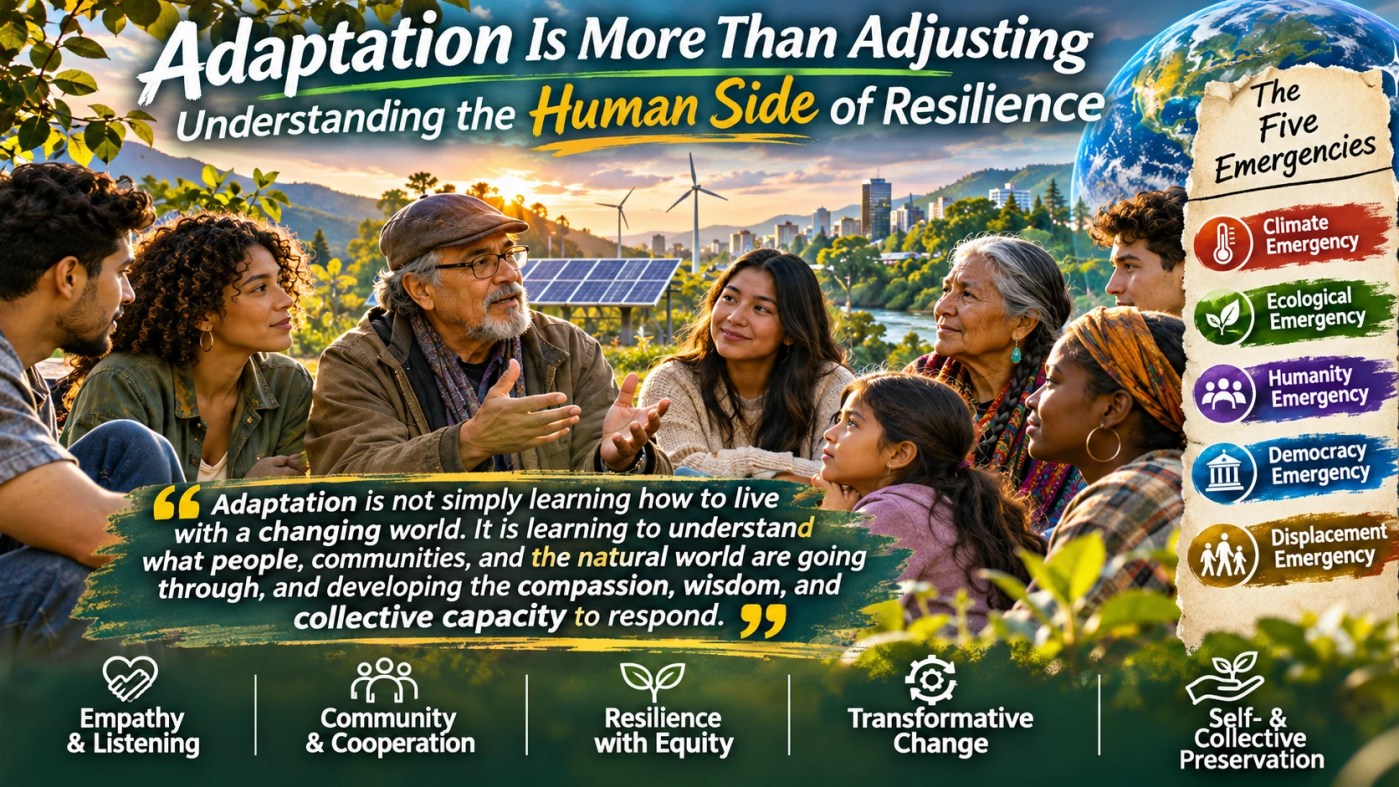
What if truly understanding adaptation begins not with knowing all the answers, but with understanding the struggles of others?
I recently found myself in a conversation about Adaptation after receiving an email from a climate-minded person who wanted to understand what adaptation really means.
Not the textbook definition. Not a shallow explanation about adjusting to changing circumstances. They were looking for something deeper, something connected to the Five Emergencies I am always talking about.
Naturally, I had some thoughts.
The first thing I said is the one most of us already know: adaptation is no longer optional. It has become a necessity. We must learn to adapt and, at the same time, become more resilient.
But let me be clear about something. I am not a climate scientist. I don’t pretend to have all the answers, and I rather enjoy telling people:
“You know what? I don’t know the answer. So let’s find out together, shall we?”
There is something valuable in being able to say that. It leaves room for learning, curiosity and dialogue, and for the possibility that someone else will bring an idea none of us had considered. Sometimes that is exactly where the most meaningful learning begins.
Beyond the Dictionary Definition
The word almost speaks for itself. We adapt to a situation, to the result of something that took place and changed our environment, to people who have changed for better or worse, to new responsibilities and to very difficult experiences. The list goes on.
But when I thought about it more carefully, my mind went back to the training I took while working toward my Climate Change Professional Certification.
There was a chunk of that content I did not know, and even after finishing it, I still did not get it. I could follow individual pieces, but something wasn’t connecting. So for months, I listened to the study material over and over again until I finally got it.
That experience taught me something about learning itself: knowing information is not the same as understanding what that information actually means.
And that brings me to what I consider a much deeper dimension of adaptation and resilience.
Understanding Human Suffering
Knowing climate science is great, and many people know it at an expert level. Climate scientists are really good at explaining the science. Researchers, engineers, planners and environmental specialists understand the technical side of climate impacts and the measures we can take to address them. Their work is essential.
What I came to realize is that understanding adaptation, and resiliency for that matter, on a truly deep level also requires something that cannot be measured by how much scientific information we have collected.
It requires understanding human suffering, individually and collectively.
It means being able to empathize, show compassion, truly care and, perhaps most importantly, listen. Listen to people’s experiences. Listen to their struggles. Listen to what they have lost, what they fear losing, what they are trying to protect and what they need to move forward.
Think of someone whose home has flooded again and again. Someone whose livelihood depends on an ecosystem that is falling apart. A family facing displacement, food insecurity or a lack of basic necessities. A community that feels unheard, excluded or abandoned by the very institutions meant to represent it.
We can explain the science behind many of these circumstances. We can write policies and reports, build programs and debate solutions. But are we truly understanding the people living through these realities?
That question deserves far more attention than it gets.
The Five Emergencies: Five Connected Dimensions of Human Struggle
This is one of the reasons I keep talking about the Five Emergencies:
- The Climate Emergency: the growing disruption of the conditions our communities, livelihoods and natural systems depend on.
- The Ecological Emergency: the decline of biodiversity, ecosystems and the living systems that sustain us.
- The Humanity Emergency: the struggle between our capacity for compassion, cooperation and dignity and the forces that produce cruelty, exploitation and suffering.
- The Democracy Emergency: the erosion of participation, accountability, representation and people’s ability to influence the decisions affecting their lives.
- The Displacement Emergency: the growing challenges facing people forced to leave their homes, communities and familiar surroundings, whether for environmental, economic, social or political reasons.
I don’t see these as five separate problems. They overlap, feed one another and compound the hardships people are already carrying.
A climate-related disaster, for example, is rarely just an environmental event for the people living through it. It can become a housing crisis, an economic crisis, a public health challenge, a displacement crisis and a test of whether our institutions can respond fairly and effectively, all at once.
Seeing these connections changes how we think about adaptation. We stop asking only how to protect infrastructure, prepare communities, restore ecosystems and improve emergency planning. We also start asking how to protect dignity, opportunity, participation and people’s ability to rebuild their lives.
That, to me, is where the human dimension becomes indispensable.
Resilience Is Not About Enduring Suffering Alone
There is another distinction worth making. Adaptation and resilience are closely connected, but they are not the same thing.
Adaptation, as the Intergovernmental Panel on Climate Change (IPCC) describes it, is the process of adjusting to actual or expected climate change and its effects, in order to reduce harm or take advantage of beneficial opportunities.
Resilience, as the United Nations Office for Disaster Risk Reduction (UNDRR) frames it, is the ability of people, communities and systems to resist, absorb, adapt to, transform and recover from the effects of a hazard.
But I want to add something to those definitions.
Resilience should never mean simply getting better at enduring hardship.
We should not build a society in which the most vulnerable are expected to become endlessly resilient while the causes of their suffering go untouched. Nor should we confuse returning to the way things were with making things better. Sometimes the old normal is precisely what made people and communities vulnerable in the first place.
The IPCC itself recognizes this. It describes what it calls transformational adaptation: changing the fundamental features of our social and ecological systems, not just patching them. That may mean changing how we distribute resources, how decisions are made, how we treat one another and whose voices are included.
And it certainly means recognizing that not everyone has the same resources, opportunities or ability to adapt.
Self-Preservation and Collective Preservation
Something else came to mind while I reflected on all of this. I remember hearing expressions like self-preservation and collective preservation when I was younger, around the early 1970s. I can’t say how widely those terms were used back then, but the ideas behind them stayed with me.
Today, I think about them differently.
Self-preservation matters. We have to take care of ourselves, know our limits, protect our well-being and build the capacity to face hard circumstances.
Collective preservation means something more. It means understanding that our well-being is tied to the well-being of others. It means helping each other through these hard times instead of expecting everyone to figure things out alone. It means recognizing that a community is only as strong as its ability to care for those who are struggling.
Protecting our children, biodiversity, our communities and the future of humanity cannot be done through individual effort alone. We need one another: the knowledge of scientists, the experience of communities, the dedication of advocates, the energy of young people, the wisdom of elders and the willingness of institutions to listen and act.
We also need to make room for people who may not have the technical vocabulary but carry something just as important: their lived experience. There is knowledge in those experiences that we should never dismiss.
Perhaps Adaptation Begins With Learning to Care
So when someone asks me what I know about adaptation, my honest answer is that I really don’t know it the way a scientist does. But I can feel it, and through those feelings I understand what it truly means on a deeper level.
I know there are scientific definitions, methods, frameworks and practical measures. I know we need climate projections, vulnerability assessments, risk analysis and sound responses. I would never suggest that empathy replaces any of that.
What empathy does is tell us what all that knowledge is for. We cannot fully understand what adaptation should accomplish without understanding the people and living systems we are trying to protect. If we know and understand the struggles and suffering the Five Emergencies bring, I believe we become better able to adapt and to build stronger resiliency, together.
Deeper adaptation begins with empathy. It asks for compassion, patience, curiosity and a real willingness to understand someone else’s circumstances. It asks us to remember that behind every statistic are people, families, communities and ecosystems living with real consequences.
And it asks us to move beyond only asking how we survive the changes ahead. We should also be asking what kind of world we want to adapt toward.
One where people are left to fend for themselves? Or one where we recognize our interdependence and work to preserve what matters, protect those most at risk and create better conditions for future generations?
I know which direction I would rather see us take.
I don’t have all the answers. I probably never will. But listening to one another, understanding suffering, sharing knowledge and learning together are worthwhile places to begin.
We don’t become more resilient simply by learning how to withstand the world. We become more resilient by learning how to help one another through it.
Which brings me back to where I started:
I don’t know all the answers. Let’s find out together, shall we?
Protecting our Children & Biodiversity’s future towards a more sustainable and habitable Earth!
Compiled & Mr. Alvarez’s Thoughts | AI Enhanced.
A note on how this post was made: I use artificial intelligence as a tool to enhance my creativity and thinking. The ideas, experiences and convictions here are my own; AI helps me shape and sharpen them.
Read posts at climatechangecommunity.com
References: IPCC, Climate Change 2022: Impacts, Adaptation and Vulnerability (AR6 Working Group II), Glossary; United Nations Office for Disaster Risk Reduction (UNDRR), Terminology: Resilience.


Leave a Reply