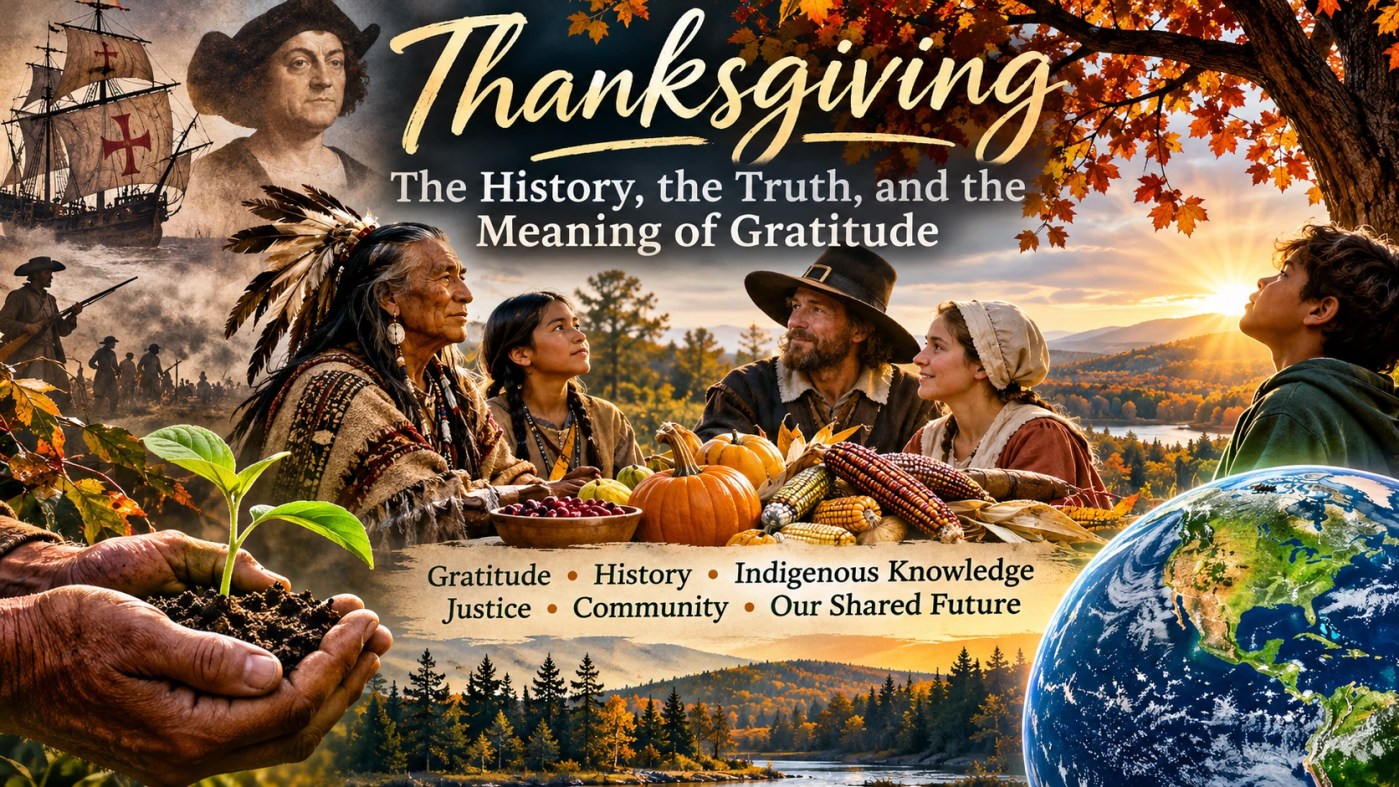
Every November, millions of us gather around a table, share a meal with the people we love, and pause, even briefly, to name what we are grateful for. That pause matters. In a world shaken by accelerating climate disruption, political division, and so much uncertainty, the simple act of saying thank you is a small act of resilience.
But gratitude asks something of us too. It asks us to be honest about where our blessings came from, and about who paid for them. This year, as I prepared this post, I went looking for the real history behind the holiday, along with a few things I had been told over the years that I could not confirm. Some of what I heard turned out to be true. Some of it turned out to be half-true. And some of it, frankly, did not hold up. I want to share all of it with you, because a community built on trust has to be built on accuracy.
This is not a post against Thanksgiving. It is a post for a deeper, more honest kind of thankfulness.
The Story We Were Taught
Most of us learned a gentle version of the story in grade school: the Pilgrims crossed the ocean, struggled through a hard winter, were helped by friendly Native Americans, and then everyone sat down together for a great feast of thanks. Paper hats, paper feathers, and a turkey at the center of the table.
That version is not entirely false, but it is badly incomplete. It places the English colonists at the center of the story and treats the Indigenous people who were already here as supporting characters. It leaves out what came before the feast and, more painfully, what came after.
What Actually Happened in 1621
In the autumn of 1621, the English colonists at Plymouth held a harvest celebration. According to the National Archives, at least 90 Wampanoag people joined 52 English colonists at what is now Plymouth, Massachusetts. Nobody at the time called it the “First Thanksgiving.” That label was attached centuries later. The only surviving eyewitness account is a short letter by the colonist Edward Winslow, which reports that the Wampanoag leader Massasoit (Ousamequin) arrived with about 90 men.
Several details rarely make it into the classroom version:
- The Wampanoag were a sovereign people on their own land. They had their own government, territory, traditions, and political interests. Their alliance with the newcomers was a strategic, diplomatic decision, and many historians describe the 1621 gathering as being as much about that alliance as about the harvest.
- They had already survived a catastrophe. Between 1616 and 1619, diseases brought by European traders and explorers killed as much as 90 percent of the Native population of coastal New England, a period now called the Great Dying. The Wampanoag were weakened, and they faced pressure from rival nations.
- They were not meeting Europeans for the first time. Traders, fishermen, and enslavers had been on these shores for years. Tisquantum (Squanto), who helped the colonists, spoke English because he had been kidnapped and taken across the Atlantic.
- Giving thanks was nothing new to them. Indigenous peoples had long held harvest ceremonies and celebrations of gratitude, long before any ship arrived. The Wampanoag still celebrate the cranberry harvest today.
The Wampanoag shared their knowledge of planting, fishing, hunting, and the land, and that knowledge is a big part of why the colonists survived at all. Within roughly two generations, however, war and colonization would cost the Wampanoag most of their land and their independence. That is the part of the story the paper hats leave out.
When “Thanksgiving” Followed Bloodshed
I had been told that Thanksgiving began with the slaughter of Native Americans. Here is what the record actually shows, and why the distinction matters.
To the English Puritans, a “day of thanksgiving” was a religious observance: a day of prayer and church services, proclaimed by colonial leaders whenever they believed God had shown them favor. They were declared for good harvests, for rain after drought, for ships arriving safely, and, at times, for military victories over Indigenous nations.
The Mystic Massacre, 1637
Before dawn on May 26, 1637, during the Pequot War, colonial forces from Connecticut and Massachusetts, with Mohegan and Narragansett allies, surrounded a fortified Pequot village near the Mystic River in present-day Connecticut. They set it on fire. Estimates of the dead range from about 400 to 700 people, most of them women, children, and elders. Survivors of the war were later sold into slavery.
Afterward, Massachusetts Bay Governor John Winthrop recorded in his journal that a day of thanksgiving was kept in the churches for the victory over the Pequots. That is a documented and deeply disturbing fact.
King Philip’s War, 1676
Massasoit’s son, Metacom (Pumetacom), known to the English as King Philip, led a coalition of Native nations against relentless colonial expansion in 1675 and 1676. It was among the deadliest conflicts in colonial American history. Colonial Williamsburg notes that in 1676 a day of thanksgiving celebrated the gruesome death of Metacom. After he was killed in August 1676, his body was mutilated and his head was displayed on a pole at Plymouth for many years. Hundreds of Wampanoag and their allies were executed or enslaved, and the Wampanoag were left nearly landless.
Think about that: the son of the man who sat at the 1621 harvest table was killed, and his death was marked with thanksgiving. Fifty-five years separated the feast from that day.
Keeping the Record Straight
So, is it true that “Thanksgiving began with a massacre”? Not exactly, and I think getting this right makes the point stronger, not weaker. The 1621 harvest gathering was not a celebration of a massacre. The modern national holiday was not created to commemorate killing. Historians, including Indigenous educators, distinguish those colonial religious observances from the holiday we celebrate today.
But it is equally true that colonial authorities proclaimed days of thanksgiving after the slaughter of Indigenous people, and that the friendly picture of 1621 has been used for generations to cover over the violence that followed. Both truths belong in the story.
Christopher Columbus: Beyond the Legend
Columbus is not part of the Plymouth story. He arrived in the Caribbean in 1492, more than a century before the Mayflower. But he belongs in this conversation because he opened the door to the European colonization of the Americas, and because the heroic way many of us were taught about him is a perfect example of the history we inherit without question.
Was He Italian or Spanish?
I was told that Columbus was actually Spanish, not Italian. I could not confirm it, and after digging in, I would not state it as fact. Here is where things stand:
- The long-accepted view: Columbus was born around 1451 in Genoa, an independent maritime republic in what is now Italy. His birth name was Cristoforo Colombo. In a 1498 document he wrote of Genoa that “from it I came and in it I was born.” Most historians still accept Genoa as his birthplace.
- Why people say “Spanish”: He sailed under the Spanish flag, sponsored by Queen Isabella I of Castile and King Ferdinand II of Aragon, and he is known in Spain as Cristóbal Colón. Serving the Spanish Crown, however, is different from being born Spanish.
- The newer claim: In October 2024, a documentary on Spain’s national broadcaster presented DNA research led by forensic scientist José Antonio Lorente, concluding that Columbus was of Sephardic Jewish descent and possibly from Western Europe, perhaps Spain. The scientific community responded with caution, because the underlying data were not published for independent review, and the documentary did not pin down a birthplace. The theory that he was a Spanish converso has circulated for more than a century.
The honest answer: Columbus is generally identified as Genoese, he sailed for Spain, and claims of Spanish origin remain disputed. If new, peer-reviewed evidence emerges, I will gladly revisit this with you. That is what learning together looks like.
What He Did
On the question of ethics, my concern held up. When Columbus reached the Caribbean, he encountered the Taíno and other peoples who had lived there for many generations. He did not “discover” an empty world. Thriving societies were already there.
The historical record, including Columbus’s own writings and accounts preserved by the Library of Congress, documents that he:
- Wrote soon after arriving that the Taíno could easily be made into servants and subjugated.
- Took Indigenous people captive and shipped hundreds of them to Spain to be sold as slaves.
- As governor of Hispaniola, imposed a brutal tribute system demanding gold from Indigenous people, enforced through violence and terror.
- Ruled so harshly, even toward Spanish settlers, that the Spanish Crown sent royal official Francisco de Bobadilla to investigate. In 1500, Bobadilla arrested Columbus and his brothers for misconduct and sent them back to Spain in chains.
Within decades, the Taíno population of Hispaniola had collapsed from forced labor, violence, starvation, and European diseases. It would be unfair to blame every later atrocity in the Americas on one man personally. But it would be just as dishonest to keep telling children he was simply a brave explorer. Many cities and states now observe Indigenous Peoples’ Day alongside, or instead of, Columbus Day for exactly this reason.
The Author Whose Name Starts with Z
The writer I was trying to remember is Howard Zinn (1922 to 2010), historian, activist, and author of A People’s History of the United States, first published in 1980. His opening chapter, “Columbus, the Indians, and Human Progress,” tells the story of 1492 from the point of view of the Arawak and Taíno peoples rather than the conquerors, drawing on Columbus’s own journal and on the accounts of the Spanish priest Bartolomé de las Casas, who witnessed the abuses firsthand.
Zinn’s book has opened millions of eyes, including many of mine. In fairness, I would not call it the one “true” history of the United States. Zinn was open that he was telling history from the perspective of people usually left out of it, and other historians have criticized parts of his work. I recommend reading him alongside primary documents and, above all, Indigenous historians and voices. That is how we get closer to the whole picture.
How Thanksgiving Became a National Holiday
The holiday we celebrate today came together slowly:
- 1621: The Plymouth harvest gathering of the Wampanoag and English colonists.
- 1600s: Colonial leaders proclaim scattered religious days of thanksgiving, some after military victories over Native nations.
- 1846 to 1863: Sarah Josepha Hale, editor of Godey’s Lady’s Book, campaigns for a national Thanksgiving, writing to five presidents.
- October 3, 1863: In the middle of the Civil War, months after Gettysburg, President Abraham Lincoln proclaims a national day of Thanksgiving on the last Thursday of November, asking the nation to pray for the healing of its wounds and the restoration of “peace, harmony, tranquility and Union.”
- 1941: Congress, with President Franklin D. Roosevelt’s approval, fixes Thanksgiving by law on the fourth Thursday of November.
Only in the 1800s did writers begin calling the 1621 harvest “the first Thanksgiving,” and it was gradually promoted as the holiday’s origin story. In other words, the holiday we know was born not in 1621 but in a time of national grief, as a call for gratitude and unity in the middle of enormous suffering. That gives us something to work with.
A Day of Mourning, Too
Thanksgiving does not mean the same thing to everyone. In 1970, the Commonwealth of Massachusetts invited Wamsutta Frank James, an Aquinnah Wampanoag leader, to speak at the 350th anniversary of the Pilgrims’ landing. When organizers read his speech, which told the truth about what colonization had cost his people, they would not let him deliver it.
Instead, he and others gathered on Cole’s Hill in Plymouth, overlooking Plymouth Rock, on Thanksgiving Day. It became the first National Day of Mourning. The United American Indians of New England, which James founded, has held it every year since. In his suppressed speech, James called for a more humane America, one “where men and nature once again are important.”
For many families, Thanksgiving is a day of gratitude and togetherness. For many Indigenous people, it is also a day of remembrance and grief. Those experiences can live side by side. Honoring one does not require dismissing the other.
Indigenous Knowledge and the Living World
Here is where this history connects directly to the work we do at Climate Change Community. The knowledge the Wampanoag shared in 1621 was not just survival tips. It was the product of thousands of years of living in relationship with the land: planting corn, beans, and squash together so each supports the others, reading the seasons, fishing and hunting in ways that let populations renew, and treating the living world as kin rather than as property.
Today, Indigenous peoples steward a remarkable share of the world’s remaining biodiversity, and Indigenous-managed lands are among the best-protected ecosystems we have. As we face the Climate and Ecological Emergency, the values that colonization tried to erase, reciprocity, restraint, and responsibility to future generations, are exactly the values we need to recover. Gratitude, in many Indigenous traditions, is not a single day. It is a daily way of relating to the Earth.
Gratitude With Awareness
So where does all of this leave us as we sit down to eat this Thursday? I believe it leaves us with a better Thanksgiving, not a smaller one. Gratitude without awareness can drift into complacency. Gratitude with awareness becomes responsibility. Here are three ways I am carrying that into this holiday.
Personal Gratitude
I am thankful for the people at my table and for those who are far away. I am thankful for the farmworkers, truck drivers, grocery clerks, and cooks who made the meal possible. I am thankful for this community, for every reader who questions, learns, and shows up. And I am thankful for the chance to be wrong, to look again, and to learn. Say thank you out loud this year, to the people who usually go unthanked.
Responsibility Toward Indigenous Communities
Appreciation means more when it becomes action. Learn whose ancestral land you live on. Read Indigenous authors and historians. Listen to Indigenous voices on Thanksgiving and every other day. Support Native-led organizations and land-protection efforts. And when the old myth comes up at the table, share the fuller story, gently and with facts, rather than with anger. The goal is understanding, not shame.
Care for Our Children and Biodiversity
The most meaningful way to honor the knowledge Indigenous peoples have shared is to protect the living world it came from. That is the heart of the Green Way Forward: the well-being of our children, who are our future, and of biodiversity, which is the health of everything that lives. Tell the children in your life the truer story, at a level they can hold. Waste less food this year. Thank the soil, the water, the pollinators, and the seasons that filled your plate. Ask yourself what kind of Earth we are leaving to the children who will sit at this table long after we are gone.
A Closing Thought
We do not have to abandon gratitude to acknowledge injustice. In fact, knowing the history makes our gratitude more honest, more thoughtful, and more genuine. The Wampanoag gave thanks long before 1621, and they are still here, still giving thanks, still telling their story. The least we can do is listen.
This Thanksgiving, may we be grateful for what we have, honest about how we came to have it, and committed to making sure that everyone, including the generations not yet born and the countless species we share this planet with, has something to be thankful for. I don’t have all the answers. Let’s keep finding them out together, shall we?
Happy Thanksgiving, Climate Tribe.
Sources and Further Reading
- National Archives, “Thanksgiving: Historical Perspectives” (visit.archives.gov)
- Smithsonian National Museum of the American Indian, “Rethinking Thanksgiving Celebrations” (americanindian.si.edu)
- Colonial Williamsburg, “When Was the First Thanksgiving?” (colonialwilliamsburg.org)
- Library of Congress, “Columbus and the Taíno” (loc.gov)
- NPR, “Christopher Columbus may have been a Spanish Jew, according to a new documentary” (October 2024)
- National Park Service, “Lincoln and Thanksgiving” (nps.gov)
- Pilgrim Hall Museum, “National Day of Mourning” (pilgrimhall.org)
- Howard Zinn, A People’s History of the United States (1980)
- The American Yawp, open U.S. history textbook (americanyawp.com)
Read posts at climatechangecommunity.com
Climate Tribe Social Founders Library: https://climatechangecommunity.com/library/
Artificial intelligence is used to enhance my creativity and thinking in preparing this post. The ideas, experiences and commitments are my own.
Mr. Alvarez, Content Curator | Climate Change Community LLC
Protecting our Children & Biodiversity’s future towards a more sustainable and habitable Earth!
Compiled & Mr. Alvarez’s Thoughts | AI Enhanced.


Leave a Reply