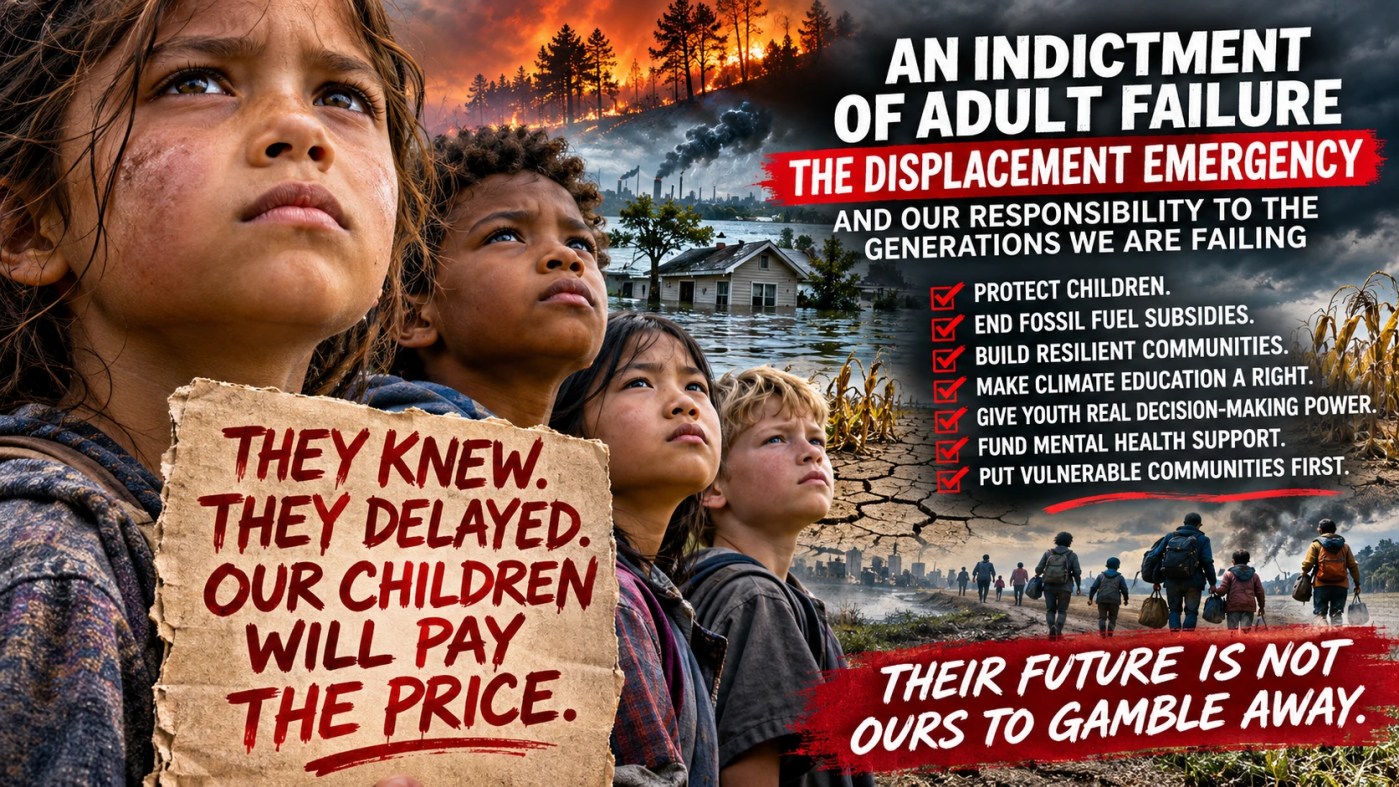
An indictment, and a list of demands, written on behalf of the children who cannot vote, cannot lobby, and cannot sue on their own behalf.
The Unfiltered Truth
A child born this year will never know the climate her grandparents knew. Not for a single summer. Not once.
She will grow up inside the consequences. Hotter heatwaves. Heavier floods. Longer fire seasons. Failing harvests. Collapsing ecosystems. A world in which tens of millions of families are pushed out of their homes. This is not a forecast about some distant century. It is the ordinary weather of her childhood.
The research is blunt. A 2021 study in the journal Science, led by climate scientist Wim Thiery, estimated that children born in 2020 will face two to seven times more extreme climate events over their lifetimes than people born in 1960, under the climate pledges governments had made at the time. Heatwaves show the gap most starkly. People born in 1960 will live through about four extreme heatwaves, on average. Children born in 2020 could face around thirty.
Read that again. Four. Thirty.
The same research found that today’s children will, on average, live through more droughts, more river floods, more crop failures and more wildfires than their grandparents, and that the burden falls heaviest on children in the Global South, who did the least to cause it.
Here is the part that should keep every adult with power awake at night: none of this was a surprise.
They knew
In 1965, scientific advisers warned an American president that carbon dioxide from burning fossil fuels could change the climate. In 1990, the Intergovernmental Panel on Climate Change published its first assessment. And inside the fossil fuel industry itself, the science was understood with startling precision.
A 2023 Harvard-led analysis, also published in Science, examined the climate projections ExxonMobil’s own scientists produced between 1977 and 2003. Between 63 and 83 percent of those projections accurately predicted the warming that followed, roughly 0.2°C per decade. During those same decades, the company publicly cast doubt on climate science and on the models it was quietly using to see the future.
My own awakening came in February 2007, when the IPCC released its Fourth Assessment Report. I am not a climate scientist, and I have never pretended to be one. I did not need to be. You do not need a doctorate to read a warning label. Those in power had the label. They read it. Then they chose delay, profit, and political convenience.
That is not ignorance. That is a decision. And children are the ones who will pay for it, with their summers, their schooling, their health, and in far too many places, their homes.
The Displacement Emergency Is Already Here
There is a word many leaders still prefer to avoid, because it makes the crisis impossible to file away as an environmental issue. The word is displacement.
Between 2016 and 2021, weather-related disasters caused 43.1 million internal displacements of children across 44 countries. That is roughly 20,000 children displaced every single day, according to an analysis by UNICEF and the Internal Displacement Monitoring Centre. Floods and storms drove 95 percent of them. Some of those moves were evacuations that saved lives, and the data cannot tell us how many children returned home quickly and how many never returned at all. That honest uncertainty is not comfort. It is an admission that, until recently, these children were not even being counted.
Look forward and the picture darkens. UNICEF projects that river floods alone could displace almost 96 million children over the next 30 years, based on current climate data. The World Bank’s Groundswell report estimates that climate change could force as many as 216 million people to move within their own countries by 2050, driven by water scarcity, declining crop productivity, and sea-level rise, with hotspots of climate migration emerging as early as 2030. Those figures do not even include people forced across borders.
The forces pushing families out
- Rising seas. Coastal neighborhoods, island nations, and river deltas are losing land, drinking water, and farmland to saltwater and storm surge. Families do not leave all at once. They leave one flooded season at a time, until staying is no longer possible.
- Uninhabitable heat. In parts of South Asia, the Middle East, and Africa, summers are approaching the limits of what the human body can safely endure without cooling. Children, whose bodies regulate heat less effectively than adults, are among the first to suffer.
- Water scarcity. When wells run dry and rains fail, the walk for water gets longer. Very often, it is girls who make that walk instead of going to school.
- Agricultural breakdown. When harvests fail year after year, rural families sell livestock, then land, then move to crowded city edges with no safety net. Hunger follows children wherever they go.
Not statistics. Children.
Numbers this large make people go numb. So stop for a moment and picture one child.
Picture a nine-year-old girl in a coastal village, the kind found in Bangladesh or the Philippines, whose school has flooded three times in two years. Her family’s rice paddy turned salty. Her father left to find construction work in the city. Now she, her mother, and her two little brothers are leaving too, to a single rented room beside a drainage canal. She had a best friend. She had a teacher who said she was good at mathematics. She will not see either of them again.
Picture a boy of twelve in the Sahel, walking farther each month beside his father to find water for the animals that are his family’s savings account. When the last animals die, the savings are gone, and so is the reason to stay.
And do not imagine this is only happening somewhere else. Those of us in New York remember Hurricane Sandy. We remember Hurricane Ida in 2021, when people drowned in basement apartments in Queens. In 2018, the Camp Fire wiped out much of the town of Paradise, California, in a single day. Children in the richest country on Earth have already been displaced by climate disasters, and every one of them lost a bedroom, a classroom, a routine, and a sense that the world is safe.
Displacement interrupts education and healthcare and exposes children to malnutrition, disease, and missed vaccinations. Even children who are never displaced are losing school days. In 2024 alone, at least 242 million students in 85 countries had their schooling disrupted by climate hazards, with heatwaves the leading cause. One in seven students. In one year.
Every one of those numbers has a face, a name, a favorite song, and a future someone else gambled away.
The Accused
I am not going to name every guilty party. The public record is long, and it is growing. But the patterns are clear enough that anyone in these positions should recognize themselves.
Governments that subsidize the fire and lecture children about recycling
We teach children to rinse yogurt cups and turn off the lights. Meanwhile, the International Monetary Fund estimates that global fossil fuel subsidies reached a record $7 trillion in 2022, once you include the environmental and health costs governments let polluters avoid paying. Even the narrower measure, direct subsidies and tax breaks, hit about $1.3 trillion that year. The G20 nations pledged in 2009 to phase out inefficient fossil fuel subsidies. More than fifteen years later, children are still sorting bottles while their governments write checks to the industry that is overheating their future.
That is not a mixed message. It is hypocrisy with a budget line.
Corporations with glossy sustainability reports and expanding extraction
You have seen the reports. Smiling children in green fields. Wind turbines at sunset. A net-zero pledge set comfortably far in the future, when today’s executives will be retired. Then turn to the investor presentation and read about new drilling, new pipelines, new exploration licenses, and new lobbying against the very policies the glossy report claims to support. A sustainability report that sits beside an expansion plan is not a commitment. It is an advertisement.
Media institutions that go quiet when it matters most
During election season, when voters are deciding who will write climate policy for the next four or more years, climate coverage too often shrinks to a passing mention or a single debate question. After disasters, coverage spikes, then rarely connects the flood or fire to its cause. Children cannot demand accountability for a crisis the public is barely shown. Silence is an editorial decision, and it has consequences.
Education systems preparing children for a world that no longer exists
Many schools still teach climate change, if they teach it at all, as one unit in one science class. Few teach children what to do in a flood, how to recognize heat illness, or how a city budget actually works. Many school buildings were never designed for today’s heat, and UNICEF has warned that education systems are largely ill-equipped to protect students and that climate finance for education remains strikingly low. We are handing children diplomas for a stable climate that is already gone.
From Fury to Demands
Anger that goes nowhere is just noise. So every accusation above becomes a demand below. Each one is concrete, fundable, and verifiable. If you hold power, these are your assignments. If you vote, organize, or attend public meetings, these are the questions you ask until you get answers.
Demand 1: Build resilient infrastructure, children first
Every school district should complete and publish a climate-risk assessment of its buildings within one year: flood exposure, heat exposure, air quality, and evacuation routes. Every district should adopt a heat action plan with temperature thresholds that trigger action. Schools should be funded to serve as cooling centers and emergency shelters, with backup power and clean water. Verify it: the assessments are public, the funding appears as a named line in the budget, and progress is reported every year.
Demand 2: Adopt climate-adapted curricula in every grade
Climate literacy belongs across subjects, not boxed into a single science unit. Children should learn the science, the history of who knew what and when, local hazards, emergency skills, and civic action. Teachers need paid training to teach it well. Verify it: state and district standards include it, training hours are funded and tracked, and students can show the skills, not just recite facts.
Demand 3: Give young people real seats with real authority
Youth advisory councils that can be politely ignored are not participation. They are decoration. Young people should hold voting seats on municipal climate and resilience committees, school board sustainability committees, and similar bodies wherever local law allows, and laws should be changed where it does not. Verify it: the seats are written into charters and bylaws, the votes are recorded, and the young members have staff support and a budget.
Demand 4: Provide mental health support sized to the crisis
A 2021 survey of 10,000 young people aged 16 to 25 across ten countries, published in The Lancet Planetary Health, found that 59 percent were very or extremely worried about climate change, and that 45 percent said those feelings affected their daily lives. Many also said they felt betrayed by their governments. That is not a fragile generation. That is an accurate one. Schools need enough counselors to meet nationally recommended ratios, trained in climate distress and in trauma-informed care after disasters. Verify it: publish counselor-to-student ratios and post-disaster response plans, and fund them.
Demand 5: Pass just transition policies that protect the most vulnerable first
The communities hit first and worst, low-income neighborhoods, communities of color, Indigenous nations, rural farm towns, and fossil fuel workers, must be first in line for protection and investment, not last. That means redirecting fossil fuel subsidies on a published timeline toward clean energy, resilient housing, and worker retraining. It means planning relocation, where it becomes necessary, with communities rather than for them, so that families move with dignity, keep their social ties, and keep their children in school. Verify it: publish the share of climate spending reaching frontline communities, and publish the subsidy phase-out schedule with dates.
What Preparedness Actually Means for Children and Young Adults
Let me be clear about something. Teaching children to prepare is not the same as making them responsible for a crisis they did not create. Adults must do the heavy lifting described above. But a child who knows what to do in an emergency is safer, calmer, and more capable than a child who was only ever told not to worry.
Practical resilience skills
- Water safety. Never walk or drive through floodwater. Know how to store, purify, and ration drinking water.
- First aid. Age-appropriate first aid and CPR, including how to recognize heat exhaustion and heat stroke.
- Emergency planning. A family plan with meeting places, emergency contacts written on paper, and a go-bag that every child helped pack and knows how to find.
- Mutual aid organizing. How to check on elderly neighbors, share supplies, and build a block-by-block contact list before disaster strikes.
- Community food systems. School and community gardens, seed saving, food preservation, and knowing where local food comes from.
- Emotional regulation in crisis. Breathing techniques, naming feelings, and knowing that fear is a normal response and that help is available.
Many of these skills can be learned for free. FEMA’s Independent Study program, for example, offers no-cost online emergency management courses open to the public. Families, schools, and youth groups can take them together.
Civic skills
- Organizing. How to build a group, run a meeting, set a goal, and keep going after the first setback.
- Litigation. Young people have learned that courts can listen. In Held v. Montana, sixteen young plaintiffs won a 2023 ruling that the state’s failure to consider climate impacts violated their constitutional right to a clean and healthful environment, and the Montana Supreme Court upheld that decision in 2024.
- Civic engagement. How elections, budgets, and public comment actually work, and how to register to vote the moment they are eligible.
- Local accountability. Attending school board and city council meetings, filing public records requests (in New York, under the Freedom of Information Law), and asking officials the same question every month until they answer it. Local government is where change moves fastest, and where a few determined voices can be impossible to ignore.
A Promise to Children, and a Warning to Power
To every child reading this, or having it read to them: we see you. (We feel you. See next blog post also.) We know you did not cause this. We will not hand you a pamphlet and a reusable bag and call it a future. We will fight for the schools, the protections, the seats at the table, and the support you deserve, and we will teach you everything we know so that you are never helpless.
To everyone who holds power over children’s futures, in office, in the boardroom, in the newsroom, in the superintendent’s office: history keeps records. ExxonMobil’s internal projections were once private documents. Today they are studied in peer-reviewed journals. Your votes, your budgets, your emails, and your excuses will be read one day too, by the very children you are failing, when they are grown.
They will know who acted and who watched.
And here is the hope, which is earned and not given. The World Bank’s own analysis found that early, concerted action to cut emissions and build inclusive, resilient development could reduce internal climate migration by as much as 80 percent. Read that as both a promise and an indictment. The worst of this future is not locked in. Every fraction of a degree, every flood wall, every cooling center, every trained counselor, every youth vote on a city committee changes how many children are uprooted. That is our Green Way Forward: the well-being of our children and the health of biodiversity, placed at the center of every decision. Not someday. Now.
The challenge you cannot scroll past
Before you close this page, answer one question out loud:
What will I have done by this time next year that a child could point to?
Not felt. Not shared. Not liked. Done.
Choose one demand from this post. Take it to one public meeting, one board, one legislator, or one shareholder vote within the next 30 days. Bring a young person with you, and let them speak. Then come back and tell us what happened.
The children are watching. They are keeping score. And very soon, they will be the ones in charge.
Sources
- Thiery, W. et al. (2021). “Intergenerational inequities in exposure to climate extremes.” Science, 374(6564).
- Supran, G., Rahmstorf, S., & Oreskes, N. (2023). “Assessing ExxonMobil’s global warming projections.” Science.
- UNICEF & IDMC (2023). Children Displaced in a Changing Climate: Preparing for a Future Already Underway.
- UNICEF (2025). Learning Interrupted: Global Snapshot of Climate-Related School Disruptions in 2024.
- World Bank (2021). Groundswell Part 2: Acting on Internal Climate Migration.
- International Monetary Fund (2023). IMF Fossil Fuel Subsidies Data: 2023 Update.
- Hickman, C. et al. (2021). “Climate anxiety in children and young people and their beliefs about government responses to climate change: a global survey.” The Lancet Planetary Health.
- Held v. State of Montana (Mont. 1st Jud. Dist. Ct. 2023; aff’d, Mont. Sup. Ct. 2024).
Read posts at climatechangecommunity.com
Climate Tribe Social Founders Library: https://climatechangecommunity.com/library/
Artificial intelligence is used to enhance my creativity and thinking in preparing this post. The ideas, experiences and commitments are my own.
Mr. Alvarez, Content Curator | Climate Change Community LLC
Protecting our Children & Biodiversity’s future towards a more sustainable and habitable Earth!
Compiled & Mr. Alvarez’s Thoughts | AI Enhanced.


Leave a Reply