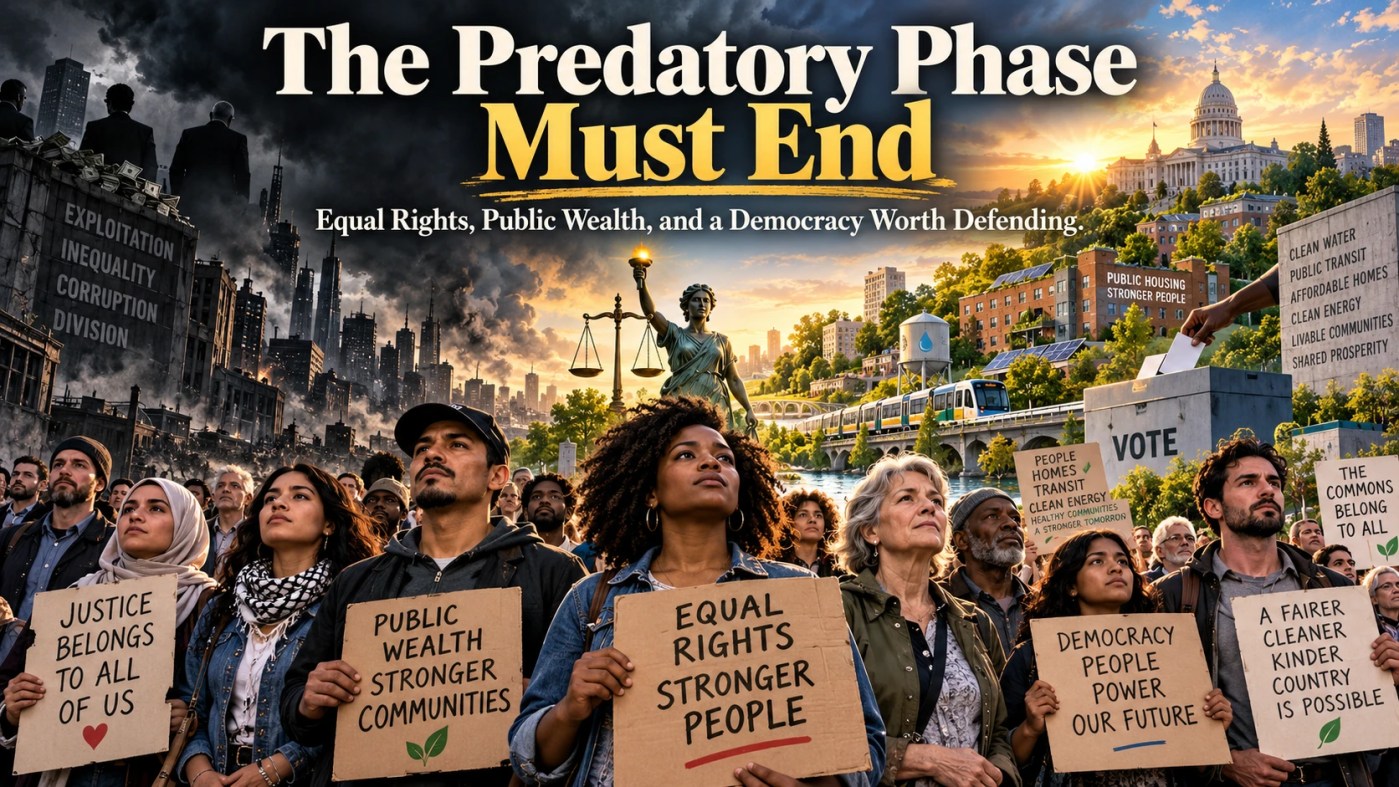
(The is the 1st draft of this post, the final one can be found at climatechangecommunity.com using the same featured images…)
Three powerful commentaries by filmmaker Matthew Cooke expose the connections between ethnic domination, economic exploitation, and the dangerous illusion that elections alone can rescue a broken political system.
Three Crises. One System. And a Civilization Running Out of Excuses.
What if the crises tearing apart our world are not separate emergencies at all?
What if the suffering of Palestinians, the growing revolt against economic inequality in France, and the desperate struggle to protect American democracy are symptoms of something much deeper?
Something embedded in the way power is organized, wealth is accumulated, and human beings are divided against one another?
Across three provocative videos, filmmaker and political commentator Matthew Cooke challenges us to confront precisely that possibility.
In Zionism Is Racism. England and Wales Green Party Just Voted, he confronts ethnonationalism and the denial of Palestinian rights.
In France Protests Are a Western Spring. America Is Next, he examines how public wealth has been transferred into private hands, leaving governments indebted and ordinary people struggling.
And in Midterms 2026 Won’t Save You, he argues that voting, however essential, cannot substitute for the organized transformation of political and economic power.
At first glance, these subjects might seem disconnected.
They are not.
The common thread is a political and economic order that repeatedly places the privileges of a few above the rights, resources, and futures of the many.
Cooke is asking us to recognize a system that has learned to justify domination as security, extraction as economic progress, and limited electoral choice as democracy itself.
The point is not that every injustice comes from an identical source or can be solved with a single policy. The point is that these injustices reinforce one another.
And if we continue fighting their symptoms while leaving their underlying structures untouched, we risk repeating the same failures indefinitely.
1. When National Identity Becomes a License to Deny Human Rights
On October 4, 2026, the Green Party of England and Wales adopted a controversial motion declaring Zionism a form of racism.
The measure passed by 1,022 votes to 813 and immediately provoked intense political disagreement, including opposition from Jewish organizations and several Green Party parliamentarians.
For Matthew Cooke, the vote represents more than a dispute over terminology.
It raises a fundamental question: Can any political system legitimately grant one population superior rights while denying another population equal freedom, security, and self-determination?
Cooke’s criticism focuses on ethnonationalism: the political organization of a state around the privileged status of a particular ethnic or national identity, especially where maintaining that privilege requires another population’s exclusion or subordination.
His central moral argument is difficult to dismiss.
Human rights cannot be universal in theory and conditional in practice.
They cannot be sacred when protecting one population and negotiable when protecting another.
And they cannot depend on whether the people seeking those rights belong to a favored religion, nationality, ancestry, or political movement.
Palestine and the moral contradiction
The suffering of Palestinians has exposed a profound contradiction in the international order.
Governments routinely celebrate universal human rights while struggling, or refusing, to enforce those principles consistently.
Palestinians have endured occupation, displacement, severe restrictions, the destruction of civilian infrastructure, and devastating loss of life.
In September 2025, an independent United Nations Commission of Inquiry concluded that Israel had committed genocide in Gaza. Israel rejected that finding, and the legal and political arguments continue.
But the immediate moral obligation does not depend on anyone winning an argument over terminology.
Civilians must not be targeted. Hostages must not be taken. Populations must not be collectively punished. Children must not be deprived of food, shelter, medical care, and safety.
These standards apply to everyone, including Palestinians and Israelis.
Condemning the atrocities committed by Hamas on October 7, 2023, does not require accepting the devastation inflicted on Gaza. Equally, demanding accountability for Israeli government policies does not justify antisemitism or hostility toward Jewish people.
Universal human rights are not a competition in which one community must lose for another to survive.
Cooke argues for a political future based on equal rights across historic Palestine rather than permanent ethnic dominance.
His preferred vision is a shared democratic political order. Others, including many advocates of Palestinian and Israeli self-determination, continue to support two states.
Those differences are significant. So are the competing understandings of Zionism: many Jews understand it as a movement for Jewish national self-determination and safety, while Cooke and other critics focus on its historical and contemporary relationship to Palestinian dispossession.
The question that no proposal can escape, however, is whether it guarantees meaningful equality, safety, representation, and dignity for everyone living under it.
The dangerous normalization of supremacy
The larger warning reaches far beyond Israel and Palestine.
History repeatedly demonstrates how destructive political movements become when they persuade one population that its rights require the permanent subordination of another.
Fear becomes identity.
Identity becomes political allegiance.
Political allegiance becomes justification for unequal treatment.
Eventually, oppression is presented not as cruelty but as necessity.
The tragedy is that societies often recognize this logic clearly in the distant past while rationalizing its modern manifestations.
We honor those who resisted historical persecution, then hesitate to challenge injustice when doing so threatens contemporary alliances or established power.
The lesson of historical atrocities cannot be that some groups deserve permanent moral immunity.
It must be that no human being should be subjected to the practices that produced those atrocities.
Never again must mean never again for anyone.
That principle, consistently applied, is not hostility toward any religion or people. It is the rejection of collective supremacy itself.
And it leads directly to Cooke’s second argument: domination is not maintained through nationalism alone.
It is also maintained through control of the resources people need to live.
2. The Great Transfer: How Public Wealth Became Private Power
Imagine a community that collectively owns its water system.
Residents have paid for the pipes, treatment facilities, maintenance, and infrastructure through generations of public investment.
Then a government announces that selling the system to private investors will create efficiency, competition, and prosperity.
The new owners gain control of an essential service.
Residents continue paying for water, except now their payments must also support investor returns.
Depending on the regulatory system and the sale terms, the public may have exchanged long-term control for short-term revenue.
Now multiply that example across energy, housing, transportation, telecommunications, land, and public infrastructure.
This is the economic history Matthew Cooke challenges in France Protests Are a Western Spring. America Is Next.
His argument is that the privatization programs pursued by numerous Western governments since the late twentieth century helped shift economic power away from the public and toward private capital.
Privatization was frequently promoted as liberation from government inefficiency.
Sometimes privately operated systems have delivered genuine benefits. Public institutions are certainly not immune to waste, corruption, or incompetence.
But this does not answer the most important question.
When assets built through public effort are transferred to private ownership, who receives the long-term benefits, and who bears the risks?
The disappearing public inheritance
Cooke points particularly to the experience of Britain, where major public industries and utilities were privatized during the Thatcher era and subsequent governments.
The United States followed a different path, but debates over public land, natural resources, housing, telecommunications, and private control of essential services expose related tensions.
The consequences deserve serious attention.
The World Inequality Report 2022 documented the remarkable decline of net public wealth in several wealthy countries. In the United States and United Kingdom, public liabilities had come to exceed the measured value of public assets.
This does not mean those countries literally possess nothing or that every privatization caused the decline.
It means that enormous private fortunes can coexist with governments whose financial balance sheets show relatively little net wealth.
That is an extraordinary political contradiction.
A society may have more aggregate wealth than previous generations could imagine while struggling to maintain public schools, affordable housing, transportation, healthcare, and basic infrastructure.
The wealth exists.
The economic question is where it is concentrated, who controls it, and how the benefits are distributed.
The price of a government that owns less and owes more
Cooke emphasizes another consequence: public debt.
By October 22, 2026, the United States had accumulated approximately $40.4 trillion in gross federal debt.
Not all that debt is owed to billionaires or hedge funds. Treasury securities are also held by institutions, retirement funds, individual investors, foreign governments, and federal trust funds.
Nevertheless, substantial interest obligations affect public budgets, and the ownership of financial assets remains highly unequal.
At the same time, the Federal Reserve’s distributional data show that a substantial majority of American household wealth is concentrated among the wealthiest households, while the bottom half owns only a small share.
This is not simply a story about wealthy individuals possessing larger bank accounts.
Concentrated wealth can become concentrated political influence through lobbying, campaign financing, corporate ownership, control of investment, and the ability to shape public debate.
Economic power can be converted into political power.
Political power can then be used to preserve the economic arrangements from which that influence originated.
The cycle perpetuates itself.
France as a warning
Cooke describes French protests as evidence of an emerging Western rebellion against an economic model that has strained public services and working-class security.
His phrase Western Spring is intentionally provocative. It expresses his belief that discontent with inequality and economic insecurity could become a much broader movement.
Whether such a coordinated international movement will actually emerge remains uncertain.
But the conditions that inspire public anger are not imaginary.
For people struggling with housing costs, energy bills, transportation expenses, and insecure employment, abstract promises of national prosperity can sound increasingly detached from reality.
What does economic growth mean to someone who cannot afford a stable home?
What does a booming financial market mean when public services deteriorate?
What does national wealth mean when large numbers of citizens possess so little of it?
These are not questions motivated by envy.
They are questions about the purpose of an economy.
An economy should be evaluated by more than the fortunes it creates at the top. It should also be judged by the quality of life it makes possible for everyone.
Cooke’s broader proposal is to restore public stewardship of essential infrastructure, confront extreme concentrations of wealth, and reorganize economic priorities around human well-being.
Such reforms require careful design, democratic accountability, effective institutions, and scrutiny of both private and governmental power.
But dismissing them without examination merely preserves an arrangement whose failures are increasingly visible.
The public should not be expected to surrender its economic inheritance and then be told there is no money left to meet its basic needs.
And here the discussion reaches Cooke’s third warning.
If these arrangements are perpetuated through political institutions, can ordinary elections really transform them?
3. The Ballot Box Is Necessary. It Is Not a Revolution.
The American midterm elections are approaching on November 3, 2026.
The stakes for democratic institutions, public policy, accountability, and the direction of the country are enormous.
Cooke does not tell people to abandon voting.
Quite the opposite.
His message is to take elections seriously while refusing to confuse electoral participation with the entirety of democratic action.
In Midterms 2026 Won’t Save You, he argues that a change in elected officials may slow harmful policies without dismantling the institutions and incentives that continue producing them.
This distinction matters.
Elections can change laws, leadership, budgets, appointments, enforcement priorities, and the treatment of vulnerable communities. They can protect rights or weaken them. Their outcomes have real consequences.
But a vote every two or four years cannot, by itself, guarantee that economic and political power is distributed democratically.
Democracy cannot end when the polls close
Consider the forces shaping American political life.
Campaigns require money.
Corporate interests employ professional lobbyists.
Wealthy donors and political organizations exert influence.
Major media and digital platforms help determine which issues receive public attention.
Political parties develop powerful institutional incentives to preserve themselves.
None of this means voters have no agency or that all politicians are interchangeable.
It means that elections take place within an existing distribution of power.
And changing the people who occupy political offices does not automatically change that distribution.
A democracy can offer meaningful electoral competition while still allowing severe economic inequalities to distort who gets heard, who can influence policy, and whose needs receive priority.
That is why Cooke turns to the legacy of Dr. Martin Luther King Jr.
Martin Luther King Jr. understood the deeper struggle
Popular portrayals of King often emphasize his dream of racial harmony while giving far less attention to his economic criticism, opposition to militarism, and calls for structural transformation.
Yet King recognized that racism, economic exploitation, and militarism were inseparably connected.
He called for a radical redistribution of economic and political power and a revolution in values.
These were not incidental observations.
They were central to his understanding of justice.
King understood that ending formal segregation was essential, but that genuine equality also required confronting poverty, disenfranchisement, and economic arrangements that denied people meaningful opportunity.
He knew that political victories required organized pressure beyond the conventional electoral process.
The civil rights movement did not achieve its gains merely by waiting for sympathetic politicians.
People organized.
They marched.
They boycotted.
They conducted sit-ins.
They challenged unjust laws through the courts.
They mobilized communities and sustained disciplined nonviolent resistance despite tremendous personal risks.
Political institutions eventually responded to demands that ordinary people had organized to make impossible to ignore.
This is the tradition Cooke invokes.
Why voting alone cannot carry the burden
Voting is essential because governments wield enormous power over people’s lives.
But voting without organization risks leaving citizens politically active for one day and politically isolated for the remaining years.
The deeper democratic work continues between elections.
It happens in unions, neighborhood associations, community organizations, civil rights campaigns, independent journalism, mutual-aid networks, public meetings, and sustained efforts to influence legislation.
It happens when people build institutions that can hold elected officials accountable after campaign promises have been made.
It happens when a community has enough organization to demand something specific and enough solidarity to remain involved until meaningful change occurs.
And it happens when people learn to cooperate across divisions that powerful interests may benefit from keeping alive.
The purpose of democracy is not simply to choose who governs.
It is to ensure that the governed retain meaningful power over the decisions shaping their lives.
A ballot is a democratic instrument. It is not a substitute for an organized democratic society.
4. The Common Architecture: Division, Extraction, and Political Dependence
Now place Cooke’s three videos beside one another.
The shared argument becomes unmistakable.
The first challenges a political order in which national or ethnic identity can be used to justify unequal rights.
The second challenges economic arrangements in which wealth and essential resources become increasingly concentrated beyond public control.
The third challenges the belief that periodic elections, without deeper social organization, can reverse entrenched concentrations of power.
Each video approaches a different dimension of the same moral question:
Who gets power, who pays its price, and who is excluded from the benefits?
The connections are not merely philosophical.
Economic interests can benefit from militarization and conflict.
Nationalist rhetoric can distract populations from economic problems or discourage solidarity with outsiders.
Financial resources can influence political campaigns, legislation, and public debate.
And weakened democratic institutions can make it more difficult for ordinary people to challenge either economic exploitation or discriminatory policies.
Not every war is caused by profit. Not every nationalist movement is identical. Not every private enterprise is exploitative, and not every election is meaningless.
Those distinctions matter.
But they do not erase the broader pattern.
Systems of unequal power frequently reinforce one another even when the individuals participating in them have different motives.
A society that normalizes the unequal treatment of people in one sphere may become more willing to tolerate it in another.
A government that treats essential services primarily as investment opportunities may gradually lose the ability to guarantee universal access.
A political system that becomes overly dependent on concentrated wealth may find it increasingly difficult to confront the same concentration.
When wealth purchases influence, influence protects wealth, and division prevents solidarity, democracy becomes progressively weaker.
And because these structures cross national boundaries, the resulting crises cannot be understood exclusively through domestic political labels.
The same global economy connects military spending, resource extraction, financial markets, labor conditions, and environmental destruction.
This matters enormously in an age of accelerating climate change.
A civilization cannot indefinitely organize its priorities around unlimited extraction, geopolitical rivalry, and short-term financial advantage while expecting environmental systems and human communities to remain stable.
Climate change is not simply another issue competing for attention.
It reveals the consequences of governing without sufficient regard for long-term collective survival.
The question, ultimately, is whether our institutions are capable of prioritizing a livable future over immediate concentrations of power and profit.
5. Beyond the Predatory Phase
Albert Einstein wrote and spoke about humanity’s need to move beyond economic and social arrangements driven by competition and exploitation.
Cooke invokes that broader philosophical tradition to challenge what he calls the predatory phase of human development.
Predation, in this context, does not simply mean that powerful people behave selfishly.
It describes institutions that permit one group’s advancement to depend on the vulnerability, deprivation, or exclusion of others.
A system becomes predatory when it rewards the accumulation of power without adequate accountability for the harm imposed on human beings and the natural world.
The alternative cannot be another hierarchy disguised under more appealing language.
It must be a different organizing principle.
Human dignity is not earned through wealth.
Fundamental rights are not privileges reserved for favored populations.
And the resources required for collective survival should not be managed solely according to the immediate financial interests of those who control them.
This is not a demand for perfection.
It is a demand for consistency.
If we believe human rights are universal, we must defend them even when doing so is politically uncomfortable.
If we believe essential public services exist to serve the population, we must evaluate their ownership and operation according to measurable public outcomes.
If we believe democracy means government accountable to the people, we must create ways for people to exercise influence beyond election day.
Such changes require more than righteous anger.
They require institutions, policies, organization, and persistence.
6. What Would Real Transformation Look Like?
The three videos offer a diagnosis. The next challenge is turning that diagnosis into constructive democratic action.
A serious response would begin with several mutually reinforcing commitments.
First, defend equal human rights without exceptions.
Support international humanitarian law, civilian protection, freedom from discrimination, and meaningful political equality. Reject antisemitism, Islamophobia, racism, ethnic supremacy, hostage-taking, collective punishment, and attacks on civilians. Insist that security and self-determination cannot be built on the permanent denial of those same rights to others.
Second, reclaim democratic accountability over essential resources.
Review privatization arrangements, strengthen public-interest regulation, and examine whether public or cooperative ownership could improve the affordability and reliability of housing, water, energy, transportation, and other necessities. Evaluate policies on their demonstrated benefits to communities, not ideological slogans.
Third, confront the political influence of extreme wealth.
Increase transparency, strengthen anti-corruption safeguards, enforce competition rules, and pursue tax and campaign-finance reforms capable of reducing undue dependence on concentrated economic power.
Fourth, build durable, nonviolent civic organization.
Vote, certainly. But also participate in local government, support independent journalism, join community groups, organize peaceful demonstrations, engage in lawful boycotts, and create networks of mutual assistance and public accountability.
Fifth, connect social justice with ecological survival.
An economy that undermines the environment also undermines the long-term security of the people who depend on it. Climate resilience, sustainable infrastructure, and responsible management of shared resources must become central economic priorities rather than afterthoughts.
These goals will produce disagreements about policy, costs, implementation, and political strategy.
They should.
Democracy requires open disagreement.
But those disagreements become productive only when we share an underlying commitment to equal dignity, evidence, and the public good.
We do not need unanimous agreement on every political philosophy to recognize that exploitation, dehumanization, and democratic exclusion are serious problems.
Nor do we need to wait for a perfect leader or a miraculous election.
Real change can begin when people organize around achievable demands and remain involved long enough to see whether those demands are fulfilled.
7. The Revolution of Values Is the Hardest Part
It is tempting to imagine that society’s problems could be solved by removing a handful of corrupt politicians or replacing one group of powerful individuals with another.
But that would leave the deeper question unanswered.
What values guide the institutions themselves?
If success continues to mean unlimited accumulation, if national greatness requires treating outsiders as lesser human beings, and if political victory becomes more important than the public good, the same destructive patterns will eventually return.
This is why King’s call for a revolution of values remains so important.
It demands that we reconsider what society is actually for.
Is government meant to protect concentrated privilege, or secure the rights and welfare of the people?
Is economic activity meant to maximize returns without regard to consequences, or help create the conditions for dignified human lives?
Is national identity a basis for solidarity within borders, or a justification for denying the humanity of those outside them?
Are elections an expression of ongoing democratic power, or the brief moments when citizens are invited to choose among institutions they otherwise cannot meaningfully influence?
These questions cannot be answered through slogans alone.
They demand education, public debate, institutional reform, and political courage.
They also demand personal responsibility.
It is easy to condemn injustice when it is committed by an opposing political faction.
It is harder to confront injustice when it benefits our preferred party, our own country, or institutions with which we identify.
But moral principles that apply only to our opponents are not principles.
They are conveniences.
A genuine revolution of values requires a willingness to apply the same standards to everyone, including ourselves.
Conclusion: Humanity Cannot Afford to Keep Repeating This Story
Matthew Cooke’s three videos are provocative because they refuse to treat the world’s crises as unrelated accidents.
One addresses the denial of equal rights through ethnonationalist politics.
Another examines the consequences of transferring public resources and economic power into increasingly concentrated private hands.
The third warns against expecting elections alone to transform the political conditions that enable those arrangements.
Together, they challenge a civilization that has become extraordinarily sophisticated at creating wealth, projecting military force, and holding elections, yet remains painfully inconsistent at guaranteeing dignity, security, and opportunity.
That contradiction should trouble us.
Humanity possesses immense scientific knowledge, productive capacity, communications technology, and the means to cooperate across borders.
We have resources and abilities that earlier generations could scarcely imagine.
Yet millions continue to experience avoidable deprivation, discrimination, insecurity, and violence.
The problem is not simply a shortage of knowledge.
It is also a failure of collective priorities.
Cooke’s deepest challenge is therefore not to one government, one political party, one ideology, or one country.
It is to the assumption that domination and exploitation are permanent features of civilization that we must simply learn to tolerate.
They are not laws of nature.
They are human arrangements.
Human arrangements can be challenged, changed, and replaced through democratic action.
Vote because elections matter. Organize because elections are not enough. Defend equal rights because no lasting peace can be built on supremacy. Protect the commons because collective prosperity cannot survive without shared responsibility.
And above all, reject the belief that another person’s dignity must be sacrificed for your own security or prosperity.
The future will not be determined solely by the next election, the next protest, or the next international crisis.
It will also be shaped by whether ordinary people can build the collective power to replace destructive arrangements with institutions worthy of human civilization.
The predatory phase must end.
Not because a perfect world is guaranteed.
But because the consequences of refusing to change are becoming impossible to ignore.
The question is no longer whether humanity has the intelligence and resources to create a more just world.
The question is whether we can develop the solidarity and political will to do it.
Featured Videos and Further Reading
The following three Matthew Cooke videos inspired this article:
- Zionism Is Racism. England and Wales Green Party Just Voted — A commentary examining the Green Party vote, Zionism, ethnonationalism, and universal human rights.
- Midterms 2026 Won’t Save You — Why elections matter, but sustained grassroots organization and structural political change remain necessary.
- France Protests Are a Western Spring. America Is Next — An examination of privatization, public wealth, economic inequality, and growing dissatisfaction with established economic arrangements.
Additional sources and context:
- Reuters — Britain’s Green Party votes to classify Zionism as a form of racism
- UN Human Rights Office — Independent Commission of Inquiry findings on Gaza
- World Inequality Report 2022 — Rich Countries, Poor Governments
- Federal Reserve — Distribution of Household Wealth
- U.S. Treasury — Debt to the Penny
- Matthew Cooke’s official website
Editorial note: This article is an independent critical synthesis inspired by Matthew Cooke’s commentaries, not a verbatim transcript or an endorsement by the filmmaker. Interpretations and policy recommendations are distinguished from the reported events and supporting research linked above.
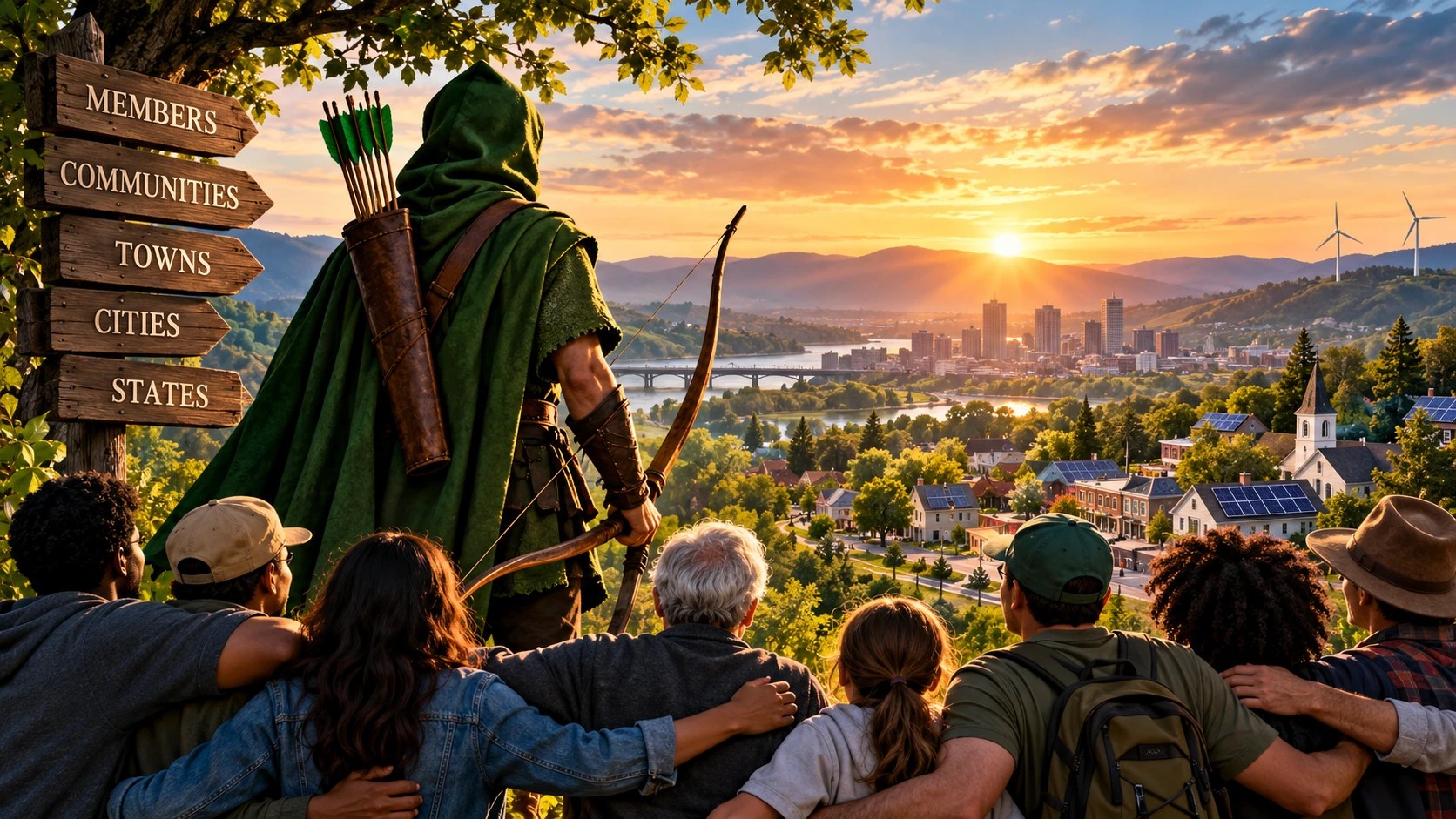
Addendum: Climate Tribe Social and the Robin Hood Principle for the 21st Century
How subscriptions could become community power—helping members, villages, towns, cities, and states meet the Five Emergencies together
A companion to “The Predatory Phase Must End: Equal Rights, Public Wealth, and a Democracy Worth Defending”
We Have Criticized the System. Now We Must Build an Alternative.
In the article to which this is an addendum, I wrote about an economy that concentrates wealth, political institutions that too often fail ordinary people, and the moral urgency of equal rights. I argued that democracy cannot end at the ballot box and that public wealth ought to serve the public.
But criticism, even justified criticism, does not repair a roof before a storm. It does not help a neighbor facing an impossible utility bill. It does not bring expertise to a village with a failing water system or provide a parent with the tools to prepare a family for extreme heat.
The question that follows is unavoidable: What are we prepared to build instead?
That is where Climate Tribe Social enters the picture.
I believe it can become a kind of Robin Hood for the twenty-first century—not an outlaw stealing from people, not a fantasy of instant redistribution, and certainly not another institution asking the public to trust grand promises. I mean something more disciplined and far more useful: a voluntary community whose subscriptions, shared knowledge, professional skills, and collective decisions help move resources toward the people and places that need them.
Robin Hood is a metaphor for changing the direction in which help flows. Today, too much value travels upward while working people, local governments, and vulnerable communities are told to make do with less. Our ambition is to build a mechanism through which some of the value that members voluntarily contribute can return to members and their communities as practical support.
The word can matters. Climate Tribe Social is being developed; its Financial Support Program is a proposal that requires the right funding, legal structure, accounting, oversight, and member participation before distributions can begin. No reader should confuse an aspiration with an already-operating financial benefit. Our credibility will depend on making that distinction every time.
The Five Emergencies Are Not Five Separate Problems
Across Climate Change Community and its related projects, we have organized our work around five connected emergencies: Climate, Ecological, Humanity, Democracy, and Displacement. The names matter because they remind us that a climate event is rarely only a weather event.
A flooded apartment can become a housing emergency. Lost wages can become a food emergency. An inaccessible evacuation route can become a disability-rights emergency. A family forced to move may encounter legal uncertainty, discrimination, and the loss of its community ties. A town struggling to finance public services may be unable to invest in the very infrastructure that would reduce the next disaster’s damage.
The emergencies amplify one another. This is why the response must connect scientific knowledge with household needs, professional expertise with lived experience, and local action with democratic accountability.
Our public materials describe Climate Change Community as the larger mission and public doorway; Climate Tribe Social as the community-and-action environment; SDL5, including the learning path associated with cCcmty.com, as a space for self-directed learning and dialogue; Adaptive-Resiliency.info as a working journal and backup site; and tito235.com as a home for reflection on personal growth, responsibility, and human relationships.
These are not five unrelated websites chasing attention. At their best, they form a pathway: learn what is happening, discuss what it means, prepare for what is coming, organize with others, and help where help is needed.
Adaptive resiliency is the thread running through that pathway. As described on Adaptive-Resiliency.info, it means adjusting to changing conditions while strengthening the capacity of people, communities, institutions, and ecosystems to survive and transform. It joins self-preservation to collective preservation. Neither can succeed for long without the other.
Why a Subscription Can Be More Than an Admission Fee
Most digital subscriptions buy access. You pay a platform; the platform delivers a service; the transaction ends there. Often, the greater the platform’s success, the greater the rewards flowing toward its owners, advertisers, or investors.
Climate Tribe Social is trying to ask a different question: What if a membership fee also helped sustain a shared capacity to act?
The published design includes a free-entry Commons and a range of annual paid Collections, Spaces, and Programs. Members can connect around climate science, biodiversity, human dignity, civic participation, preparedness, emergency response, education, and professional practice. Climate Tribe Social has also publicly described itself as an advertising-free community. Its founding idea is that members should be people to serve, not attention to sell.
Subscription income, however, is not automatically surplus. The platform must pay for hosting, software, cybersecurity, accessibility, moderation, administration, lawful operations, and enough reserves to remain dependable. Employees and contractors must be paid fairly. Taxes and other obligations do not disappear because our mission is compassionate.
Only after those responsibilities are accounted for can the next question be answered honestly: How much remains, and what portion can responsibly be directed into a Financial Support Program?
The materials already published describe the intended principle: a cap on leadership compensation and a program meant to return excess revenue to members and communities. They also state that eligibility is expected to begin with paid plans and that specific terms will be published before money is distributed. That is the correct starting point for this addendum—not an imaginary payout amount, not a guaranteed dividend, and not a promise that every member will receive financial assistance.
No membership should be sold as an investment, an entitlement to a cash return, or a shortcut to personal wealth. The ethical opportunity is to pool modest contributions and organize them for real public benefit, transparently and within the law.
What the Robin Hood Principle Could Look Like in Practice
Let us move from metaphor to possibilities. None of the following examples should be read as an approved grant, an existing benefit, or an announced allocation. They are the kinds of projects members and qualified professionals could evaluate once the Financial Support Program has been properly established.
First, Help the Members Who Are Carrying the Heaviest Load
A community cannot speak convincingly about resilience while ignoring the material conditions of its own members.
Consider a member who needs smoke filtration during a dangerous wildfire season, a family looking for an affordable emergency preparedness kit, or an older adult struggling to keep a home safely cool. Consider a worker seeking training for a cleaner, safer trade or a caregiver who needs accessible guidance and reliable local contacts before disaster strikes.
A future member-support track could help fund eligible preparedness supplies, vetted training, hardship assistance, or other clearly defined needs. A referral to existing public benefits or reputable local services may sometimes be more valuable than a small grant. Where possible, we should help people gain capability rather than force them to return repeatedly for relief.
The dignity of the recipient must come first. Assistance should not require someone to expose private suffering to a public forum or perform gratitude for an audience. The standards should be written, fair, privacy-conscious, and subject to review. Membership must never become a competition in telling the saddest story.
Second, Empower Towns, Villages, Cities, and States
One remarkable feature of the Climate Tribe Social planning documents is the proposal for local Spaces dedicated to particular towns, cities, villages, and states. The published draft anticipates locally designed Spaces in 2027, with communities participating in how they are built. Elsewhere the structure includes Civic Hearth for local civic institutions, professional networks, and a Climate Emergency Control Center with a Response Hub.
Imagine a small town using such a Space to connect residents with a civil engineer, local educators, a grant writer, and volunteer organizers to identify its most urgent flood risks. Imagine a city neighborhood developing a map of cooling locations, accessible transit routes, and people who need check-ins during heat emergencies. Imagine a village coordinating water conservation, backup communications, community gardens, and emergency transportation. Imagine communities in different states exchanging practical lessons without having to reinvent every solution independently.
Funding, when available, could support carefully reviewed local pilot projects: materials for neighborhood preparedness, training for community volunteers, translation of emergency information, accessible meeting tools, or seed funding for proposals with measurable benefit. The projects should originate with local people, not be imposed by a distant platform that assumes it understands every place.
A town’s needs are not a city’s needs. An island community’s risks differ from those of an inland farming village. States have different laws, budgets, infrastructure, and climate exposures. The same principle must be adaptable across them: listen locally, plan openly, fund responsibly, and measure results.
Third, Make Professional Knowledge Reach Ordinary People
Climate Tribe Social’s developing network brings together scientists, emergency personnel, educators, skilled tradespeople, health professionals, public officials, and others. The site’s Response Hub has described roughly 125 subjects and response areas, including extreme weather, food and water security, health, displacement, and local planning.
That range is important because the barrier facing a community is often not a lack of concern. It is a lack of access to the people who know what to do next.
A professional might volunteer a short educational session. A retired tradesperson might help design a practical skills workshop. A local organizer might explain how residents can speak effectively at a public budget hearing. A teacher might help turn complicated climate information into plain language. A qualified practitioner could identify the boundary between general information and work that requires a licensed professional.
Sometimes the most valuable support is not a check. It is a credible answer, the right introduction, a reviewed plan, or a door that finally opens.
Fourth, Protect the Living World Alongside Human Communities
Our mission has repeatedly emphasized protecting our children’s future and Earth’s biodiversity. That requires resisting the false choice between helping people and helping nature.
Community gardens, native plantings, urban tree stewardship, watershed restoration, seed sharing, and habitat protection can all become local resilience activities when designed for actual conditions and supported by appropriate expertise. A neighborhood that gains shade, healthy soil, cleaner water, and stronger social connections has more than an environmental talking point; it has improved the foundations of everyday life.
Proposals would need ecological review, permission from landowners or authorities where necessary, maintenance plans, and honest evaluation. Planting something is not the same as sustaining it. A worthwhile program should care about what survives three summers later, not merely about the opening-day photograph.
A Community That Calls the Shots Must Have Real Power
The earlier post argued that democracy is not a ceremony performed every election season. That standard must also apply here. We cannot denounce concentrated power in government and industry while building a community that depends entirely on one person’s goodwill.
I use the title Content Curator deliberately. Published project materials express an intention to make the membership influential in the platform’s direction and eventually transfer ownership to a younger generation. Those intentions should mature into clear and workable governance arrangements, not remain inspirational language.
Members ought to have meaningful ways to propose priorities, examine budgets, question leadership decisions, and influence which eligible projects receive support. Processes should be accessible to people with different schedules, languages, disabilities, and technical experience. Voting procedures should be documented. Conflicts of interest should be disclosed. Recipients and decision-makers should not be able to quietly award themselves favorable treatment.
A proposal can also be turned down. Not every worthy request can be funded. A fair system must explain why, permit appropriate review, and distinguish an unfortunate lack of resources from an unfair decision.
There should be regular public-facing reports showing how funds were received and used, consistent with privacy and legal requirements. Over time, independent financial review or audit—proportionate to the size and nature of the program—should become part of that accountability. We should publish what did not work as well as what did.
If we ask other institutions to be accountable, our own must welcome accountability first.
We Are Seeking an Attorney Who Understands Ordinary People’s Struggles
This is not a footnote. It is essential to the entire idea.
We will be actively seeking an attorney to work alongside us—someone technically competent, ethically grounded, and familiar with the pressures felt by working people, low-income households, renters, caregivers, small communities, and those who are too often overlooked when institutions make decisions.
We do not need a lawyer who simply applauds our ambition. We need one who is willing to challenge us, identify legal weaknesses, and help build rules that protect members before a dispute or mistake causes harm.
The work may involve determining the proper structure for the Financial Support Program; reviewing the relationship between Climate Change Community LLC, its platforms, and any future funding vehicle; drafting eligibility and distribution rules; advising on consumer protection, charitable fundraising or other applicable laws; clarifying taxation and reporting duties; and protecting personal information. Depending on the program’s design and geographic reach, other licensed specialists may also be necessary.
We will need guidance on what members may reasonably expect from a subscription, what must be disclosed, how funds can lawfully be offered across jurisdictions, how to avoid conflicts of interest, and how to protect both applicants and administrators from favoritism or misuse.
If direct legal assistance to members ever becomes a contemplated service, that would require additional safeguards. An online community must not imply that it offers an attorney-client relationship merely because legal professionals participate in a discussion.
I want legal counsel who knows that a technically elegant policy can still be unjust in practice if it excludes the people with the least time, money, literacy, or access to technology. We want someone who understands that the law should help ordinary people stand upright, not only help powerful people remain comfortable.
Until that work is completed, financial-support details remain proposals. There will be no invented guarantees, no promised payments, and no implication that subscription fees are tax-deductible donations.
No Saviors, No Billionaire Owners, No New Dependency
The Robin Hood comparison has another important limit. I do not want Climate Tribe Social to become a kingdom with a benevolent ruler at the center.
The project has already emphasized a hard cap on leadership pay, an advertising-free design, member participation, and the principle that a financial backer should not buy control. That is a serious departure from the familiar digital business model in which attention and data are monetized primarily for private wealth.
But good intentions are only the beginning. An ethical donor may help, provided the terms are disclosed and their support does not purchase extra power over members. A skilled leader may contribute enormously, but no individual should be beyond scrutiny. A successful platform may need staff, reserves, and growth; it should not pretend those legitimate needs are greed. The goal is not to punish success. It is to define success differently.
Success could mean a member avoiding a preventable disaster, a village securing a practical preparedness plan, a local group winning a public hearing on the merits, or a neighborhood gaining the skills to help itself next time. Success could mean that a member who once came looking for help eventually has the confidence to help someone else.
The program should never encourage a person to pay money they cannot spare because they hope to receive more back. Free participation and useful public information must remain important. We should seek scholarships, sponsors, or other lawful access arrangements so that the people most affected by the emergencies are not automatically shut out of the conversation.
Our ambition is not to manufacture dependency on Climate Tribe Social. It is to help members and communities become strong enough that they can make decisions and act for themselves.
From Global Dialogue to Local Results
The internet makes it possible to connect a schoolteacher in one country with an engineer in another, an emergency volunteer with a community organizer, or a village with another village that has already solved a similar problem.
Climate Tribe Social’s continental and planned local Spaces offer a framework for that exchange. SDL5 contributes the discipline of self-directed learning. Adaptive-Resiliency.info contributes the practice of thinking openly, preparing carefully, and maintaining redundancy if a main platform becomes unavailable. tito235.com brings a repeated concern with inner transformation, emotional maturity, respectful dialogue, and personal accountability. Climate Change Community connects those pieces to a mission larger than any one platform.
The lesson is that the work must move in both directions: from knowledge to action, and from real-world experience back into shared knowledge.
When one community tests a cooling-center outreach plan, another community should be able to learn from the results. When a local group discovers that an application process excludes low-income residents, the system should be corrected. When a member questions our use of money, that question should be treated as a contribution to good governance, not as a personal attack.
We should start with what is manageable. A transparent pilot program with a handful of effective projects would teach us more than a grand promise covering every continent. Scale should follow evidence, financial stability, legal readiness, and the trust we actually earn.
The Promise—and the Test
So can Climate Tribe Social become the Robin Hood of the twenty-first century?
Yes, as an ambition. Not yet as an accomplished fact.
We already have more than a slogan. Our public planning describes an organized community built around the Five Emergencies, a Response Hub, professional and local Spaces, member voice, a proposed Financial Support Program, and a commitment to constrain what leadership can extract. It also recognizes the role of practical learning, responsible AI, respectful dialogue, and both personal and collective preservation.
What remains is the difficult work of making every one of those commitments dependable: choosing sound legal arrangements, funding operations honestly, drafting fair rules, safeguarding private information, inviting real member participation, and publishing results that can be checked.
If we succeed, subscriptions will not simply maintain a website. They can help sustain an infrastructure of relationships, knowledge, preparedness, and carefully governed financial support. The benefits may reach a struggling member first, then a neighborhood, a village, a town, a city, or a state. As resources and capacity grow, the circle of practical cooperation could grow with them.
That is the kind of redistribution I want to pursue: not the seizure of someone else’s livelihood, but the voluntary sharing of resources and power in ways that enable other people to stand taller.
We cannot solve the Climate and Ecological Emergency by giving speeches about compassion while leaving people alone to face the consequences. We cannot condemn the concentration of wealth while refusing to ask where our own revenue should go. And we cannot call for democracy unless we are prepared to practice it inside the institutions we create.
The predatory phase must end. But it will not end merely because we say so.
It begins to end when we make different choices about ownership, money, responsibility, dignity, and each other.
Our proposal is simple enough to understand and demanding enough to hold us accountable: let membership build community power, let responsible surplus support people and places in need, and let the members help decide what comes next.
That is the Robin Hood principle I believe this century needs.
And that is the future we intend to work toward—together.
Related Reading and Project Sources
- Climate Change Community — https://climatechangecommunity.com/ — Mission and parent-project public doorway, as described in affiliated project materials.
- cCcmty / SDL5 — https://cccmty.com/ and https://sdl5.org/ — The Five Emergencies and self-directed learning pathways described in the project network.
- Adaptive-Resiliency.info, “About” — https://adaptive-resiliency.info/about/ — Definition of adaptive resiliency and the role of self-directed learning and redundancy.
- Adaptive-Resiliency.info, “Climate Tribe Social — Internal Structure & Intent” — https://adaptive-resiliency.info/climate-tribe-social-internal-structure-intent-draft-of-post-2-of-2/ — Annual membership structure, local Spaces, and the planned Financial Support Program. This is a publicly labeled draft, not a final binding schedule.
- Adaptive-Resiliency.info, “When Wealth Becomes a Shield…” — https://adaptive-resiliency.info/when-wealth-becomes-a-shield/ — Leadership compensation principles, intended use of surplus, and accountability.
- Adaptive-Resiliency.info, “The Missing ‘We-the-People’ Collective Force & Impact” — https://adaptive-resiliency.info/the-missing-we-the-people-collective-force-impact-part-i-ii/ — Member participation, partnerships, community preparedness, and financial transparency.
- tito235.com, “A Kinder Way Forward” — https://tito235.com/2026/08/22/a-kinder-way-forward-the-heart-of-climate-tribe-social/ — Respect, dignity, evidence, cooperation, and the respective roles of the sites.
- tito235.com, “A Peek Into the Response Hub” — https://tito235.com/2026/08/28/a-peek-into-the-response-hub/ — Response Hub subjects and the emphasis on practical collaboration.
- tito235.com, “A Short Pause Here—and Where to Find Us Next” — https://tito235.com/2026/10/12/a-short-pause-here-and-where-to-find-us-next/ — Current development and founding-member plans.
- Climate Tribe Social landing page — https://climatetribe.social/ — The public domain redirects to the Climate Tribe Social community platform.
Editorial note: This addendum describes a developing vision and proposed mechanisms. No Financial Support Program payments, grants, guaranteed distributions, or completed legal arrangements are represented as existing. Details are subject to legal review, published program rules, available funding, and member governance. This is not an offer of an investment or a promise of financial returns.


Leave a Reply