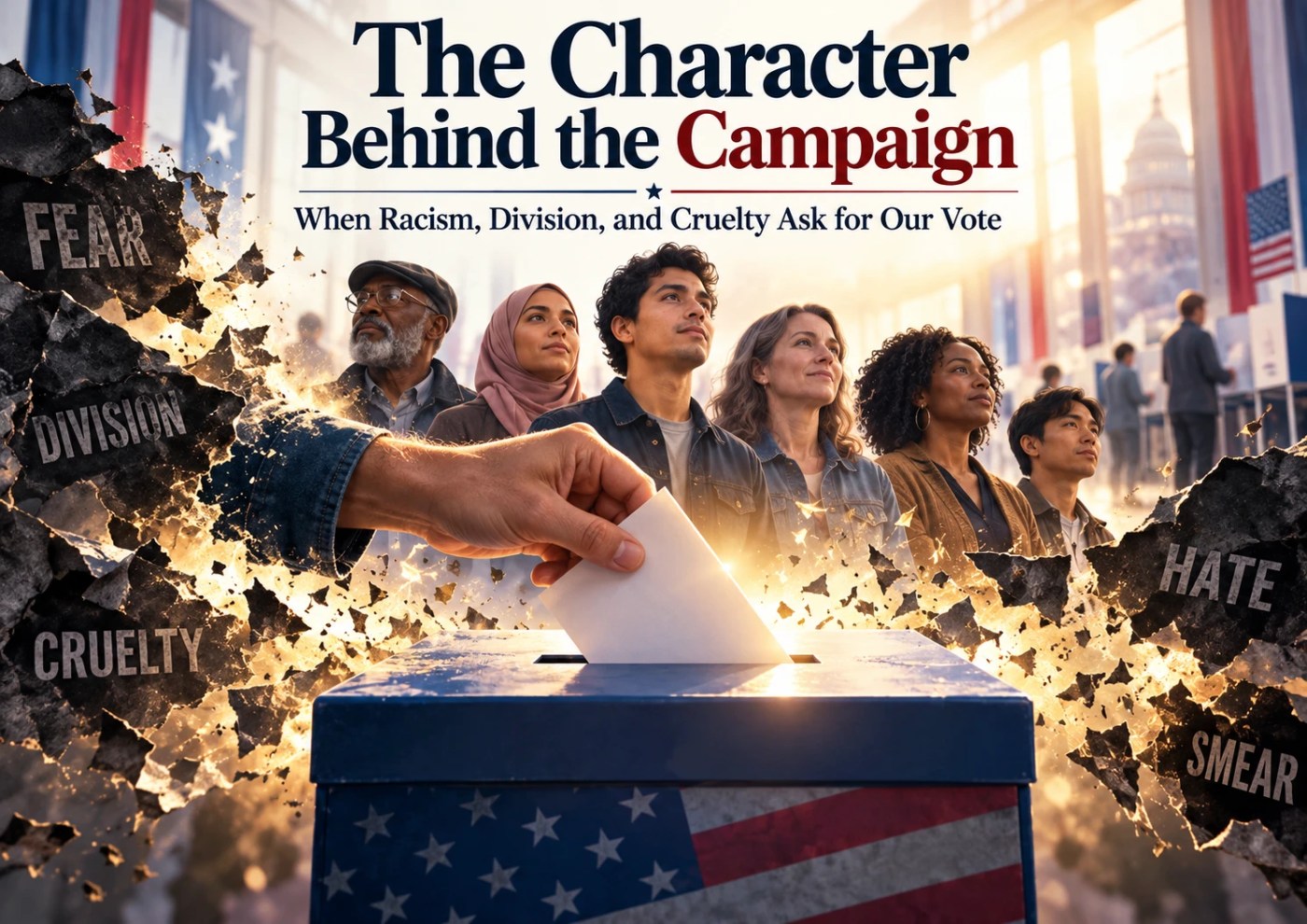
Racism, division, cruelty, and hate say more about the people using them than about the people they target.
An election-season reflection on conscience, accountability, and the people we choose to become.
I have been thinking about the messages we use to ask one another for our votes. Not only the promises, the policies, or the slogans about freedom, security, and change, but the messages underneath them: whom we are encouraged to fear, whose suffering becomes a punch line, whose faith or family becomes an accusation, and whose belonging is suddenly presented as something the rest of us should question.
For me, this is not a question about one political party. It is a question of character. When racism, division, cruelty, or hate becomes part of an appeal for votes, I believe we should pause before letting our agreement with a candidate’s policies excuse the methods used to promote them. We can disagree about government without degrading people. We can challenge a candidate’s record without turning their ancestry, religion, appearance, or childhood into evidence against them. And when someone chooses otherwise, that choice tells us something important. It does not prove the unworthiness of the person being attacked. It reveals the standards the attacker is willing to abandon.
A Line From an Old Novel
The thought that started this reflection was a short sentence I have carried around for years: “Honest people don’t hide their deeds.” I could not remember where it came from, so I went looking. It comes from Emily Brontë’s Wuthering Heights, published in 1847. In the tenth chapter, the housekeeper Nelly Dean says it to young Isabella, who is falling for Heathcliff and refusing to hear warnings about his true nature. Nelly’s point is simple: the people who speak plainly about what they have seen are not the ones to fear. The danger lies with those who need to disguise what they are doing.
That line has a companion in an older text. The Gospel of John (3:21) speaks of those who live by the truth coming into the light, so that what they have done may be seen plainly. Whether one reads that as scripture or as wisdom, the idea is the same: integrity is comfortable being examined.
I want to be careful with this idea, though. Privacy is not proof of dishonesty, and people have every right to protect their families and themselves. And cruelty is not always hidden. Some of the ugliest political messages in history were shouted from stages to cheering crowds. So the better test is not whether something is visible. It is whether a message could survive honest examination: is it true, is it relevant, and could its author defend it without denying someone else’s equal dignity?
Criticism Is Necessary. Dehumanization Is a Choice.
I do not want a political culture without criticism. Public officials should face hard questions. Candidates should explain their votes, defend their proposals, and answer for dishonesty or misconduct. No one deserves immunity from scrutiny because the scrutiny is uncomfortable.
For nearly fourteen years I worked inside the court system as a tech support specialist, in daily conversation with judges, court officers, and law and bench clerks. It remains one of the most rewarding periods of my life, and one lesson from it has never left me. In a courtroom, an accusation is only the beginning. It has to be supported by evidence, it has to be relevant to the matter at hand, and it has to be made with a basic respect for the people in the room. A lawyer who tried to win by mocking a witness’s religion or a defendant’s accent would not be admired for toughness. They would be seen as someone whose case could not stand on its own.
That is the distinction I want to hold onto. There is a difference between asking whether a proposal will work and suggesting that someone’s faith makes them unfit to serve. There is a difference between documenting misconduct and circulating an insinuation because it will disgust people. There is a difference between criticizing someone’s words and treating everyone who shares their background as suspect. My standard is straightforward: challenge what someone has done, what they propose, and what the evidence shows. Do not manufacture a case against their humanity. And keep that standard the same when the person breaking it is someone I otherwise support. Especially then.
What This Midterm Season Has Shown Us
As I write this, the 2026 midterm elections are eight days away, on November 3. The results are not known, and I will not pretend to know how any of these messages will play out at the ballot box. What we can examine now are the words themselves, the evidence behind them, and the standards they ask voters to accept.
A Candidate’s Faith Turned Into an Accusation
In Michigan, Democrat Abdul El-Sayed, a physician and former Wayne County health official, is running for the open U.S. Senate seat against Republican Mike Rogers. If he wins, he would be the country’s first Muslim senator. Over the past several weeks, President Trump has called him a “jihadist,” referred to him as “Mohammed,” and labeled him a terrorist sympathizer. In August, the president shared side-by-side photos of himself with the First Lady and of El-Sayed with his wife, Dr. Sarah Jukaku, who wears a hijab, under a caption calling them “Two VERY DIFFERENT America’s.” Senator Tommy Tuberville called El-Sayed a radical Islamist and a terrorist on social media, and Representative Nancy Mace wrote that Muslim Americans holding public office were a threat to national security.
In fairness, not everyone on the Republican side framed it that way. Senator Tim Scott, who leads the party’s Senate campaign committee, said Republicans were highlighting El-Sayed’s political associations rather than his religion. And there are legitimate questions on the record. Reporting surfaced old social media posts from his half-sister describing family ties to Egypt’s Muslim Brotherhood, which El-Sayed has denied and which the same reporting found no evidence he was personally involved in. He has also faced criticism, including from the Anti-Defamation League and some Jewish Democrats, over his own rhetoric, and he later apologized for comments he said may have been misconstrued. Those are fair subjects for voters to weigh. Accountability does not disappear because a candidate also becomes the target of prejudice.
But accountability requires specificity and evidence. It does not require turning a man’s name and his wife’s headscarf into proof of disloyalty. El-Sayed put the question directly when he asked why anyone should suspect people “simply because they are different from you in how they pray.” Over the weekend, campaigning in Detroit, former President Obama, who faced years of false claims about his own birthplace and faith, told the crowd, “We have seen this movie before. I starred in it.”
A Mother Turned Against Her Daughter
In Ohio, the cruelty took a different form. Republican gubernatorial candidate Vivek Ramaswamy released an ad featuring the estranged birth mother of his Democratic opponent, Dr. Amy Acton, Ohio’s former COVID-era health director. In the ad, the mother calls Acton a liar and insinuates she has mental health problems. Acton has spoken publicly for years about a childhood that included abuse, neglect, and homelessness; her mother lost custody after her stepfather was indicted on a rape charge involving Acton.
What I find most instructive is who objected. Ohio’s Republican governor, Mike DeWine, called for the ad to come down. Iowa Republican Senate candidate Ashley Hinson told ABC News, “I think it’s absolutely terrible, and I think they should take the ad down.” Representative Mace, herself a survivor of sexual assault, called it “the most shameful, disgusting, offensive ad this election season.” These are not people who share Acton’s politics. They simply recognized a line. Vice President Vance, on the other hand, told fellow Republicans to “stop whining” about the ad, and both he and President Trump defended it. The Ramaswamy campaign responded to the criticism by announcing a $4 million push to air it more widely. Acton’s response was brief: she said her opponent had chosen to exploit her childhood to save a struggling campaign, and that decency still matters.
The Standard Has to Cut Both Ways
These are not the only examples. President Trump has used an anti-transgender slur against Annie Andrews, the Democratic Senate nominee in South Carolina. In Texas, false claims spread online that Democratic Senate candidate James Talarico had been hospitalized for mental illness, when he had stepped off the campaign trail with the flu. In California this spring, the Santa Barbara County Republican Party texted voters an AI-generated image of Latino county supervisor candidate Ricardo Valencia painted as a sad-faced clown, which the county’s Democrats condemned as a racist caricature.
Being nonpartisan does not mean pretending every side has behaved identically in every season. It means applying the same principle no matter whose name is on the ad. So I have to note that the most widely reported examples this year have come from one direction, and I also have to note what happens when the direction reverses. This month an outside ad supporting El-Sayed linked U.S. aid to Israel with Americans’ grocery bills and drew widespread accusations of antisemitism; the Anti-Defamation League’s CEO called it “a case study in antisemitism.” El-Sayed’s campaign said the ad was not affiliated with it in any way, and critics, including Jewish Republican groups, said distancing was not the same as condemning. By my own standard, they have a point. If I would ask Republicans to reject a smear against a Muslim candidate, I have to ask a Democratic campaign to reject an ugly trope against Jewish Americans in plain words, not just a disclaimer.
And this goes back further than one election. After the 2024 election, Black Americans in dozens of states, including high school students, received anonymous text messages telling them to report to plantations; the FBI investigated. No campaign claimed them, which is exactly the point Brontë’s housekeeper was making. The people who send messages like that are counting on not being seen.
The People Who Run Our Elections Are Paying a Price
The consequences of a hostile political climate do not stop with candidates. Consider the people whose work makes voting possible. The Brennan Center for Justice surveyed 834 local election officials between late January and late February of this year. About a third said they had experienced threats, harassment, or abuse because of their job, and nearly one in four said they worried about being assaulted at home or at work. Princeton’s Bridging Divides Initiative found something similar among local elected officials more broadly: in just the first quarter of 2026, about half reported being insulted, nearly four in ten reported harassment, and about one in six reported threats.
These surveys describe experiences and fears. They do not prove that any particular ad caused any particular threat, and I do not want to answer irresponsible accusations with irresponsible conclusions of my own. Still, the findings describe a real problem. An election worker should not have to wonder whether counting ballots will put their family at risk. When we say we value elections, our treatment of the neighbors who run them should reflect that. Otherwise we are praising the institution while making the people who sustain it afraid to show up.
History Does Not Let Us Pretend This Is New
It is tempting to call every ugly campaign season unprecedented. History asks us to be more careful. In 1898, in Wilmington, North Carolina, white supremacist Democrats ran a campaign of racist newspaper propaganda and intimidation against the city’s multiracial government, which had been elected by a coalition of Republicans and Populists. Two days after the election, on November 10, an armed mob killed Black residents, burned the city’s Black-owned newspaper, and forced the elected leaders out. It remains the only successful coup d’état on American soil, and it helped usher in decades of Jim Crow voting restrictions in the state.
I name the party labels because history should not be edited, not because the parties of 1898 map onto the parties of today. They do not. The lesson I draw is not that every offensive ad is another Wilmington. Scale and circumstance matter enormously. The lesson is that hateful political messaging cannot always be dismissed as harmless theater. In Wilmington, the propaganda was not separate from the violence. It prepared people to accept it.
Wilmington also corrects a comforting idea I would like to believe: that hatred always defeats the people who use it. Sometimes it does not. Sometimes it wins, and the people it targets pay a price far greater than any reputational cost the perpetrators ever face. If my argument rested on a promise that cruelty always loses the next election, history could disprove it. My argument has to be stronger than that. Cruelty is wrong even when it wins.
Fifty-two years later, a Republican senator from Maine made that case on the Senate floor. On June 1, 1950, Margaret Chase Smith delivered her “Declaration of Conscience,” aimed at the fear-driven, unproven accusations then being spread by Senator Joseph McCarthy, a member of her own party. She was not neutral. She wanted Republicans to win, and she believed the Democratic administration of the day deserved to lose. But she refused to let that desire become a blank check. She said she did not want to see her party ride to victory on the “Four Horsemen of Calumny — Fear, Ignorance, Bigotry, and Smear,” and she offered a warning I think about often:
“While it might be a fleeting victory for the Republican Party, it would be a more lasting defeat for the American people.”
Four years later, during the televised Army-McCarthy hearings, the attorney Joseph Welch finally turned to McCarthy after he attacked a young lawyer on Welch’s staff and asked the question that helped end McCarthy’s power: “Have you no sense of decency, sir?” The question landed because the country could suddenly see, in plain view, what the accuser was willing to do.
When the People Who Used It Looked Back
Some of the most powerful testimony on this subject comes from people who once practiced these tactics and later reckoned with them. Lee Atwater managed George H. W. Bush’s 1988 presidential campaign, the campaign associated with the racially charged Willie Horton messaging against Michael Dukakis. In 1991, dying of a brain tumor at forty, Atwater wrote publicly that his illness had changed how he saw people, and he apologized to Dukakis for what he called the naked cruelty of things he had said during that campaign.
George Wallace, a Democrat, stood at his 1963 inauguration as Alabama’s governor and promised “segregation now, segregation tomorrow, segregation forever.” Years later, after being paralyzed by an assassin’s bullet, he went to the Dexter Avenue Baptist Church in Montgomery, where Dr. King had once preached, and asked Black Alabamians for forgiveness. Historians still debate how much of that was conscience and how much was political calculation. Both can be true. What is not debatable is that he came to understand that the words he had used to win had defined him more than they ever defined the people he aimed them at.
Apology does not erase harm, and it should never be demanded only from the other side. When an aide to California Democrat Jerry Brown was caught on tape in 2010 using a sexist slur about his Republican opponent, Meg Whitman, Brown apologized to her directly in their final debate. It was not a graceful moment. He also tried to point out that her own team had used the word before. But he did say he was sorry, in public, to the person who had been demeaned. That is a low bar. It is still a bar, and it is one too many campaigns are refusing to clear today.
When Someone Chose the Better Path
The other half of history is full of people who refused to go low even when it would have helped them. In October 2008, at a town hall in Lakeville, Minnesota, Republican nominee John McCain took the microphone back from a supporter who told him she could not trust Barack Obama because he was “an Arab.” McCain shook his head and told her Obama was a decent family man and citizen with whom he simply had disagreements on fundamental issues. Some in his own crowd booed him. He did it anyway, three weeks before an election he was losing.
A few days later, former Secretary of State Colin Powell, a lifelong Republican, went on national television and addressed the whispers that Obama was secretly Muslim. He said Obama was a Christian, and then he said the part that mattered more: the real answer to the question “Is there something wrong with being a Muslim in this country?” is no. He described a photograph of a mother resting her head on the gravestone of her son, Army Specialist Kareem Rashad Sultan Khan, killed in Iraq at twenty and buried at Arlington with a crescent and star carved into his headstone. Powell’s point was that a young Muslim American had given his life for this country, and that his faith was no reason to doubt his belonging.
There are smaller examples this year, too. Before the Michigan primary, as online mockery of his opponent Haley Stevens grew among his own supporters, El-Sayed publicly told them to stop and to focus on the issues. That did not erase the sharp things he had said about her himself, but it was a candidate asking his own side to be better. And the Republicans who called on Ramaswamy to pull his ad are doing the same thing, at some political risk to themselves. Telling an ally “this is wrong” is one of the most valuable things a person can do in public life, precisely because it costs something.
How Cruelty Works Against the People Who Use It
So does this kind of messaging actually backfire? The honest answer is: sometimes, and in more ways than one. Political scientists have long described a “backlash effect” in negative campaigning. An attack sends voters two messages, one about the target and one about the attacker. Research has found that personal attacks in particular can lower voters’ opinions of the person making them, making that candidate seem less trustworthy and less suited to serve, and field experiments have documented cases where going negative cost the attacker votes. But these effects depend on the race, the audience, and the message. They are not a law of nature.
A broader body of research points to a quieter cost. A 2022 review of dozens of studies on political incivility, published in Human Communication Research, found that incivility had a small but real negative effect on people’s trust in politics, even though it did not measurably change whether they participated. In other words, cruelty may not keep people from voting, but it slowly teaches them to expect less from the people they vote for.
That is why I think of “working against them” in several layers. Sometimes the cost is lost votes. Sometimes it is lost allies, like the Republicans in Ohio who now find themselves defending their own conscience against their own party’s leaders. Sometimes it is lost credibility that never quite comes back. And sometimes the deepest cost is to the attacker’s own character: a person who decides that humiliating others is an acceptable price of winning has to keep telling themselves that story, and it changes them. None of these costs, though, should distract us from the people who absorb the blow. The responsibility for an attack belongs first to the person who chooses to make it.
What Am I Practicing?
Beyond any single election, I keep returning to a personal question: what am I practicing when I take part in this? If I share an accusation without checking it, I am practicing speed over responsibility. If I laugh at someone’s humiliation because they belong to the other party, I am carving out an exception to the dignity I would want for myself and my own family. If I condemn a slur from an opponent but explain away the same thing from an ally, I am not applying a principle. I am protecting a preference.
I do not write this from a place of perfection. I write it as a standard worth coming back to. Self-transformation is not only about becoming calmer in private or more hopeful about our own futures. It also means examining what we permit ourselves to do when anger feels justified and the people around us reward us for going further. Can I recognize a falsehood when it helps my side? Can I acknowledge someone’s pain without first checking how they vote? Can I withdraw my approval from a cruel tactic without treating that as a betrayal of everything else I believe? Those questions turn political conscience into a personal responsibility, and they keep a reflection like this one from becoming one more exercise in pointing outward.
Refusing Cruelty Without Becoming Passive
None of this means the answer to hate is silence. We can name racism accurately. We can reject religious prejudice. We can document lies, challenge intimidation, and hold people responsible for what they choose to say and do. A calm voice does not require a weak conclusion. And the people targeted by cruelty should never have to respond with perfect composure before the rest of us take their mistreatment seriously.
For those of us watching from the sidelines, a practical standard might begin with checking a claim before passing it along, and separating documented conduct from insinuation and identity-based suspicion. It continues by keeping our criticism tied to what someone has actually done or proposed, rather than to who they are or where their family comes from. It requires applying the same rule to our allies that we apply to our opponents, because a standard that changes with party affiliation is not much of a standard. It asks us to correct our own mistakes out loud, since quietly deleting something false does nothing for the people who already saw it. And it leaves room for people to change, because rejecting someone’s conduct does not require declaring them beyond redemption. Lee Atwater and George Wallace are reminders that even people who built careers on division can come to see it differently.
The Message I Want My Participation to Send
I want my participation in public life to say more than whom I oppose. I want it to say that truth matters even when a falsehood would be convenient, that another person’s dignity is not a bargaining chip, that accountability does not require contempt, and that loyalty has limits when it asks me to excuse what I know is wrong. I want to be able to criticize a candidate without teaching myself to despise everyone who looks, prays, or loves like them.
In 1861, with the country coming apart, Abraham Lincoln closed his first inaugural address by hoping Americans would once again be touched “by the better angels of our nature.” Dr. Martin Luther King Jr. later put the same truth more bluntly: hate cannot drive out hate; only love can do that. Neither of them was naive about how hard that is. Both understood that the way we fight shapes who we become.
Every election message is also a demonstration. It shows how we handle difference, what we are willing to reward, and what we will tolerate in exchange for the chance of winning. Racism, division, cruelty, and hate do not prove the unworthiness of the people they target. They expose the choices of the people using them. Honest people don’t hide their deeds, and they don’t need to. The question for each of us, in the next eight days and long after, is whether we will reward those choices or make different ones ourselves.
A note on how this was made: I use artificial intelligence as a tool to enhance my creativity, research, and thinking. The reflections, values, and final choices in this post are my own.
Read posts at climatechangecommunity.com
Protecting our Children & Biodiversity’s future towards a more sustainable and habitable Earth!
Compiled & Mr. Alvarez’s Thoughts | AI Enhanced.


Leave a Reply