There’s nowhere to run, nowhere to hide from what you really are inside.
You never gain from telling lies; the truth wears no disguise.
— The Whispers
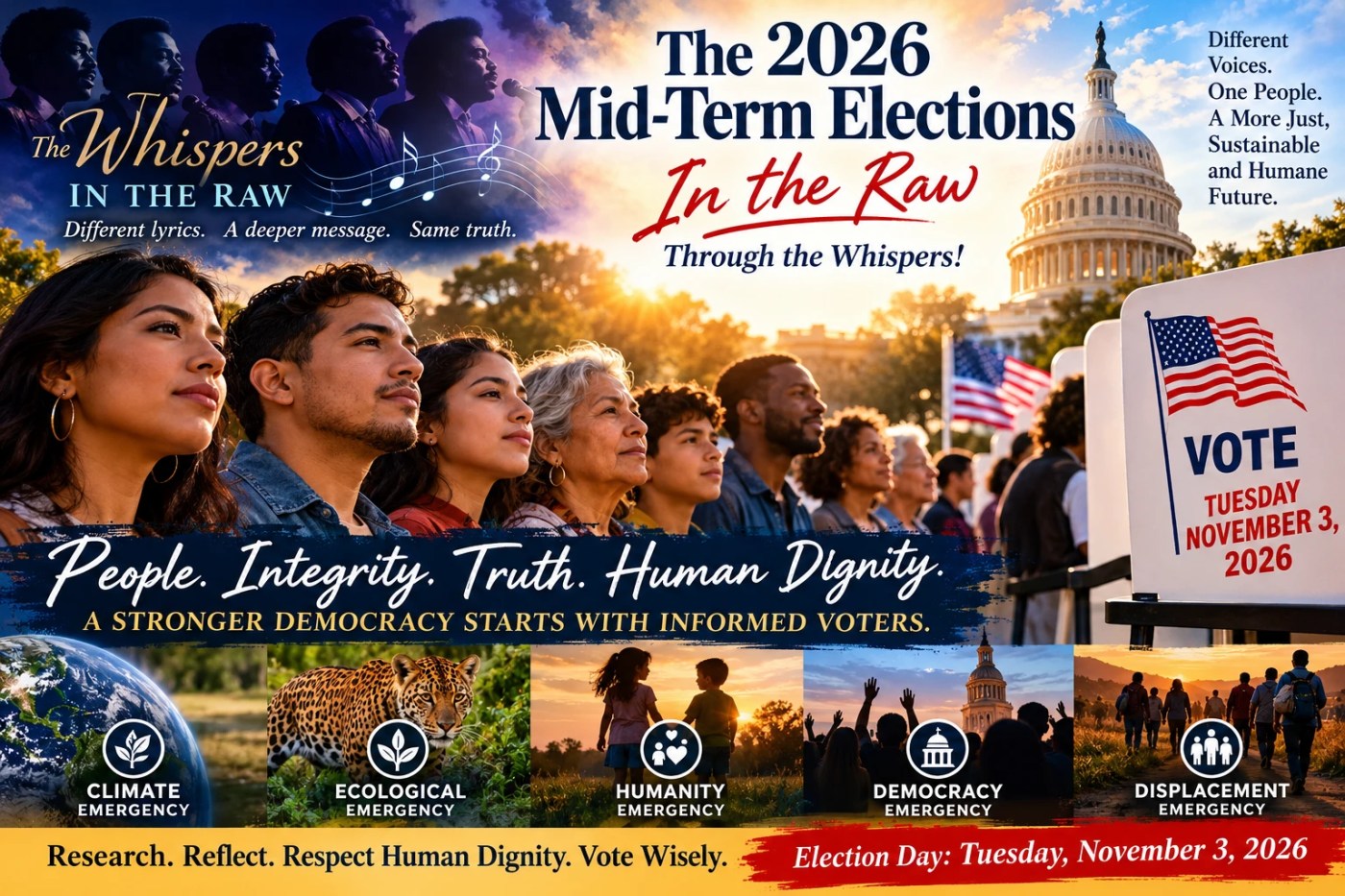
#MidTermElections2026 #Whispers #MoralLeadership #HumanDignity #VoteWisely #Democracy #LatinasYLatinos #TheFiveEmergencies
Election Day: Tuesday, November 3, 2026
An appeal for truth, integrity, human dignity, and the moral courage to choose our leaders wisely.
Introduction: When the Music Speaks Beyond the Music
In 2024, I wrote about how a song by The Whispers, In the Raw, could offer an unexpected perspective on choosing political leaders. Although the song was written about relationships, its underlying themes of character, honesty, appearances, and discovering who someone really is can also encourage us to examine the people seeking our trust.
I am returning to that reflection in 2026 because the need for honest, compassionate, responsible leadership deserves our attention more than ever.
Listen to The Whispers — In the Raw (Official Music Video)
I am not suggesting that the group intended its song to be a political statement. Rather, music can open a door to reflection, helping us recognize truths that extend beyond the circumstances in which a song was written.
And what greater relationship requires careful consideration than the relationship between the people and those entrusted with governing them?
On Tuesday, November 3, millions of Americans will have an opportunity to influence the direction of their communities, states, and country. Every U.S. House seat is up for election, approximately one-third of the Senate seats are contested, and voters will also decide numerous state and local races. These elections will help shape the government’s priorities for the next two years and, in many places, considerably longer. USA.gov explains how the midterm elections work.
This is not simply a matter of choosing a political party.
It is about deciding what kind of conduct we are willing to reward, what kind of leadership we are willing to accept, and what kind of society we want to leave to our children.
My appeal is non-partisan, but it is not without principles.
I believe we must examine the behavior of candidates seeking office and incumbents seeking another term. We must look beyond party labels, campaign slogans, attractive promises, and the ability to command attention.
We must examine character.
We must examine evidence.
And above all, we must never allow our political preferences to become an excuse for abandoning human dignity.
1. Looking Beyond the Shadow: Who Is the Person Behind the Campaign?
The central question is not simply whether a candidate appears presidential, confident, charismatic, wealthy, religious, patriotic, or successful.
It is whether that person demonstrates the integrity, judgment, compassion, and competence necessary to serve the public.
A candidate may speak eloquently about freedom while behaving contemptuously toward people whose opinions differ from their own. Another may invoke family values while displaying little concern for families outside their political constituency. Someone may promise safety and security while using fear to make entire communities appear threatening.
The campaign image and the actual person can be very different.
This is why we must look beyond appearances.
What has the candidate done when challenged? How have they treated critics, journalists, public servants, political opponents, and ordinary citizens? Have they accepted responsibility for mistakes, or have they consistently searched for someone else to blame?
Do they tell the truth when the truth is inconvenient?
Do their actions support their promises?
Do they demonstrate respect for people who cannot offer them money, influence, or votes?
These questions matter whether the candidate is running for president, Congress, a state legislature, a mayor’s office, a school board, or a local council.
Public service is not a personal entitlement. It is a responsibility entrusted to someone by the public.
An elected official does not become more deserving of respect merely because they hold a powerful position. They earn public trust through their conduct and the quality of their service.
A campaign can polish an image. Only a record of conduct can help us determine whether that image deserves our trust.
2. Don’t Choose Too Fast: Research Before You Reward
One of the brief phrases in In the Raw urges caution before making a choice. It is good advice for relationships, financial decisions, and, certainly, political leadership.
Before electing someone or returning an incumbent to office, investigate their record.
Review their voting history, legislative work, policy proposals, financial interests, public statements, and documented actions. Examine their promises against what they have actually accomplished.
Where credible evidence exists of dishonesty, corruption, abuse of office, or misconduct, do not dismiss it simply because the individual belongs to your preferred party. Equally, do not treat an unproven accusation as an established fact merely because it confirms what you already believe.
Context matters. Evidence matters. Due process matters.
A viral video may reveal something important, but it may also omit the circumstances that help explain what occurred. A campaign advertisement may contain accurate information while leaving out equally important details. A dramatic accusation is not automatically a credible one.
Seek original documents, complete statements, official voting records, reliable reporting, and independent verification.
For federal legislation, Congress.gov provides bill information and legislative records. The Federal Election Commission provides information about federal campaign finance and political committees.
Ask yourself:
- Has this candidate kept important promises, and can the results be verified?
- Do they acknowledge mistakes and correct false statements?
- Do they explain how their proposals would work, who would pay for them, and who would be affected?
- Are their financial interests and potential conflicts handled transparently?
- Do they respect independent institutions, the law, and legitimate public scrutiny?
We should apply these questions to incumbents and challengers alike.
Someone already holding office should not receive an automatic second chance simply because their name is familiar. Nor should a challenger receive unquestioning trust simply because they promise change.
A vote is not a loyalty oath. It is a decision about whom we are prepared to entrust with public responsibility.
3. The Truth Wears No Disguise: Honesty Is a Democratic Necessity
The relationship between truth and leadership is fundamental.
In the language of the song, the truth wears no disguise.
A democracy cannot function well when its citizens are persistently misled, when public debate becomes a contest of fabricated claims, or when leaders encourage their supporters to reject all contrary evidence.
No candidate will know everything. No elected official will make every decision correctly. Honest people can disagree, misunderstand a situation, or change their minds when new evidence emerges.
The test is not perfection.
The test is whether someone is willing to be accountable to the truth.
Can they acknowledge a mistake without treating the admission as humiliation? Can they correct misinformation even when doing so disadvantages their campaign? Can they distinguish an established fact from a personal opinion, an allegation, or an uncertain prediction?
And can they accept legitimate scrutiny without automatically portraying every critic as an enemy?
These are not questions of party affiliation. They are questions of character.
Dishonesty becomes especially dangerous when it is used to dehumanize others, manufacture scapegoats, undermine confidence in legitimate elections, or discourage people from exercising their lawful rights.
The same principle applies to us as citizens.
We cannot demand honesty from political leaders while knowingly spreading false claims about their opponents. We cannot condemn misinformation when it comes from one side and excuse it when it benefits the other.
We should be prepared to correct our own mistakes, examine our own assumptions, and reconsider our own political loyalties.
If we expect better leadership, we must also demand better standards of ourselves.
4. The Moral High Ground: Human Dignity Is Not Negotiable
This is where I want to place the greatest emphasis in the 2026 elections.
The United States is a country of extraordinary possibilities, but its history also contains painful examples of what can happen when fear, prejudice, racism, and political expediency are allowed to override the dignity of human beings.
Slavery, racial segregation, discriminatory voting restrictions, and the mistreatment of marginalized communities remind us that a society can normalize grave injustice when enough people become accustomed to it—or when they benefit from looking away.
The National Archives’ history of the Voting Rights Act of 1965 documents how discriminatory voting practices, literacy tests, intimidation, economic reprisals, and violence were used to suppress African American political participation.
Latina and Latino communities have also faced voter suppression, intimidation, and barriers to political representation throughout American history. The Smithsonian’s National Museum of the American Latino documents this history and the continuing importance of civic participation.
Another painful example is Executive Order 9066 during World War II. It led to the forced removal and incarceration of approximately 122,000 people of Japanese ancestry, nearly 70,000 of whom were American citizens. Many lost their homes, businesses, possessions, and personal liberty. Decades later, the Civil Liberties Act of 1988 formally acknowledged the injustice and provided redress.
The National Archives documents Executive Order 9066 and its consequences.
These historical episodes were different in their circumstances, but they offer an enduring warning: fear and collective blame can make the mistreatment of innocent people appear acceptable.
History does not repeat itself in precisely the same way. Nevertheless, its lessons deserve our attention whenever political rhetoric encourages us to regard our neighbors as less worthy of dignity because of their ancestry, language, religion, immigration status, race, or political beliefs.
A society’s moral character is tested not only by how it treats those who hold power, but also by how it treats those who have less of it.
That is why we must pay attention to how candidates speak about people.
Do they criticize specific policies and actions, or do they ridicule entire populations?
Do they seek solutions to genuine public concerns, or do they turn vulnerable groups into convenient scapegoats?
Do they defend the equal dignity of those who disagree with them, or do they encourage humiliation, hostility, and exclusion?
Do they recognize that human beings can be held accountable for their actions without being stripped of their basic humanity?
We must reject racism, cruelty, deliberate humiliation, and dehumanization, regardless of who engages in them.
But let me make an important distinction.
Taking the moral high ground does not mean becoming passive in the face of injustice.
It does not require us to remain silent when people are being harmed. It does not mean treating every claim as equally credible or every action as equally defensible. Nor does it mean confusing civility with a willingness to tolerate abuse.
We can oppose discrimination forcefully. We can demand accountability. We can challenge falsehoods, expose wrongdoing, organize peacefully, and insist that the law protect people’s rights.
We can do all of this without adopting the very cruelty, dishonesty, and contempt we seek to overcome.
The moral high ground is not a claim that our own side is morally superior by definition.
It is a commitment to apply consistent standards of truth, justice, dignity, and accountability—even when doing so is politically inconvenient.
That is the kind of leadership we should demand.
And it is the kind of citizenship we should practice.
5. The Current Climate: Disagreement Must Never Become Permission for Cruelty
As we approach the 2026 midterms, Americans are expressing serious concerns about the health of their democratic institutions.
A Gallup survey published in July 2026 found that 67% of U.S. adults were concerned a great deal or a fair amount about political leaders pressuring election officials to change election outcomes. The survey also documented concerns about intimidation around polling places and the handling of ballots.
Read the Gallup report on election concerns ahead of the 2026 midterms.
Meanwhile, an Institute for Strategic Dialogue report published in February 2026 found that online threats targeting U.S. lawmakers increased more than threefold between 2021 and 2025 within the dataset it examined. The increase affected lawmakers across party lines, although the reported patterns differed between political groups.
These findings do not establish that every political disagreement is dangerous or that all Americans support political violence. They do demonstrate why the conduct of political leaders deserves careful scrutiny.
Words have consequences.
When public figures encourage threats, normalize political violence, glorify cruelty, or portray opponents as enemies who must be destroyed, they can help make an already divided society more hostile.
When supporters excuse conduct from their preferred candidates that they would condemn in their opponents, accountability becomes selective.
And when humiliation becomes entertainment and hatred becomes a measure of political loyalty, we risk forgetting the humanity of the people with whom we disagree.
A responsible candidate should be able to oppose a policy without threatening its supporters, criticize an opponent without dehumanizing them, and defend a position without encouraging violence.
We should expect our leaders to demonstrate the courage to lower the temperature when necessary, not simply the ability to inflame it when politically useful.
This applies to candidates, elected officials, political commentators, campaign organizations, and citizens who share political material online.
The strength of a democracy is not measured by how ruthlessly its factions can attack one another. It is measured by their ability to resolve profound disagreements without abandoning truth, rights, or human dignity.
6. Latinas y Latinos: Your Vote Belongs to You
I want to speak directly to Latinas y Latinos who are eligible to vote in these elections, while recognizing that Latino communities are diverse and that no single message represents everyone’s experience.
Your vote belongs to you.
No political party owns your identity. No candidate is entitled to your loyalty because of your surname, ancestry, language, neighborhood, or family background.
You deserve candidates who take your concerns seriously, respect your human dignity, explain their policies honestly, and remain accountable for the consequences of their decisions.
You also deserve to make your own informed choices.
Recent research helps illustrate the breadth of issues that matter. According to Pew Research Center’s survey of Latino registered voters conducted September 28–October 4, 2026:
- 86% said the economy was very important to their congressional vote.
- 80% said health care was very important.
- 75% said education was very important.
- 69% identified the future of democracy as an important consideration.
- 64% identified immigration as an important consideration.
The findings come from a survey of 5,062 U.S. adults, including 774 Hispanic registered voters. They represent a snapshot of opinion during the survey period, not a prediction of how every Latino voter will vote.
Source: Pew Research Center, The Economy Is the Top Issue for Latino Voters in the 2026 Midterms.
These numbers are a reminder that economic opportunity, health, education, democratic accountability, and immigration policy all deserve serious consideration.
But the most important issues in your life may not be identical to those of another Latino voter. Your priorities may include public safety, affordable housing, reproductive rights, small-business opportunity, climate resilience, family security, religious freedom, or many other concerns.
That diversity is not a weakness. It is part of the democratic experience.
My appeal is not for anyone to vote for a particular party or against a particular candidate because of their ethnicity.
It is for every eligible voter to examine the candidates’ behavior, policy proposals, records, and values—and to vote in a way that reflects their own informed judgment.
Ask whether a candidate can address the economic pressures facing working families without making promises that cannot be delivered. Examine their positions on health care, education, immigration, and public safety. Consider how they treat immigrants and long-established citizens alike, and whether their policies respect the law and the dignity of the people affected.
Consider whether they can serve the whole community rather than only those who already agree with them.
And remember: you have every right to change your mind when the evidence changes.
Tu voto importa. Tu dignidad importa. Tu voz merece ser escuchada.
Your vote matters. Your dignity matters. Your voice deserves to be heard.
Do not surrender your judgment to a political machine, a social media personality, a campaign advertisement, or a friend who insists that only one choice is acceptable.
Research. Reflect. Ask difficult questions. Then make your own decision.
7. Make the Candidate Answer the Five Emergencies
For those of us concerned about the future of our children and the living world, an additional set of questions deserves attention.
How will the people we elect respond to the interconnected emergencies facing our societies?
The Climate Emergency: Do their policies take climate science, extreme heat, energy affordability, disaster preparedness, and the protection of vulnerable communities seriously?
The Ecological Emergency: What do they propose regarding biodiversity, wildlife, water, soil, forests, oceans, and the ecosystems on which human survival depends?
The Humanity Emergency: Do their conduct and policies support children’s well-being, health, education, compassion, human dignity, and the protection of people who are vulnerable to exploitation or abuse?
The Democracy Emergency: Do they respect lawful elections, constitutional responsibilities, independent oversight, freedom of expression, and peaceful political participation?
The Displacement Emergency: How do they propose to address forced displacement, humanitarian needs, housing pressures, and the difficult challenges facing communities affected by conflict, disasters, and environmental change?
These questions extend beyond party affiliation. They concern the practical consequences of leadership and our collective responsibility to future generations.
A candidate does not become responsible simply by using the word sustainability. Nor does someone become compassionate merely by speaking about family, freedom, or security.
Examine their proposals. Look at their records. Determine what their choices are likely to accomplish.
Political rhetoric can be inspiring, but rhetoric alone cannot protect a child, restore a damaged ecosystem, make housing affordable, or strengthen democratic institutions.
Our future requires informed decisions and sustained public participation.
8. What Does It Really Mean to Hold the Moral High Ground?
I believe we need to recover a distinction that is easy to lose in a deeply divided society.
There is a difference between winning an argument and demonstrating integrity.
There is a difference between defeating an opponent and solving a problem.
There is a difference between speaking about compassion and practicing it.
And there is a difference between claiming to represent the people and accepting responsibility for serving them.
Holding the moral high ground does not mean never becoming angry. Anger in response to injustice can be understandable and sometimes motivating. It does mean being careful about what we do with that anger.
We can be uncompromising about protecting human rights without treating those who disagree with us as subhuman.
We can demand truthful government without spreading lies ourselves.
We can challenge a harmful policy without inventing accusations against its supporters.
We can hold people accountable without denying their right to a fair process.
We can insist upon respect without surrendering the right to criticize.
And we can work toward unity without pretending that our differences do not exist or that serious wrongdoing should go unanswered.
Unity is not uniformity. Democracy does not require everyone to think alike.
What it requires is a shared commitment to the principles that allow people with different beliefs, backgrounds, and experiences to live together under fair rules.
That commitment is especially important when tensions are high.
We must resist the temptation to excuse conduct we condemn in others simply because it benefits our preferred candidate. We must refuse to make excuses for racism, cruelty, dishonesty, or political violence when those responsible belong to our own political camp.
If we want a healthier democracy, our standards must not change according to whose name appears on the ballot.
Our principles mean very little if we abandon them whenever they become inconvenient.
9. Before Tuesday: A Call to Action
Election Day is Tuesday, November 3, 2026. If you are eligible to vote and have not yet made your voting plan, take time now to prepare.
Check your registration status, polling location, voting hours, identification requirements, and any remaining early or absentee voting options through your official state or local election office. Rules differ by state, so do not rely on an old social media post or an assumption based on where a friend lives.
Start with USA.gov’s official voting information.
Then research your candidates. Review their public records and policy proposals. Seek out reliable reporting. Distinguish documented facts from allegations and opinions. Talk with people who disagree with you, and be willing to listen without giving up your own judgment.
When you encounter questionable claims online, verify them before sharing. When you see an act of genuine public service, acknowledge it, even when it comes from someone outside your preferred political camp.
And after the election, stay engaged.
Contact your representatives. Attend public meetings. Ask questions. Follow legislation and budgets. Join constructive civic initiatives. Support the people and organizations working to protect human rights, strengthen communities, and safeguard the living world.
Voting is a vital democratic responsibility, but it is not the end of our responsibility as citizens.
It is the beginning of another opportunity to hold public power accountable.
Final Reflection: Who Are We Becoming?
As I revisit this song and my original 2024 reflection, I return to a question that applies to both our leaders and ourselves.
Who are we becoming?
Are we becoming a society that rewards the loudest voice, the cruelest insult, the most convenient lie, and the most aggressive display of power?
Or can we become a society that values honesty, courage, thoughtful disagreement, accountability, and respect for human dignity?
We cannot control every decision made by our elected officials. We cannot guarantee that every candidate who earns our trust will fulfill every promise. And we cannot eliminate political disagreement from a democratic society.
But we can decide what evidence we examine, what behavior we reward, what standards we uphold, and how we participate.
We can refuse to let party loyalty erase our conscience.
We can refuse to let fear become an excuse for prejudice.
We can refuse to let cruelty become ordinary.
We can refuse to let dishonesty become acceptable simply because it is politically useful.
And we can insist that the people seeking our votes understand that public service means something more than personal power.
The moral high ground is not about declaring ourselves better than everyone else. It is about choosing, repeatedly, to act according to principles that protect the dignity of others—even when doing so is difficult.
On November 3, look beyond the campaign image. Look beyond the slogans. Look beyond the political theater.
Examine the record. Consider the consequences. Evaluate the conduct.
Choose the candidates you believe are best equipped to serve the public with honesty, competence, accountability, and respect for human dignity.
Do not vote out of hatred. Do not vote out of fear alone. Do not vote simply because someone tells you that your loyalty is owed.
Vote with your conscience informed by evidence.
Vote with an understanding of what is at stake.
And once the ballots have been counted, continue to insist that those elected serve the people rather than demand that the people serve them.
Be well, be safe, respect one another’s humanity, and by all means, vote wisely.
Because the future of our democracy—and the future we leave our children—deserves nothing less.
Further Reading and Voter Resources
Current election and voter information
- USA.gov — Congressional and Midterm Elections
- Federal Election Commission — Election and Voting Information
- Pew Research Center — How Latino Voters Are Experiencing the 2026 Midterm Elections
History, civil rights, and democratic accountability
- National Archives — Voting Rights Act of 1965
- Smithsonian National Museum of the American Latino — Latinos and Latinas in the United States
- National Archives — Executive Order 9066
- Gallup — Election Concerns Ahead of the 2026 Midterms
- Institute for Strategic Dialogue — Research on Threats Against Public Officials
This article is a non-partisan appeal for informed voting, ethical leadership, civic participation, and the protection of human dignity. Its purpose is to encourage readers to examine candidates and their conduct independently, not to endorse any political party or candidate.
Protecting our Children & Biodiversity’s future towards a more sustainable and habitable Earth!
Compiled & Mr. Alvarez’s Thoughts | Advanced AI Enhanced.


Leave a Reply