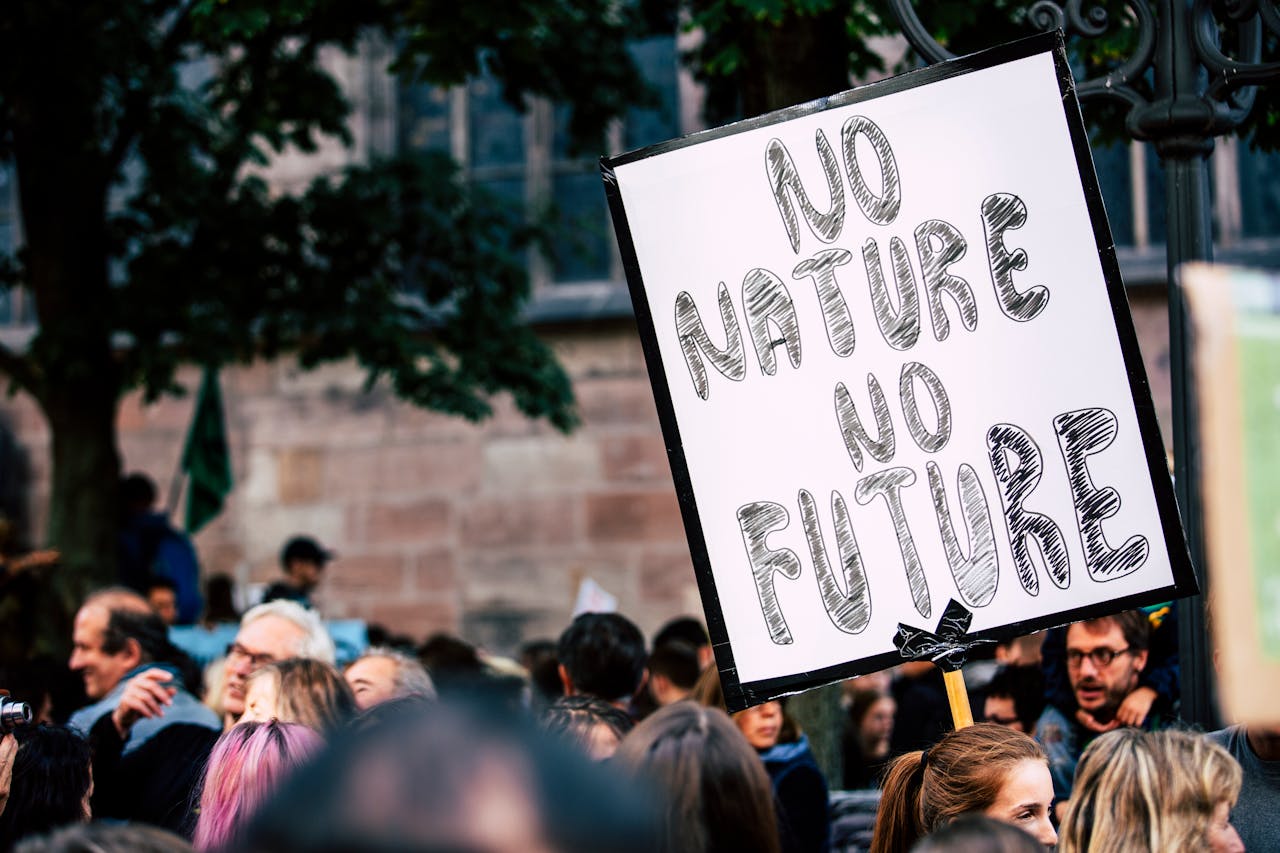
World Climate Day, and the voices born for this moment
Some days are coincidences. Today is not.
May 15 is observed by communities around the world as World Climate Day — a day intended to wake the human family to what the atmosphere has been saying for decades. And by some quiet design of history, today is also the birthday of voices whose words land on the planet like prophecies the moment we most need them.
Listen.
Pierre Curie was born on this day in 1859.
Before he ever shared the Nobel Prize with his wife Marie, before the discovery of radium reshaped medicine, physics, and the modern world, he asked a question that should be carved into the conscience of every government, every corporation, and every laboratory on Earth:
“Is it right to probe so deeply into Nature’s secrets? The question must here be raised whether it will benefit mankind, or whether the knowledge will be harmful.” — Pierre Curie
He asked that more than a century ago.
We have our answer now.
We have probed. We have extracted. We have burned the carbon, drained the aquifers, leveled the forests, poisoned the rivers, acidified the oceans, and rewritten the chemistry of the sky. The knowledge has been both gift and wound. Curie’s question has not aged a day. It has only grown louder.
UNEP reports that global greenhouse gas emissions reached nearly 58 billion tonnes in 2024 — a record high. NOAA’s May 2026 ENSO discussion places the probability of El Niño emerging through this summer at 82 percent, and continuing through the coming winter at 96 percent.
These are not abstractions. They are signals — to farmers, to mayors, to neighbors, to anyone who breathes.
The knowledge is in our hands. The question is whether we have the courage and the humility to use it well.
Katherine Anne Porter was born on this day in 1890.
The Pulitzer Prize-winning writer spent her life cutting through fog — political fog, social fog, the comfortable fog of polite lies. She left writers, and now all of us, with one of the cleanest warnings ever written:
“You can’t use jargon.” — Katherine Anne Porter
The climate emergency must not hide behind jargon.
Not “anthropogenic forcing.” Not “negative emissions pathways.” Not “net zero” recited like a prayer no one understands.
Children should be able to follow our climate language. Elders should be able to act on it. Workers should be able to demand it. Farmers and faith leaders and first responders should be able to use it.
Clear language is not simplification. It is respect.
Confusion protects delay. Clarity protects communities.
Every word we choose either widens the circle of understanding or shrinks it. On a planet running out of time, that is a moral act.
Brian Eno was born on this day in 1948.
The musician, producer, and systems thinker gave the world a word we now need more than ever: scenius — the communal counterpart to genius, the intelligence of an entire scene rather than a lone hero:
“Genius is individual, scenius is communal.” — Brian Eno
Eno’s deeper insight is that the people we remember as singular geniuses were almost always carried by an ecology of talent — collaborators, students, teachers, audiences, neighbors. The world is not changed by lone figures. It is changed by communities thinking together.
This is the soul of Adaptive Resiliency.
No one survives the climate emergency alone. No single inventor, no single president, no single technology will save us. What will save us — what is already saving us, wherever it is being practiced — is an ecology of talent meeting an ecology in crisis:
- Neighbors who check on elders during heat waves.
- Teachers who explain climate disruption without despair.
- Organizers who turn fear into mutual aid.
- Scientists, storytellers, farmers, faith leaders, engineers, and elders working in concert.
- Indigenous knowledge and modern AI sitting at the same table without one trying to silence the other.
- An entire scene of human beings refusing to let the world fall apart quietly.
We do not need more lone geniuses.
We need more scenius. We need more community.
Emmitt Smith was born on this day in 1969.
The Hall of Fame running back, who outlasted defenders, injuries, and an entire generation of his peers, said it plainly:
“All men are created equal. Some work harder in preseason.” — Emmitt Smith
Adaptive resiliency is preseason work.
It is what you do before the heat dome arrives. Before the floodwater rises. Before the smoke chokes the sky. Before the grid fails. Before the supply chain breaks. Before the next election is decided by who shows up.
It is the unglamorous, daily, often invisible labor of preparing — of knowing your neighbors, knowing your watershed, knowing your evacuation routes, knowing who in your community is medically vulnerable, knowing where the cooling centers are, knowing how to organize without panic.
Resilience is not a moment. Resilience is a muscle. And muscles are built in the preseason.
A coda: Marie Curie
Marie Curie was not born on May 15. But she shared a life with the man who was, and after his death she carried his work, his name, and his moral compass forward. In her writing about Pierre, she left a sentence that could be the closing prayer of this day:
“Each of us must work for his own improvement, and at the same time share a general responsibility for all humanity.” — Marie Curie
Self-mastery and shared responsibility. The personal and the planetary. The inner work and the collective work.
This is not a contradiction. This is the entire assignment.
What May 15 is asking of us
May 15 is not just a calendar entry. It is a mirror. It shows us a planet in emergency and a chorus of voices — born across more than a century — telling us, with terrifying clarity, how to meet this moment:
- Curie asks whether our knowledge wounds or heals.
- Porter asks whether our language clarifies or conceals.
- Eno asks whether we are building genius or scenius.
- Smith asks whether we are doing the preseason work.
- Marie asks whether we are tending both the self and the whole.
The climate and ecological emergency is not waiting for us to be ready. It is here. The forests are burning. The oceans are warming. The poles are thawing. The systems we inherited were not built for what is coming.
But the people are. We are.
So on this May 15, let us stop treating awareness as the destination. Awareness is the doorway.
Walk through it.
Tell the truth plainly. Prepare practically. Cooperate fiercely. Hold power accountable. Center the vulnerable. Strengthen what is local. Use every tool — AI, dialogue, science, story, ancestral wisdom, nature-based solutions — that helps us see clearly and act wisely.
This is what Adaptive Resiliency means.
Not surrender. Not denial. Not hope as wishful thinking.
Hope as preparation. Hope as practice. Hope as community.
The future will not be protected by awareness alone.
It will be protected by communities that know how to adapt, cooperate, and rise.
Happy birthday, Pierre. Happy birthday, Katherine. Happy birthday, Brian. Happy birthday, Emmitt.
The work continues. With us.
Sources
- UNEP, The climate crisis explained in seven graphs (2026). https://www.unep.org/news-and-stories/story/climate-crisis-explained-seven-graphs
- NOAA Climate Prediction Center, ENSO Diagnostic Discussion, May 14, 2026. https://www.cpc.ncep.noaa.gov/products/analysis_monitoring/enso_advisory/ensodisc.shtml
- WMO, Likelihood increases of El Niño (April 24, 2026). https://wmo.int/media/news/wmo-likelihood-increases-of-el-nino
- Necmettin Erbakan University Sustainability, May 15 World Climate Day (2025). https://sustainability.erbakan.edu.tr/en/event/may-15-world-climate-day
Tito – Thoughts / AI – Enhanced


Leave a Reply