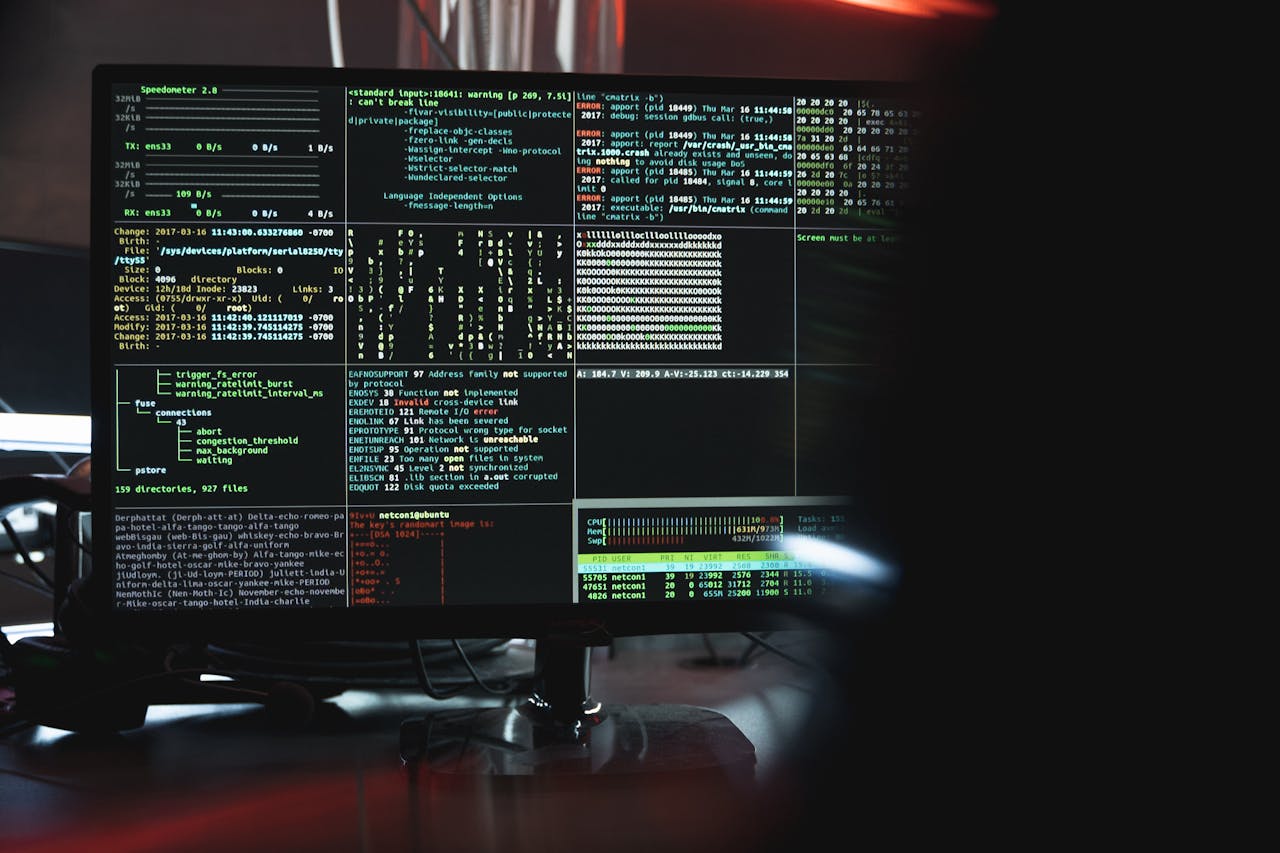
Why atomic Linux distros — Bluefin, Aurora, Silverblue, Secureblue — and Qubes OS deserve a seat at the climate table, alongside the AI we are learning to wield with care.
“Qubes OS is a security-focused operating system that allows you to organize your digital life into compartments called ‘qubes.’ If one qube is compromised, the others remain safe, so a single cyberattack can no longer take down your entire digital life in one fell swoop.” — Qubes OS Project, official FAQ
We are living through two emergencies at once — the slow violence of ecological collapse and the fast violence of a digital infrastructure under daily siege. They are not separate stories. They are the same story, told in different timescales. And the question of which operating system we choose to run, on the laptops where climate scientists write their warnings and journalists publish them, has somehow become a quiet front in the larger fight for a livable future.
This is not hyperbole. It is arithmetic. Hold that thought.
A short history of fragility
On a Friday in May 2017, a piece of malware called WannaCry swept across more than 150 countries and infected over 200,000 computers within hours. Britain’s National Health Service was among the worst hit: at least 81 of 236 trusts affected, around 19,000 appointments cancelled, including 139 for patients with suspected cancer. The UK Department of Health and Social Care estimated the cost to the NHS at roughly £92 million — about £19 million in lost output and another £73 million scrambling to restore systems. Globally, damages climbed into the billions.
Six weeks later, NotPetya arrived. Disguised as ransomware but engineered as a wiper, it tore through Maersk and stopped the planet’s logistics in its tracks. Maersk alone reported losses of $200–300 million; the Stimson Center calls it one of the most impactful malware incidents in history, with total damages exceeding $10 billion.
Now name the common thread: outdated, mutable operating systems whose owners could not — or did not — patch them in time. Microsoft itself had to take “the highly unusual step of hurriedly developing and releasing a patch” for systems it had stopped supporting years before. The fragility wasn’t in the people. It was in the architecture.
And the climate cost of all that fragility is hidden, but real. Cybercrime runs on electricity. Botnets, cryptominers, and ransomware infrastructure consume enormous computational power, and data centers already burn through roughly 1.3% of global electricity demand. Every compromised machine quietly conscripted into someone else’s spam engine is a small, persistent leak of carbon. Every premature hardware replacement after a breach throws away the roughly 80% of a laptop’s lifetime emissions that were burned during manufacturing before it ever reached your desk. And every dollar a hospital, school, or city pays to recover from a cyberattack is a dollar diverted from the work of decarbonization.
“Decreasing an organization’s carbon footprint often involves high upfront costs. The high cost of cybercrime can stand in the way of businesses spending that on environmental initiatives.” — Tripwire, How Does Cybersecurity Impact Environmental Services and Infrastructure?
Security and climate are not separate budgets. They are the same budget.
What atomic Linux actually is
Now consider a different architecture. Fedora Silverblue, the GNOME-based atomic desktop, describes itself plainly: “An atomic variant looks, feels, and behaves just like a regular desktop operating system, but your updates are delivered as full images of a working system. This makes every installation identical to every other, and it will never change while you’re using it.” That last clause is the revolution. The core of the system cannot be modified at runtime. Applications live in containers and Flatpaks, separate from the OS itself. Updates arrive as a complete image — either the whole new system boots successfully, or the machine rolls back, instantly, to a known-good state.
Project Bluefin — built on Fedora Atomic and maintained by the Universal Blue community — markets itself as “the next generation cloud-native Linux workstation, designed for reliability, performance, and sustainability.” Read that last word again. Sustainability is in the tagline.
Aurora is Bluefin’s KDE sibling: same atomic foundation, different desktop, same philosophy. Secureblue takes the same Fedora Atomic base and hardens it further — adding GrapheneOS’s hardened_malloc, USBGuard, a hardened Chromium derivative, and aggressive kernel mitigations — describing itself as an OS “for those whose first priority is using linux, and second priority is security.” These distros are not competitors. They are a family tree, each one applying the same architectural truth to a different audience.
That architecture yields three properties the climate emergency desperately needs:
Security as stability. Because the root filesystem is read-only, attackers cannot quietly install persistent malware the way they can on a mutable Windows or traditional Linux box. The long tail of half-compromised machines — running crypto-miners, spamming the world, joining botnets that hammer climate-justice journalists offline — gets shorter.
Predictable maintenance. Image-based updates are transactional. They either succeed, or they don’t. There is no twelve-hour scramble at 2 a.m. patching individual packages while a hospital diverts ambulances. Less firefighting means more attention for the actual fires.
Hardware longevity. When the OS resists configuration rot and offers instant rollback, organizations and individuals can run hardware longer. And since manufacturing accounts for roughly 80% of a laptop’s lifetime carbon, extending a device’s useful life is among the most impactful climate actions a user can take. An immutable OS is, quietly, an act of resource stewardship.
Qubes OS: the architecture of “assume breach”
If atomic distros harden the foundation, Qubes OS redesigns the building itself. Its guiding principle is what its developers call “Security by Compartmentalization (or Isolation).” Your browser, your email, your banking, your sensitive research — each lives in its own isolated virtual machine, with the Xen hypervisor enforcing the walls between them. If one qube is breached, the rest stay sealed.
This is exactly the resilience principle that ecologists and emergency planners preach in every other domain: don’t trust any single barrier; segment, contain, assume partial failure. A wetland’s value isn’t in being impervious; it’s in being able to absorb a shock and keep functioning. Qubes is wetland thinking applied to a desktop.
For the people most exposed to weaponized digital pressure — journalists tracking petrostate corruption, scientists holding politically inconvenient datasets, NGOs at the negotiating table — that compartmentalization is not paranoia. It is professional infrastructure.
AI as the co-pilot of the immutable
These operating systems are arriving at exactly the moment AI is rewriting what security can mean. And here is where two of my deepest convictions converge: that AI must be wielded as a constructive tool, and that resilience is built in layers, not in single heroic acts.
On a mutable OS, AI-driven anomaly detection drowns in false positives. Configuration drift, ad-hoc package installs, random local changes — every machine is a unique snowflake of noise. But on an immutable base, there is a clean, declarative baseline. Every legitimate state of the system is known. An AI watching for unusual container, Flatpak, or qube behavior has a non-moving target to compare against. It can act decisively — isolate, roll back, alert — without breaking the user’s work.
This is the pairing the emergency calls for: an immutable root of trust, compartmentalized activity, and AI-driven detection that can finally act because it isn’t lost in chaos. The future of operating-system security is moving toward zero-trust kernels and on-device models analyzing behavior in real time. Atomic and compartmentalized OSes are the only honest foundation for that future. The rest is theater.
Toward a digital stack worthy of the future we owe
Climate work is, in the end, infrastructure work. We pour concrete for seawalls. We replant mangroves. We rebuild grids around renewables. We should also, with the same seriousness, rebuild the operating systems on which the rest of that work depends.
Bluefin. Aurora. Silverblue. Secureblue. Qubes. They are not the only answer. But they are an answer — a serious one — to the question of what a climate-aligned digital stack looks like. They reduce successful compromises. They cut the hidden carbon of cybercrime. They extend hardware lifespans. They free human attention from endless triage. They give the AI tools we are learning to use a foundation worth defending. And they treat security, resilience, and sustainability not as three separate checkboxes but as one design problem with one elegant answer: build it so it cannot easily break, and so that when it does, it heals.
That is Adaptive Resiliency, in the form of code.
We do not get to choose the century we were born into. We only get to choose what we build inside it. Let us build the OS the emergency deserves — and the AI to defend it — together, in dialogue, in cooperation, in a refusal to surrender the future to either fossil collapse or digital sabotage.
The wetland thinks in layers. The forest thinks in layers. The Earth thinks in layers.
So should our machines.
Sources & further reading
- Fedora Silverblue official site
- Project Bluefin and Aurora
- Secureblue (Fedora Atomic hardened)
- Qubes OS FAQ
- UK National Audit Office: WannaCry investigation
- Imperial College London: WannaCry NHS impact analysis (Nature/npj Digital Medicine)
- Computer Weekly: NotPetya cost Maersk up to $300m
- Stimson Center: Cyber and Climate Threats — Shared Risks
- Tech Carbon Standard: Hardware Lifecycle Emissions
 empowerment & inner transformation...
Leave a comment