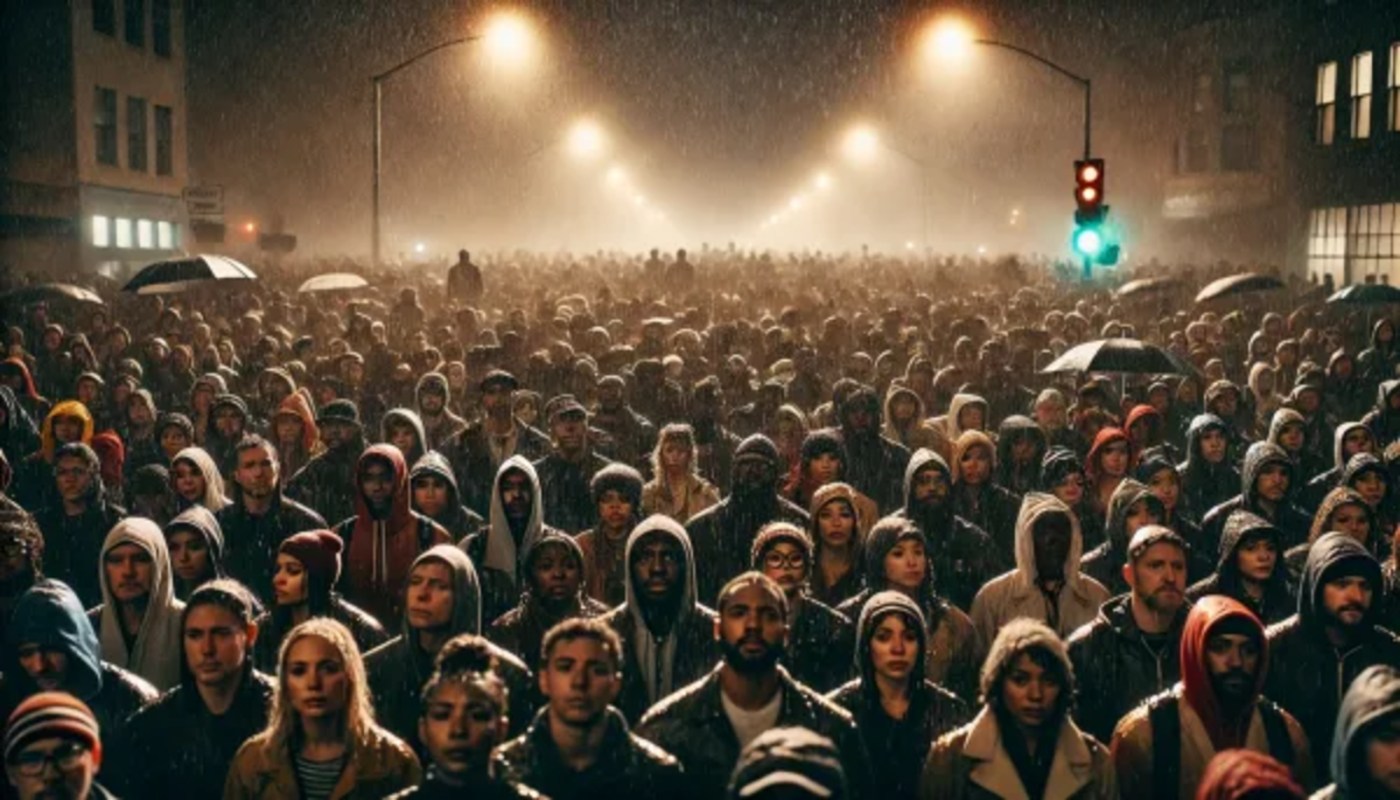
Wealth, Power, Climate, and the Case for Building Something Better
Maybe “The System Is Rigged” Is the Wrong Place to End the Conversation
You hear the phrase everywhere now:
“The system is rigged.”
You hear it from people on the left. You hear it from people on the right. You hear it from people who have stopped trusting either side. You hear it from people who work full-time and still struggle to pay rent, people buried beneath medical bills, young people wondering whether they will ever own a home, small-business owners competing against corporate giants, and people living on streets in one of the wealthiest nations in human history.
I understand why they say it.
But I think we make a mistake if “the system is rigged” becomes the end of the discussion.
It should be the beginning.
Because the more important questions are:
Rigged in what ways? By whom? Through what mechanisms? And, most importantly, what are we going to build instead?
I am not against wealth.
I am not against business.
I am not against capitalism simply because somebody succeeds within it.
There are wealthy individuals, families and companies doing tremendous good. There are businesses trying to decarbonize, improve working conditions, strengthen communities, fund research, support education and leave something worthwhile behind.
My problem is with unethical wealth, unethical capitalism and concentrated power that treats human beings, communities and the Earth primarily as resources to be extracted.
That distinction matters.
Because if we turn this into a war against everybody who has money, we have learned nothing.
The Numbers Tell Us Something Is Wrong
Consider wealth.
The Congressional Budget Office found that in 2022, the wealthiest 10 percent of American families held about 60 percent of total family wealth, while the entire bottom half held about 6 percent under a measure that includes expected Social Security benefits. Excluding Social Security makes the concentration even greater.
That does not prove some secret room exists where wealthy people collectively conspire against everyone else.
It proves something more important: economic power is extraordinarily concentrated.
Now consider homelessness.
HUD’s latest nationwide Point-in-Time assessment counted 745,652 people experiencing homelessness on a single night in January 2025. That was a 3.3 percent improvement from the extraordinary 2024 count, but it still represents hundreds of thousands of human beings without stable housing in the United States. And because a Point-in-Time count measures one night, it should never be mistaken for the total number of people who experience homelessness over an entire year.
Then there is health.
The Census Bureau reported that 92 percent of Americans had health insurance for some or all of 2024. That is substantial coverage, but it still leaves millions uninsured, and possessing an insurance card does not by itself answer questions about deductibles, medical debt, affordability, availability of specialists or whether someone can realistically obtain the care they need.
So when people say something is wrong, we should not dismiss them.
Something is wrong.
The harder question is what exactly we intend to do about it.
America Has Been Here Before
There is another reason I resist hopelessness.
History.
The United States has confronted concentrated economic power before.
During the Gilded Age and Progressive Era, Americans watched enormous industrial trusts accumulate extraordinary control over sectors of the economy. Public pressure eventually contributed to the Sherman Antitrust Act of 1890, followed by the Federal Trade Commission Act and Clayton Act in 1914. Those laws remain pillars of American competition policy today.
In other words, people looked at an economic system that appeared overwhelmingly powerful and said:
No. These rules can be changed.
During the Great Depression, Franklin D. Roosevelt took the argument further. In his 1944 State of the Union address, he argued that political freedom could not be separated entirely from economic security.
His words were strikingly simple:
“Necessitous men are not free men.”
Roosevelt went on to speak about decent employment, housing, healthcare, education and protection from severe economic insecurity.
More than two decades later, Dr. Martin Luther King Jr. called for what he described as a “radical revolution of values”—a transformation that placed human beings above materialism and challenged a society willing to tolerate poverty amid abundance.
These people differed enormously from one another, and none provided a perfect blueprint for the twenty-first century.
But the historical lesson is important:
Economic arrangements are not laws of nature.
They are human arrangements.
Humans created them.
Humans can improve them.
Power, Control and the Battle Over the Narrative
I am deeply disturbed by our present political atmosphere.
But I also refuse to reduce this entire problem to one political party.
Greed does not carry a membership card.
Ego is bipartisan.
The hunger for power has appeared throughout human history under kings, corporations, religious institutions, political parties, governments, movements and charismatic leaders of almost every ideological description.
Still, particular movements must be examined honestly when they hold power.
Project 2025, for example, describes itself as an effort involving more than 100 organizations preparing policy, personnel and training for a new conservative administration.
Separately, the Trump administration has directed the Secretary of Education to take steps, within the law, toward closing the federal Department of Education and returning greater authority to states and local communities. Supporters describe that as decentralization and parental empowerment. Those of us who are concerned about equal access, civil rights, educational standards and the politicization of knowledge have every right—and I would argue a responsibility—to examine what replaces the institutions being dismantled.
That is why education matters so much to me.
Not indoctrination.
Education.
Learning how government works.
Reading legislation ourselves.
Understanding regulations.
Learning history rather than merely consuming somebody else’s interpretation of it.
Understanding science.
Learning climate science.
Understanding economics.
Knowing how corporations operate.
Knowing what our constitutional rights are.
Knowing how state and local governments work.
Understanding voting.
Understanding protest.
Understanding organizing.
And increasingly, understanding artificial intelligence well enough that it becomes a tool we use rather than a mysterious technology used on us.
An educated person can still be deceived.
But an educated, curious and connected population is much more difficult to manipulate.
We Have Another Choice: Build
This is where I think many conversations about inequality go wrong.
People become excellent at identifying villains.
Then what?
We scroll.
We rage.
We argue.
We make memes.
We insult the other political tribe.
We go to sleep.
Then we wake up and give our money to exactly the same systems we complained about yesterday.
I am increasingly interested in another response:
Build alternatives.
And this idea is not imaginary.
In 1844, 28 working people in Rochdale, England—many facing low wages and expensive basic necessities—pooled their limited resources and created what became the prototype of the modern cooperative movement. They wanted affordable goods, honesty in business and a democratic stake in the enterprise they supported.
Today the International Cooperative Alliance says there are roughly three million cooperatives worldwide, with cooperative membership encompassing at least 12 percent of humanity.
Think about that.
People have already demonstrated, across generations and continents, that commerce does not have to mean maximizing extraction from everyone involved.
Businesses can make money.
Workers can earn decent livelihoods.
Innovation can flourish.
And communities can still matter.
I believe we need millions more locally rooted businesses, cooperatives, social enterprises, independent creators, repair businesses, renewable-energy companies, community organizations and ethical technology ventures.
Call it ethical capitalism.
Call it stakeholder capitalism.
Call it cooperative economics.
Call it mutual aid combined with entrepreneurship.
The label interests me less than the outcome.
Does the enterprise serve human beings—or merely extract from them?
What I Want Climate Change Community LLC to Test
This is where my own company enters the argument.
I do not want Climate Change Community LLC merely to publish articles telling corporations and governments what they should do.
I want us to test some of these ideas ourselves.
One idea I am proposing is a $235,000 annual salary ceiling, regardless of how large the company might eventually become.
Why?
Because if an organization becomes enormously successful, I want us asking a different question from the beginning:
Not, How much more can the person at the top take?
But:
What can the organization accomplish with the surplus?
Can some support members in genuine emergencies?
Can some strengthen climate education?
Can some help communities build resilience?
Can some fund new programs?
Can some support people facing climate-related displacement?
Can some seed other ethical enterprises?
Can some help people get back on their feet?
That thinking is behind the Financial Support Program I have been developing. It remains something that must be structured responsibly, legally and sustainably; it should not be interpreted as a guaranteed financial benefit merely for joining one of our communities. But the philosophy behind it is already clear:
If a community creates value together, more of that value should circulate back through the community.
I do not know whether our model will work exactly as I imagine it.
That is precisely why I call it a test.
Try it.
Measure it.
Correct it.
Improve it.
And if something works, let other people copy it.
In fact, I hope they do.
I recently told my daughter something that I want younger people especially to understand: if you discover a business idea that genuinely helps communities while creating a reasonable livelihood, your first instinct does not always have to be, How do I stop anybody else from doing this?
Sometimes the victory is replication.
Imagine one successful community-centered business becoming ten.
Then one hundred.
Then ten thousand.
That is not losing your idea.
That is changing a system.
A Lesson YouTube Taught Me About Dependency
Part of this philosophy comes from personal experience.
In 2024, I created two new YouTube channels and expanded an older one. By my count, I created close to 300 videos dealing largely with Adaptive Resiliency, and I was beginning to move more deeply into renewable energy.
Then my ability to upload stopped.
I tried multiple computers and three different operating systems.
I could still access the account, but I could not continue using those channels in the way I had built them to be used.
I want to be very precise here: I cannot prove why it happened, and I am not going to invent an explanation I do not possess.
What I can tell you is what the experience taught me.
I had built a large body of work on somebody else’s infrastructure.
And suddenly that infrastructure was no longer dependable for my purpose.
That was a powerful lesson.
Platforms can change policies.
Algorithms can change.
Companies can change ownership.
Accounts can disappear.
Revenue programs can change.
A creator can spend years building an audience and discover that the actual relationship belongs largely to the platform connecting them.
That does not mean we should never use large platforms.
It means we should understand the difference between using infrastructure and owning our foundations.
That experience pushed me further toward building independent communities and toward reducing unnecessary dependence on systems whose priorities I do not control.
And, personally, the difficult experiences of the last decade have changed me in ways the people creating those difficulties probably never intended. They forced me to develop resilience, patience and a level of emotional discipline I did not previously possess. My faith has also been an enormous source of the strength and wisdom I have needed through that process.
Sometimes adversity does not disappear.
Sometimes we learn how to transform what it produces in us.
Then Comes the Climate Emergency
All of this becomes much more urgent when placed beside the Climate and Ecological Emergency.
I frequently use the phrase Climate Refugee Emergency because I want people to understand the human scale of what is coming and what, in many places, has already begun.
There is an important technical distinction, however.
UNHCR notes that “climate refugee” is not formally recognized as a category under international refugee law. Most people displaced by disasters and climate pressures move within their own countries, and climate change frequently operates as a risk multiplier alongside poverty, conflict, governance failures and other pressures.
The terminology does not make the humanitarian challenge smaller.
The Internal Displacement Monitoring Centre recorded nearly 45.8 million disaster-related internal displacements in 2024, the highest annual number since it began monitoring. Those are displacement movements rather than 45.8 million unique “climate refugees,” and not every disaster can simply be attributed to climate change. But the scale should destroy any illusion that displacement is some distant theoretical problem.
We are entering an era in which climate adaptation, housing, energy, food, migration, public health, infrastructure and inequality increasingly intersect.
And we are wasting precious time fighting one another.
Green AI Must Mean More Than Calling AI Green
Artificial intelligence belongs in this conversation too.
I use AI.
I believe AI can become an extraordinary educational, scientific and adaptive-resilience tool.
But that does not mean I am willing to ignore its environmental footprint.
Berkeley Lab’s 2025 update estimates that U.S. data centers could consume roughly 9.5 to 15.3 percent of U.S. electricity by 2030 under its scenario range. That is significant enough that anyone serious about sustainable AI should be paying attention.
I have called the alternative Green AI.
Part of Green AI should mean asking whether every AI task really needs enormous centralized computing infrastructure. When technically practical, smaller and local computing should be part of the discussion. So should more efficient hardware and software, cleaner electricity, responsible cooling, heat reuse, transparent resource reporting and siting decisions that respect surrounding communities and ecosystems.
I previously imagined desert data centers supplied by desalinated seawater as one possible answer.
But even that idea requires far more scrutiny than simply saying “put them in the desert.” Deserts are ecosystems, not empty wastelands, and desalination itself can create problems involving energy use, cost, marine impacts and concentrated brine disposal.
That is what responsible environmental thinking requires.
We do not replace one ecological problem with another and declare victory.
Human beings matter.
Freshwater matters.
Biodiversity matters.
Animals matter.
Oceans matter.
Communities matter.
And technological progress should be measured partly by whether it improves those things rather than sacrificing them.
The Future Is Dismal Only If We Surrender It
I hear young people asking:
“What is the use?”
That may frighten me more than almost anything else.
Because hopelessness is extraordinarily convenient for entrenched power.
A hopeless person does not organize.
A hopeless person does not build.
A hopeless person does not vote.
A hopeless person does not study legislation.
A hopeless person does not start the cooperative.
A hopeless person does not invent the alternative.
A hopeless person concludes that somebody else owns the future.
I reject that.
The future is not predetermined.
Yes, the Climate and Ecological Emergency is extraordinarily serious.
Yes, inequality is real.
Yes, concentrated wealth creates concentrated influence.
Yes, political institutions can fail.
Yes, corporations can exploit.
Yes, governments can overreach.
Yes, people can manipulate one another through fear, identity, religion, ideology, algorithms and propaganda.
But there is another force in human history:
people who decide to cooperate.
People who educate themselves.
People who organize.
People who vote.
People who protest lawfully.
People who defend the rule of law.
People who create businesses.
People who build cooperatives.
People who teach.
People who grow food.
People who install renewable energy.
People who care for neighbors.
People who create technology.
People who refuse to measure their worth by whether they look richer than the person standing beside them.
People who understand that a comfortable life, meaningful work, family security, community, purpose and a livable planet are forms of wealth too.
That is where I believe our power still lives.
Not in waiting for billionaires to rescue us.
Not in waiting for politicians to rescue us.
Not in pretending government is unnecessary.
Not in pretending business is evil.
And not in replacing one powerful ruling class with another.
Our power is in creating institutions worthy of our participation.
Government that serves people.
Business that serves people.
Technology that serves people.
Education that liberates people.
Communities that support people.
And an economy that recognizes something our current civilization desperately needs to remember:
There is such a thing as enough.
You can succeed without humiliating someone else.
You can become comfortable without becoming predatory.
You can build a company without worshipping unlimited accumulation.
You can compete and still cooperate.
You can make money and still possess a conscience.
You can use technology without surrendering your humanity to it.
And we can confront the Climate and Ecological Emergency without abandoning one another in the process.
Maybe the system is rigged in important ways.
Fine.
Then let us study exactly how.
Let us challenge what is unlawful.
Reform what is unjust.
Replace what is destructive.
Support what is ethical.
And where necessary—
build something better ourselves.
Because the most powerful answer to a system that no longer serves enough people may not simply be resistance.
It may be creation.
By Mr. Alvarez | Thoughts Enhanced through AI Assistant


Leave a comment