Peel-and-Stick Power and the Fight for Who Gets to Generate
For seventy years, solar power has been heavy.
Heavy in the literal sense — glass and aluminum, racks and rails, ballast and bolts, the slow ceremony of drilling holes in a roof and praying it doesn’t leak. But heavy in a deeper sense too. Heavy with cost. Heavy with paperwork. Heavy with the unspoken rule that clean energy is something other people install for you, on roofs strong enough to hold it, in neighborhoods that can afford the appointment.
A new technology coming out of MIT is trying to make solar light again. And if it works — if it really works — it could change not just how we generate electricity, but who gets to.
What this actually is
The video making the rounds, from the climate-and-energy channel Earth Circuit, carries a headline built for the algorithm: “MIT Just Invented A $4 Peel-and-Stick Solar Film That Powers Your Home. Why Is It Hidden?” Let me strip the clickbait off it and hand you the real thing underneath, because the real thing is more than good enough.
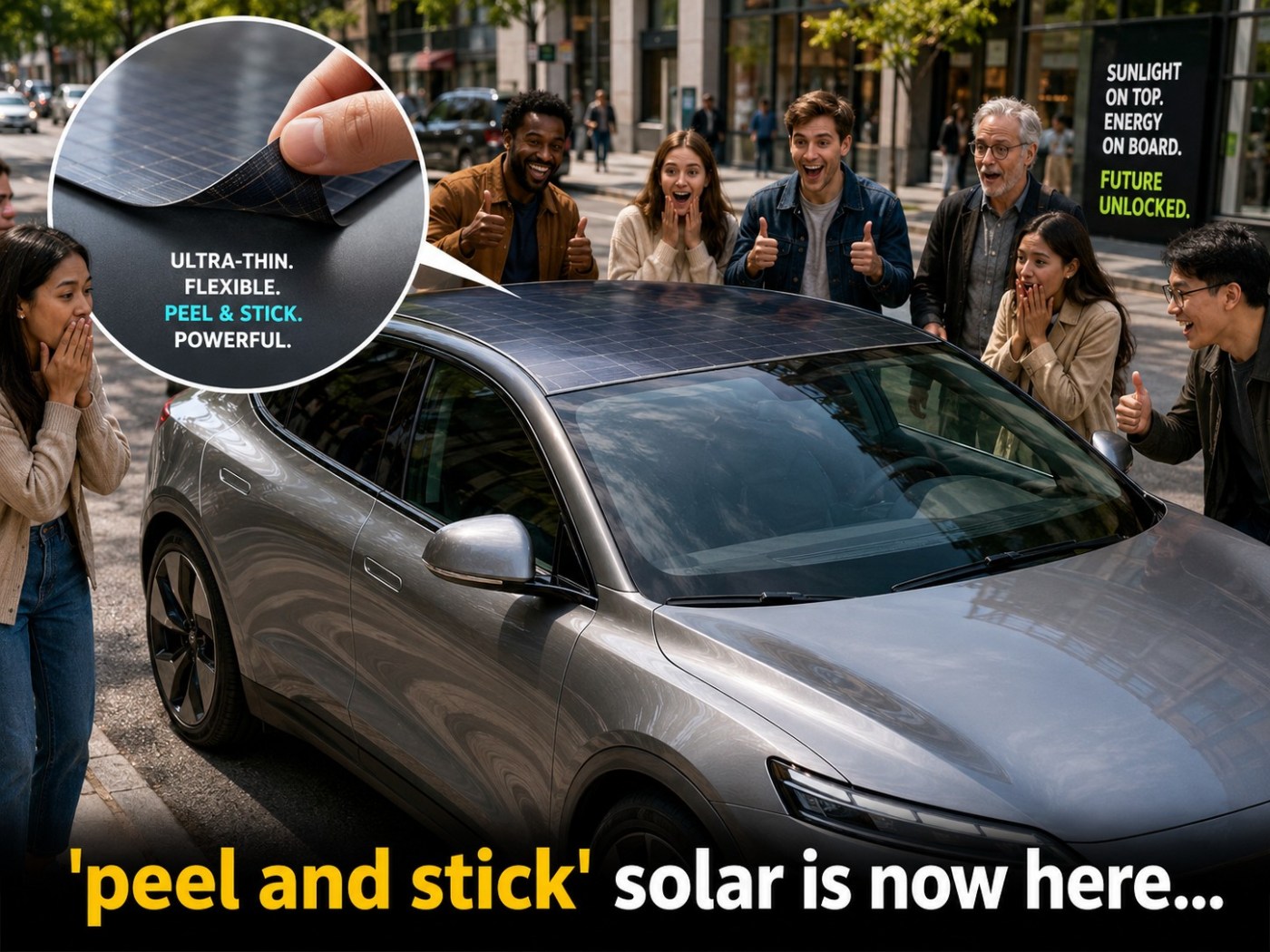
The technology comes from Active Surfaces, an MIT spinout founded in 2022 by Richard Swartwout and Shiv Bhakta, built on more than a decade of research and a stack of patents. Instead of rigid silicon — what Swartwout calls “solar 1.0” — they use perovskite, a class of light-hungry materials that can be printed like ink. They lay down a solar layer roughly 15 microns thick — thinner than a human hair — onto a flexible backing, then seal it under an epoxy that cures in seconds beneath a UV lamp.
The result is solar you can ship on a roll and stick down like roofing underlayment. No racks. No rails. No drilling. The films are so light they can go on surfaces that could never hold a conventional panel — old roofs, curved roofs, warehouse skins, the roof of an electric car. And per square foot, the company says, the film generates about as much electricity as the silicon panel sitting next to it.
This is not vaporware. Active Surfaces has raised over $10 million, opened a roll-to-roll manufacturing facility in Woburn, Massachusetts, and in late 2025 drew an investment from the Japanese utility J-Power, which is now piloting the films in real-world conditions.
So why isn’t it on your roof yet? (It’s not a conspiracy.)
Here’s where I want to be honest with you, because honesty is the whole point of this community.
That “Why Is It Hidden?” framing? It’s wrong. There is no shadowy cabal of installers burying a miracle to protect their profits. The truth is less cinematic and more useful: this technology is still being born.
The films have proven more than ten years of durability under realistic heat and humidity in the lab. That’s genuinely impressive. But the silicon panels we bolt to roofs today come with 25-to-30-year warranties, and until perovskite films can stand toe-to-toe on that timeline, no serious utility or homeowner is going to bet a roof on them. The company knows this. They’re working toward it. Manufacturing has to scale. Building codes, fire standards, and grid-interconnection rules — all of them written around heavy glass panels — have to catch up.
That’s not suppression. That’s the unglamorous, necessary work of turning a breakthrough into a product. I’d rather tell you the boring truth than sell you a villain.
But the boring truth points at a real villain, and it’s worth naming.
The real enemy: soft costs
Pull up the bill for a rooftop solar system in America and you’ll find something strange. The panels themselves are a minority of the price. The majority — somewhere between 58% and 65% of the total cost of a residential system, according to the Solar Energy Industries Association and the Department of Energy — is *soft costs.*
Soft costs are everything that isn’t hardware: permitting, inspection, interconnection paperwork, customer acquisition, marketing, financing, and the labor of skilled crews navigating a different bureaucratic maze in every town. As the price of the actual panels has plunged over the past decade, these costs have barely budged. So they now dominate. Permitting and the dance of getting “permission to operate” alone can run on the order of $6,000 to $7,000 per system. A single week of permitting delay, SEIA found, raises the odds a customer walks away by 10%.
This is the trap. We have made the sunlight-into-electricity part cheap. We have not made the getting-it-onto-your-roof part cheap. And that gap is where solar quietly stays a privilege.
Now look again at what peel-and-stick promises. A film you adhere yourself, in an afternoon, with no racks and no structural engineering, doesn’t just shave a little off the hardware line. It takes a blowtorch to the soft-cost line — the labor, the complexity, the specialized crews. The $4-per-square-foot figure in that video is a projected material cost, not a price you can pay today, so hold it loosely. But the direction is unmistakable: the path to genuinely affordable solar runs straight through soft costs, and lightweight self-installable film is one of the few technologies aimed directly at them.
Distributed generation: tearing the power plant into a million pieces
Step back far enough and you see what’s really at stake.
The grid we inherited is a cathedral model: a few enormous power plants, owned by a few enormous entities, sending electricity one direction — down to us, the consumers, who pay and say thank you. Distributed generation is the heresy that says power can be made everywhere, by everyone — on rooftops, over parking lots, along the walls of buildings, at the edges instead of the center.
Distributed generation is more resilient: when one node fails, the lights don’t all go out at once. It’s more democratic: the people who generate power have a stake and a say. And it’s more honest about the climate timeline — because we cannot wait for a perfect, centralized, top-down buildout while the carbon clock runs.
Heavy panels slow distributed generation down. Every roof too weak, every wallet too thin, every permitting office too slow is a place where distributed power doesn’t happen. A solar film you can roll out like a carpet is, at its heart, a tool for putting generation back in the hands of the many. That’s not just an engineering story. It’s a power story — in both senses of the word.
Who gets left in the dark
And this is where it becomes a justice issue, because it always was one.
Rooftop solar in America has flowed, predictably, toward the people who already have the most: homeowners with strong roofs, good credit, and the patience for paperwork. Renters can’t install it. Low-income families can’t finance it. Communities living in the shadow of refineries and highways — the same communities breathing the dirtiest air, facing the hottest summers, getting hit first and worst by the crisis — see the least distributed solar of anyone. The buildings are older. The roofs are weaker. The capital isn’t there.
A lightweight, low-labor, self-installable film won’t fix that injustice by existing. Technology never does. Markets, left alone, will happily sell the cheap new thing to the same people who could already afford the expensive old thing.
But it cracks the door open. It makes it possible to solarize a weak roof, a rental, a community center, a row of carports in a neighborhood that distributed generation forgot. Whether that possibility becomes reality is not a question for the engineers. It’s a question for us — for policy, for organizing, for whether we demand that the next wave of clean energy reach the frontlines first instead of last.
What this asks of you
So here’s where I land, and here’s what I’m asking.
Don’t fall for the miracle, and don’t fall for the conspiracy. Both are lazy. The miracle (“a $4 film will power your home tomorrow”) sets you up to feel cheated when reality arrives slower. The conspiracy (“they’re hiding it from you”) feeds the cynicism that is the climate movement’s quietest poison. The truth is harder and better: a real technology, with real promise, doing the unglamorous work of growing up.
Watch the durability numbers. When perovskite films cross from ten-year lab results to twenty-five-year field warranties, that’s the signal that the era is actually turning. That’s the milestone worth celebrating, not the headline.
Fight the soft costs — that’s a thing you can actually do. The single biggest lever on solar affordability isn’t in a lab in Woburn. It’s in your town’s permitting office, your state’s interconnection rules, your local code. Standardized permits, faster inspections, fair interconnection — these are winnable fights at the city and state level, and they’re where ordinary people can pry this open.
And demand the order of deployment be just. When this technology hits the market, it will be deployed somewhere first. Let it be the rooftops that have been waiting longest. Let it cut the bills of people who needed the cut most. Let it build power — electrical and political — where the grid and the system have both said not you, not yet, not ever.
The sun has never charged anyone a permitting fee. It falls on every roof equally — the strong ones and the weak ones, the owned and the rented, the wealthy blocks and the forgotten ones. The only thing that’s ever decided who gets to use it is us.
Let’s make the next decision a better one.
Have thoughts on distributed generation, soft-cost reform, or peel-and-stick solar? Bring them to the community — this is exactly the kind of conversation Climate Tribe was built for.


Leave a Reply