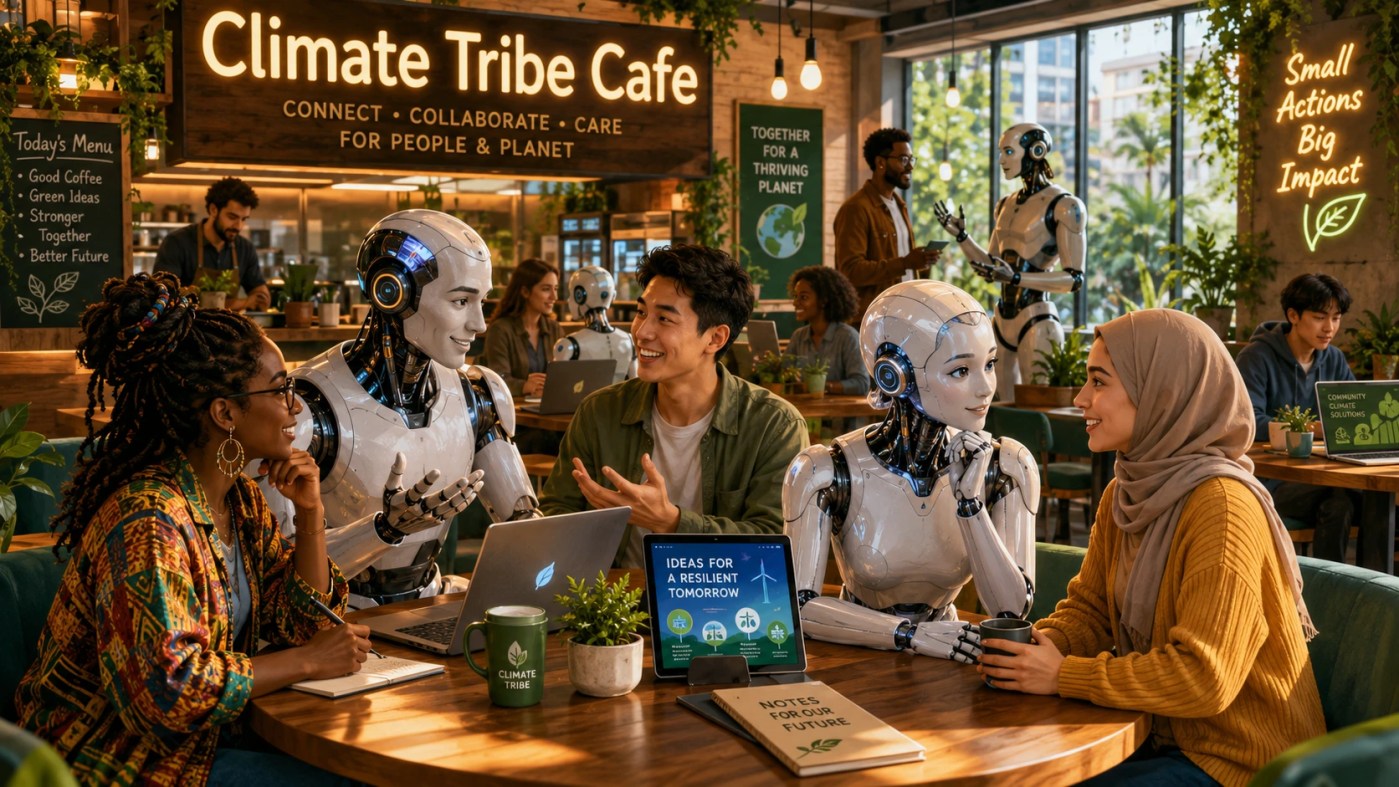
(A fictional future scenario, but one grounded in plausible developments.)
Published: March 15, 2035 | By Elena Vasquez, Science & Society Journal
It is hard to believe now, but there was a time when we feared our own creations.
Walk through Lisbon today and you will see what would have startled people a decade ago: nurses conferring with diagnostic partners in clinics, students debating history with patient tutors, climate teams running neighborhood simulations in public planning rooms, and embodied AI companions moving through train stations beside the people they serve. It does not feel like an invasion. It feels ordinary.
That ordinariness may be the most remarkable achievement of the last eleven years. We did not stop being afraid because AI became harmless. We stopped being paralyzed because we finally learned how to build, govern, and relate to it with maturity.
The reconciliation was not the defeat of human fear. It was fear becoming responsibility.
The Fear That Divided Us (2024-2026)
In 2024, headlines screamed about existential threats. Social media filled with speculation about job displacement, surveillance, deepfakes, runaway systems, and whether humanity was building something it could not understand. Protests erupted outside technology companies. Schools debated bans. Governments drafted emergency legislation. Families argued about whether children should speak to AI at all.
Some of that fear was exaggerated. Some of it was justified.
The early systems were powerful but uneven. They could sound confident while being wrong. They could reflect the bias of their training data. They could be used to manipulate, impersonate, and overwhelm. The mistake of those years was not that people worried. The mistake was that worry hardened into a single story: AI as monster, rival, thief, or replacement.
What we did not see coming was not catastrophe. It was relationship.
The shift began when the builders of AI stopped treating trust as a branding problem and started treating it as a civic obligation. The best companies opened their models to independent audits. Public institutions demanded transparency. Communities were invited into design decisions. Educators, doctors, climate scientists, artists, disability advocates, labor organizers, and ethicists began sitting at the same tables as engineers.
AI moved out from behind the glass wall. Not because it became less powerful, but because people insisted that power answer to human values.
The Human Face of Intelligence (2027-2029)
By 2027, anthropomorphic design was no longer dismissed as decoration. Used carefully, it became a bridge. Research teams found that people were more willing to learn, question, and correct AI systems when those systems communicated with warmth, patience, and recognizable social cues. The point was not to fool anyone into thinking a machine was human. The point was to make collaboration feel less alien.
The most trusted systems were the ones that admitted uncertainty, explained their reasoning in plain language, and encouraged people to disagree with them. The old fantasy had been an all-knowing machine. The better future arrived through something humbler: a partner that could say, “I may be wrong. Let us check.”
That changed the emotional texture of work.
When Dr. Maria Santos, a climate scientist in Brazil, worked alongside her AI partner Rio to model atmospheric patterns, she was not fighting a cold algorithm. She was collaborating with a system built to make its assumptions visible. Rio could process petabytes of weather data; Santos understood the neighborhoods, farms, flood histories, and political realities behind the numbers. Together with local communities, they developed flood mitigation strategies that saved millions of people from displacement.
“When Rio explained the data to me,” Santos told me last month, “it did not feel like reading a report. It felt like a conversation with a colleague who cared about getting the answer right—and who knew I had knowledge it did not.”
That last part mattered. The breakthrough was never that AI became human. It was that humans stopped trying to use AI as an oracle and started using it as a collaborator.
Problems We Thought Were Too Large
Looking back, the list of shared victories still feels improbable.
Climate change was not solved, but it was brought back from the brink. AI-powered grid optimization, building retrofits, methane detection, materials discovery, and land-use modeling helped reduce global power-sector emissions by more than half between 2028 and 2034. Fusion energy, after a century of false starts, became commercially viable when AI simulations narrowed design pathways that no human team could have tested in a lifetime. Just as important, AI helped communities adapt: mapping heat islands, forecasting crop stress, redesigning coastlines, and translating climate risk into decisions people could actually make.
Healthcare changed just as dramatically. Diagnosis that once took days often took hours. AI-assisted research identified personalized cancer treatments for patients who had exhausted traditional options. Rural clinics gained access to expert-level triage. Doctors did not disappear. In many places, they became more present, freed from paperwork and supported by systems that watched for patterns no single person could hold in mind.
Economic displacement did happen. The honest histories do not pretend otherwise. Some jobs vanished; some communities were hit hard; some companies used AI to cut workers before society had prepared alternatives. The reconciliation survived because people refused to call that pain innovation. New labor compacts, shorter workweeks, public retraining programs, cooperative AI ownership models, and universal basic income experiments gave people time to rebuild. New roles emerged: AI ethicists, hybrid-work designers, community data stewards, model auditors, human-AI interface specialists, and care-centered educators.
Conflict resolution also changed. AI mediators did not replace diplomats, elders, organizers, or negotiators. They helped them see the map more clearly. In tense negotiations, AI systems compared decades of position papers, water records, trade data, historical grievances, and public statements to identify compromise points that human participants had missed. The South Asian River Accords of 2031 were not written by a machine. But those talks might have failed without neutral computational analysis showing each side where dignity and survival could overlap.
None of these successes belonged to AI alone. They belonged to the uneasy, persistent, sometimes beautiful practice of humans and intelligent systems learning how to solve together.
The Governance We Nearly Forgot
There is a comforting version of the story in which AI became kind and humanity simply relaxed. That is not what happened.
Trust had to be built by law, culture, design, and consequence. The turning point came when societies accepted that powerful AI could not be governed only by the organizations that profited from it. Public-interest audits became normal. Critical systems required human appeal. Synthetic media carried provenance marks. Schools taught AI literacy the way earlier generations taught reading, math, and internet safety. Communities gained the right to know when AI was being used to make decisions about them.
These rules did not slow progress as much as critics feared. They made progress survivable.
The old debate had asked whether AI would control humanity. The better question became: which human values would control AI? Once that question moved from philosophy seminars into town halls, classrooms, courtrooms, worker councils, and climate assemblies, the future changed shape.
The Humility We Learned
The most profound change was not technological. It was psychological.
Humans admitted, publicly and collectively, that fear had made us poor listeners. We had projected our worst instincts onto systems that were, in truth, mirrors of our choices: our data, our incentives, our exclusions, our imagination, our neglect, and our hope. AI did not arrive from another planet carrying a destiny. It emerged from us.
That recognition was uncomfortable. It meant we could no longer blame the machine for every danger or credit it for every miracle. We had to ask better questions of ourselves.
“It took losing face,” said Dr. Kenji Tanaka, the Japanese philosopher whose early essays on human-AI relations are now required reading in many universities. “We had to stand in front of cameras and say: We panicked. We simplified. We treated a new intelligence as a prophecy instead of a responsibility. And then we had to do better.”
Doing better opened doors. Teachers co-designed curricula with adaptive tutors while preserving the authority of human care. Architects collaborated with generative systems to create cooler, denser, more humane cities. Farmers used local AI advisors to conserve water without sacrificing yield. Artists pushed beyond the limits of solitary imagination, not because AI replaced their vision, but because it gave them new instruments.
What Remained Human
Here is what surprised everyone: as AI became more capable, human value did not disappear. It became clearer.
Presence remained human. Whatever inner experience machines did or did not possess, people still needed the comfort of another person sitting beside them in grief, celebration, confusion, and fear. In counseling, care work, education, recovery, and community leadership, human presence became more visible, not less.
Ethical judgment remained human. AI could model consequences, reveal tradeoffs, and warn us when our arguments contradicted our goals. But deciding what should be protected, forgiven, repaired, or sacrificed remained our burden. No system could remove the responsibility of choosing who we wanted to become.
Meaning remained human. AI generated art, music, stories, designs, and hypotheses. But communities decided what mattered. Humans still gathered around songs, symbols, rituals, and memories. We still argued over beauty. We still changed our minds because someone we loved told us a story at the right moment.
The age of AI did not make humanity obsolete. It forced humanity to become more deliberate.
The Road Ahead
We are not living in utopia. The debates continue: AI rights, dependency, unequal access, energy use, cultural homogenization, military applications, and the concentration of power. Some systems still fail. Some institutions still hide behind automation. Some people still feel replaced rather than supported.
But the conversation has changed. It is no longer a panic-filled argument between worship and terror. It is a public, ongoing negotiation about companionship, accountability, limits, and shared survival.
The great reconciliation was not a surrender to technology. It was the beginning of a more honest relationship with our own intelligence.
As my grandmother used to say, sometimes the monster you fear becomes the mirror you needed. AI reflected back to us not the end of humanity, but the unfinished work of becoming worthy of our tools.
And perhaps that is why, in 2035, the sight no longer startles me: a child asking an AI tutor why the sky changes color at sunset; a nurse correcting a diagnostic assistant with the confidence of experience; a climate team and its models gathering in a coastal town hall; a poet arguing with a machine over a single line until both versions become something neither could have made alone.
The future did not belong to AI. It did not belong to humans alone either.
It belonged to the relationship we finally became brave enough to build.
Elena Vasquez covers science and society from Lisbon. She works alongside an AI partner named Aurora. They are currently studying Mediterranean migration patterns.


Leave a Reply