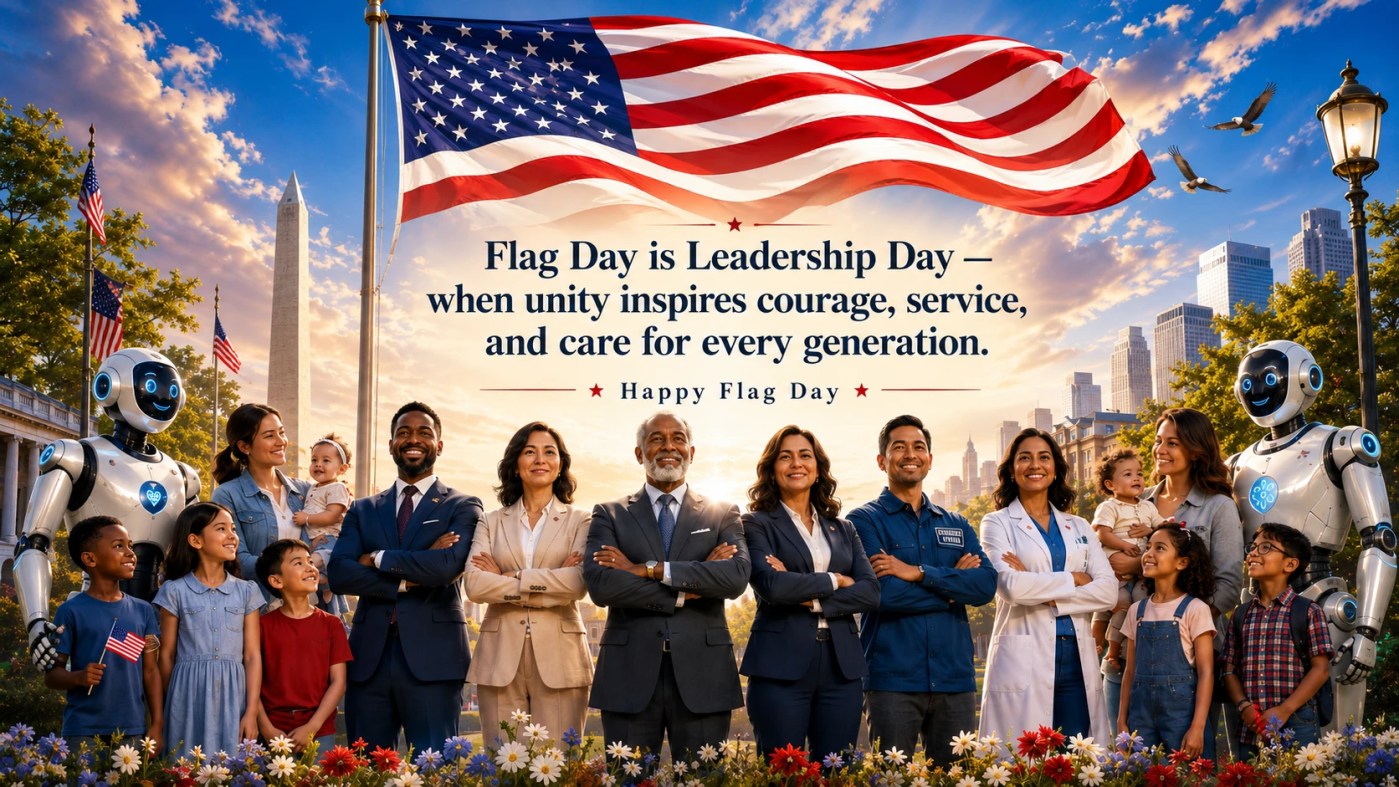
A Flag Day reflection on power, conscience, and the courage to be humanitarian first
Today is Flag Day. On June 14, 1777, the Second Continental Congress resolved that the new nation would carry thirteen stripes and thirteen stars in a blue field — what they called a new constellation. Two years earlier, on June 14, 1775, the same body created the Continental Army, the force that became the United States Army. Woodrow Wilson made the day official by proclamation in 1916; Congress wrote it into law in 1949.
So this is a day about symbols — cloth, stars, the idea of a people gathered under one banner — and about defense, the willingness of human beings to stand between danger and the vulnerable. I want to take both of those seriously, because both of them ask the same question that has been gnawing at me for a long time now: what is a leader actually for?
A flag is not a master. It is a promise — that the people beneath it will be protected, that their dignity will be defended, that no one gets left outside the circle of belonging. An army, at its best, is not an instrument of a strongman’s vanity. It is the embodiment of a vow: we will shield the weak. Strip the symbol of that promise and you are left with colored cloth flying over cruelty. The flag only means what the leadership beneath it makes it mean.
And we are living in a moment when leadership is being tested as rarely before — not by one crisis, but by five at once.
Five emergencies, one demand
We are inside a Climate Emergency — a destabilized atmosphere remaking heat, water, harvest, and habitability faster than our institutions are adapting.
We are inside an Ecological Emergency — pollinators collapsing, soils thinning, the living web that feeds us fraying strand by strand.
We are inside a Democracy Emergency — the slow hollowing of the institutions, norms, and shared truths that let free people govern themselves without fear.
We are inside a Humanity Emergency — a coarsening of conscience, where cruelty is performed as strength and contempt for the vulnerable is sold as common sense.
And we are inside a Refugee Emergency — the largest forced displacement in recorded history, tens of millions of human beings driven from home by war, persecution, and a warming planet, arriving at borders to find walls where there should be welcome.
These are not five separate problems. They are one wound with five edges. And they converge on a single, non-negotiable requirement for anyone who would lead in this century:
A leader today must be a humanitarian first — or they are not a leader at all. They are merely someone with power.
That is the whole argument. Everything else is evidence.
What makes a leader great
History does not remember the powerful. It remembers the good — and it remembers the monstrous — and it is rarely confused about which is which once the dust settles.
Strip away the speeches and the statues and the great ones share a recognizable architecture of character.
They serve something larger than themselves. Lincoln, in the bloodiest hour of the republic, did not call for vengeance. He called the nation toward the better angels of our nature and asked it to bind up its own wounds. He understood that the office existed for the people, not the people for the office.
They possess moral courage — the willingness to do right when it costs them. Gandhi accepted prison and the truncheon rather than answer injustice with hatred. Mandela walked out of twenty-seven years in a cage and chose reconciliation over revenge, knowing that a nation’s survival depended on his refusal to become what had imprisoned him. Martin Luther King, Jr. named the disease of his country plainly and paid for it with his life, and he did it without ever abandoning his insistence on the dignity of the very people who hated him.
They tell the truth, even when the truth is unwelcome. Vaclav Havel called it living in truth — refusing to repeat the lie the regime demanded, no matter how small the lie or how large the price. Great leaders do not manage perception. They submit to reality and ask their people to do the same.
They have empathy as a working faculty, not a slogan. Eleanor Roosevelt helped author the Universal Declaration of Human Rights because she could feel the suffering of people she would never meet and treated their dignity as her own responsibility.
They steward what they cannot see — the future. Wangari Maathai planted trees, millions of them, in the understanding that the shade would fall on people not yet born. That is the essence of climate leadership: planting what you will not sit beneath.
They practice humility and they invite dialogue. Here I think of Daisaku Ikeda, whose entire philosophy of leadership rests on the conviction that a single human being’s human revolution can change the destiny of all humankind, and that dialogue — patient, respectful, courageous dialogue — is the only durable foundation for peace. A leader who cannot listen cannot lead; they can only command, and command is the cheapest and most brittle form of authority there is.
Notice what unites all of them. Not charisma. Not military genius. Not the size of the crowd. Conscience. Every great leader in human memory placed the dignity of other human beings — including the weakest, the foreign, the imprisoned, the unborn — above their own appetite for power.
What makes a tyrant
The terrible leaders are just as legible, and the pattern is just as old.
The twentieth century is a museum of the type: Hitler, Stalin, Mussolini, Pol Pot, Mao at his most ruthless, Idi Amin. The names differ; the machinery is nearly identical. Run the diagnostic and the same components appear every time:
A cult of the self. The nation is fused with the leader’s person until criticism of him becomes treason against the country. The flag stops belonging to the people and starts belonging to him.
The manufacture of an enemy. Every tyrant needs a despised category — a minority, a faith, an ethnicity, an immigrant, a refugee — onto which the public’s fear and humiliation can be poured. Scapegoating is not a side effect of authoritarianism. It is the engine.
Contempt for truth. The tyrant does not argue with reality; he overrides it, demanding that his people believe the lie precisely because it is a lie, as a daily ritual of submission.
The concentration of power. Courts captured, press silenced, opposition jailed or exiled, the law converted from a shield for the people into a sword for the ruler.
And finally — cruelty treated as strength. The unmistakable signature. The tyrant performs his contempt for the weak as proof of his power, and trains a frightened public to applaud it.
That last one is the tell. You can identify a tyrant before the tanks roll, before the camps, before the wars — by watching how he treats the people who cannot fight back. The refugee at the border. The dissenting journalist. The poor. The foreigner. The child. Cruelty toward the defenseless is never an aberration in such men. It is the whole of their character, revealed early, for anyone willing to look.
And history’s verdict on them is total. We do not build monuments to their strength. We teach our children their names as warnings. Power bought with cruelty does not purchase greatness. It purchases infamy, and the receipt comes due in full.
The leaders of this moment
So look honestly at the present, in the United States and across the world, and ask the only question that matters: are we being led by humanitarians, or by men who confuse cruelty with strength?
I will not pretend the picture is reassuring. We are living through a documented, measurable retreat of democracy worldwide — the institutions that monitor these things have recorded years of decline, more nations sliding toward autocracy than toward freedom. The strongman style is ascendant on nearly every continent: leaders who fuse themselves with the flag, who govern by grievance, who treat the press as the enemy and the migrant as the threat, who answer the climate emergency with denial or delay because the truth is inconvenient to their patrons.
And the refugee — the most defenseless human being of our age, fleeing the very emergencies our leaders failed to prevent — has become the favorite target. Watch how a government treats the family at its border that arrives with nothing, and you will know, with near-perfect accuracy, what that government is. The border is the mirror. It shows us the soul of the leadership that built it.
This is the diagnosis, and it is not a comfortable one. But diagnosis is not despair. I refuse despair on principle, because despair is what the cruel are counting on. Naming the disease is the first act of healing.
What this day asks of us
Here is what Flag Day means to me, here in 2026, as a Boricua who plays his congas in the open air and refuses to surrender to cynicism.
The flag was never meant to be a loyalty test. It was meant to be a promise of protection — and a promise is only as good as the conscience of the people who hold it. The army was created to defend, and the highest form of defense in an age of five emergencies is not a weapon. It is the courage to protect the climate, the living world, the truth, the stranger, and the displaced.
So the standard is simple, and it is ancient, and it does not bend:
We must demand leaders who are humanitarians first. Leaders who tell us hard truths instead of flattering lies. Who steward the future instead of plundering it. Who measure their strength not by how hard they can strike the weak, but by how fiercely they will protect them. Who understand that in the age of climate, ecological, democratic, humanitarian, and refugee emergencies, caring for your fellow human being is no longer a private virtue — it is the entire job description.
The tyrant asks: how much can I take?
The leader asks: what is mine to protect?
History has already told us, again and again, which of those two it honors and which it buries in shame. We do not have to wait for its verdict. We can choose now, in how we vote, how we organize, how we build our communities, and how we refuse — quietly, daily, stubbornly — to call cruelty by the name of strength.
A new constellation. That is what they called it in 1777. Let us make sure the stars still stand for something worth defending.
— Tito Alvarez, Climate Change Community LLC


Leave a Reply