A Voting Rights Reflection for a Democracy That Must Be Practiced
Excerpt: Rights do not survive on memory alone. From New York’s early suffrage exclusions to Mississippi’s machinery of disenfranchisement, from Selma to the Supreme Court’s 2026 gutting of the Voting Rights Act, the history of the ballot shows that democracy requires constant public defense — everywhere, by everyone.
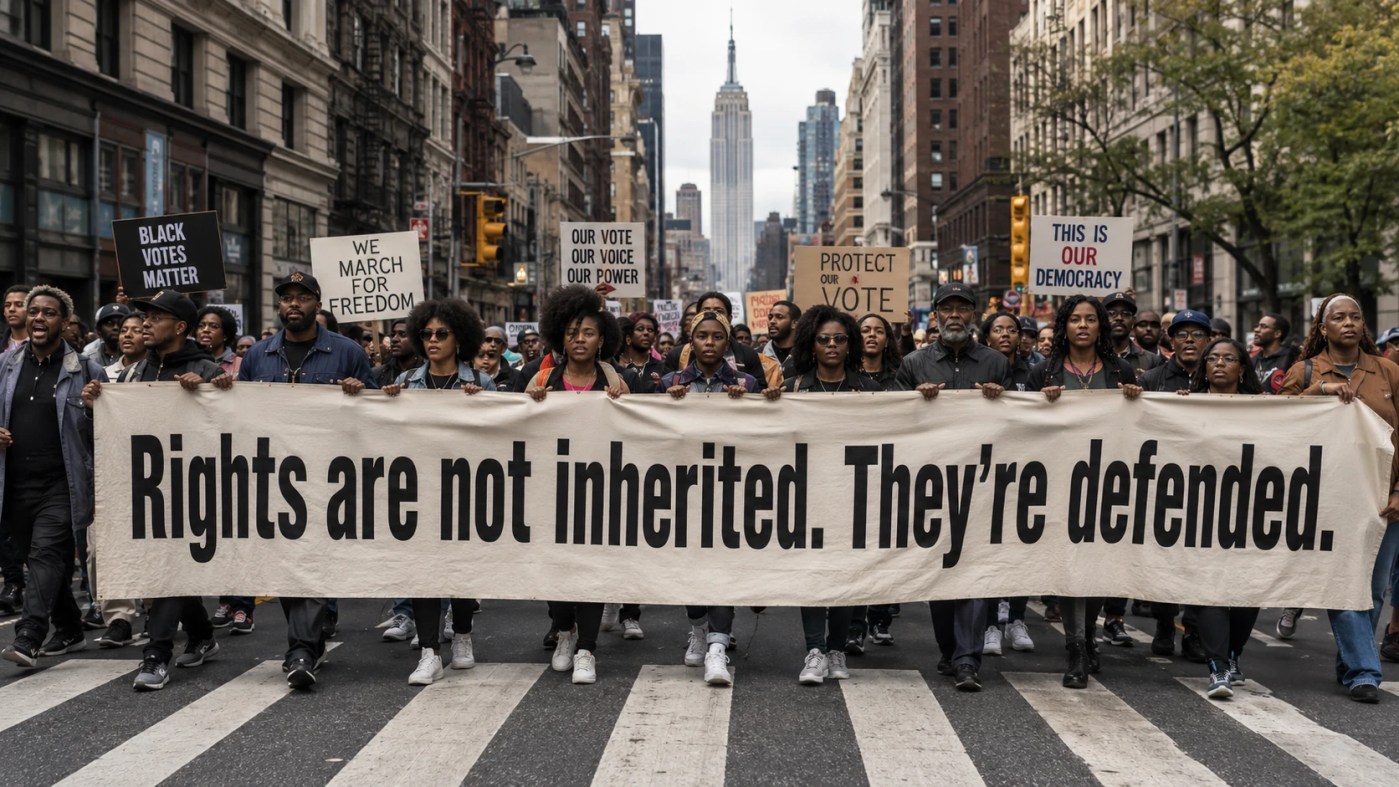
A crowd moving through the streets with a banner reading, “Rights are not inherited. They’re defended,” carries more than a slogan. It carries a warning from history. The right to vote is often described as a cornerstone of democracy, but history shows that this cornerstone has been repeatedly built, broken, rebuilt, and defended again — in every region of the United States, and most brutally in the places where minority communities had the least power and the most to lose.
No generation receives justice fully finished. Each generation receives a record: laws passed, sacrifices made, promises written into constitutions, and barriers that were removed only because ordinary people insisted that democracy must mean more than words on paper. Voting rights are the clearest example we have. They were not handed down neatly. They were fought for in conventions, churches, courthouses, streets, schools, union halls, jail cells, reservation lands, barrios, and long lines at polling places.
The Ballot Was Never Equally Given
The United States Constitution created a republic, but it did not originally define a universal right to vote. That silence left states with enormous power to decide who counted as a voter. In practice, access to the ballot was tied to race, gender, property, age, citizenship status, language, disability, incarceration rules, and local political control.
And this was never only a Southern story. New York offers a sharp Northern example. In 1821, the state removed property qualifications for white male voters while raising them for African American men — requiring Black New Yorkers to hold $250 in property before they could vote, a sum designed to exclude nearly all of them. One group’s access widened at the exact moment another group’s access was deliberately narrowed. The racism was not hidden; it was written into the state constitution. Northern cities, Western territories, and the Jim Crow South all built their own versions of exclusion. The fight for the ballot belongs to the whole map.
Reconstruction’s Promise — and the Violent Backlash
After the Civil War, the Fifteenth Amendment (1870) promised that the right to vote could not be denied because of race, color, or previous condition of servitude. It was a transformative constitutional step. Black men voted, organized, served in Congress and statehouses, built schools, shaped public policy, and expanded the meaning of citizenship.
The backlash was immediate, organized, and openly racist. In Colfax, Louisiana, in 1873, a white paramilitary mob massacred dozens of Black men defending the results of a contested election — and the Supreme Court’s response in United States v. Cruikshank gutted the federal government’s ability to prosecute the killers. In Wilmington, North Carolina, in 1898, white supremacists carried out the only successful coup d’état in American history, overthrowing a legitimately elected multiracial city government, burning the Black-owned newspaper, and murdering Black residents — explicitly to destroy Black political power.
Mississippi showed the nation how to dress terror in legal clothing. Its 1890 constitution pioneered the literacy test, the poll tax, and the “understanding clause,” tools that other Southern states quickly copied. The intent was never disguised: delegates said plainly that the convention’s purpose was to eliminate the Black voter. Grandfather clauses exempted white men from the very tests used to disqualify Black men — a scheme so nakedly discriminatory that the Supreme Court struck down Oklahoma’s version in Guinn v. United States (1915). Texas ran “white primaries” that locked Black and Mexican American voters out of the only elections that mattered, until Smith v. Allwright (1944) finally ended the practice.
And where law was not enough, violence filled the gap. In Ocoee, Florida, on Election Day 1920, a Black man’s attempt to vote triggered a massacre that destroyed the town’s Black community. Lynching, economic retaliation, and the loss of jobs, homes, and credit were the everyday enforcement mechanisms of disenfranchisement. This is why the banner matters: a right written down is not the same as a right protected. A right can exist in law and still be denied in practice — at gunpoint, at the courthouse door, or at the registrar’s desk.
Women’s Suffrage and the Wider Demand for Democracy
The Nineteenth Amendment, ratified in 1920, legally guaranteed women the right to vote after decades of organizing, petitioning, marching, lobbying, and civil disobedience. Yet even this milestone did not create equal access for all women. Black women across the South faced the same poll taxes, literacy tests, and terror that blocked Black men. Native women were largely not recognized as citizens at all. Asian American women were barred by racist naturalization laws. Latina women in Texas and the Southwest confronted English-only ballots, all-white primaries, and intimidation.
The lesson is not that constitutional victories are meaningless. They are essential. The lesson is that victories can be partial, uneven, and vulnerable — and that the women left behind in 1920 had to keep fighting for another half century and beyond.
The Exclusions America Rarely Names
Some of the hardest fights for the ballot happened in places the standard textbook skips.
Native Americans were not granted U.S. citizenship until the Indian Citizenship Act of 1924 — and even then, states refused to let them vote. Arizona and New Mexico blocked Native voters until court victories in 1948, arguing that people living on reservations were “under guardianship” and therefore not true citizens. Utah did not remove its barrier until 1957. People indigenous to this land were among the very last allowed to vote on it.
Asian Americans were barred from naturalized citizenship — and therefore from the ballot — by explicitly racial laws, beginning with the Chinese Exclusion Act of 1882. The racial bar on naturalization did not fully fall until 1952.
Mexican Americans and Puerto Ricans faced what historians call “Juan Crow”: English-literacy tests, poll taxes, white primaries, and intimidation across Texas and the Southwest. And to this day, the more than three million U.S. citizens living in Puerto Rico — fellow Boricuas — cannot vote for president and have no voting representation in Congress. Territorial disenfranchisement is not a relic. It is current events.
These were not oversights. They were choices, made by people who understood exactly whose voices they were silencing, and why.
Poll Taxes, Freedom Summer, Selma, and the Voting Rights Act
By the mid-twentieth century, the struggle for voting rights had become the central battle of the Civil Rights Movement. The Twenty-Fourth Amendment (1964) prohibited poll taxes in federal elections; the Supreme Court extended that to state elections in Harper v. Virginia Board of Elections (1966). But on the ground, registering to vote while Black in Mississippi or Alabama could still cost you your job, your home, or your life.
During Freedom Summer in 1964, volunteers fanned out across Mississippi — where fewer than 7 percent of eligible Black citizens were registered — to run voter registration drives and Freedom Schools. Three of those workers, James Chaney, Andrew Goodman, and Michael Schwerner, were murdered by Klansmen with the cooperation of local law enforcement. Their deaths told the country what Black Mississippians already knew: the denial of the vote was enforced by terror.
In 1965, the Selma marches forced the nation to look directly at that terror. On Bloody Sunday, state troopers beat peaceful marchers on the Edmund Pettus Bridge — a bridge named for a Confederate general and Klan leader. Local organizers, the Dallas County Voters League, the Student Nonviolent Coordinating Committee, the Southern Christian Leadership Conference, faith leaders, students, workers, and ordinary residents turned the denial of the ballot into a national moral crisis. The Voting Rights Act of 1965 followed as one of the most important civil rights laws in U.S. history, giving the federal government real tools — including preclearance of election changes in the worst-offending jurisdictions — to enforce the promise of the Fifteenth Amendment. In 1975, Congress extended the Act’s protections to language minorities, finally bringing Latino, Asian American, and Native voters under its shield.
The results were immediate and undeniable. Black voter registration in Mississippi rose from under 7 percent to roughly 60 percent within a few years. Selma teaches that voting rights were not defended only by famous names. They were defended by people who made phone calls, held meetings, walked roads, risked jobs, endured threats, registered neighbors, documented abuse, sang through fear, and refused to accept silence as peace.
The Backlash Returns — In Robes Instead of Hoods
History did not stop in 1965, and neither did the backlash. In Shelby County v. Holder (2013), the Supreme Court struck down the formula that determined which jurisdictions needed federal preclearance, declaring that “things have changed in the South.” Within hours, states began rolling out voter ID laws, polling place closures, and restrictive maps that the Act would previously have blocked.
Then, on April 29, 2026, the Supreme Court went further. In Louisiana v. Callais, a 6–3 majority struck down Louisiana’s congressional map containing a second majority-Black district and dramatically narrowed Section 2 of the Voting Rights Act — the law’s last fully functioning pillar, the tool communities of color have used for decades to challenge discriminatory maps and election rules. Justice Elena Kagan, in dissent, warned that the decision renders Section 2 all but a dead letter in redistricting. Civil rights organizations have called it one of the most consequential setbacks for multiracial democracy in a generation, and within weeks states were already moving to redraw maps that courts had previously found racially discriminatory.
Sixty-one years after Freedom Summer. Sixty-one years after Chaney, Goodman, and Schwerner were buried in an earthen dam for the crime of registering voters. The expansion-and-backlash cycle that defines this entire history is not behind us. We are living inside it right now.
Why the Quote Still Speaks
“Rights are not inherited. They’re defended.” The quote speaks because it rejects passive citizenship. It says that democracy is not a family heirloom stored safely on a shelf. It is a living system that depends on participation, vigilance, public memory, fair rules, and the courage to confront exclusion when it appears in new forms — whether those forms are a poll tax, a literacy test, a closed polling place, a purged voter roll, or a redistricting map drawn to dilute a community into silence.
Defending voting rights does not belong to one election season or one political party. It belongs to the basic question of whether every eligible person can participate freely, safely, and meaningfully. That includes fair registration systems, accessible polling places, accurate information, language assistance where needed, protection against intimidation, fair districting, transparent election administration, and civic education that helps people understand their power.
A Democracy Worth Practicing
The banner in the street is a reminder that rights survive when people practice them. A vote is a personal act, but voting rights are collective infrastructure. They depend on neighbors, organizers, poll workers, teachers, lawyers, journalists, public servants, and community members who refuse to let barriers become normal.
To defend voting rights is to remember that democracy is not self-executing. It has to be staffed, taught, protected, challenged, repaired, and renewed. It has to be made real for people who have been told, in one way or another, that their voice is too inconvenient, too poor, too Black, too Brown, too Indigenous, too young, too foreign, too disabled, too displaced, or too difficult to count.
The history of voting rights is not a straight line from exclusion to inclusion. It is a struggle between expansion and backlash — from New York in 1821 to Mississippi in 1890, from Wilmington in 1898 to Ocoee in 1920, from Selma in 1965 to the Supreme Court in 2026. That is why each generation must learn the history, watch the rules, protect access, and build communities that treat the vote not as a ritual, but as a shared defense of human dignity.
Rights are not inherited. They are defended by memory. They are defended by law. They are defended by protest. They are defended by registration drives, public education, mutual aid, careful journalism, community organizing, and the simple but powerful insistence that every eligible voice must be heard.
And when people march through the streets carrying that truth together, they are not only remembering the past. They are announcing a responsibility: democracy must be defended in public, by the people, for the people, again and again.
Sources: National Archives (Constitution, 15th and 19th Amendments, Selma, Voting Rights Act); U.S. House of Representatives History Office (24th Amendment); New York State Archives (1821 constitutional convention); Library of Congress / Congress.gov (Louisiana v. Callais analysis); Brennan Center for Justice; NAACP Legal Defense Fund; SCOTUSblog.
Tito /with the help of Fable AI…


Leave a Reply