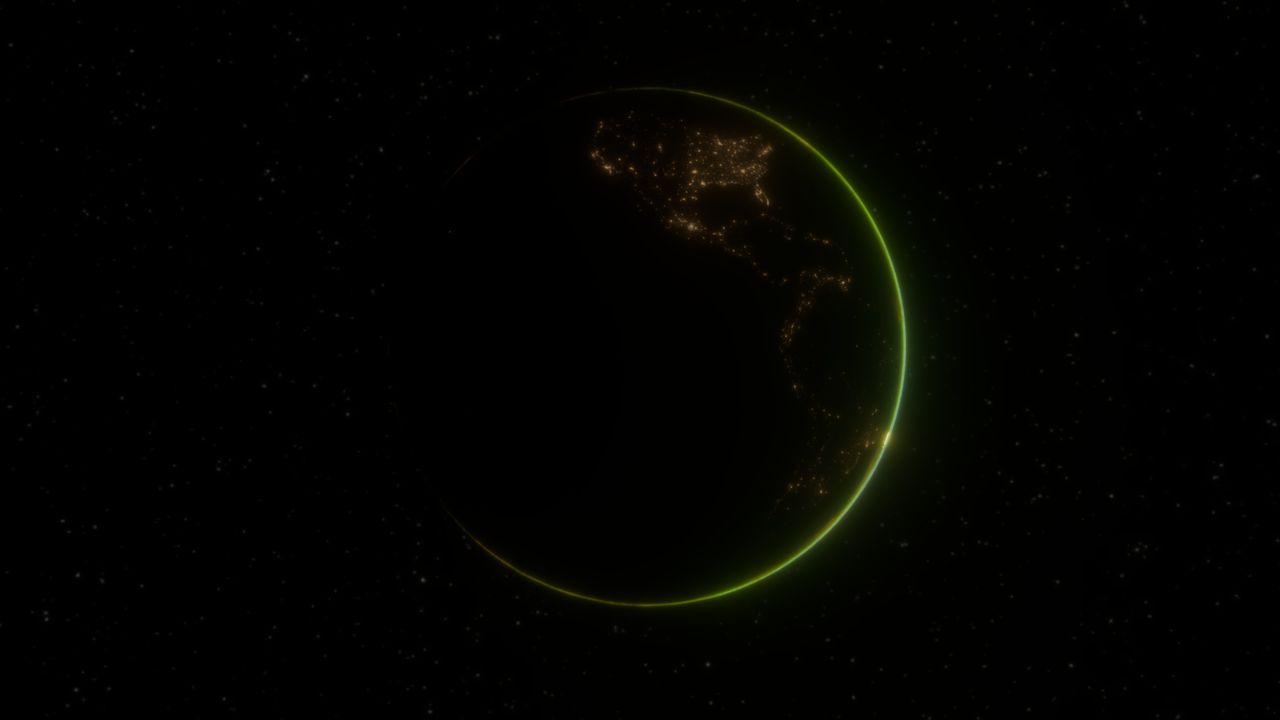
The speed of our response, as nations and as a species, is not matching the speed of the problem.
Que Humanidad / Compiled & Mr. Alvarez’s Thoughts | AI Enhanced.
Earth is shared. We share it with every living thing that swims, flies, crawls, roots, and breathes. More recently, we have begun sharing it with something new: the machines we are building to think alongside us, which draw on the same water, land, and energy as everything else. Of those three, one is doing most of the damage, and it is us.
I want to be honest about why I sat down to write this. I was watching Thom Hartmann’s YouTube channel when he covered a story about how much fresh water is moving from the land into the oceans. It stopped me cold. Not only because of what the science says, but because I had not seen it anywhere else. A finding that touches drinking water, food, sea levels, and ocean circulation all at once should have been on every front page. It wasn’t.
That is the pattern I keep noticing. Some things on this planet are genuinely getting better. Others are getting worse, and faster than most people realize. And the speed of our response, as nations and as a species, is not matching the speed of the problem. At times it is dangerously slow. So let me lay out, as plainly as I can, where things stand in the fall of 2026.
The Story That Should Have Been Everywhere
Continents Are Drying Out
In July 2025, a team led by Arizona State University published a study in Science Advances using more than two decades of NASA satellite data from the GRACE and GRACE Follow-On missions. These satellites measure tiny changes in Earth’s gravity, which lets scientists track how much water is stored on land. What they found is sobering.
Since 2002, the continents have been losing fresh water at an unprecedented rate. About 75 percent of the world’s population lives in the 101 countries that have been losing fresh water over that period. Dry areas that were once separate have merged into four vast “mega-drying” regions across the Northern Hemisphere, and since around 2014 the drying has been spreading each year by an area roughly twice the size of California.
Here is the part that connects directly to the oceans. Roughly 68 percent of that lost water came from groundwater, pumped out of aquifers faster than rain can refill them. Once that water is used, much of it eventually ends up in the sea. The researchers found that the continents are now contributing more fresh water to sea level rise than either of the great ice sheets on Greenland or Antarctica. We tend to picture sea level rise as melting ice. Increasingly, it is also our wells running dry.
The Ocean Is Changing Its Salt
A second study, published in Nature Climate Change in February 2026 by researchers at the University of Colorado Boulder and colleagues, found that the southern Indian Ocean off Western Australia, historically one of the saltiest parts of the global ocean, is becoming fresher at a remarkable pace. Over six decades, warming has shifted winds and currents in ways that carry more fresh water into the region.
Why does salt matter? Fresher water is lighter, so it floats on top of the saltier water below. That layering weakens the mixing that normally brings nutrients up from the depths to feed plankton near the surface, and it traps heat at the surface where marine life is already under stress. Plankton and seagrass sit at the base of the ocean food web. When the base shifts, everything above it feels it. The same region also plays a role in the global circulation that helps regulate climate far beyond the Indian Ocean.
Put these two stories side by side and a picture emerges. We are moving fresh water from the land into the sea through pumping and drought, and warming is rearranging where fresh water goes once it gets there. Both changes are driven by human activity. Both have consequences for billions of people. Neither made the evening news the way it should have.
A Planet Out of Balance
Just this week, on September 21, 2026, scientists at the Potsdam Institute for Climate Impact Research released the 2026 Planetary Health Check. It tracks nine planetary boundaries, the Earth-system processes that must stay within safe limits for the planet to remain stable. Seven of the nine are now crossed: climate change, biosphere integrity, land system change, freshwater change, biogeochemical flows such as nitrogen and phosphorus pollution, novel entities such as plastics and synthetic chemicals, and ocean acidification. According to the report, all seven are now at their highest recorded levels of transgression.
Ocean acidification was the most recent to cross the line, in 2025. Since the industrial era began, the ocean’s surface has become roughly 30 to 40 percent more acidic, and scientists are already seeing shell damage in tiny sea snails called pteropods, a food source for many other species.
The temperature record tells the same story. The World Meteorological Organization confirmed that 2015 through 2025 were the eleven hottest years on record, with 2025 at about 1.43°C above pre-industrial levels. For the first time, the WMO highlighted Earth’s energy imbalance, the gap between heat coming in and heat going out, and it hit a record high in 2025. More than 90 percent of that excess heat is going into the ocean.
At the poles, the 20 lowest Arctic sea ice minimums in the satellite record have all occurred in the last 20 years. In the Southern Hemisphere, Antarctic sea ice this September appears to have reached one of its lowest winter maximums on record.
And the root cause keeps growing. The Global Carbon Project found that fossil fuel carbon dioxide emissions rose about 1.1 percent in 2025 to a record 38.1 billion tonnes. The remaining carbon budget for holding warming to 1.5°C is estimated at roughly 170 billion tonnes, which is about four years of emissions at the current pace.
The Life We Share It With
Biodiversity is not a side issue. It is the living fabric that keeps soils fertile, water clean, crops pollinated, and oceans productive. WWF’s Living Planet Report found that monitored wildlife populations declined by an average of 73 percent between 1970 and 2020. Freshwater species fell the most, by 85 percent. In Latin America and the Caribbean, the decline averaged 95 percent. The leading driver is habitat loss, much of it from the way we produce food.
Beneath the waves, the world’s coral reefs have been going through the most intense bleaching event ever recorded. Between January 2023 and March 2025, bleaching-level heat stress reached about 84 percent of the world’s reefs across 82 countries and territories. For comparison, the first global bleaching event in 1998 reached 21 percent. Reefs support a huge share of marine life and protect coastlines and fisheries that millions of people depend on.
Notice how these threads connect. Freshwater ecosystems are losing species fastest at the same time that the land is losing its fresh water. The ocean is absorbing the heat and carbon we release, and the reefs and plankton that live there are paying the price. None of these crises is separate.
Where Artificial Intelligence Fits In
I use AI every day in my work, and I believe in it as a tool for research, communication, and education. That is exactly why I think we have to be honest about its footprint. AI runs on data centers, and data centers run on electricity and, often, water for cooling.
The International Energy Agency reported that electricity demand from data centers jumped 17 percent in 2025, far faster than overall global electricity demand. It expects data center electricity use to double by 2030, with AI-focused facilities tripling. At the same time, the energy needed for each individual AI task is falling rapidly as the technology becomes more efficient. The problem is that use is growing even faster than efficiency.
Where those data centers get their power and water matters enormously. A facility running on clean energy in a water-rich region is a very different neighbor than one running on gas in a region that is already drying out. Given what the satellite data shows about groundwater, that choice is not a small one.
AI can help us model climate systems, manage power grids, monitor forests and oceans, and make complex science understandable to more people. It can also accelerate the very pressures we are trying to relieve. Like every powerful tool, its value depends on the choices of the people using it and the rules we set around it.
What Is Getting Better
It would be dishonest to leave out the good news, and there is real good news.
In 2025, according to the energy think tank Ember, renewable energy overtook coal as the world’s largest source of electricity for the first time in about a century, at 33.8 percent of global generation compared with coal’s 33.0 percent. Clean power growth met all of the growth in global electricity demand, and fossil fuel generation slightly declined. Solar alone covered about three-quarters of new demand. Both China and India, two of the world’s largest fossil power users, saw fossil generation fall in the same year for the first time this century.
The ozone layer continues to heal, and air pollution from aerosols remains within its planetary boundary. These are proof that coordinated global action can turn a crisis around. The Montreal Protocol worked. There is no scientific reason the same kind of resolve cannot work again.
Nature also recovers when we give it room. On parts of the Mesoamerican Reef, better fisheries management helped fish populations rebound and some areas improve even after heavy bleaching. When we reduce local pressures like overfishing and pollution, ecosystems gain resilience against the pressures we cannot remove overnight.
As Johan Rockström of the Potsdam Institute has put it, failure is a choice. The diagnosis is serious, but the window for treatment is still open.
Our Speed Is the Problem
Here is the uncomfortable truth. Improvement is not the same as enough. Renewables are growing, yet fossil emissions still hit a record. Planetary boundaries are being studied more carefully than ever, yet every one of the seven that are crossed is still getting worse. Clean energy is now cheaper in much of the world, yet the carbon budget for 1.5°C may be spent within a few years.
In some places we are even moving backward. Funding lapses in 2025 forced the U.S. National Snow and Ice Data Center to suspend or reduce some of its sea ice tools and services, and only part of that work has since resumed with outside support. When we cut the instruments that tell us what is happening to the planet, we are choosing to fly blind at the worst possible moment.
Why don’t stories like the freshwater findings dominate the news? Partly because slow emergencies do not look like emergencies. There is no single dramatic moment when an aquifer runs dry or a current weakens. The change happens quietly, year after year, until it arrives at someone’s tap, farm, or coastline. By then, the choices are fewer and more expensive.
This is exactly why climate literacy matters. If the headlines will not carry these stories, then we have to carry them ourselves, to our families, our neighbors, our workplaces, and our communities.
What We Can Do With What We Know
Knowledge only matters if it changes what we do. Here are places to start.
- Talk about water. Learn where your own drinking water comes from, whether your region depends on groundwater, and what your local utility and officials are doing to protect it.
- Support the science. Satellite missions, monitoring networks, and research institutions are how we see what is happening. Defend their funding and share their findings.
- Push for groundwater policy. The researchers behind the drying study argue that better groundwater management is something governments can act on now, and that it would also slow sea level rise.
- Use AI deliberately. Use it where it adds real value, ask where the data centers serving your tools get their power and water, and support transparency from the companies that run them.
- Protect living systems close to home. Wetlands, rivers, urban trees, and local green spaces are where biodiversity and water security meet.
- Join others. No one can carry this alone. Communities that learn together, share information, and organize together are how we turn concern into competence.
Earth is the only home any of us has, whether we have fins, feathers, roots, or voices. We are the species doing most of the damage, and that also means we are the species that can do the most to stop it. The science is clear enough. The tools are increasingly in our hands. What remains is the will, and the speed, to use them.
Sources
- Chandanpurkar, Famiglietti et al., “Unprecedented continental drying, shrinking freshwater availability, and increasing land contributions to sea level rise,” Science Advances, July 2025.
- Chen, Han et al., “The expanding Indo-Pacific freshwater pool and changing freshwater pathway in the South Indian Ocean,” Nature Climate Change, February 2026.
- Planetary Boundaries Science Lab, Potsdam Institute for Climate Impact Research, Planetary Health Check 2026 (September 2026) and Planetary Health Check 2025.
- World Meteorological Organization, State of the Global Climate 2025 (March 2026).
- Global Carbon Project, Global Carbon Budget 2025 (November 2025).
- National Snow and Ice Data Center, Sea Ice Today (September 2026).
- WWF and Zoological Society of London, Living Planet Report 2024.
- International Coral Reef Initiative and NOAA Coral Reef Watch, Fourth Global Coral Bleaching Event updates (2025).
- International Energy Agency, Energy and AI (2025) and Key Questions on Energy and AI (2026).
- Ember, Global Electricity Review 2026 (April 2026).
A note on how this was made: AI is used to enhance my creativity and thinking. The ideas, direction, and responsibility for this work remain human, and remain mine.
Mr. Alvarez, Content Curator, Climate Change Community LLC
#Earth #PlanetaryBoundaries #Freshwater #Groundwater #OceanHealth #Biodiversity #ClimateEmergency #AIandClimate #AdaptiveResiliency #ClimateTribeSocial


Leave a Reply