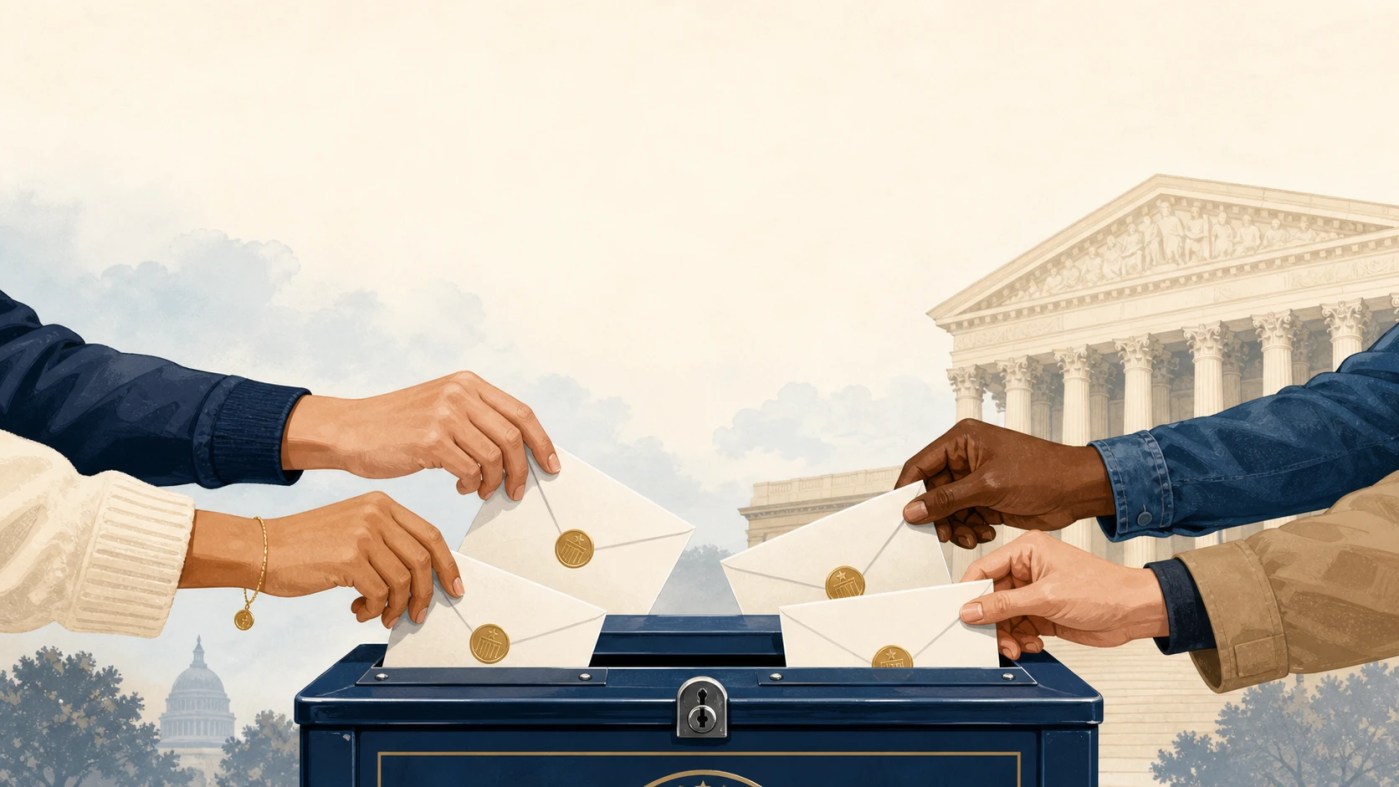
Mail-In Voting, Democratic Guardrails, Ordinary Voters — and Why This Matters to the Climate Emergency
I will begin with something simple: I am not a political or voting-law expert. I am learning. And today I found myself trying to understand a Supreme Court decision involving mail-in voting that, at first, sounded technical and distant. The more I read, however, the more I realized that this is not only about envelopes, barcodes, lists, deadlines, or the Postal Service. It is also about who has authority over our elections, what limits exist on executive power, and what ordinary voters should do when the rules themselves appear to be shifting.
That is why a woman I saw crying in public stayed with me. At first her reaction surprised me. Then I began to understand what she was trying to say. She kept repeating that “they’re going after ordinary voters” by giving authority to a leader or figure who never had that authority before. Her fear was not abstract. She was worried that the machinery of democracy could be changed in a way that makes an ordinary citizen’s vote harder to cast, harder to receive, or harder to count.
What the Supreme Court Actually Did on August 24, 2026
On March 31, 2026, President Donald Trump signed Executive Order 14399. Among other things, it directs the Department of Homeland Security to develop state citizenship lists, directs the Attorney General to prioritize certain election-related investigations and prosecutions, and directs the U.S. Postal Service to develop new rules for federal mail ballots. The contemplated postal system includes special ballot-envelope requirements, unique Intelligent Mail barcodes, state-provided lists of mail-ballot participants, and a rule under which USPS would not transmit certain federal mail ballots unless the voter is enrolled on a state-specific list.
Source: White House — Executive Order 14399
The administration describes these measures as election-integrity safeguards intended to verify eligibility and secure absentee and mail voting. Critics — including a group of states, voting-rights organizations, and Democratic lawmakers — argue that the order reaches into election administration in ways the Constitution and federal statutes do not authorize and could cause eligible voters to lose access to mail ballots.
Source: White House fact sheet on the order
Source: Sen. Sheldon Whitehouse — June 25 letter and statement
On August 24, the Supreme Court, by a 6–3 vote, paused one lower-court injunction that had prevented the administration from implementing key portions of the order against 23 states and the District of Columbia. But this point is essential: the Court did not finally decide that the President’s mail-voting plan is constitutional. The majority largely concluded that the states had gone to court too early and had not yet shown the kind of concrete injury required for that particular lawsuit to proceed at that stage. The Court expressly left room for challenges to a final Postal Service rule if it harms states.
Source: SCOTUSblog — August 24 ruling explained
Source: Reuters — August 24 report
A separate injunction in another case still temporarily blocks the Postal Service from implementing one part of the executive order nationwide. So this legal fight is not over. Justice Sonia Sotomayor emphasized in dissent that the August 24 decision did not decide whether the President’s attempt to intervene in state election administration is lawful. Justice Ketanji Brown Jackson warned that delaying review could create serious problems close to the November midterms.
There Was Another 2026 Supreme Court Mail-Ballot Ruling
It is also easy to confuse the August 24 case with another important mail-voting case decided on June 29, 2026: Watson v. Republican National Committee. In that case, the Supreme Court concluded that federal Election Day statutes do not automatically override state laws allowing mail ballots that were timely cast or postmarked to arrive and be counted after Election Day. According to the National Conference of State Legislatures, the decision left existing state ballot-receipt timelines in place.
Source: NCSL — absentee/mail ballot receipt deadlines after Watson v. RNC
So, in plain language, there are at least two different Supreme Court mail-voting stories this year: one about when states may count timely cast mail ballots that arrive after Election Day, and another about how far the federal executive branch and USPS may go in restructuring the administration and transmission of mail ballots. They should not be blended into one ruling.
Mail Voting Is Not New
Mail and absentee voting are not modern inventions. During the Civil War, nineteen states enacted laws allowing soldiers to vote from the field, and the 1864 presidential election became the first large-scale use of absentee voting in the United States. The practice evolved over generations and expanded for military personnel, travelers, people with disabilities, older voters, and eventually many ordinary voters. MIT’s Election Data + Science Lab reports that 29 percent of voters cast ballots by mail in 2024. It also notes that documented vote-by-mail fraud is rare and that research has not found a reason to believe fraud is more common in states that broadly use vote-by-mail, even though isolated fraud cases do occur.
Source: Library of Congress — Civil War absentee voting
Source: MIT Election Data + Science Lab — Voting by mail and absentee voting
What Senator Sheldon Whitehouse Has Been Saying
Senator Sheldon Whitehouse of Rhode Island has been one of the outspoken critics of the administration’s mail-ballot policy. In April, during an appearance with Lawrence O’Donnell, Whitehouse argued that the executive order should be understood in the context of electoral advantage and said the administration was looking for ways to “throw the election.” That is a partisan political judgment, not a judicial finding, but it helps explain why some voters interpret the postal changes as something more than routine election administration.
Source: The Last Word transcript — April 2026 discussion with Sen. Whitehouse
Whitehouse later joined other Senate Democrats in letters demanding that USPS abandon its proposed rule. Their argument is that the Constitution gives states primary responsibility for administering elections, subject to Congress’s constitutional authority, and that the President cannot simply create a new executive power to decide who receives a mail ballot. The administration strongly disputes that characterization and says the order is a lawful effort to enforce federal election law. The courts have not yet issued a final merits ruling resolving that constitutional conflict.
A President Is Not a King
I have heard people use words such as “king” and “authoritarian” to describe their fear about expanding presidential power. Those are serious terms, and I do not think we should use them carelessly. The United States does not become a monarchy because of one executive order or one Supreme Court ruling. The narrower constitutional question is still extremely important: where does a President’s authority come from, what powers belong to the states or Congress, and can courts and other institutions still enforce those boundaries? My concern is not a title. It is the concentration of power without adequate checks, especially when that power touches the process by which voters choose their representatives.
Have We-the-People Faced Moments Like This Before?
History never repeats itself neatly, and I do not want to pretend that today’s dispute is identical to Jim Crow, Watergate, or any other past crisis. But American history does contain repeated struggles over who may vote, what barriers may be placed in front of voters, and how much power a President may exercise without Congress.
The Fifteenth Amendment was ratified in 1870 to prohibit racial discrimination in voting, yet states later used poll taxes, literacy tests, intimidation, and other devices to suppress Black political participation. The Nineteenth Amendment, ratified in 1920, followed decades of organizing for women’s suffrage. The Twenty-Fourth Amendment prohibited poll taxes in federal elections in 1964, and the Voting Rights Act of 1965 followed the brutal suppression of voting-rights activists in places such as Selma. Each of these advances required far more than good intentions. People organized, litigated, marched, petitioned, voted, and forced institutions to respond.
Source: U.S. Senate — Fifteenth Amendment history
Source: National Archives — Nineteenth Amendment
Source: National Archives — Twenty-Fourth Amendment text
Source: U.S. Senate — Voting Rights Act of 1965
We have also seen serious contests over executive power. In 1952, the Supreme Court rejected President Harry Truman’s attempt to seize private steel mills without congressional authorization. During Watergate, congressional investigation, judicial review, public scrutiny, and ultimately the Supreme Court’s unanimous decision requiring President Richard Nixon to turn over the White House tapes demonstrated that a President is not beyond institutional checks. Nixon resigned in August 1974.
Source: U.S. Senate — checks and balances and Watergate
Source: U.S. Senate — National Emergencies Act and Youngstown
The lesson I take from that history is not that everything always works out. It plainly does not. The lesson is that democratic guardrails are not self-operating. Courts, Congress, states, journalists, civic organizations, public servants, and ordinary citizens all matter — and voting is one of the most basic ways ordinary people remain part of that system.
My First Thought: Why Not FedEx, UPS, or a People’s Mail Service?
I admit that my first reaction was practical: if the Postal Service becomes a problem for mail ballots, why not use FedEx, UPS, or even organize a People’s Mail Delivery service? I would gladly work for minimal pay if it meant helping lawful ballots get where they need to go.
But ballots are not ordinary packages. Election law is state-specific, and voters should not improvise a delivery method that their state does not authorize. Federal guidance advises voters to check with their state or local election office for lawful ways to return a mail ballot besides postal mail. Depending on the state, those methods may include secure official drop boxes, hand delivery to an election office, early in-person voting, or Election Day voting. Some states may recognize forms of common-carrier delivery; others may not. A private national replacement system cannot simply be invented without law, security standards, chain-of-custody rules, and state authorization.
Source: USA.gov — absentee voting and lawful return options
That does not mean the People’s Mail idea has no value. It means we should translate it into something lawful and resilient: a people-powered voter-support network. Volunteers can help neighbors check registration, learn deadlines, locate official drop boxes, get transportation to election offices or polling places, understand identification rules, and obtain accurate information from election officials. We can build redundancy around democracy without taking custody of ballots in ways the law does not permit.
Where AI Can Help — and Where It Cannot
AI can be useful here if we use it carefully. It can translate legal language into ordinary English, summarize court opinions, compare competing claims against primary sources, build state-specific voting checklists, track changing deadlines, prepare questions for election officials, summarize public meetings, identify misinformation that needs verification, and help community groups organize information quickly. It can also help connect election decisions to climate policy, budgets, agency authority, environmental justice, and resilience planning.
But AI should never be the final authority on whether your ballot is valid or how you must return it. AI can make mistakes, misunderstand a state rule, or rely on outdated information. For voting instructions, the final check should always be your official state or local election authority and, when needed, qualified legal counsel.
Why This Is Also a Climate and Ecological Emergency Issue
Some people may ask what voting procedure has to do with climate change. The connection is direct and indirect. Elections determine who writes laws, controls budgets, oversees agencies, confirms judges, funds disaster preparedness, regulates pollution, plans transportation and energy systems, protects ecosystems, and decides whether climate science is translated into public policy. If citizens lose confidence that they can participate fairly, the capacity to build durable climate policy also suffers.
Adaptive resiliency is not only about seawalls, cooling centers, food systems, microgrids, or disaster plans. It is also about whether a community can obtain trustworthy information, preserve institutions, protect participation, respond lawfully to disruption, and organize without panic. Democratic resilience and climate resilience are different things, but they strengthen one another.
Climate Hawks Vote: Climate Politics Meets Voting Rights
Climate Hawks Vote describes its mission as identifying, training, and electing climate leaders while creating the political conditions for strong climate policy. It is a federal Super PAC and climate-focused advocacy organization that says it does not accept money from fossil-fuel corporations, executives, or lobbyists.
Source: Climate Hawks Vote — mission and current work
Source: Climate Hawks Vote Political Action
As of August 25, I did not find a Climate Hawks Vote statement posted specifically in response to the Supreme Court’s August 24 mail-ballot order. I did find that Climate Hawks Vote is listed as an additional sponsor of a current Action Network campaign urging Congress to reject the President’s mail-ballot executive order and protect voting rights. It also has an active campaign calling for Supreme Court reforms. That tells me the organization is treating voting rights, court power, and climate politics as connected parts of the larger democratic system.
Source: Action Network — voting-rights campaign listing Climate Hawks Vote as an additional sponsor
Source: Action Network — Climate Hawks Vote-sponsored Supreme Court reform campaign
There is also an upcoming online briefing, “Time for Climate Hawks to Update Your Midterms Plans,” scheduled for Wednesday, September 9 at 8:00 p.m. Eastern and hosted by Unitarian Universalists for Social Justice with Climate Hawks Vote. It is described as an off-the-record, issue-focused briefing on how climate issues are appearing in the 2026 midterms. Because it is off the record, I would plan to attend live rather than assume a recording will be posted.
Source: UUSJ August 2026 newsletter — September 9 Climate Hawks Vote briefing
Indivisible: Hands Off Our Vote and “What’s the Plan?”
Indivisible is already organizing directly around election protection. Its national “Hands Off Our Vote” program says it is building its largest election-protection effort to date across all 50 states, with the goal of helping eligible voters cast ballots, ensuring ballots are counted, and preparing local groups for rapid response to voting disruptions. The program advises people to keep checking their registration and learn the rules that apply in their state.
Source: Indivisible — Hands Off Our Vote
There is a national “Hands Off Our Vote: Election Protection 101 & 201” training scheduled for Wednesday, August 26, 2026, from 8:00 to 9:00 p.m. Eastern. Indivisible also holds its national “What’s the Plan?” conversation every Thursday from 3:00 to 4:00 p.m. Eastern with co-founders Leah Greenberg and Ezra Levin. The organization describes it as a participatory discussion of the week’s political news, the state of democracy, and strategies for action.
Source: Indivisible — national trainings and calls
Source: Indivisible — What’s the Plan with Leah and Ezra
The August 21 show notes say the next “What’s the Plan?” program will include a deep dive on Supreme Court reform with writer and litigator Elie Mystal. Indivisible also distributes the conversation as a weekly podcast through major podcast platforms, so people who cannot attend live can follow the recordings and show notes afterward. In addition, Indivisible is supporting the August 28 March on Washington: Defend the Vote.
Source: Indivisible — What’s the Plan show notes
Source: Indivisible — announcement of the weekly What’s the Plan podcast
I would encourage readers who are concerned, confused, angry, or simply trying to understand what is happening to attend these meetings when possible — especially Indivisible’s weekly national call — or listen to the recordings afterward. We do not have to agree with every position taken by any organization to learn from what organizers, lawyers, voters, and communities are discussing.
Do Not Let Confusion Become Withdrawal
One danger in moments like this is exhaustion. Another is confusion. A third is the belief that because powerful institutions are fighting over the rules, an ordinary voter no longer matters. History tells me the opposite. Ordinary voters matter precisely because political power ultimately depends on whether people remain engaged.
I have updated and added blog posts to climatechangecommunity.com, and I invite you to consider reading them as we continue connecting the Climate and Ecological Emergency with democracy, community resilience, responsible technology, and the choices we make together.
AI can help us understand more, organize faster, ask better questions, and find lawful alternatives — but it cannot replace our civic responsibility or our human judgment. We-the-People still have agency. We can learn the rules, challenge unlawful actions through lawful institutions, support one another, protect access to accurate information, participate in public meetings, and build resilient community networks.
Educational note: Voting laws and court orders can change quickly. This article is not legal advice. Always verify current instructions with your official state or local election authority.
And above all: do not let any of this stop you from voting. Voting remains one of the mechanisms of our voice in selecting capable leaders who lead with integrity. If one lawful voting method becomes uncertain, learn the lawful alternatives available in your state — and use your voice.


Leave a Reply