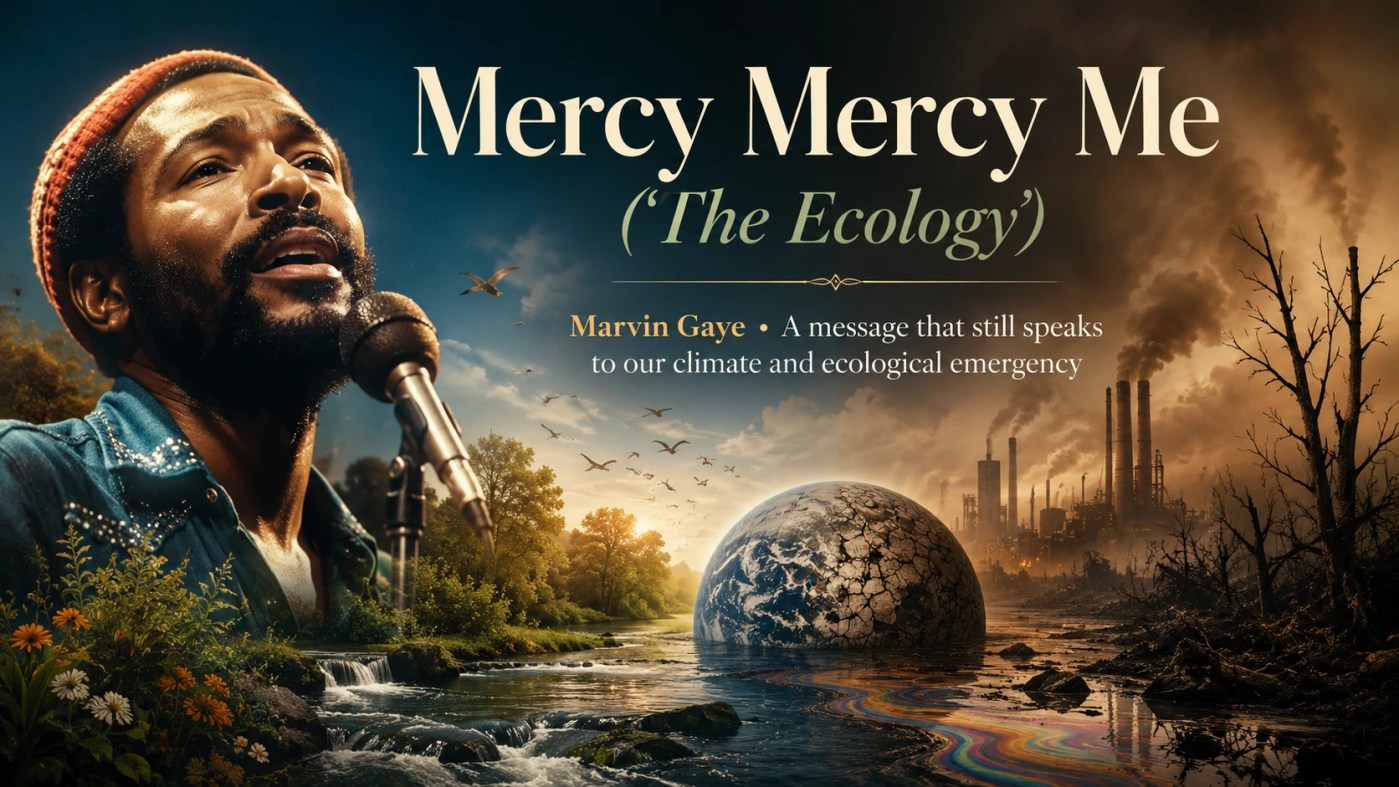
Featuring the Soul Purrfection Version
No comment necessary? Almost.
For those of us who grew up with Marvin Gaye, “Mercy Mercy Me (The Ecology)” can feel as if it has always been somewhere in the background of our lives. But hearing it again today — especially this Soul Purrfection version, with its intimate vocal opening — makes the song feel less like a piece of musical history and more like a message that has been waiting for us to catch up with it.
I loves me some Marvin, and this one hit differently today.
More than half a century after it was recorded, the environmental grief inside the song is still recognizable. What changed is the scale of the emergency around us.
A Soul Classic That Put “Ecology” Into Popular Music
Marvin Gaye released What’s Going On in 1971 after pushing for greater creative control at Motown. The album was a sharp departure from the company’s usual formula: a connected body of songs about war, poverty, racism, faith, social breakdown, environmental damage, and the condition of the country.
The Library of Congress describes it as a self-written, self-produced concept album that joined deeply held spiritual beliefs with social commentary, while the Motown Museum notes that it changed the direction of Gaye’s career and expanded the place of social messaging in mainstream music.
Source: Library of Congress; Motown Museum, Still Going On.
“Mercy Mercy Me (The Ecology)” became the album’s second single in 1971. It reached No. 4 on the Billboard Hot 100 and No. 1 on the R&B chart, and it was later inducted into the GRAMMY Hall of Fame in 2002.
More important than its chart position, though, was its subject: polluted air, oil in the water, mercury contamination, radiation, dying wildlife, and the growing pressure human activity was placing on the living world.
This was Marvin Gaye using soul music to talk about ecology when environmental consciousness was only beginning to enter mainstream American culture.
Source: GRAMMY; Library of Congress.
The Turmoil Behind What’s Going On
The album emerged from a period of profound upheaval.
Gaye was absorbing the violence, racial conflict, political division, and war surrounding the United States, while also hearing directly from his brother Frankie about his experience serving in Vietnam.
GRAMMY’s history of the album describes those experiences — along with personal loss and Gaye’s growing frustration with injustice — as part of the emotional foundation for What’s Going On.
Berry Gordy initially doubted the new direction, but Gaye was determined to make music that spoke to what he believed was happening around him.
Source: GRAMMY, Inside Marvin Gaye’s Revolutionary What’s Going On; Motown Museum.
A quick historical note: the title single “What’s Going On” was released in January 1971, while the album itself followed on May 21, 1971. “Mercy Mercy Me (The Ecology)” was then released as the album’s second single in June.
Source: GRAMMY; official Marvin Gaye/Universal Music release metadata.
Why the Song Feels Even More Urgent Now
In 1971, Gaye was singing during the first great wave of modern U.S. environmental awareness, just after the first Earth Day and the creation of the Environmental Protection Agency.
The EPA traces its official birth to December 2, 1970 — only months before What’s Going On arrived.
Today, the environmental problems Gaye mourned have not disappeared. They have become entangled with a planetary climate emergency.
The World Meteorological Organization reported in March 2026 that 2015 through 2025 were the eleven hottest years on record. It found that 2025 was approximately 1.43°C above the 1850–1900 average, while ocean heat reached the highest level in the observational record.
Extreme heat, destructive rainfall, tropical cyclones, retreating ice, glacier loss, and rising greenhouse-gas concentrations are no longer warnings about some distant future.
They are part of the world we are living in now.
Source: U.S. Environmental Protection Agency, The Origins of EPA; World Meteorological Organization, State of the Global Climate 2025.
And the gap between what the world says it will do and what is actually needed remains dangerous.
The United Nations Environment Programme’s 2025 Emissions Gap Report estimated that even if current national climate pledges are fully implemented, the world would still be headed toward roughly 2.3°C to 2.5°C of warming this century.
That means Marvin’s lament about what we are doing to the Earth has moved from environmental foresight to lived climate reality.
Source: United Nations Environment Programme, Emissions Gap Report 2025.
The EPA Connection: Why This Message Is Landing Again in 2026
There is another reason this song feels particularly relevant right now.
Concern about changes to environmental protections is no longer hypothetical.
On February 12, 2026, the U.S. Environmental Protection Agency finalized the rescission of the 2009 Greenhouse Gas Endangerment Finding for motor vehicles and repealed the federal greenhouse-gas emission standards for highway vehicles and engines that depended upon it.
EPA argues that the previous interpretation exceeded the authority provided by the Clean Air Act and says the change will substantially reduce regulatory costs.
Environmental organizations, states, and other critics argue that the action removes a major foundation of federal climate policy, and legal challenges are underway.
Whatever one’s political perspective, the significance is difficult to dismiss: the federal government’s approach to regulating greenhouse-gas pollution has undergone a major change.
Source: U.S. EPA, Final Rule: Rescission of the Greenhouse Gas Endangerment Finding; Reuters, February 2026.
EPA has also proposed other regulatory changes during 2026.
In May, the agency proposed moving implementation of its Tier 4 light- and medium-duty vehicle pollution standards from model year 2027 to model year 2029. In June, EPA proposed changes to the way it conducts environmental reviews under the National Environmental Policy Act (NEPA).
EPA says these changes are intended to improve feasibility, lower costs, reduce delays, and preserve environmental protections. Taken together, however, they demonstrate how significantly the environmental-policy landscape is changing — and why continued public attention matters.
Source: U.S. EPA, Tier 4 proposed revision; U.S. EPA, proposed NEPA reforms.
Why This Aligns With Our Current Challenges
This is where Marvin Gaye’s song becomes more than a piece of music from 1971.
It connects environmental destruction with something deeply human:
grief, responsibility, and the question of what kind of world we are willing to leave behind.
It does not treat ecology as some highly technical subject reserved for scientists, regulators, universities, or environmental organizations.
It makes ecology personal.
And that matters now.
We are trying to respond to several realities at once:
A destabilizing climate.
Polluted air and water.
Ecological decline.
Political battles over environmental protections.
Economic pressures that can make long-term environmental action harder.
Communities increasingly needing to prepare for heat, flooding, storms, displacement, food insecurity, health risks, and other climate-related disruptions.
And perhaps most importantly, the challenge of helping people understand the seriousness of what is happening without allowing that seriousness to turn into hopelessness or paralysis.
These problems require science.
They require regulations.
They require climate policy.
They require mitigation and adaptation.
They require technology.
But they also require culture, memory, empathy, cooperation, community, and a reason to care.
Marvin Gaye understood something important in 1971:
Facts can tell us that something is wrong. Art can make us feel what those facts mean.
“Mercy Mercy Me” turns environmental harm into a lament.
That emotional connection can become a doorway into awareness.
Awareness can become conversation.
Conversation can become cooperation.
And cooperation can become participation, protection, adaptation, resilience, and collective response.
Source: Motown Museum, Still Going On — Climate Change/Air Pollution; World Meteorological Organization, State of the Global Climate 2025.
Listen: Soul Purrfection Version
The Soul Purrfection version shared here gives the song a different kind of closeness.
The vocal-focused introduction brings Marvin’s voice forward before the full arrangement settles in, making the song feel less like something coming through a speaker and more like a warning — and almost a prayer — arriving in the room with you.
YouTube — Marvin Gaye ~ Mercy Mercy Me (The Ecology) 1971 Soul Purrfection Version
Watch the Soul Purrfection Version on YouTube
Still Asking the Same Question
More than fifty years later, “Mercy Mercy Me (The Ecology)” has not become outdated.
If anything, we have acquired more scientific knowledge, better monitoring, stronger technology, and a much clearer understanding of the risks — while the underlying question has become harder to avoid:
How much pressure can we keep placing on the systems that keep us alive before we decide that protecting them is not optional?
Maybe that is why this song still lands so hard.
Marvin was not singing about an environmental movement as a trend.
He was singing about home.

