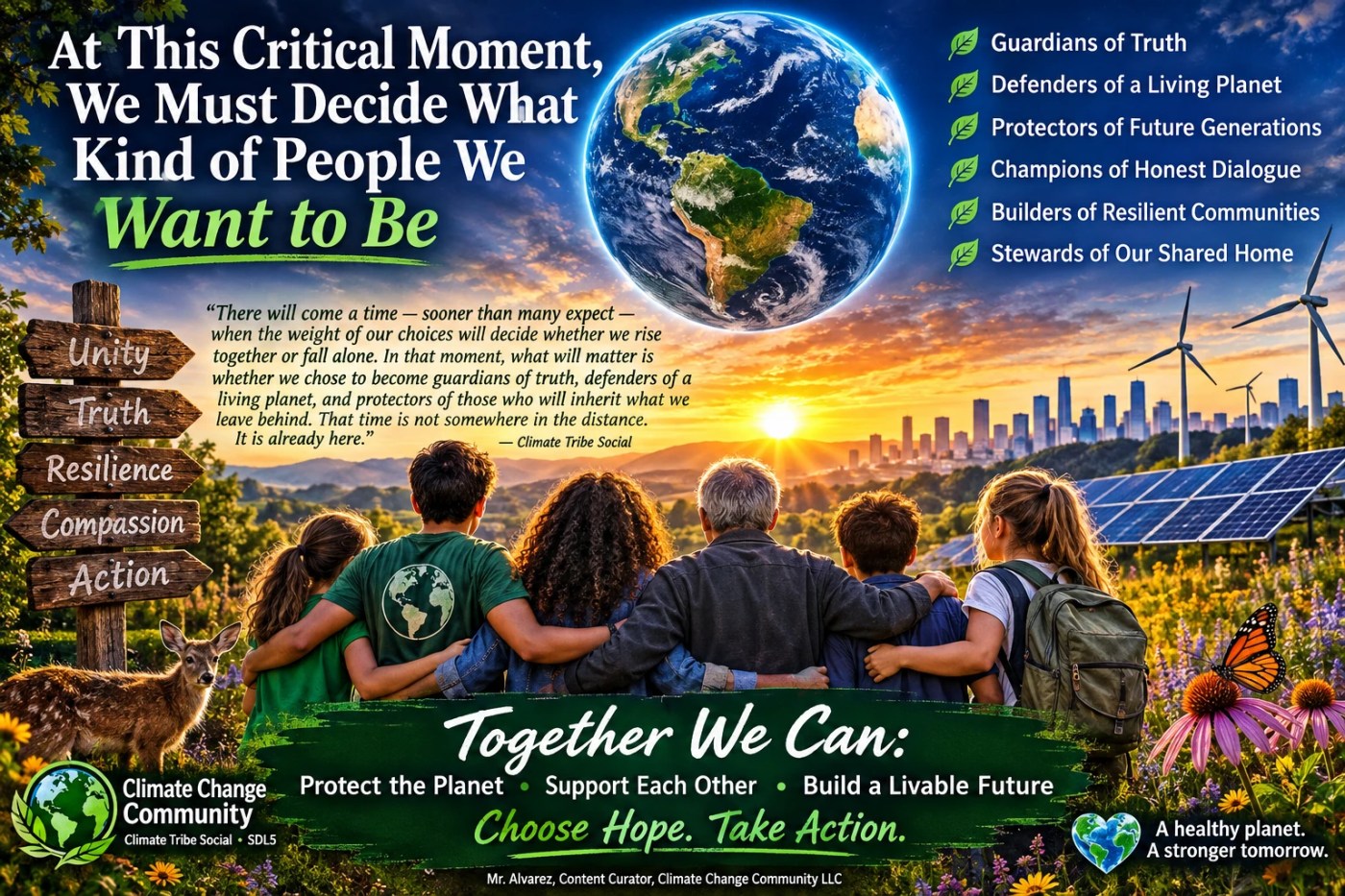
“There will come a time — sooner than many expect — when the weight of our choices will decide whether we rise together or fall alone. In that moment, many of the lines that once divided us will matter far less than we imagined. It will not matter what flag we waved, what title we held, or which labels we used for one another. What will matter is whether we chose to become guardians of truth, defenders of a living planet, and protectors of those who will inherit what we leave behind. That time is not somewhere in the distance. It is already here. And what happens next will be shaped by what we decide to do together.”
This message began within Climate Tribe Social and is being amplified through Climate Change Community because it belongs beyond any one website, community, organization, or person. It is about the kind of people we choose to be while multiple emergencies converge around us. Most of all, it is about the children and young adults who will live longest with the consequences of our decisions, and about the biodiversity and living systems upon which every human future depends.
The climate emergency is no longer a warning about a distant century. The ecological emergency is no longer something happening somewhere else. Democratic institutions, public trust, social cohesion, information systems, infrastructure, public health, food systems, and community safety are increasingly being tested at the same time. These pressures do not remain neatly separated. They interact, compound one another, and expose the weaknesses of societies that have spent too long treating interconnected problems as if they belonged in separate rooms.
The Evidence Is No Longer Distant
In March 2026, the World Meteorological Organization reported that 2015 through 2025 were the hottest eleven years in the observational record. It estimated that 2025 was the second- or third-warmest year recorded, about 1.43°C above the 1850–1900 average. Ocean heat content reached another record, glaciers continued to lose mass, and extreme weather disrupted lives and economies around the world.
The United Nations Environment Programme’s 2025 Emissions Gap Report delivered an equally sobering message. Even if current national climate pledges are fully implemented, the world is still projected toward roughly 2.3–2.5°C of warming this century. Under policies currently in place, the estimate is about 2.8°C. UNEP concluded that exceeding 1.5°C on a multi-decadal basis is now very likely within the next decade, making the task not one of surrender, but of limiting the overshoot as much as possible and driving warming back down.
That distinction matters. Climate urgency is not a reason for fatalism. It is a reason for precision. Every fraction of a degree matters because every increment of warming raises risks to people, ecosystems, food and water security, infrastructure, health, and the ability of communities to adapt. The Intergovernmental Panel on Climate Change has put it plainly: “There is a rapidly closing window of opportunity to secure a liveable and sustainable future for all.”
History Already Warned Us — and Gave Us a Better Example
1988: “It Is Already Happening Now”
On June 23, 1988, NASA scientist James Hansen testified before the United States Senate about the warming signal scientists were already detecting. His conclusion was memorable because it was so direct:
“It is already happening now.”
That was nearly four decades ago.
The significance of that moment is not that one scientist predicted every storm, wildfire, flood, drought, or heat wave that followed. Climate science does not work that way. Its significance is that humanity was publicly warned, with growing scientific confidence, that greenhouse-gas pollution was changing the climate. Since then, the evidence has become vastly stronger, the observing systems far more sophisticated, and the consequences increasingly visible.
We should remember 1988 not simply to assign blame, but to understand the cost of delay. A warning ignored does not remain frozen in time. It accumulates interest.
1987: Proof That Collective Action Can Work
History also offers another lesson. In 1987, nations adopted the Montreal Protocol to confront the destruction of the stratospheric ozone layer. The problem was global, technically complex, economically disruptive, and impossible for any one country to solve alone. Scientists had to identify the danger. Governments had to negotiate. Industry had to change products and processes. Wealthier nations had to help finance a transition in developing countries. The agreement had to evolve as the science improved.
It worked.
The United Nations reports that nearly 99 percent of banned ozone-depleting substances have been phased out. If current policies remain in place, the ozone layer is expected to return to 1980 levels around 2040 for most of the world, around 2045 over the Arctic, and around 2066 over Antarctica.
Climate change is a larger and more deeply embedded challenge than ozone depletion, so the comparison should not be oversimplified. But the Montreal Protocol destroys one of the most dangerous myths of our time: that humanity is incapable of cooperating across borders when science reveals a shared threat. We have done it before. The question is whether we are willing to do it at the scale and speed the present emergency requires.
A Call to the People Closest to Reality
This message is for everyone, but it is especially directed toward the people who live closest to the consequences of failing systems.
It is for climate scientists, ecologists, biologists, meteorologists, oceanographers, foresters, conservationists, engineers, emergency planners, farmers, public-health researchers, and environmental professionals who spend their lives studying changes that the rest of society may encounter only as headlines. It is for the people who have watched datasets turn into lived experience.
It is for parents trying to protect children in a hotter and more uncertain world; teachers helping young people understand events that can feel overwhelming; nurses and healthcare workers caring for people during heat waves, smoke events, disasters, displacement, and stress; essential workers who keep food, water, energy, transportation, sanitation, communications, and care systems functioning; and emergency responders who meet the consequences of our collective decisions in real time.
It is also for public servants who still believe that facts, competence, and duty matter, and for local leaders who know that resilience is built street by street, neighborhood by neighborhood, long before a disaster declaration is issued.
And above all, it is for young people. Not because they should be asked to “save the world” that older generations have placed in danger, but because they deserve a meaningful voice in decisions that will shape the longest portion of their lives. They are not merely our future. They are participants in the present.
We Cannot Meet a Compound Emergency in Isolation
For years, climate work was often treated as a specialized environmental issue. That frame is no longer sufficient. Climate disruption interacts with ecosystems, housing, migration, public health, insurance, food prices, energy reliability, disaster response, inequality, and political stability. The IPCC increasingly describes climate risk in terms of compound and cascading hazards because a failure in one system can intensify failures in others.
The same is true of democracy and public trust. Freedom House reported in 2026 that global freedom declined for the twentieth consecutive year in 2025, with 54 countries showing deterioration in political rights and civil liberties and 35 improving. Different democracy-monitoring organizations use different methods, and no index should be treated as an unquestionable oracle. But the broad warning is difficult to ignore: institutions that protect expression, accountability, due process, independent information, and peaceful participation are under pressure in many parts of the world.
That matters to climate action. A society that cannot agree on basic facts, trust legitimate institutions, protect independent expertise, or hold leaders accountable will have a harder time preparing for any long-duration emergency. Climate resilience and democratic resilience are not identical, but they increasingly depend on some of the same civic muscles: honesty, transparency, participation, accountability, cooperation, and the ability to correct course when evidence changes.
This is one reason the work across Climate Change Community, Climate Tribe Social, and SDL5 is increasingly centered on learning, dialogue, Adaptive Resiliency, Self- and Collective-Preservation, and practical cooperation. The goal is not to create another place where people simply consume alarming information. The goal is to help people understand what is happening, connect across disciplines and experiences, and become more capable of responding together.
Truth Is Infrastructure
We often talk about infrastructure as roads, bridges, power lines, hospitals, water systems, and communications networks. But a functioning society also depends on information infrastructure. People need some reliable way to distinguish evidence from invention, uncertainty from deception, reporting from propaganda, and disagreement from deliberate manipulation.
This does not mean every disputed claim is “misinformation.” It does not mean experts are infallible. It does not mean majority opinion is always correct. Science advances precisely because claims can be challenged, evidence can be reexamined, methods can be criticized, and conclusions can change.
A healthy truth culture therefore requires more than fact-check labels. It requires habits: asking where a claim came from, looking for primary sources, distinguishing an anecdote from a dataset, checking whether an image or quotation is authentic, recognizing when uncertainty is being communicated honestly, and being willing to revise our own beliefs.
Digital platforms complicate this work. UNESCO has warned that the same systems that expand access to information can also amplify misinformation, conspiracy narratives, and hate, especially when attention-driven algorithms reward content that provokes reaction more effectively than content that encourages careful thought. That is why moderation should be understood not as punishment for disagreement, but as stewardship of a shared environment.
In the communities we build, standards should be based on behavior and evidence, not political identity, profession, religion, nationality, or ideology. People should be free to disagree strongly. They should also be expected to argue in good faith, provide evidence for factual claims when asked, avoid harassment and dehumanization, and allow conversations to remain conversations rather than turning them into coordinated disruption.
Free Expression Does Not Require Equal Credibility for Every Claim
Free expression is essential to democracy, science, learning, and community life. It protects the ability to question authority, challenge consensus, criticize institutions, advocate unpopular ideas, and sometimes simply be wrong.
But protecting expression is not the same thing as requiring a community to treat every factual claim as equally credible. A statement supported by decades of physical measurements, multiple independent lines of evidence, and transparent scientific review does not stand on the same evidentiary footing as a viral post with no verifiable source.
This distinction is important because the phrase “free speech” is sometimes used as though it guarantees freedom from criticism, correction, moderation, or consequences. It does not. In a healthy community, speech is met with more speech, questions, evidence, context, and—when necessary—boundaries against harassment, threats, impersonation, spam, or coordinated manipulation.
The purpose is not to create ideological conformity. The purpose is to preserve the conditions in which genuine disagreement can still happen.
AI Can Help — but It Cannot Be Our Arbiter of Truth
Artificial intelligence now sits directly inside this struggle over information. It can translate scientific material, summarize long reports, compare sources, help identify patterns, support accessibility, assist moderators in triaging large volumes of content, and help communities organize knowledge that would otherwise be difficult to process.
It can also be wrong with extraordinary confidence.
The U.S. National Institute of Standards and Technology warns that generative AI systems can produce “confabulations”: false or misleading content presented in a way that may appear convincing. AI can also be used to generate persuasive disinformation, impersonate people, fabricate images or audio, and overwhelm information environments with synthetic content.
So AI should never become the community’s unquestioned referee. The better model is human accountability assisted by machines. AI can help surface a claim for review; people should still inspect the evidence. AI can suggest a source; people should still verify that the source exists and says what the system claims. AI can help moderate at scale; people should remain responsible for appeals, context, proportionality, and the values behind the rules.
There is also an environmental responsibility that cannot be ignored. The International Energy Agency estimates that data centers used roughly 415 terawatt-hours of electricity globally in 2024 and could approach 945 terawatt-hours by 2030, with AI a major driver of the increase. Renewables are expected to supply a large share of new demand, but fossil fuels will also contribute in the near term. If we use AI to advance climate resilience, we should also demand greater efficiency, transparency, cleaner electricity, better siting, responsible water use, and honest accounting of its physical footprint.
Technology is not automatically green because the purpose we assign to it is green.
Adaptive Resiliency Means More Than Bouncing Back
Resilience is sometimes described as the ability to “bounce back” after a shock. In an era of accelerating climate and ecological disruption, that definition is no longer enough. Returning to the exact conditions that made a community vulnerable may simply rebuild the same failure.
Adaptive Resiliency asks a harder question: how do we learn, adjust, reorganize, cooperate, and become better prepared as conditions change?
That idea aligns closely with what the IPCC calls climate-resilient development: combining adaptation with emissions reduction while strengthening sustainable development. It means preparing for the impacts we can no longer avoid while still fighting to prevent those that can be prevented. It means designing systems that do not merely survive a disturbance, but learn from it.
At the community level, that can mean stronger social ties, better emergency communication, heat preparedness, food and water planning, support for vulnerable neighbors, local ecological restoration, media literacy, public-health readiness, mutual aid, civic participation, and the ability to share trustworthy information quickly during a crisis.
Self-preservation without collective preservation will not be enough. A household may prepare for a heat wave, but it still depends on the electrical grid, water system, healthcare network, transportation system, food supply, and neighbors. A town may strengthen its infrastructure, but it still depends on regional ecosystems, national institutions, and a stable climate system.
Interdependence is not a weakness to be embarrassed by. It is a fact to be organized around.
What Kind of People Do We Decide to Be?
The most important question before us may not be whether humanity possesses enough technology, scientific knowledge, money, or ingenuity. We possess astonishing amounts of all four.
The deeper question is whether we can develop enough trust, courage, discipline, compassion, and cooperation to use what we already know.
Will we become people who look away because the problem feels too large, or people who learn how to carry one part of it together? Will we reward those who keep us frightened and divided, or those who help us understand one another without pretending our differences do not exist? Will we treat young people as spectators, or as partners whose futures give them a legitimate claim on the decisions of the present? Will we treat nature as an infinite warehouse, or finally recognize the living systems that make civilization possible?
We do not need perfection before we begin. The Montreal Protocol was not born perfect. Climate science did not arrive in one finished document. Democracies have never been self-maintaining. Communities are never complete.
They survive because people keep repairing them.
That may be the most useful definition of hope at this stage of the emergency: not optimism that everything will somehow work out, but the decision to become people who keep repairing what can still be repaired, protecting what can still be protected, and refusing to abandon one another while there is still work worth doing.
This was never about one curator, one organization, or one platform. At best, any of us are temporary caretakers—holding knowledge, community, and responsibility long enough to pass them forward in better condition than we received them.
The question is no longer whether this moment asks something of us.
It does.
The question is what kind of people we will decide to be in answer.
— Mr. Alvarez, Content Curator, Climate Change Community LLC
AI used to Enhance my Creativity and Thinking
Sources and Further Reading
World Meteorological Organization. State of the Global Climate 2025. Published March 23, 2026. Source
United Nations Environment Programme. Emissions Gap Report 2025: Off Target. Published November 4, 2025. Source
Intergovernmental Panel on Climate Change. Climate Change 2023: AR6 Synthesis Report. Source
NASA Goddard Space Flight Center. Temperature Record 101: historical discussion of James Hansen’s 1988 Senate testimony. Source
United Nations Environment Programme. Scientific Assessment of Ozone Depletion: 2022. Source
Freedom House. Freedom in the World 2026: The Growing Shadow of Autocracy. Source
UNESCO. Guidelines for the Governance of Digital Platforms. 2023. Source
National Institute of Standards and Technology. Artificial Intelligence Risk Management Framework: Generative Artificial Intelligence Profile. Source
International Energy Agency. Energy and AI. 2025. Source


Leave a Reply