The Line Just Moved. Here’s What That Actually Means for You.
On September 2, 2026, the United Nations said out loud what scientists have been saying quietly for years: we are going past 1.5°C. Not “might.” Will. But the report also said something most headlines skipped, and it matters more than the bad news.
Written for everyone between 13 and 33 — the people who will live inside the results.
Start here: the short version
The UN Environment Programme released a report called Limiting Overshoot. It is the first UN report to stop arguing about whether we’ll cross the 1.5°C line and start dealing with the fact that we will.
Three things it says:
- We are going over. The best realistic case now peaks at about 1.8°C above pre-industrial temperatures. Most other projections are worse.
- Going over is not the end. The report calls the path “overshoot, peak, and decline.” Temperatures can come back down below 1.5°C this century, but only if emissions fall fast starting now.
- How high we go, and how long we stay there, has not been decided yet. That part is still being written by choices being made this year.
That third point is the one to hold onto. Savio Carvalho of 350.org put it in ten words that are worth memorizing: “delay is not a neutral act, it is a decision.”
Julia Conley’s write-up at Common Dreams is the version I’d hand to a friend. It’s clear, it’s honest, and it doesn’t perform either panic or false comfort. Read it. Share it. Link is at the bottom.
What 1.5°C actually means (most people get this wrong)
Here’s a correction worth making before anything else, because you’ll see it misused constantly online.
1.5°C was never about a single hot year. The Paris Agreement target refers to the long-term global average temperature, smoothed over roughly two decades. So when you saw headlines in 2024 saying “we passed 1.5,” that was one calendar year crossing the line, not the Paris goal being breached.
What changed this week is different, and bigger. The world in 2026 is already running about 1.4°C above pre-industrial levels, and we will likely pass 1.5°C on the long-term measure around 2030. The UN is no longer treating that as a risk. It’s treating it as the operating condition.
Also worth knowing: the report is blunt that some damage doesn’t reverse even if temperatures come back down. Glaciers that melt stay melted on any timescale that matters to us. Species that go extinct do not come back. “Temporary overshoot” is a real strategy, not a get-out-of-jail card.
Speaking of which — the report leans on carbon dioxide removal, pulling CO2 back out of the air by planting forests or using machines. Read the fine print. The report itself says even optimistic scaling of carbon removal is unlikely to reverse more than a few tenths of a degree this century. Forests burn. The technology is largely unproven and eats enormous amounts of energy. One of the report’s own authors called it something you can’t treat as a free pass. Cutting emissions is still the main event. Everything else is cleanup.
This is not a forecast anymore. Look around.
Younger readers sometimes get told climate change is a “future problem.” It stopped being one while you were in school.
In the week before this report came out, a glacier collapsed on Langtang Lirung in the Himalayas. The collapse triggered a wall of water, ice, and rock that came down the Trishuli valley in Nepal. Scientists calculated the flood wave traveled the first 22 kilometers at an average of 193 kilometers per hour — roughly 14 miles in under seven minutes. More than a thousand people were confirmed dead and thousands more listed missing, and the flood carried some victims 240 kilometers into India. The event was so violent that seismometers around the world registered it as a magnitude 5.2 tremor.
Scientists are careful here, and so should we be: they haven’t finished determining how much climate change contributed to that specific collapse. But the background is not ambiguous. Glaciers across the Hindu Kush Himalaya lost ice 65 percent faster between 2011 and 2020 than in the decade before, and Nepal’s glaciers have lost close to a third of their ice volume in about thirty years.
The same summer: extreme heat killed more than a thousand people across Europe, wildfires burned through parts of Canada and South America. The United Kingdom warned of food shortages during a historic drought. Fires hit new areas of France and Spain. The oceans are at their hottest level on record.
This is 1.4°C. Sit with that.
Nobody can say they weren’t told
I want you to understand something about the shape of this, because it changes how you should feel about it. This is not a case of humanity being surprised. The warnings arrived on schedule, decade after decade, and were set aside.
1965. A US presidential science advisory report warned that burning fossil fuels was loading the atmosphere with carbon dioxide and could change the climate. President Johnson mentioned it to Congress. Nothing structural followed.
1977–1982. Exxon’s own scientists ran the numbers internally. Decades later, researchers Geoffrey Supran, Stefan Rahmstorf, and Naomi Oreskes tested those old projections against what actually happened and published the results in Science in January 2023. Between 63% and 83% of the projections Exxon’s scientists reported were accurate, and they showed warming of roughly 0.20°C per decade, in line with independent academic and government work at the time. The company then spent years telling the public that climate models couldn’t be trusted.
June 1988. NASA scientist James Hansen testified to the US Senate that global warming had begun and that he was confident it was underway. It made front pages. Then it faded.
1992. At the Rio Earth Summit, a twelve-year-old named Severn Cullis-Suzuki told the assembled delegates that if they didn’t know how to fix what they’d broken, they should stop breaking it. She got a standing ovation. Emissions kept climbing.
1997. Kyoto Protocol. The world’s largest emitter at the time never ratified it.
February 2007. The IPCC’s Fourth Assessment Report landed and said human influence on the climate was unequivocal. That report is the moment I personally stopped being a bystander on this issue. Almost twenty years later, I’m writing about the consequences of what it warned us about.
2015. Paris. Nearly two hundred countries agreed to try for 1.5°C.
August 2018. A fifteen-year-old sat outside the Swedish parliament with a hand-painted sign. October 2018, the IPCC published its special report on 1.5°C and gave the world a deadline. September 2019, millions of people walked out of schools and workplaces across the planet in the largest climate mobilization in history.
2023. Sixteen young plaintiffs in Montana won a constitutional climate case in state court. The Montana Supreme Court upheld it in late 2024.
July 23, 2025. The International Court of Justice issued a unanimous advisory opinion on states’ climate obligations. Fifteen judges adopted an expansive reading of what states owe, and largely rejected the arguments put forward by major emitters. The Court found the 1.5°C target legally binding under the Paris Agreement and said the largest emitters in particular must act in line with the best available science. Participation in the case was the highest in the Court’s history.
September 2, 2026. The UN confirms we’re going over anyway.
Now hold that timeline against this: the day before the UN report came out, a judge struck down a New York law that would have required oil and gas companies to pay $75 billion toward a climate superfund. In the first half of 2026 alone, the oil industry spent over $17 million fighting climate and worker-safety legislation in California. Recent UN climate summits have been packed with fossil fuel lobbyists.
Sixty years of warnings. That’s the record. When someone tells you young people are being dramatic, hand them the timeline. Feel me?
Now the harder part: correcting my own framing
I started writing this piece angry, and some of what I first wrote didn’t survive contact with the evidence. I’m leaving the corrections in, because watching someone revise in public is more useful than watching them perform certainty.
“Chicken Little” is the wrong metaphor — and so is “the sky is falling”
I originally wrote that the sky is actually falling. I want to take that back, and not because things aren’t serious.
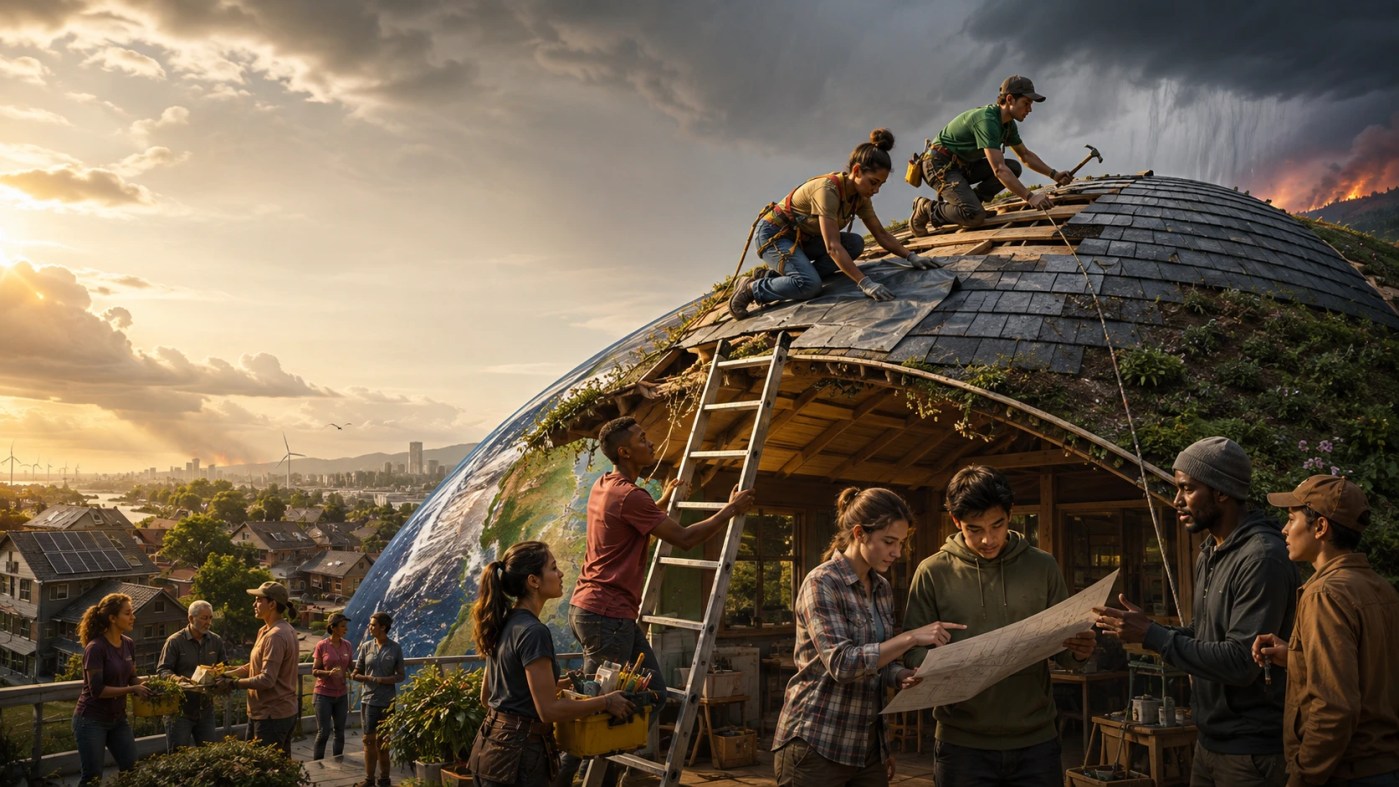
“The sky is falling” describes a single catastrophic event you can neither predict nor influence. That’s not our situation, and believing it is actively harmful. Our situation is a roof with a growing leak, where the size of the hole depends on decisions being made right now, by identifiable people, in identifiable rooms.
That distinction is everything. If the sky is falling, the rational response is to panic or check out. If the roof is leaking and getting worse, the rational response is to grab tools and figure out who has the ladder. Research on climate communication is consistent on this point: fear without a clear path to act produces paralysis and disengagement, especially in young people. A generation that believes it’s already over will not organize.
The UN report says overshoot is inevitable. It does not say collapse is inevitable. Those are different sentences and the difference is where all the remaining work lives.
Your driving matters, but not in the way the story usually goes
I wrote that we should use our vehicles only for necessity — errands, appointments, work, worship, shopping — and stop the joyriding. I still believe that as ethics. But I have to be honest about the arithmetic, because getting this wrong hurts our movement.
Road transport is around 15% of global CO2 emissions, all of it, everywhere, including trucking and freight. Your individual discretionary driving is a small slice of a slice.
Meanwhile: Oxfam’s research with the Stockholm Environment Institute found that the richest 1% of humanity produced as much carbon pollution in 2019 as the poorest two-thirds — about five billion people. Since the 1990s, that 1% burned through more than twice as much of the remaining carbon budget as the bottom half of humanity combined. Their annual emissions cancel out the savings from nearly a million wind turbines.
On flying, the numbers are even starker. Aviation is about 2.5% of global CO2 emissions, and only around 10% of the world’s population flies in a given year. The most frequent fliers — at most 1% of the world’s population — account for more than half of all emissions from passenger air travel. Counting non-CO2 effects, aviation’s total contribution to warming is around 4%.
So: cutting unnecessary flights is real and worth doing, and it lands hardest if you’re someone who flies a lot. If you fly once every few years, your restraint is a rounding error and you should not carry guilt you didn’t earn.
Here’s the part I want young readers to know, because it’s history and it’s ugly. The phrase “carbon footprint” was pushed into everyday language by a BP advertising campaign in the early 2000s, complete with a personal footprint calculator. The strategy worked exactly as designed. It moved the argument from “who is producing this” to “what are you personally doing wrong,” and it turned people who should have been allies into people auditing each other’s grocery bags.
Do not fall for it. Personal restraint is a form of integrity, not a substitute for power. Live with less waste because it’s right and because it makes you harder to shame into silence. Then go after the systems, the subsidies, the permits, and the politicians. The people who benefit from the status quo would love it if you spent your one life feeling guilty about a road trip.
Why cruelty is a climate problem (the real version)
Here’s where the original instinct was right, and I want to give it the argument it deserves.
When conditions get harder — heat, water shortages, crop failure, displacement, rising prices — societies face a fork. They can extend the circle of who counts, or they can shrink it. History says that under pressure, the reflex is to shrink it. Scarcity gets blamed on outsiders. Migrants become threats instead of neighbors. Suspicion becomes policy.
That reflex isn’t just morally corrosive. It’s operationally fatal, and here’s the proof.
In real disasters, the thing that determines whether you live is your neighbors. Not the government. Not the app. Not the emergency broadcast. Ordinary people nearby, in the first hours, with hands and a boat and a spare room.
The clearest evidence of this comes from the 1995 Chicago heat wave, which killed hundreds of people over a few days. Sociologist Eric Klinenberg went back and studied why two adjacent neighborhoods with near-identical poverty, demographics, and housing had wildly different death rates. The answer wasn’t income or air conditioning. It was social infrastructure — whether people knew each other, whether there were sidewalks and shops and reasons to be outside, whether someone would notice an elderly neighbor hadn’t come out in two days. In the neighborhood where people were connected, people lived. In the neighborhood where they were isolated and afraid of each other, they died alone in overheated apartments.
That’s what racism, suspicion, and cruelty actually cost in a warming world. They don’t just make us worse people. They dismantle the exact machinery that keeps people alive when the grid fails. A community that has spent a decade learning to fear each other has no capacity to organize a cooling center, a phone tree, a boat rescue, or a shared generator.
So when I say we no longer have time for hate, contempt, and the surveillance of ordinary people, I’m not making a sentimental appeal. I’m telling you that your neighbors are your survival infrastructure, and every act of cruelty is a piece of that infrastructure knocked out.
This is what I mean by Adaptive Resiliency. Not stockpiling in a basement alone. Building the kind of community where, when the water comes, somebody knows your name and comes looking.
What to actually do
Sorted by where you are in life, because a fourteen-year-old and a thirty-two-year-old have different tools.
If you’re 13–17
- Learn the difference between a fact and a vibe. The single most valuable skill in this decade is being able to check a claim. When you see a scary climate stat, find the original source. Half of what circulates is exaggerated, and the exaggerations get used to discredit the real numbers.
- Find one thing near you. A creek, a park, a heat-vulnerable block, a school with no shade in the yard. Local and concrete beats global and abstract every time, and it protects you from despair.
- Your school is a lever. Schools have budgets, buildings, energy bills, and food contracts. They are also unusually responsive to organized students.
- Guard your head. Doomscrolling climate content is not activism. It feels like caring and it produces nothing. Set a limit.
If you’re 18–24
- Vote in the boring elections. Utility commissions, city councils, county boards, state legislatures. These bodies decide permits, building codes, transit, and grid rules. Turnout in these races is often under 20%, which means your vote is worth several times what it’s worth in a presidential year.
- Pick a skill the transition needs. Electricians, HVAC and heat-pump technicians, grid engineers, water systems, urban planning, emergency management, agriculture. There is a labor shortage in nearly every one of these fields and the work is not going away.
- Join something that already exists. New organizations are hard. Existing ones need people. Show up three times before you decide it’s not for you.
- Learn where your money sits. Not as a purity test — banks and pension funds move real capital, and organized customers have won real fights.
If you’re 25–33
- You’re entering decision-making rooms now. Procurement, hiring, budgets, vendor selection. This is where the actual leverage is and almost nobody uses it deliberately.
- Housing and transit are climate policy. Where you can build, how dense, whether the bus runs. Show up to a planning meeting. The room is usually nearly empty, which is precisely why the outcomes are what they are.
- Build the phone tree before you need it. Know the four neighbors closest to you. Know who’s elderly, who’s disabled, who lives alone, who has a generator. This costs one afternoon and it’s the highest-return climate action available to a private individual.
- Mentor down. The teenagers are watching how adults handle this. Model steadiness.
Everyone
- Verify before you amplify. Our credibility is a shared resource and every viral falsehood spends a little of it.
- Argue with people, not at them. The goal is one more person on our side, not a better clip.
- COP31 is in November. The Türkiye presidency has said the summit has to convert urgency into concrete action. Watch what governments actually put on the table and hold your own accountable.
What I’m asking
Not optimism. Optimism is a prediction and I don’t have one.
I’m asking for something more durable: the decision to be useful regardless of the odds. The Nepali rescuers who went into that valley didn’t know if they’d find survivors. They went anyway. That’s the posture.
The report says the size and length of the overshoot has not been decided. Believe that sentence. It’s the only one in the whole document that’s addressed to us.
Every tenth of a degree we claw back is measured in real lives — crops that hold, coastlines that stay, people who don’t have to leave home. That’s the work. It doesn’t require you to be hopeful. It requires you to be present.
Sources and further reading
- Julia Conley, “With Planet Set to Overshoot 1.5°C Threshold, Emissions Must Still Be Cut Rapidly to Limit Damage: UN Report,” Common Dreams, September 2, 2026 — https://www.commondreams.org/news/un-climate-report-2677808523
- UN Environment Programme, Limiting Overshoot (2026) — https://www.unep.org/news-and-stories/press-release/unep-world-set-cross-15degc-global-warming-can-still-limit-adapt-and
- 350.org, response to the UNEP report, September 2, 2026 — https://www.commondreams.org/newswire/350-org-responds-to-un-report-confirming-world-set-to-breach-1-50c-every-fraction-of-a-degree-still-worth-fighting-for
- Jacqueline Peel and Wesley Morgan, “A landmark UN report says the world will overshoot the 1.5°C climate target. What happens now?” The Conversation, September 2, 2026 — https://theconversation.com/a-landmark-un-report-says-the-world-will-overshoot-the-1-5-c-climate-target-what-happens-now-290818
- Al Jazeera, “Nepal-Tibet floods: What happened, what caused them and who is missing?” August 27, 2026 — https://www.aljazeera.com/news/2026/8/27/nepal-tibet-floods-what-happened-what-caused-them-and-who-is-missing
- Supran, Rahmstorf & Oreskes, “Assessing ExxonMobil’s global warming projections,” Science, January 13, 2023 — https://www.science.org/doi/10.1126/science.abk0063
- Oxfam & Stockholm Environment Institute, Climate Equality: A Planet for the 99%, November 2023 — https://www.oxfam.org/en/press-releases/richest-1-emit-much-planet-heating-pollution-two-thirds-humanity
- Our World in Data, “What share of global CO₂ emissions come from aviation?” — https://ourworldindata.org/global-aviation-emissions
- International Court of Justice, Advisory Opinion on the Obligations of States in respect of Climate Change, July 23, 2025 — https://www.icj-cij.org/case/187/advisory-opinions
- Eric Klinenberg, Heat Wave: A Social Autopsy of Disaster in Chicago (University of Chicago Press, 2002)
Que Humanidad / Compiled & Mr. Alvarez’s Thoughts | AI Enhanced.
A note on method
I use both local and internet-based artificial intelligence to enhance my creativity and thinking — as a research partner, a drafting aid, and a way to pressure-test my own reasoning. I do not use AI as a substitute for judgment, understanding, or responsibility. Before I publish, I make a serious effort to review the work, question its claims, verify important information, correct errors, and make sure I can stand behind what is being said.
The judgment, values, corrections, and final word remain mine.
Many of my posts are working examples of that process. Sometimes the premise I begin with turns out to be partly — or even completely — wrong. Careful checking, questioning, and revision can then lead to something more accurate, more honest, and ultimately more useful than where I started.
— Mr. Alvarez
(I created another version of this at climatechangecommunity.com, check it out)


Leave a Reply