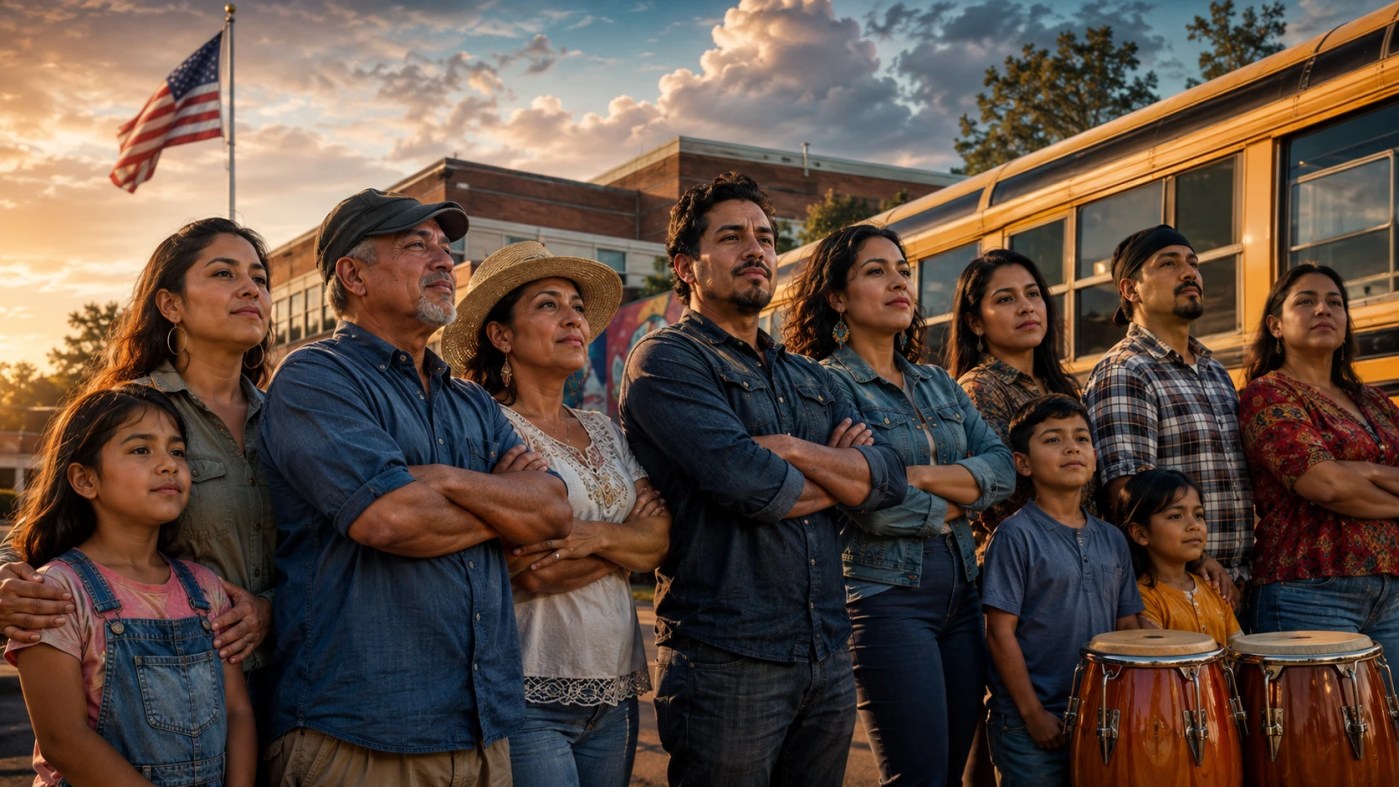
Americans have always been known for being kind, proud, and helpful. That is still true. It is true on my block, it is true in the churches and bodegas and union halls, and it is true in the hands of the people who show up when something breaks.
Many trusted the words of someone running for office who promised a better and more equitable economy, real health care, attention to criminal mischief, and stronger educational opportunity. Some were duped. Some are still loyal. And some live with a deep regret about what the last few major elections set in motion.
What compounds an election — and the larger the election, the worse the compounding — is that it does not bring in one person. It brings in a cabinet, a legal apparatus, and a class of loyalists who take an agenda further than any single officeholder ever said out loud. That is how it reaches down to a school bus window, where a child watches a parent who has never had so much as a parking ticket get taken off the sidewalk.
I am writing this as an American exercising the First Amendment. I am also writing it as someone who has spent nearly two decades studying the Climate and Ecological Emergency. Those two things are not separate subjects in this essay. By the end, I hope you will see why they were never separate at all.
Danbury Has Lived This Twice
In September 2006, ICE ran an operation in Danbury, Connecticut, in which a federal agent disguised himself as a contractor, hired eleven men for a construction job, and delivered them into custody. They became known as “The Danbury 11.” Nine were later released on bail. It was a sting built on the willingness of working men to take a job.
Twenty years later, the same city, the same community, a different set of tactics.
Beginning Monday, August 24, 2026, federal agents moved through Danbury for days in a row. Local officials estimated that at least 70 residents were taken between Monday and Thursday, with the statewide number believed to be in the hundreds. Agents in unmarked cars, some masked, detained people outside apartment buildings, during traffic stops, in Kennedy Park, near an elementary school, and outside a daycare center. One father was taken at a bus stop moments after he walked his child to the school bus and watched it pull away.
Mayor Roberto Alves — who came to this country from Brazil as a boy — has been blunt about what changed. ICE had been present in Danbury for two years, he said. What was new was the intensity, and the visibility, and the intent to frighten. Agents ran an operation on the first day of school, in front of one of the city’s most populated elementary schools, while children were getting off buses and parents were dropping them off.
Among those detained was a man who had lived in Danbury for thirty years, held work authorization, paid his taxes, and was working toward permanent residency. As the mayor put it, the people doing it the right way are getting deported too.
Danbury is roughly 35% foreign-born. That is not a statistic about outsiders. That is a description of the city.
Newark: What Happens After the Doors Close
Detention is the part of this the cameras do not follow, so let me follow it.
In February 2025, the private prison company GEO Group secured a fifteen-year, roughly $1 billion contract with ICE to reopen Delaney Hall in Newark as an 1,100-bed detention facility — the largest on the East Coast. Newark sued, arguing the facility opened without the permits and inspections state and city law require. In May 2025, Mayor Ras Baraka was arrested by federal agents outside it.
On May 22, 2026, hundreds of people held inside Delaney Hall began a joint labor and hunger strike over conditions. Members of Congress who visited described detainees receiving small food portions and inadequate medical care. One New Jersey representative said she had personally verified people being denied medication or given a fraction of what they were prescribed.
Two men have died there. One, Edwin Lopez-Cornejo, was pronounced dead at University Hospital in Newark. His mother said he had called the day before to say part of his face and one of his hands had gone numb, and that a doctor was coming. The call she expected the next day never came. His family has asked for an independent investigation and the release of his medical records.
New Jersey’s attorney general and the City of Newark have gone to court simply to get state health inspectors through the door.
Texas: The Model, Built at Scale
Texas holds more immigrants than any other state, across roughly two dozen detention facilities. It is where the current approach is being built at full scale, and where the consequences show first.
Camp East Montana, a tent facility erected on the grounds of Fort Bliss outside El Paso, opened in August 2025 and became the largest immigrant detention center in the country. It has also been among the deadliest. Between December and January, six people died in ICE custody in Texas in a six-week span — three of them at that camp. The contractor initially running it, Acquisition Logistics, had never operated a detention center before receiving a federal contract worth $1.3 billion.
One of those deaths belongs in the record with his name attached. Geraldo Lunas Campos, 55, a father from Cuba. ICE attributed his death to medical distress. The autopsy found he became unresponsive while being physically restrained by law enforcement. The El Paso County medical examiner ruled it a homicide. No criminal investigation or charges have followed.
In July 2026, Lorenzo Salgado Araujo, a 52-year-old Houston man with no criminal record in the state, was shot and killed by federal immigration agents in the city’s predominantly Latino East End. His son said his father was on his way to a job building homes.
Nationally, ICE reported 33 deaths in custody in 2025 — the highest total in more than two decades. As of September 1, 2026, at least 26 more people have died this year.
The Numbers That Collapse the Justification
We were told this was about the worst of the worst. Here is what the government’s own data shows.
As of July 11, 2026, 46,436 of the 65,765 people held in ICE detention — 70.6% — had no criminal conviction of any kind. Many of those who did were convicted of minor offenses, including traffic violations.
Look at the growth rather than the snapshot and it gets starker. Of the increase in ICE detention between September 2025 and January 2026, 92% came from people with no criminal charges or convictions at all. Just 8% came from people with criminal convictions. Analysis by the Cato Institute — not an organization anyone would call progressive — found that roughly 5% of ICE detainees had violent convictions.
In late January 2026, ICE held 70,766 people in a single day. That is the highest number ever recorded, and the first time the agency crossed 70,000.
These are not the numbers of a public safety operation. They are the numbers of a dragnet.
The Strategies, Named Plainly
People keep asking how this is happening so fast in so many places at once. It is not mysterious. It is a set of repeatable tactics, and naming them is how communities defend themselves.
Arrest quotas. The Wall Street Journal reported an agency-wide daily arrest target of 3,000 — a figure chosen to reach one million arrests in a year. The government has denied such a quota exists as a matter of policy. Individual agents have reportedly been rewarded per arrest, even when the person is later released without charges. When the goal is a number, the number is what gets served.
Masks and unmarked vehicles. Agents operating with faces covered, in unmarked cars, without visible identification. Members of Congress have warned that this obfuscation not only stokes fear but makes it harder for people to tell real agents from impersonators, at a time when kidnappings by civilians posing as officers are rising. ICE leadership has defended masking by citing threats against officers.
Saturation surges. Concentrated multi-week operations that flood one metro area — Boston, Minneapolis, Charlotte, Indianapolis, and now southern Connecticut. The point is not efficiency. The point is visibility.
Targeting the routines of working people. Work vans. Home improvement store parking lots. Traffic stops. Courthouses. Check-in appointments — where people who have complied with every requirement are texted to come in early and arrested when they arrive. In New York, courthouse arrests jumped from 11 in 2016 to 144 in 2017 and never came back down. The lesson people learn is that cooperation is not protection.
Proximity to children. School bus stops. Daycare centers. First days of school. ICE states it does not target schools. Parents in Danbury watched what happened anyway.
The ACLU has sued over suspicionless stops, warrantless arrests, and racial profiling in Minnesota, where Somali and Latino residents were the stated focus of Operation Metro Surge. DHS rejects profiling allegations as false. The courts will sort the law. The communities are living the practice.
Meanwhile, the Emergency That Does Not Negotiate
Here is the part I cannot separate from the rest, and I have stopped trying.
While this apparatus consumed our attention and our budget, the planet kept its own books.
- 2025 was among the three warmest years in the 176-year record, at roughly 1.44°C above the 1850–1900 baseline. The past eleven years are the eleven warmest ever recorded. The past three are the top three.
- For the first time, a full three-year period — 2023 through 2025 — averaged above 1.5°C. The Paris limit was never a cliff edge, but it was a line, and we have now spent three consecutive years past it on average.
- In May 2026, atmospheric CO₂ at Mauna Loa reached 432 parts per million, the highest ever measured. Pre-industrial was about 280. Across 800,000 years of ice-core record, it never once passed roughly 300. The last time the air held this much carbon was around three million years ago.
- The 2023–2024 jump was the largest single-year increase in the record. The last decade absorbed more CO₂ than any ten-year stretch since measurement began in 1959.
- In 2025, the United States absorbed 23 separate weather and climate disasters costing at least $1 billion each — an estimated 276 deaths and roughly $115 billion in damages.
And then there is this, which I want people to sit with.
In May 2025, NOAA announced it would stop updating the Billion-Dollar Weather and Climate Disasters database — the federal government’s own long-running ledger of what climate disasters cost this country. The archive from 1980 to 2024 remains. Nothing after that will be added. The administration’s budget proposal called for cutting NOAA by roughly $1.5 billion, eliminating its research division, and closing climate laboratories. Climate Central has since taken the database over and continues it independently, led by the scientist who ran it at NOAA for fifteen years.
Read that again. As the disasters accelerated, the government turned off the instrument that counted them.
You cannot be proactive about a threat you have made it policy not to measure.
The Second Responders
Now let me bring the two halves of this essay together, because this is the part I most need people to understand.
The men and women being pulled off our streets are not incidental to America’s ability to survive the Climate and Ecological Emergency. They are central to it.
Undocumented workers make up somewhere between 25% and 40% of the entire U.S. disaster recovery workforce. They tarp and repair roofs. They tear out water-logged, mold-blackened walls. They clear charred debris and fallen trees. After Hurricane Harvey, the Migration Policy Institute found that 72% of the day laborers doing recovery work in East Texas were unauthorized immigrants. After Katrina, after Sandy, after Ian, after Helene, after the Altadena and Palisades fires — the same pattern, every time.
Pablo Alvarado of the National Day Laborer Organizing Network calls them the second responders. That is exactly right. The first responders save the living. The second responders make the place livable again. There is no recovery without them, and there is no resilience without recovery.
Zoom out from disasters to the ordinary infrastructure of survival: Latinos are 32.3% of U.S. construction workers and 43.4% of workers in agriculture, forestry, fishing, and hunting. Roughly 75% of America’s 2.4 million farmworkers are foreign-born. Nearly all — 97% — of noncitizen agricultural workers are Hispanic, and about three in four of them do field work, the hottest and most exposed work there is.
Which brings the cruelty into focus.
These are the Americans-in-practice most exposed to the emergency itself. Immigrants are far likelier than U.S.-born workers to hold outdoor jobs, where they face up to 35 times the risk of dying from heat exposure compared to the general population. A Latino outdoor worker sees roughly 40 to 45 days a year above 90°F; a white worker, about 25 to 30. Among construction workers, heat-related death risk is elevated for Hispanic workers and nearly double for workers born in Mexico. There is still no federal heat standard protecting outdoor workers in this country.
So the ledger reads like this. We ask them to feed us. We ask them to rebuild us. We send them into the heat without a federal standard to protect them. We let them absorb the physical cost of a crisis they did the least to cause.
And then we send masked agents to take them out of a park, a work van, a bus stop.
These are Adaptive Resiliency experts. Not in a credentialing sense — in the only sense that will matter when the water comes. They know how to work in heat. They know how to rebuild fast. They know how to organize mutual aid without waiting for an agency. They carry knowledge of drought, storm, flood, and scarcity from the places they came from, which are frequently the places this emergency hit first.
We are deporting our own adaptive capacity. And we are doing it in the exact decade we will need it most.
A Wall at One Hundred Miles an Hour
We are heading for a wall at a hundred miles an hour, and we are arguing about the radio.
Being reactive to this emergency is already expensive. Being proactive is the only affordable option left. Both require people — skilled, experienced, physically capable, community-embedded people — and both require honest measurement. Right now we are losing the people to enforcement and the measurement to budget cuts, simultaneously.
I want to be fair to the counterargument, because a case that cannot survive the other side is not worth making. DHS says agents are enforcing laws Congress passed, pursuing people with final removal orders, overstays, and criminals. It says it does not target schools and does not engage in racial profiling. Officials point to genuine threats against agents to justify masking. Those positions deserve to be stated in their own words rather than caricatured.
But policy is judged on its record, not its press release. And the record says seven in ten of the people in these facilities have no conviction, 92% of the growth came from people with no charges at all, 33 people died in custody in 2025 with 26 more this year, one death was formally ruled a homicide with no charges filed, and men are being taken at bus stops on the first day of school. That is the record. It does not match the promise.
What the Midterms Are For
The midterm elections are among the strongest accountability tools Americans hold. If there was ever a moment to use one, this is it.
No one should tell you who to vote for. I am not going to. But I will say this plainly: look at the actions of the people a candidate aligns with, not just the words the candidate uses. When someone stays loyal to an agenda that treats a population as something to be controlled rather than something to thrive, the outcome is suffering and regression — and it does not stop at the group it started with. It never has.
Ask your candidates, of any party, three questions:
- Do you support independent medical and health inspection access at every detention facility in this state?
- Will you vote to restore federal climate measurement, including the disaster cost database and NOAA’s research capacity?
- Will you support a federal heat standard for outdoor workers?
Those are not partisan questions. They are questions about whether we intend to count what is happening to us and protect the people holding this country together.
Who We Are
We have been a strong support around the world and a good friend to people in their hardest hours. That reputation was not built by our military or our markets. It was built by ordinary Americans who showed up.
Our Latina and Latino sisters and brothers are those Americans, whatever a piece of paper says. They are our supporters, our friends, our family, our neighbors, and our fighters. They embody the very spirit of being American that we are now trying to preserve and protect.
They deserve our deepest respect and our appreciation — not for what they contribute, though the contribution is enormous and documented, but for who they are to us.
Kindness is still who we are as a nation. It is being tested, in public, in daylight, on our streets. We get to answer.
Answer in November.
Mr. Alvarez
Que Humanidad / Compiled & Mr. Alvarez’s Thoughts | AI Enhanced.
A Note on Method
AI is used in my work to enhance my creativity and thinking — for research, verification, structure, and sourcing. The convictions, the anger, and the argument are my own. Every statistic in this piece traces to a named source below, and I encourage you to follow them yourself.
Sources
Danbury, Connecticut
- Connecticut Public / CT Mirror, “ICE makes arrests in Danbury as activists document agent activity,” Aug. 25, 2026 — ctmirror.org/2026/08/25/immigration-arrests-danbury/
- CT Mirror, “Danbury residents express fear, anger as ICE arrests escalate,” Aug. 26, 2026
- WFSB, “ICE detains dozens in Danbury for fourth straight day,” Aug. 27, 2026
- ABC7 New York, “Leaders demand answers after more than 70 residents detained,” Sept. 2026
- CBS New York, “At least 50 taken into ICE custody in Danbury,” Aug. 2026
- Wikipedia, “Operation Return to Sender” — on the 2006 “Danbury 11” sting
Newark, New Jersey
- CNN, “Immigrant held at New Jersey ICE facility dies,” Aug. 4, 2026
- ABC News, “New Jersey attorney general, city of Newark pursue legal action,” June 2, 2026
- WHYY, “Delaney Hall ICE facility in NJ: Escalating violence reported,” May 29, 2026
- American Friends Service Committee, “What’s really happening at Delaney Hall,” June 25, 2026
- NBC News, “N.J. targets prison company running immigration detention center,” June 2026
Texas
- The Texas Tribune, “What you need to know about Texas ICE detention deaths,” Feb. 19, 2026
- The Texas Tribune, “Tracking ICE shootings, migrant deaths in Texas since 2025,” July 9, 2026
- NPR / Texas Public Radio, “ICE detention deaths are on a record pace,” Apr. 5, 2026
- American Immigration Council, “6 Deaths in ICE Custody and 2 Fatal Shootings,” Feb. 11, 2026
Detention data
- TRAC Reports, Immigration Detention Quick Facts — tracreports.org/immigration/quickfacts/
- Austin Kocher, “92% of ICE Detention Growth in FY 2026 Driven by Immigrants with No Criminal Convictions,” Jan. 2026
- Cato Institute, “5% of People Detained By ICE Have Violent Convictions, 73% No Convictions,” Nov. 2025
- National Immigration Project (NIPNLG), “Mourning Those Who Have Died in ICE Custody”
Tactics
- Immigration Policy Tracking Project — on reported daily arrest quotas
- Stateline, “With new tactics, ICE reaches new high in monthly arrests,” Aug. 2026
- ACLU, suit over suspicionless stops and profiling in Minnesota, Jan. 15, 2026
- PBS NewsHour, “Top immigration official defends tactics as arrests rise nationwide”
Climate and ecological data
- World Meteorological Organization, “WMO confirms 2025 was one of warmest years on record,” Jan. 14, 2026
- Copernicus Climate Change Service, “2025 was the third hottest year on record”
- Berkeley Earth, “Global Temperature Report for 2025”
- NOAA Global Monitoring Laboratory, Trends in CO₂ — gml.noaa.gov/ccgg/trends/
- Met Office, Mauna Loa CO₂ forecast for 2026
- Climate Central, “2025 in Review: U.S. Billion-Dollar Disasters”
- NOAA NESDIS, Notice of Changes: Billion-Dollar Weather and Climate Disasters (retirement notice, May 8, 2025)
- Taxpayers for Common Sense, “What Happened to Public Data on Disaster Costs?”
Immigrant labor and climate resilience
- Capital B News, “Immigrant Labor Crackdowns Make Disaster Recovery Harder for Black Americans”
- Associated Press / PBS NewsHour, “From LA wildfires to hurricanes, immigrants help rebuild after disasters”
- Migration Policy Institute, via South Florida Sun-Sentinel — on Harvey day laborer composition
- Axios, “Latino farmworkers more likely to die from extreme heat,” citing BLS and Farmworker Justice
- KFF, “Potential Implications of Immigration Restrictions on the U.S. Agricultural Workforce,” Aug. 2025
- American Immigration Council, “Amid Deadly Heat, Migrant Farm Workers are Keeping Americans Fed”
- CDC, “Heat-Related Deaths Among Construction Workers in the United States”


Leave a Reply